
Have you ever been struck to discover that all that reading you’ve done over recent years has actually made an integral change in your life…just like “they” say it can?

For the past 5 years or so, I’ve been reading a lot of the research coming out of the Laboratory for Affective Neuroscience, The Waisman Center for Brain Imaging and Behavior (Richard Davidson), the Massachusetts Neuropsychological Society and The Center for Mindfulness in Medicine, Health Care and Society at UM/Boston (Jon Kabat-Ziin).
In fact, I get a weekly email from Rick Hanson (http://www.rickhanson.net/writings/just-one-thing/) which is often based on Richard Davidson’s work. Nice, succinct and almost always useful.
For awhile I kept up a Gratitude Journal

Writing 3 things that happened during the course of a day (even a crappy day) toward which I could nod a quick “thank you” before going to sleep.
Research shows that writing down 3-5 things to be grateful for each night develops and then strengthens new neuro-passages in the brain, eventually creating a default there.
That particular outlook on life and life’s daily events strengthens the part of the brain anatomically associated with happiness, satisfaction and positive self-image which, in turn, have been shown in other research to be associated with physical health, healthy relationships and, perhaps surprisingly, task completion.
 Who knew?
Well, it turns out quite a few people knew. It just took time for “real” scientists, respected in the “real” sciences, to prove it with the amazing tools, developed over the last decade or so, which map the brain.
Many of us, Jews, begin our day everyday with a one-sentence prayer, thanking God for compassionately returning our soul to us. Personal confession: I grew up doing this but have only returned to it over the past couple of years after more than a few years of rolling out of bed, headed for my toothbrush, with nary a thought as to how that happened , or that it happened at all. 
And, really, isn’t it a great idea to be grateful for opening our eyes to a new day, full of potential, just waiting for us to make choices – again – about what we do and how we do it?
So maybe we don’t all think there’s a God who gave us this gift again this morning. But can most of us agree that, if we made it, we might want to say a word of gratitude for the opportunity, regardless of how it happened?
Here’s the rub. And many of you may have thought of this instantly when you read the last sentence of the paragraph before this one.
For some of us, our reality seems more like this –

Maybe not everyday. But maybe a lot of them.
Maybe our health is dicey. Maybe we’ve lost people, jobs, capabilities, relationships, opportunities that were really REALLY important to us.
Maybe our goals, our path, our very existence has gotten a little fuzzy, out of focus or just plain LOST.
Life has a way of knocking us around, off balance.
Remember those neuro-passages we can develop and strengthen? The downside is that the people and situations that insult, hurt and humiliate us, the tasks, improvements, and goals we don’t accomplish, the aches and pains (psychic and physical) that pop up (and the ones that stick around) – these all build and strengthen neuro-passages, too.
Sometimes we feel like Sisyphus with the proverbial rock, trying to stave off impending doom and disaster in our lives – day after day after day.

And are we really grateful for the opportunity to do THAT – again?
Well, here’s the deal, guys. Feeling gratitude for the small, maybe tiny and flickering, lights of goodness in our lives will help break up that huge boulder into more manageable rocks and then, maybe someday, stones and, maybe, if we’re really lucky, pebbles.
Those little specks of goodness can be so tiny that our frontal cortex has trouble overriding the medulla oblongata, which controls our fight, flight or freeze response. That’s the part of the brain that insured our survival back in the days when our major threat was the lion that might be lurking behind the trees waiting to pounce on his dinner (us). 
We should be grateful for this part of our brain, too.
But our threats today, for the most part, are more psychological than physical. Even our physical threats are influenced by our psychological responses to them it seems.
Yesterday I had an appointment with a doctor I’d waited almost 3 months to see. Unfortunately, he’d forgotten to tell his office (or computer scheduler) that he would be on vacation last week when I (and lots of other folks) had my appointment scheduled.
The office ended up scheduling in all the people whose appoin tments had to be re-scheduled into this week’s schedule in between other clients.
Yay!
Not so much.
Naturally, there were the people who forget (or never learned) that a public place isn’t their personal space. Lots of cell phones ringing, loud conversations (on the phone or with their companions), and those people who “only have a quick question”.
In short, what could’ve been a 20 minute event in my day ended up being a 3-hour event.
There was a time when I would’ve been in alert, tense mode (fight) to prevent people from cutting in front of me with their “quick questions”, or just because my medulla oblongata was being activated way before I even got there. Maybe even when I got the original phone call telling me of the re-scheduling. 
Not to say that I was calmly in touch with my inner peace for 3 hours. Oh no!
There were certainly moments of consciously going into meditative Ujai breathing…right after that inner voice shouted “SERIOUSLY? Talking on the phone – in my ear – again, dude?!?) and “Who the hell has a Barbra Streisand ringtone…and then let’s it ring 10 damn times…EVERY time?!”
But, aside from Ujai, I had my gratefulness practice, and all those articles and emails, to steer me into the very objective reality of being grateful for (basically) FREE MEDICAL CARE! How amazing is that in this day and age where (here’s a shocker) 45,000 Americans die annually from inadequate or inaccessible health care? And that’s not the Third World where who-the-Sam-Hill knows how many people lack health care. 
Yep, folks, we, in Israel, get it for free.
And it’s great health care for the most part. Up to date tests and treatments. Excellent doctors.
So the price we pay is waiting for certain kinds of specialists and being patient with our fellow patients-in-waiting by cultivating some patience-in-waiting skills.
Wow! Small price to pay, right? Feeling grateful yet?
Waiting for the doctor pales in comparisons to many of the Sisyphus-ian boulders in many people’s lives but it’s a practice.
And, really, how many of our boulders are our medulla oblongata seeing a mountain where there’s a proverbial molehill?
So – lots of compassion for those whose mountains are mountains and also compassion for those of us whose mountains are molehills but still mountains for us in our mind’s eye and in our hearts. 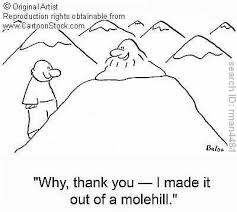
No judgment. Just a suggestion.
Set aside 30-60 seconds every night before you roll over to go to sleep to think of 3 things for which, in spite of all, you can, in all honesty, be grateful.

Even if it’s as basic as the food on your table.

Or the ability to breathe.
I make one promise: ONLY GOOD THINGS CAN HAPPEN.
 gettingoutalive