
Seven years ago, before leaving home for India, I received the name and phone number of a yoga teacher in Rishikesh. I’d been teaching yoga for six years and thought learning with an Indian master might add something special to my practice. As it turned out when I arrived in Rishikesh, that particular yogi was traveling abroad but his phone was answered by a young Sikh yogi and, since one unknown Indian yogi was the same as any other for me, I made arrangements to do yoga with him every morning of our five day stay there.
The studio was a large room with murals on one way and a large window overlooking The Ganges on another. We climbed a precarious metal spiral staircase outside to reach the room.
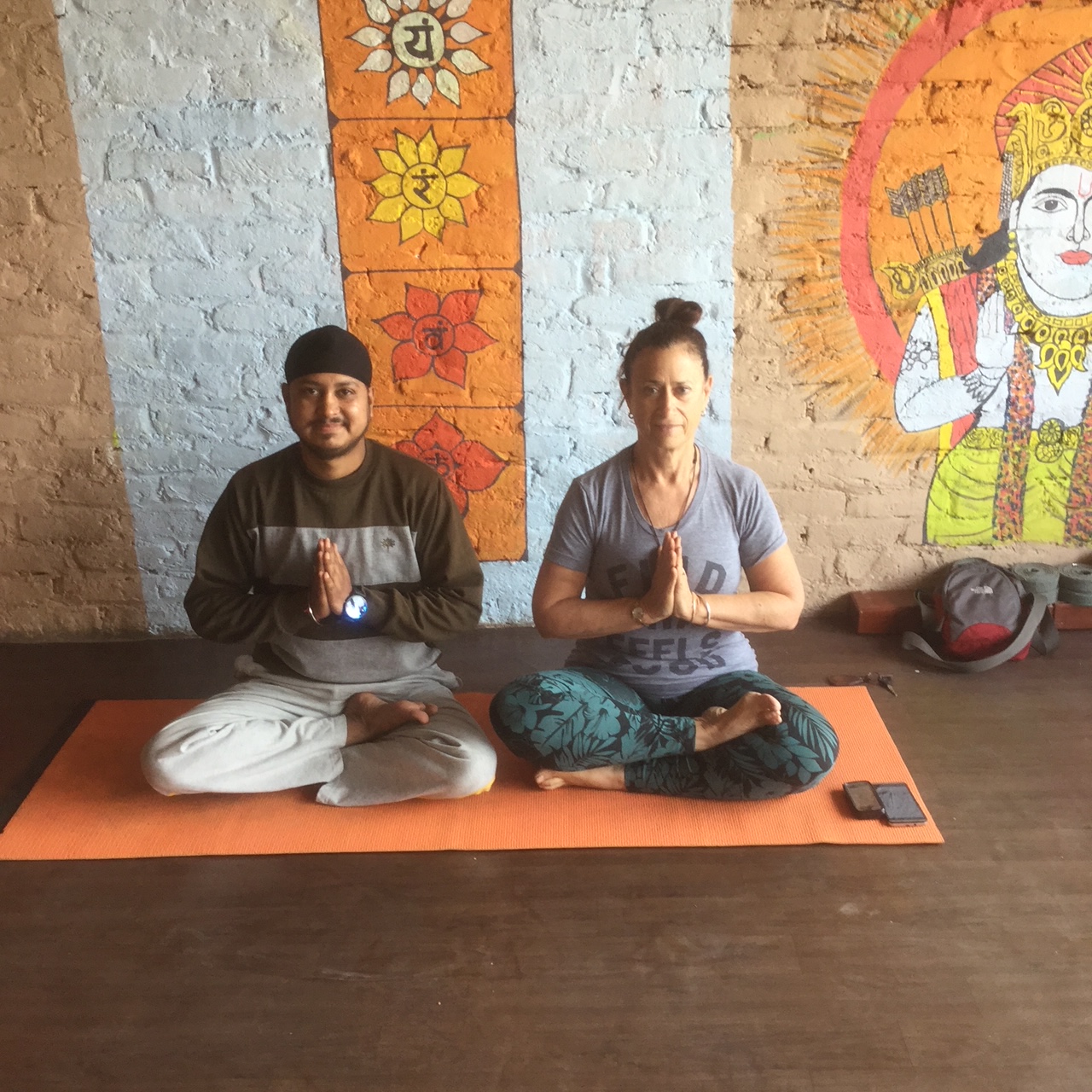
My newly-discovered teacher was very young and had only been teaching a year longer than me. But he was very sweet and I realized long ago that if I open my eyes, my ears, and my heart, lessons can be learned in unexpected places from unexpected people.
We met for 3 hours every day for the five days I spent in Rishikesh.
He taught me a long series of poses called Pawanmuktasana especially suited to loosening and strengthening our joints. My husband still begins every workout at the gym with poses from Pawanmuktasana and I often integrate some of the poses in my classes.
We exchanged interpretations of philosophical issues even if we didn’t always understand each other perfectly.
We learned a bit about each others lifestyles and cultures.
When our time together came to an end I asked him him how much to pay him. He said there was no payment to be made. At my urging he agreed to accept whatever I wanted to pay. I’d asked around and paid him a bit more than what was being paid at studios in the area, still about a third of what I would’ve had to pay at any Western studio for 15 hours of drop in classes.
Three years ago I was in touch with him before our return trip to India. We agreed that we would meet again for classes. By that time I’d been teaching for ten years and lost my enthusiasm for trying other styles of yoga and other teachers. I’d taken a two year yoga and yoga therapy course to receive Western certification, been to a dozen silent retreats of various lengths, been to yoga festivals, marathon sun salutation sessions, and taught hundreds of classes. Out of respect, I agreed to take two classes a week with him. My partner took an additional three classes a week.
This time he was teaching in a small, dark room with inadequate ventilation to save money and told us up front that there was a required payment per session. He’d begun teaching a few foreign groups from time to time and realized that it was possible to increase his income.
The classes were lackluster and the short dharma talks he gave lacked the depth of the hundreds of hours I’d heard over the previous four years from so many talented teachers.
Before returning to India on our current trip I asked for his input about lodging near Beit Chabad in Rishikesh. We were planning to be there for the holiday of Passover and needed to have easy access to a Seder, food according to the holiday’s restrictions, and prayer. The iconic Laxman Bridge is no longer in use and staying across the river is no longer a practical option.
He was very helpful.
During our first month in India we were down south at beautiful Thumpoly Beach at our friend Antony’s place, then Kanyakumari, Pondicherry, and Auroville. From time to time we got WhatsApp messages from him asking about our trip. Odd, but okay.
We spent a week in Rishikesh as planned, where one of our daughters and her three children joined us before we all headed off to Rajasthan for a week. While in Rishikesh our former yoga teacher asked to come by a few times. Out of respect, we agreed. Awkward, but okay.
On our first full day back in Rishikesh we happily explored learning possibilities for our month visit.
And then received progressively angrier and hostile audio WhatsApp’s from our former yoga teacher.
Inexplicably he was under the impression that we would be doing yoga with him every day for a month. He’d set aside that time for us and put off other potential clients.
He’d told us his days were filled with lucrative online classes of people from the UK, US, and Israel. We never dreamed he was counting on us for his monthly income. We weren’t even positive we’d be in Rishikesh for a full month because many people said it gets too hot to go outside (it doesn’t).
We were confused at his assumptions, dismayed by his feeling that we’d used him as a travel agent and misled him, and taken aback at his claim to be losing a 10-15,000 rupee payment. We offered to meet three times a week but kept getting more angry audio WhatsApp’s. Eventually we stopped responding, as did he, and we thankfully haven’t heard from his since,
My husband found an excellent yoga teacher just a five minute walk away, not surprising since if you toss a stone here chances are you’ll hit a cow or a yoga teacher.
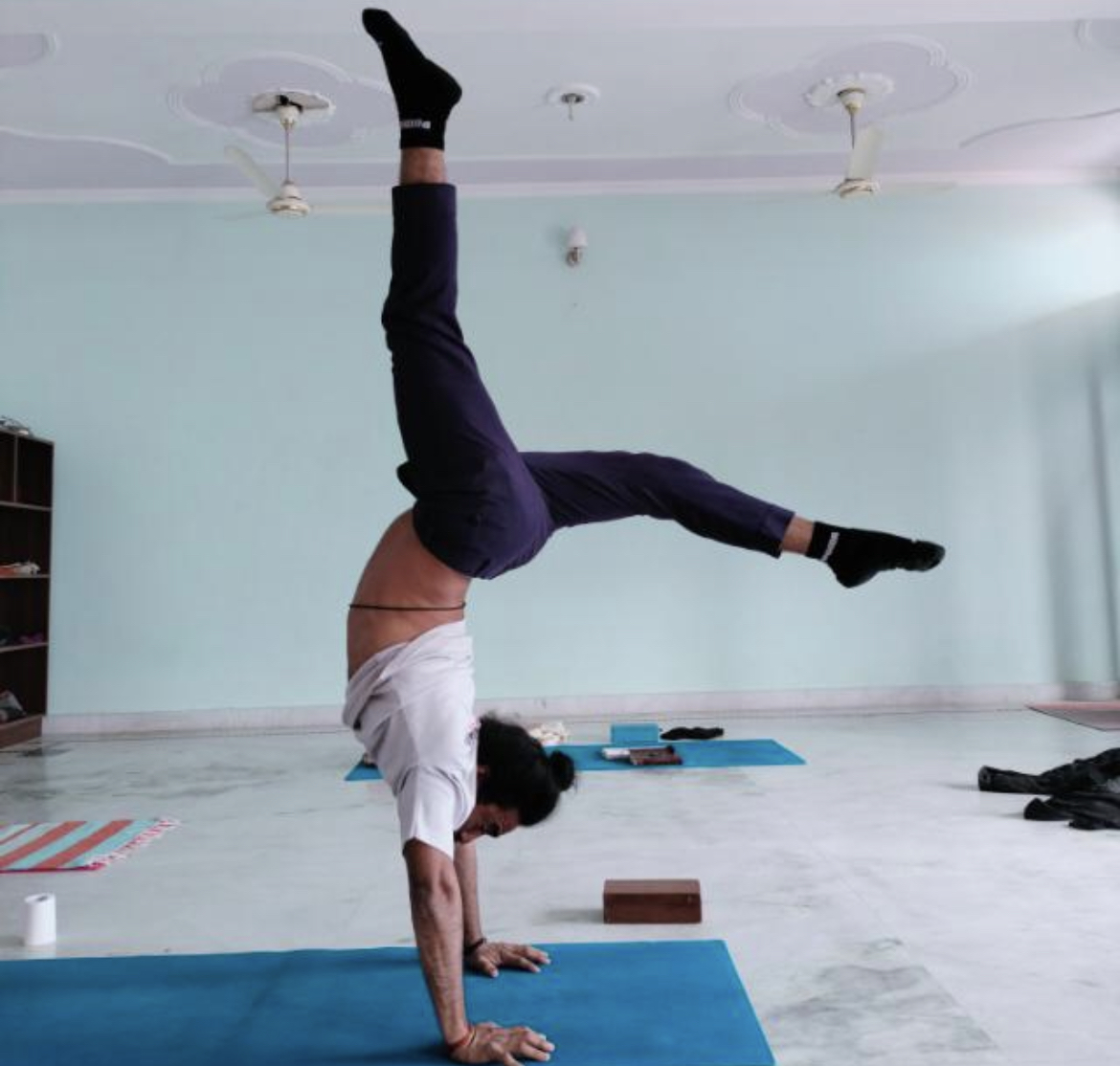
Our new teacher. He’s also teaching me Ayurvedic massage and reflexology.
My partner is taking Hindi classes daily from the same pedantic teacher he studied with three years ago. He’s actually speaking Hindi to people already. He practices like a demon.
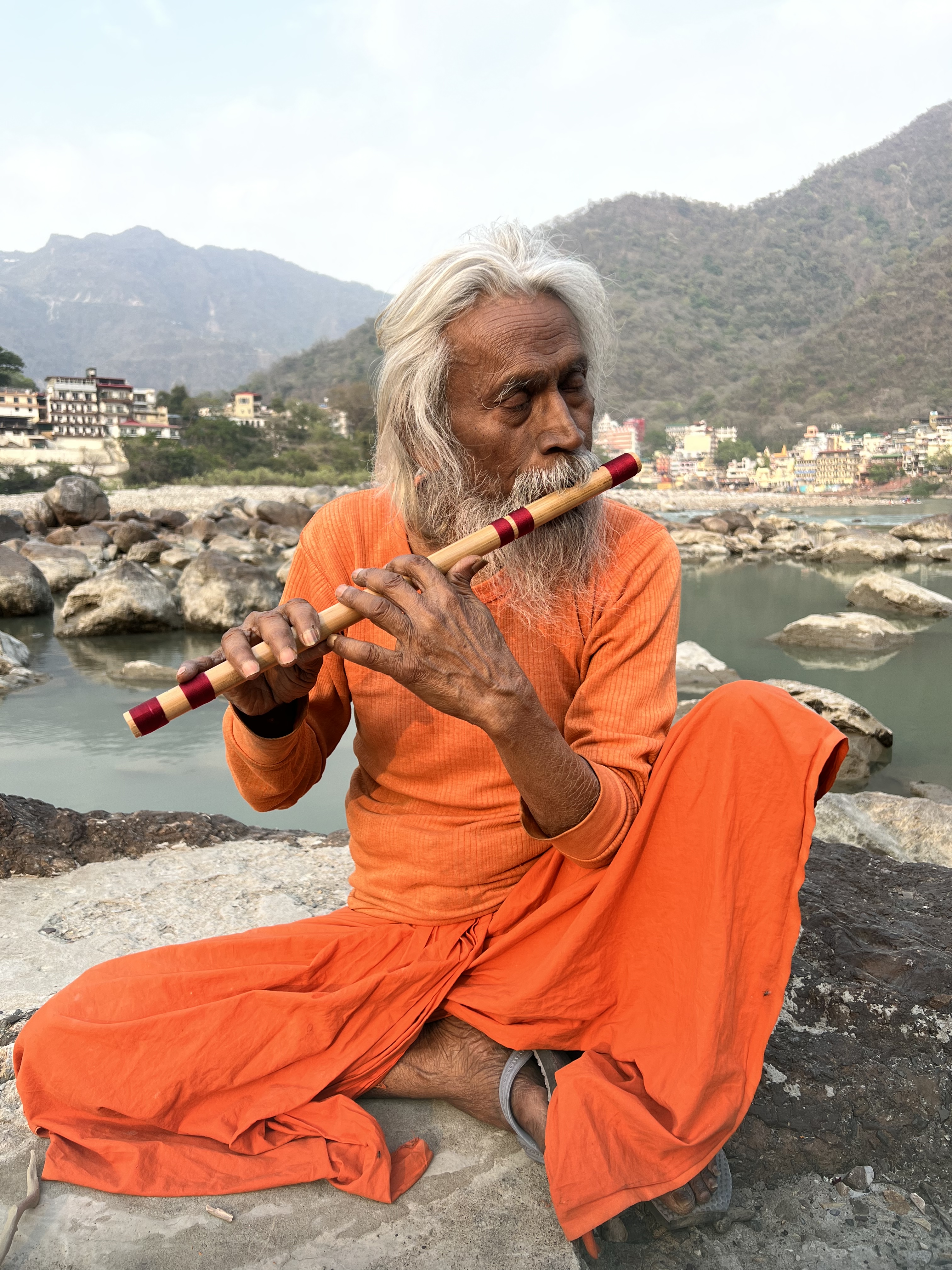
And I meet with a charming monk at a nearby ashram from time to time to learn to play the Indian flute, but mostly to listen to his stories, watch his expressive face, and soak in the atmosphere. He, also, by the way, refuses payment and is only willing to receive a donation according to what I feel is appropriate.
I feel sad when I think of the epitome of yoga I met seven years ago who taught yoga out of love and took payment only through Dana or Dan – personal giving from the heart.
I’m convinced that he became corrupted by his contact with foreign tourists and his online classes. He told us that he enjoys working with them since it doesn’t bother them to pay high prices. His Facebook is full of the new car he purchased and his many holidays. His messages to us were filled with ego and grasping.
Necessarily, in my opinion, the increase in the Westernization of yoga leads to a decrease in living and practicing according to the beautiful ideals of the eight limbs of yoga. It’s a huge challenge to combat that reality.
In my studio there are four teachers. Two of us are happy to charge little, encourage our students to attend class whether or not they’re able to pay, and remain flexible about keeping track of payment. One teacher lives with that approach comfortably but will probably be happy to earn more if she decides to work elsewhere. And one teacher constantly struggles with the studio’s approach.
They’re all excellent teachers. I feel that part of my role as the owner of the studio is that of helping all of us remain as much as possible within the healthy, self-nourishing framework of the philosophy of yoga. As I often remind them, and myself, we’re not an after school music lesson or drama group.
Being a yoga teacher is a commitment to a lifestyle.
Being a yoga teacher in this way is, first and foremost, a gift to ourselves.
It may be impractical and out of fashion in today’s world but I believe it still has a place that should be protected.
 gettingoutalive