
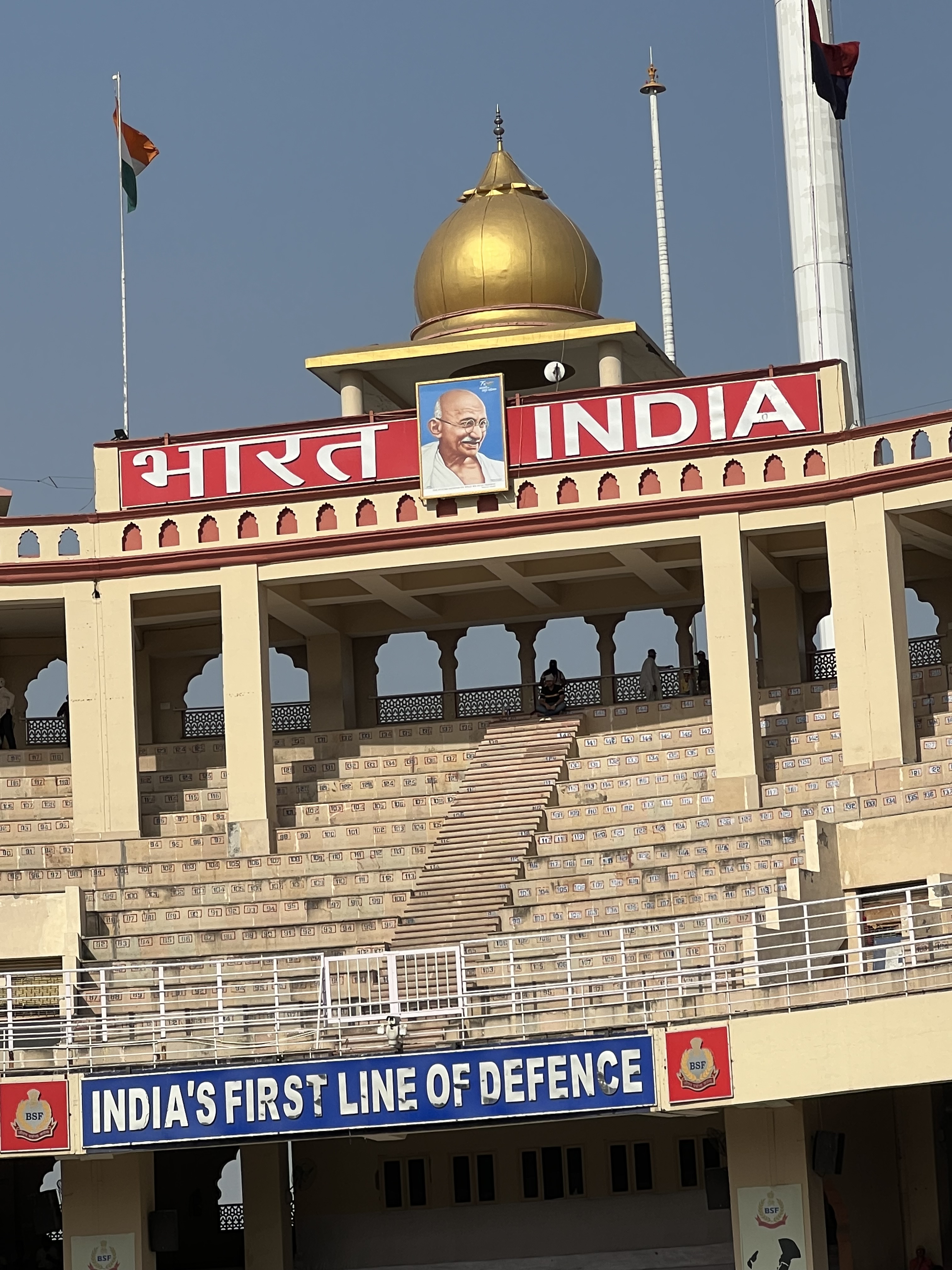
India is a country of a billion and a half people. A number inconceivable in practical terms. Almost 20% of the world’s population in less than 3% of the world’s land mass.
There are 33 million people in Delhi alone.
Hindi, the official language of the country, is the mother tongue of only 40% of her population. There are over 375 other spoken languages.
Until 1947 there were 584 “princely states”, each ruled by a Raj. Most have retained their native culture to this day and from time to time there are local uprisings to secede from India and return to independence. Just a month ago the internet was shut down in Punjab while the government searched for the leader (since imprisoned) of the most recent Sikh uprising aimed at achieving an independent Sikh state.
The current prime minister, Narendra Modi, elected in 2014, born to a Hindu grocer in Gujurat, whose mother tongue is Gujurati, has taken upon himself the emotional unification of India as one entity, Hindustan, with one language, Hindi.

Popular for his economic measures to improve the lives of Indians from the lower socioeconomic groups and special programs aimed at raising the quality of life for villagers who make up close to 70% of India’s population, he is hated by many who have great resistance to the concept of Hindustan.
Given all these complexities, it might be reasonable to assume a certain antipathy toward public expression of nationalism.
In a world where patriotism is considered by many to be dead, military heroes and flag waving is largely passé or even looked at as primitive. At best ridiculed and at worst requiring cancellation of those who participate.
Not so in India.
We’ve been to flag ceremonies in other countries; Thailand and the presidential palace in Lima, Peru, come to mind. Mostly a big yawn. But since there’s not a lot to do in the hot, dirty, crumbling city of Amritsar where we came to volunteer at The Golden Temple, we decided to go to the nearby Pakistani border to see the ceremony.
We’d been told to get there at 3 pm because the lines are long and the seating is first come first seated. Turns out this is for the winter when the ceremony is held at 4:15. In the sweltering summer heat the ceremony is at 5:15 and we could’ve saved ourselves an hour of broiling in the sun. In addition, there’s a separate line for VIPs (primarily army veterans) and foreigners. We ended up both befriended by a friendly Indian family, grown daughter, mother and army veteran father, who guided us along, and being the first in the VIP line.
We’d been instructed to bring our passports to prove our foreign status but our white skin was sufficient.

At exactly 3:30 the gates opened and we were directed to a special seating area with actual seats instead of stone steps, and even a bit of shade.
By 4:30 the entire huge stadium was full. Keep in mind that this happens every day, this was not a school holiday, and it was 40 degrees (over 100 degrees Fahrenheit).
There were the inevitable hawkers of mango juice, popcorn, potato chips, and cold water.
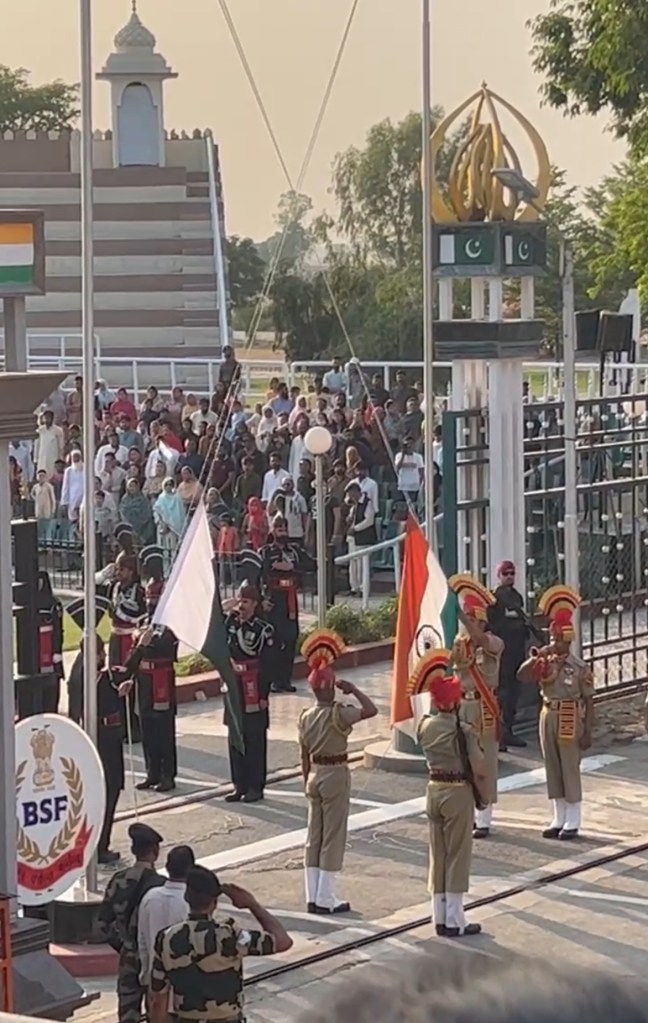
At about 5:00 people, mostly women, lined up below and began running in groups of 4-5 with Indian flags 25 meters forward then back where they handed off the flags to another group.
Music was blaring. People were cheering. The excitement was palpable.
When that ended, though there were dozens of disappointed women who didn’t have a chance to run with the flag, hundreds of women crowded down to the barrier and joyfully danced, arms raised, to loud Bollywood music.
Next a soldier in camouflage uniform ran back and forth between the two sides of the stadium shouting encouragement to wave flags, raise one fist high in the air and yell “Hindustan!”
The enthusiasm was so contagious we found ourselves with one fist held high adding our voices to the thousands and thousands already yelling “Hindustan!”

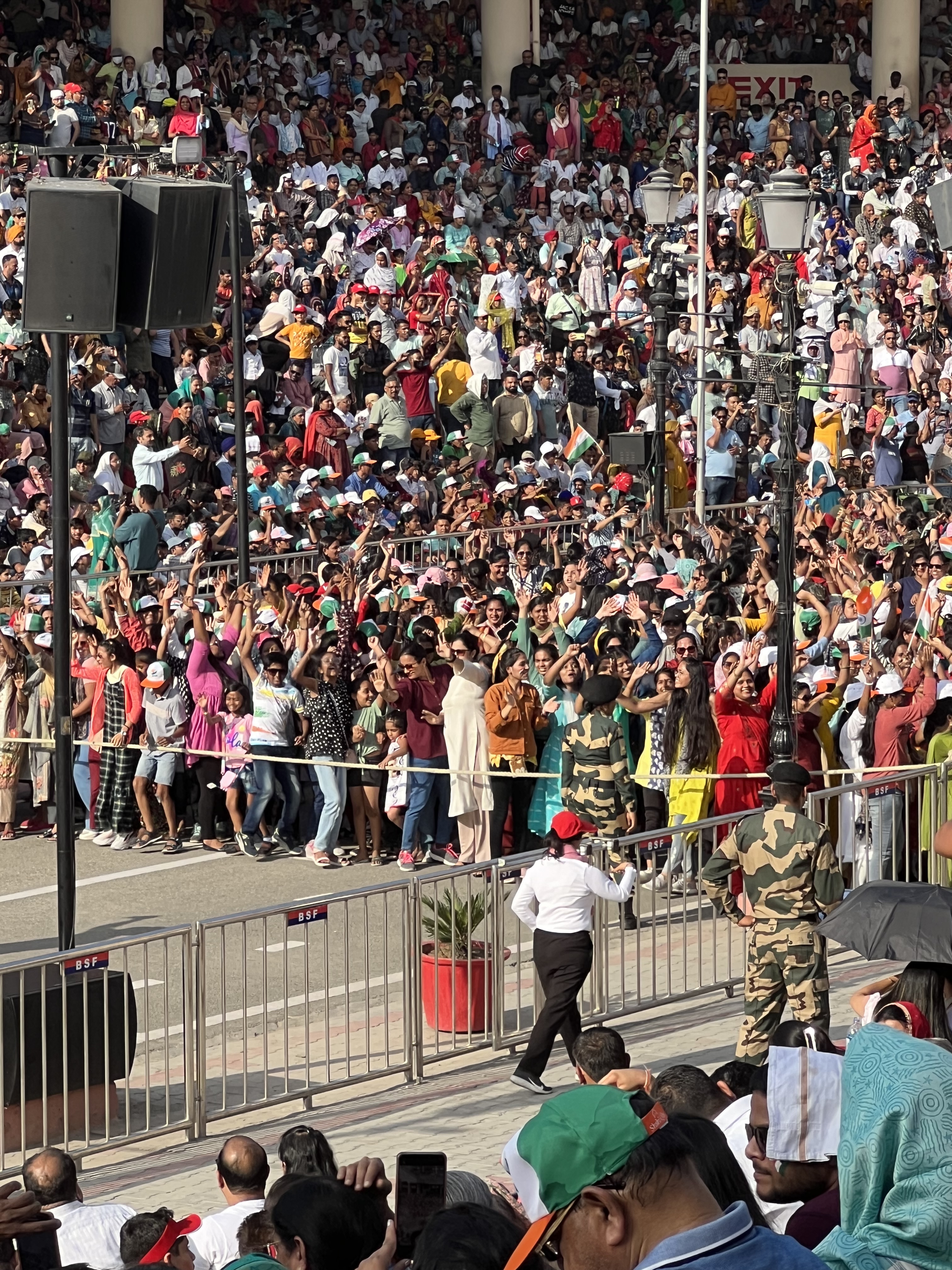
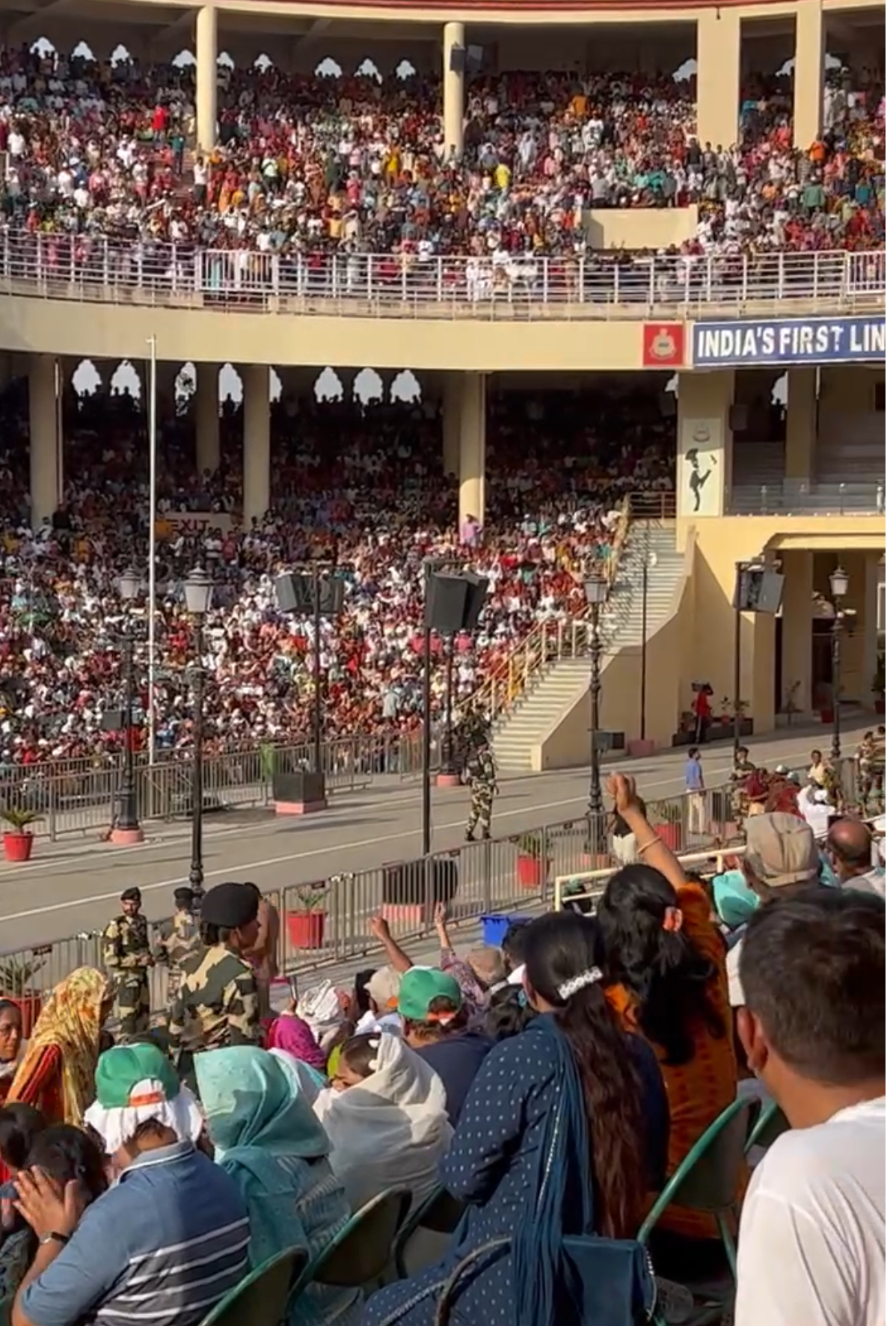
Finally the ceremony itself began. Soldier strutted by kicking their legs out at crazy heights. Army dogs paraded by. Women soldiers, men soldiers, saluting their highest officer standing on a raised platform as they marched by.
The crowd continued to cheer and wave flags tirelessly.
On the Pakistani side the loudspeakers blared and Pakistani soldiers in their black uniforms paraded, too. There was a paltry audience but then Pakistan is a country of less than 250,000 million where the females of 96% of the population are not allowed to travel without a male escort, preferably a relative.

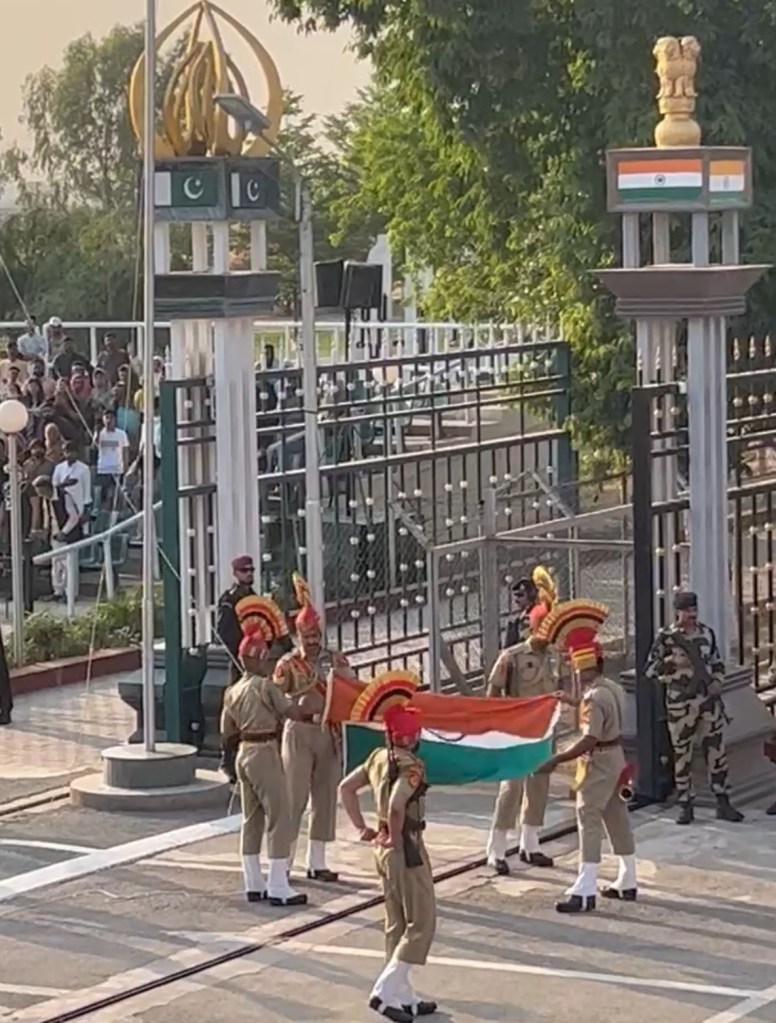
The two sides saluted each other before each lowered their respective flags. Very correct; no visible sign of the tension and animosity between their nations. Although we all know better.
Above the loud music on both sides of the fence the continuous roar of “Hindustan!”
The Indian multitudes rose to their feet as their folded flag was marched back to the accompaniment of what we assumed was the Indian national anthem.




I live in a country still proud of its nationhood, where Memorial Day and Independence Day are days we unite in honoring those who fought to protect our right to live safely in our own independent country and the fact of our very existence after 75 continuous years of struggle.
I remember all too well the surprise I felt when I realized with the creation of Bangladesh and Pakistan that countries can disappear off the map and appear on the map. Czechoslovakia no longer exists. Neither do Yugoslavia, Ceylon, or The Soviet Union.
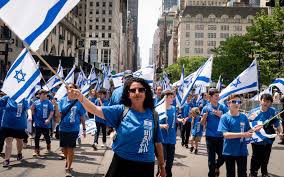
There are all too many in the world who actively plot and fight for Israel to join that list and many others who would either be happy or indifferent if that were to occur.
Our patriotism is essential for our continued existence.
I don’t have any illusion that I understand the Indian culture or mentality. But I do know that when asked from which country we come and we answer “Israel”, this is one of the only countries in the world where that answer is greeted with smiles.
More often than not we’re also told that they love Israel, that Israel is powerful and strong, that they trust Israel to come to their aid if they need assistance in fighting Pakistan, or Muslims in general. I often think they have no idea how tiny our country is.
This speaks to their own fear of aggression against them and their status as an independent country.
Perhaps their enthusiastic patriotism is essential for their survival, just as ours is.
Whatever the reason, we were happy we’d spent 3 hours in that unimaginable heat to be surrounded by such an outpouring of love for this beautiful, crazy quilt of humanity and cultures called India. Encouraged by what should be a simple and obvious unity for a common goal, but all too often isn’t.
We wish you luck, Narendra Modi, and the entire country of India.
 gettingoutalive