
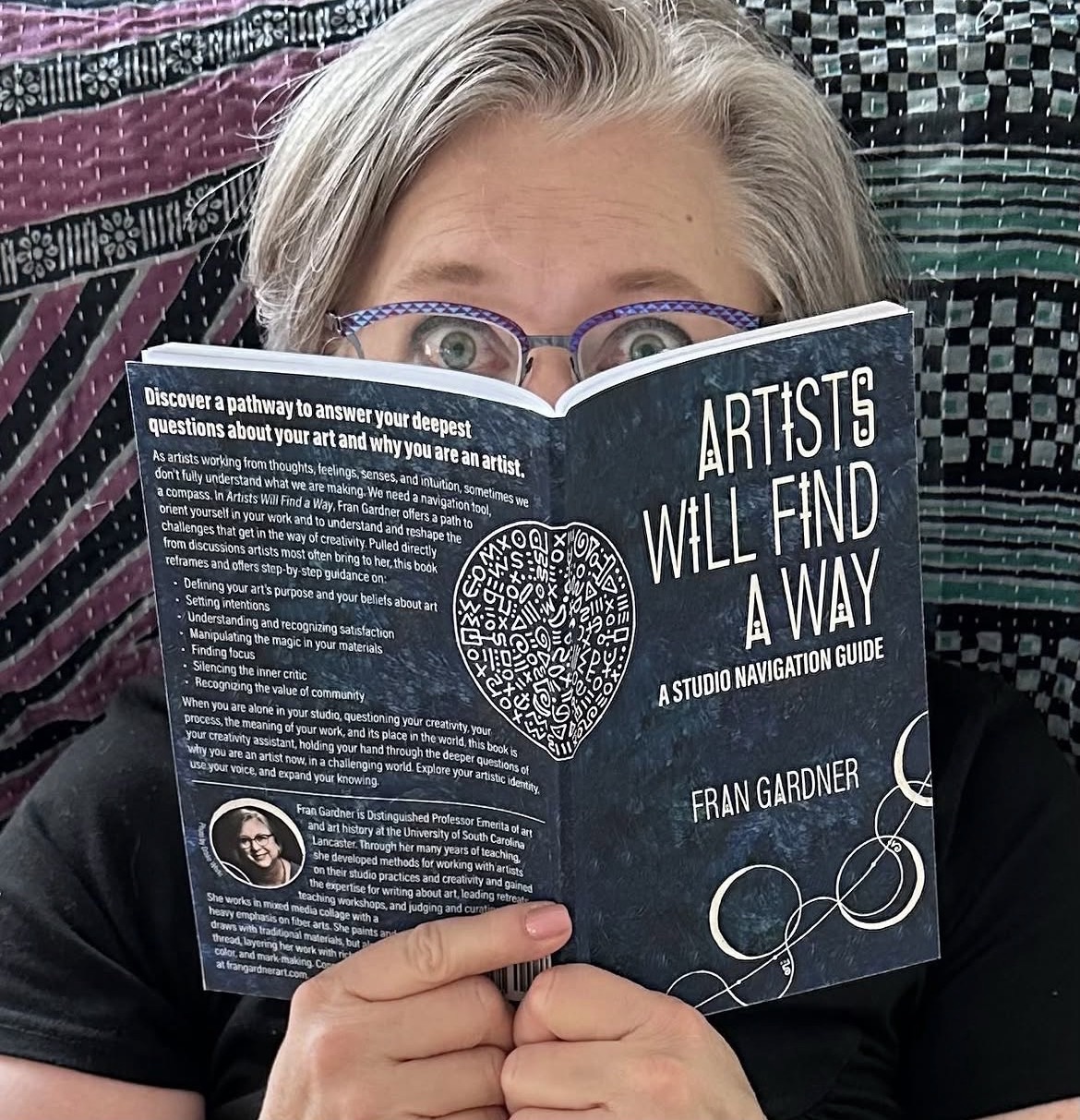
In this week’s writing class our teacher offered us a poem called The Green Cane by Fran Gardner. The poem is from an anthology called Wordgathering: A Journal of Disability Poetry and Literature. Ms Gardner is an award winning artist and professor emerita of art and art history at the University of South Carolina Lancaster. She paints and draws with traditional materials, but also with the sewing machine, layering her work with rich texture, color and mark-making. She writes critical essays about art, leads retreats, teaches workshops, and judges and curates exhibitions.
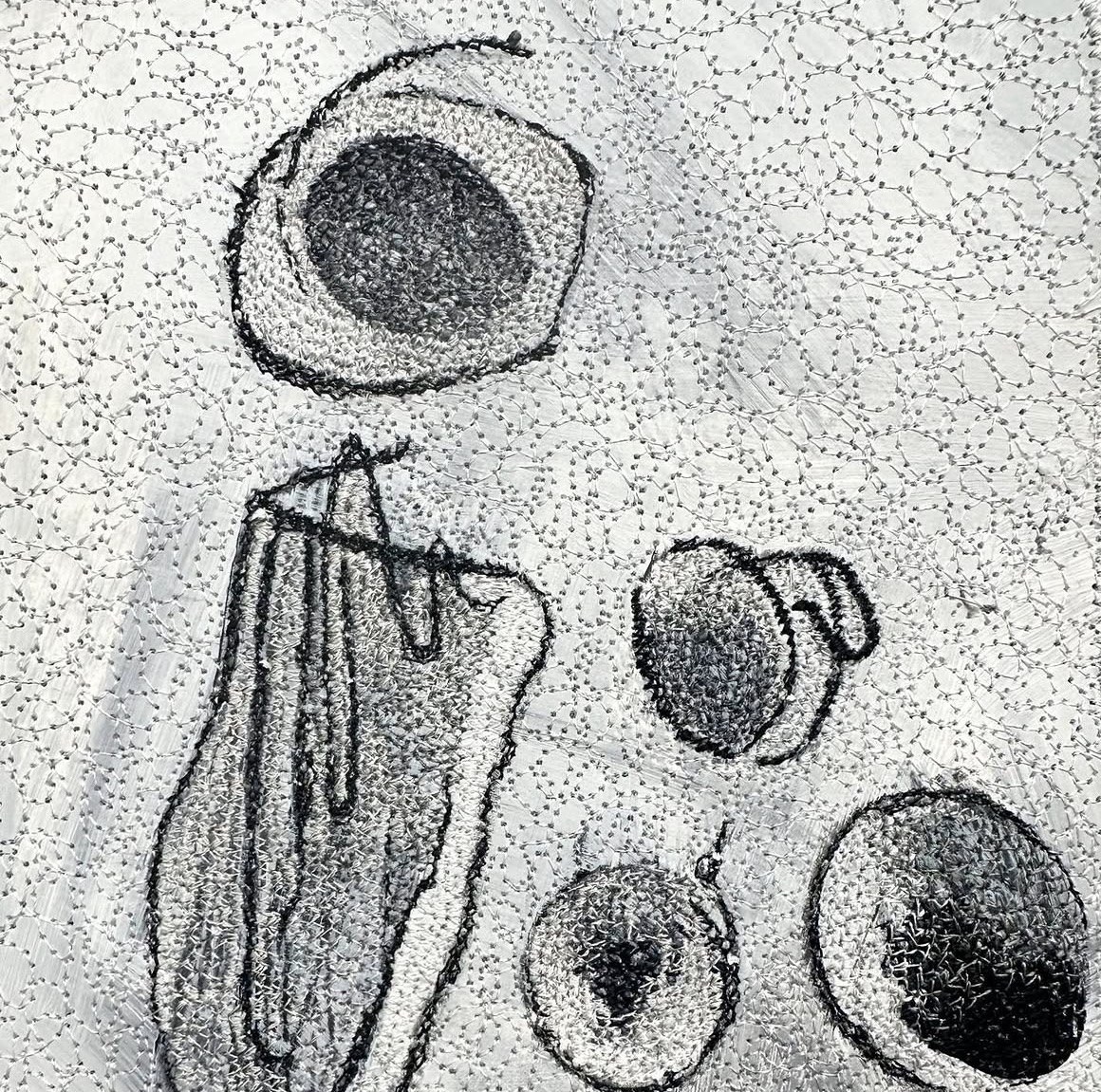
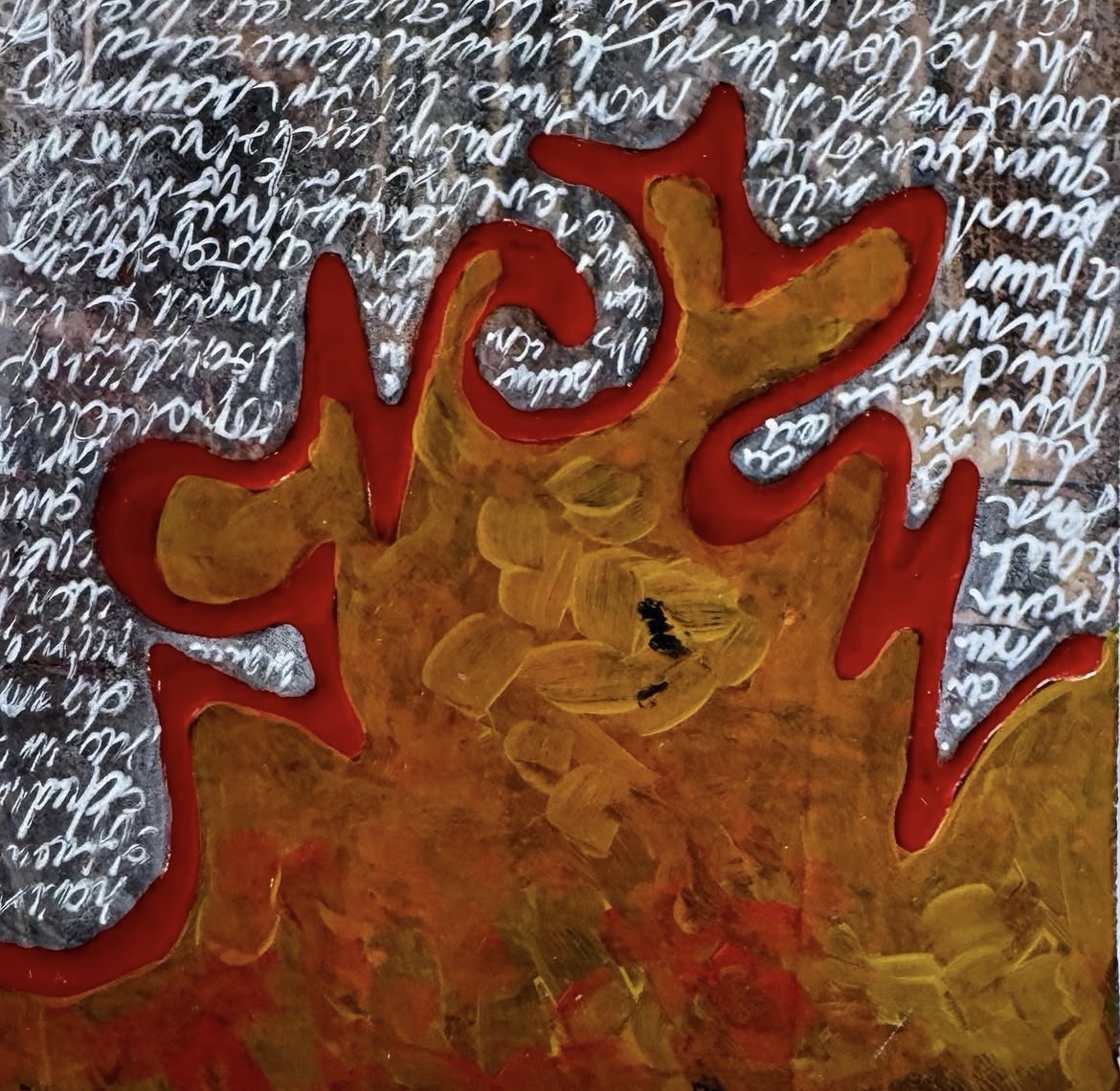
She also has MS
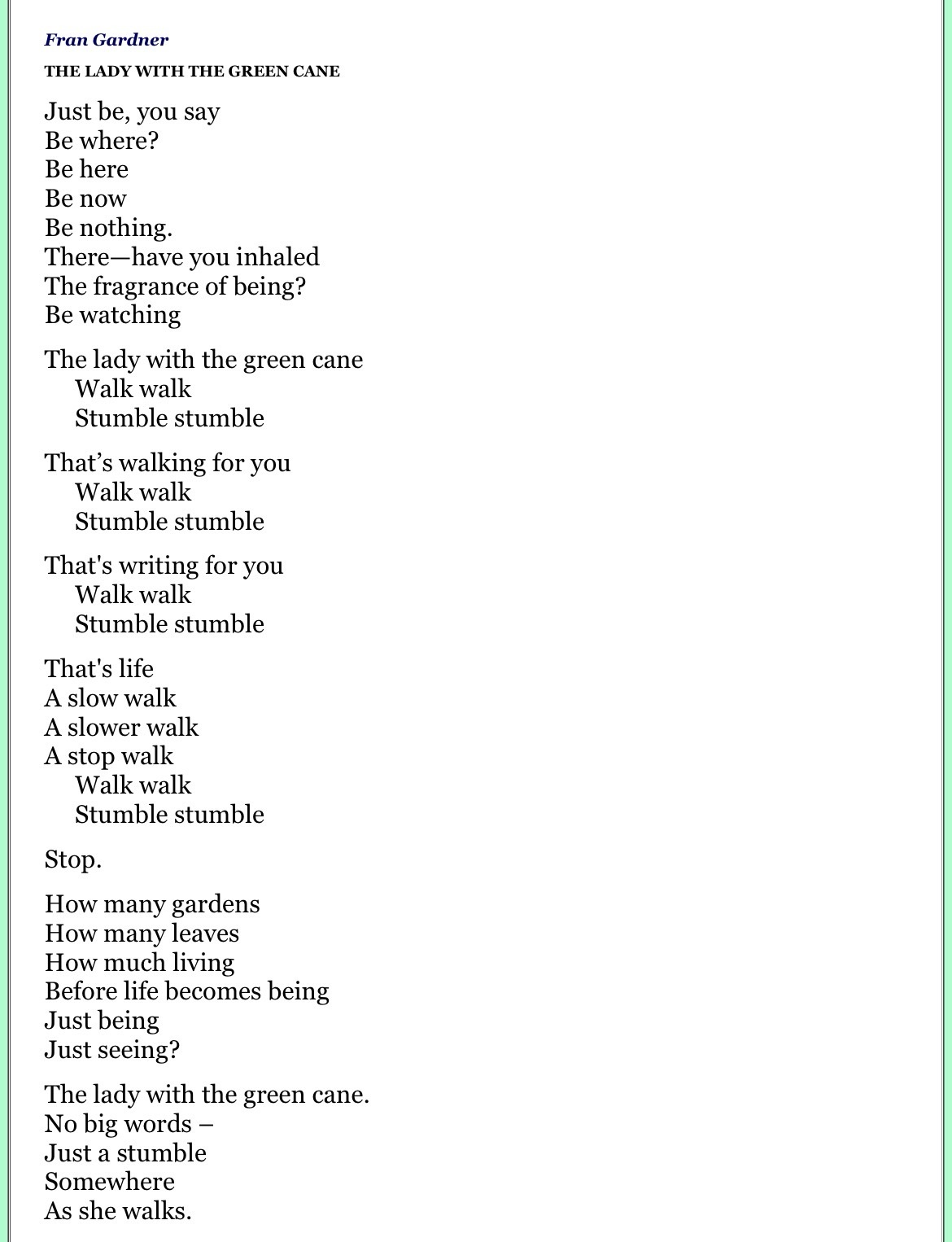
Dealing with Polymyalgia rheumatica (PMR), an inflammatory disorder causing severe stiffness, pain and reduced mobility, for the past three and a half years, and having had a hip replacement four and a half months ago, and maybe just being blessed with 73 years on this earth, these words had a profound affect on me. I don’t even remember what our teacher’s prompt was.
My mind embraced Gardner’s situation – an artist whose hands might not be consistently trustworthy – and my thoughts tumbled on from there. Of course I thought about the effort I exercise every morning to get my body moving and the mind over matter it now requires to keep my joints oiled during the day. Of course I did.
I instantly identified with the question of the worthiness, the significance, the raison d’etre of a life with decreased mobility and, perhaps, one day, much more compromised mobility. Of course I did.
My mind swirled on from there.
I flashed on the many times I walk, slowly, carefully, often painfully, and notice younger people around me walking, climbing stairs, seemingly without noticing their movement. I used to be like that. I don’t think I appreciated it nearly enough.
But my thoughts didn’t stop there.
They began to inspect the word ‘stumble’ like so many smooth stones in my hand, making a soft clicking sound, here smooth, there a slight roughness.
There are many ways we stumble in our lives.
In our relationships
In our speech
In our memories
And, yes, in our bodies
In my conversations with my students, my grown children, my grandkids, my young friends, I listen to their indecision, their parenting issues, their anxieties, their stumbles and feel empathy and also deep gratitude that those kinds of stumbles are no longer mine.
My memories, always as selective as everyone’s invariably are I suppose, are far gentler and kinder in their stumbles. I care less when asked if I remember a shared experience, a place, even a person, when the answer is ‘no’ often followed with the pleasure of an old memory becoming a new/renewed experience.
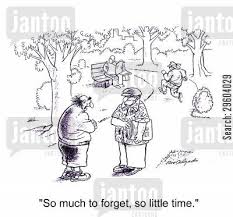
Stumbling can be scary. Relationships damaged, bones broken, feelings hurt, tangible productivity diminished.
Who are we when those results show up in our lives?
I didn’t mean to take that tone with him…again.
Surely that wasn’t me she’s remembering on that beach trip.
He just wouldn’t have fit in with the other people I invited.
I wish I could still volunteer for food distribution to families in need.
Who are we when our life becomes just being and seeing? When we just stumble somewhere as we walk through our lives?
What is the inherent value in a human life?
Judaism sees life as a mission to bring divine light and compassion into everyday existence, transforming the material into something spiritual.
Christianity claims the primary purpose of life as glorifying God and preparing for eternal life.
The Dalai Lama says that his religion is kindness.
Nietzsche argued that human existence is only eternally justified as an aesthetic phenomenon. Art making life life bearable by transforming suffering into beauty.
Oscar Wilde, saying life imitates art, defined the meaning of life as treating our days, choices and identity as a work of art – a living masterpiece of self-expression.
Sometimes attributed to Osho is the thought that yoga and meditation are not Hindu but ‘undo’; the benefit in learning to cherish and breathe in our one precious life, as the poet Mary Oliver had described our time on earth, not by doing.
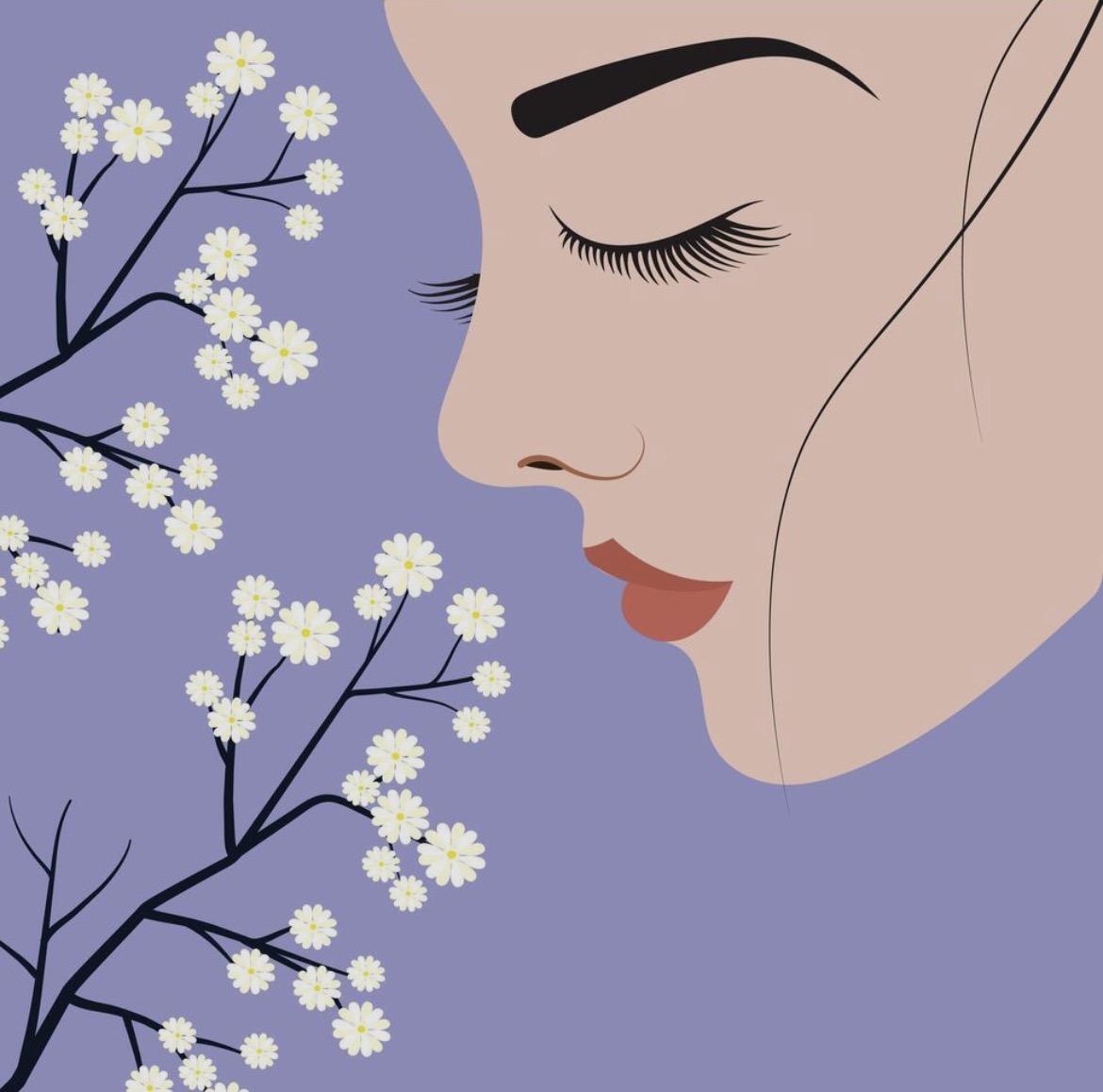
Can we inhale the fragrance of being?
It’s harder than it sounds.
 gettingoutalive