Vegan Experience Brings Gratitude in Unlikely Places

I went to a wonderful one-day yoga retreat about seven months ago. It almost looked like there wouldn’t be enough people registered for the retreat to take place, and then, at the last moment, there were.

We were hosted by an interesting, lovely woman in her amazing house, with beautiful gardens. The weather was perfect. The yoga teacher, my original teacher who created that spark in me with which began my love affair with yoga, was wonderful. (thank you, Rachel!)

Displaying 2014-06-06 15.13.33.jpg                                                            Displaying 2014-06-06 11.30.42.jpg

As an additional treat, a vegan chef prepared our meals, taught us about the vegan lifestyle and how to prepare several of the gorgeous foods she prepared.

Displaying 2014-06-05 19.46.03.jpg                                               Displaying 2014-06-06 12.42.52.jpg

She became vegan for all the health benefits about which she spoke and also because of her deep commitment to respecting the lives of all living things.

animals

Hmmm. Sounded good to me. I’m not all that against eating animals, truth be told. I don’t get teary-eyed when contemplating a steak on my plate or a little Cornish hen that even looks like she could get up and waddle away. But I’m not against refraining from eating them either. And lowering my cholesterol while, perhaps, losing a big of weight, might finally get my levels to a more comfortable place in the middle of that pesky graph.

And, not only that, but I could be COOL.

All the coolest people are vegan these days, right?

I could be IN.

Yay!

Cool Kids

Gershon put up lots of shelves in our pantry for all the containers with nuts, grains, dried soy chunks, coconut oil, beans and lentils. I bought a little  extra refrigerator for that pantry to put all the leafy green things and the overflow of vegetables in.

He was supportive and I was…

INTO     IT!

Vegan pyramind

I was careful not to preach to anyone else. (how obnoxious is it when people do that, right?) I cooked all the usual victims for Gershon and he didn’t roll his eyes even once at the odd side dishes on his plate (my main course).

cholesterol

My cholesterol went down 20 points.

proud of myself


All was going just spiffy there for a minute until…wait!

WHAT THE HECK IS THIS???

Diarrhea  D I A R R H E A!!

I don’t mean the kind where you have to go an extra time or two a day. Or the kind where there’s a slight change in texture or color. Okay, this is getting a bit graphic for the weak of heart but you get the picture.

I’m talking BIG TIME and 4 months.

So, I googled the heck out of the subject from every which way. I went to my family physician. We did tests. Blood tests and stool specimens. All normal. I took soy products out of my diet and started peeling vegetables and fruits. No change.

Finally, I picked up the phone and sent out a few emails to people I know who were vegans for years and either became simple vegetarians or, as one friend put it, now eat a paleolithic diet (yeah, I had to look it up, too)

carnivore

And guess what? Every single last one of them said that they changed their diet because THEY WERE SICK…

FOR MONTHS!

Ha Ha Ha! Joke’s on me. Eating healthy was making me sick. And not only that but all that healthy eating makes lots of those COOL people sick.

So you guys all know I’m a yoga and meditation instructor, right? At least 6 times a week I tell my students that they should incorporate body and mind awareness into everything they do; not just yoga. If they find themselves doing something that doesn’t feel good they should ask themselves why the Sam Hill they’re doing it. And if the answer is, among other things, to be COOL, well, they need to cut it to heck out.

If you’re gossiping to entertain your friends; you might want to find new material (or different friends).

If you’re wearing high heels to attract men; you might want to find a good podiatrist (or a different kind of man).

And if you’re eating in a way that gives you diarrhea for four months; you might want to find a different way of eating!

And, so, I decided on Monday that I would start eating eggs and chicken and even add a few milk products into my life and kick all those beans and whole grains out. I unceremoniously (or maybe a bit ceremoniously actually, if that’s a word) and literally threw out everything that had a whiff of soy in it.

Lo! and behold. Immediate relief. And I mean immediate.

By Tuesday my digestive system switched back from Mr. Hyde to Dr. Jekyll. And, a bonus, I had more energy. I thought I was feeling a bit lethargic because of it being winter but, it turns out, it was all that healthy eating. In case you think this might be my imagination, one of those ex-vegan friends said that giving up grains upped her energy level like 5 cups of coffee for breakfast.

jump for joy 2

And here comes the gratitude part for those of you who get annoyed when the title has no distinguishable connection with the book or, in this case, blog.

Grateful to be energetically out of the bathroom, yes. But also grateful for my friends and relations who didn’t feel the need to warn me about the connection between veganism and feeling crappy (only a little sorry for the pun). Why, you might ask, would I be grateful for that?

There’s nothing like learning for oneself through experience (as long as it’s not lethal). That’s first off.

Would I have listened to them? Maybe, but then I might’ve always wondered.

I wonder

And then there are all the lessons that I’ve internalized.

  • the one about not giving advice where none has been solicited
  • the one about being forthcoming and honest when it has
  • the one about examining goals with clarity (and throwing out the ones that are unskillfully motivated)
  • the one about APPRECIATING the glorious natural functioning of my body (recovering from 4 months of diarrhea is a super teacher for this one)

So, thank you, friends and relatives. Thank you, body. Thank you, Gershon. (a friend AND a relative but his support is distinctly different from anyone else’s) Thank you, eggs. Thank you, chicken.

And now I have to go eat some chorizo.  See ya’

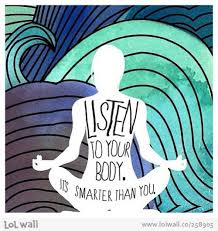
Listen to your body


Friends

I’m blessed with people in my life who are very kind to me.

They rock and roll with all the strangeness and new ideas I come up with. With the new projects I talk about doing.

bored

They never roll their eyes. Their body language never makes me feel silly or defensive or reluctant to talk to them about the next idea or project.

My best friends often try to think of ways I might be able to achieve my new projects. They ask good questions and think of ways they might be helpful in the new project.  A couple of them even suggest new projects they think might suit me or generate income for me someday (and some of them actually have!)

But probably the best part is that they just listen in that active listening  kind of way.

These friends never say “I told you so” (and, in fact, they don’t “tell me so” even if they figure the idea is unrealistic or that I probably won’t do anything with it other than talk about it).   hyena laughing

They don’t even mention it or say “Hey, whatever happened to your idea about…” or remind me in any way that something I was excited about and for sure going to do has faded into the sunset.

So I always feel just fine sharing my next idea.

Used to be that when  my friends talked to me about their ideas or projects, I’d listen and…give advice. I didn’t ask them if they wanted advice…or if they just wanted me to listen.

My advice was usually practical ways to make their ideas actually work…even if they were somewhat different than the direction my friends’ ideas were going.

In being practical I might have told them their idea wouldn’t work. I might have told them it wasn’t realistic…and why. Lucy The Dr is In

Usually my direction and suggestions were pretty accurate. (My judgments are pretty good about a lot of things) But I certainly wasn’t giving them that acceptance and unconditional encouragement that I was receiving from them.

Truth is, most of my friends don’t have harebrained schemes like I do. There’s never usually a reason their ideas totally won’t work or that it’s totally clear that their ideas are mostly pipe dreams (like many of mine are). They don’t have crazy ideas. (I think if they did, it might have been easier for me to be unconditionally encouraging. I like crazy ideas).

Some time ago I decided that I would like to be kinder to my friends not only in the ways they’re kind to me when I talk to them about new ideas and projects…but in general.

I wasn’t noticing things they were kind enough to notice and comment on. I didn’t notice haircuts or new clothes. I didn’t notice changes they made in their homes. I didn’t compliment them on new things I did notice if I didn’t especially like them (I’d sometimes try but it totally sounded fake and ingenuous to my ears).  skinny legs

I’m guessing they don’t always like my new clothes and changes I make but they always make me feel like they do.

And then there was my impatience with them. Impatient with their phone calls when they called just to say “hi” and didn’t really have anything to say.  gilda radnerImpatient when I had things planned and they called or came over (even though, admittedly, it wouldn’t matter a bit if I spent a focused 10 or 30 minutes – or even an hour – with them before going on to the next thing on my list.)

So I decided to use my meditation skills and breathing methods to bring awareness to my behavior with my friends. To be kinder. Have more empathetic joy in their new ideas and things. Be more patient. baddha konasana drawing

That was a couple of years ago.

I’ve woken up to the fact recently that I no longer have to use meditation skills and breathing methods to be kinder, more patient and more joyful for my friends. Wow! It works!  hug

Awareness practice. I read about it, listen to podcasts about it and talk about it with my students. And now I’ve experienced it for real. Here’s the very good news – It’s all true!

embracing lifeAnd another thing that turns out to be true – all of that stuff really does make me feel happier. The gift of kindness, patience and empathetic joy for others ends up being a gift to myself. Just like “they” said all along.

Patience and Determination; forgiving myself

Yom Kippur – probably the most serious day on the Jewish calendar. A day of introspection to take self-inventory, acknowledge all the places you’ve fallen down in being the person you want to be and resolve to make the changes you need to make.

Synagogues and temples fill up all around the world. People dressed in white with somber faces. There’s an earnestness in their prayer.

Notice I said “their”…hmmmm…yep, I’ve barely been in a synagogue on Yom Kippur in years. Our community shul is in my backyard. Well, right across the street from my backyard. I can hear the davening and the blowing of the shofar from my kitchen. And, yet, I haven’t walked in there much since I finished saying kaddish for my father almost 25 years ago.

My father was a community Rabbi. I hear that things have changed over the past few decades, but, when I was growing up, the Rabbi’s wife and kids were an unspoken part of the contract between the Rabbi and his congregation. We all had to tow the line. We were examples of correct Jewish life in a town which couldn’t support a kosher restaurant and in which most social events and interactions took place on the Jewish Sabbath when we couldn’t participate.

My father was from a rabbinic family. Nine generations of Rabbis, or so the story goes. He was the black sheep because, although he was certified as an orthodox Rabbi, he became a conservative community Rabbi instead of orthodox. To his hassidic, Israeli father, who had been the head of a yeshiva, my father was a minimally better Jew than his brother who had married a shiksa and for whom he and my grandmother had sat shiva. So suffice to say that my father had his own issues with Judaism.

Looking back from my own life perspective of living in a community where people take joy in their Judaism, I understand how the stern, unemotional Judaism of the home in which I grew up created obstacles to my own Jewish observance. Every Shabbat, every holiday, three afternoons a week and Sunday morning – all filled with restrictions and none of the incredible beauty and spiritual fullness I’ve seen in my Israeli community’s observance.

And all carried out in our glass house under the scrutiny of my father’s employers.

So, no, I don’t join in the davening on Yom Kippur or any other day. It’s all too fraught with darkness for me.

But over the past 20 years an apparent need for spirituality – the seed of spiritual growth – has been watered and nurtured in a constant and persistent manner. An unconscious patience and determination took advantage of every opportunity, every glimmer of interest, to lead me to a softer, kinder relationship with spirituality.

Patience and determination. They go hand-in-hand.

Patience without determination can mean mediocrity, settling for less, never becoming the person you want to be and could be, never having the influence for good in your own life and the lives of others that you might.

Determination without patience can mean aggression, violence, insensitivity to yourself and those around you, hurrying ahead, constantly pushing, mowing down the fragile buddings of beauty in your path.

Patience without determination may lead to frustration, sadness, regret.

Determination without patience may lead to disappointment, self-flagellaltion, isolation.

I’ve been harsh to myself for the past couple of weeks. Critical of my lackluster pre-Yom Kippur state.

Always before I’ve justified my lack of formal Jewish observance in knowing that pretty much every day is a day of introspection and self-inventory for me. Pretty much every day for the past 20 years or so has been a day filled with spirituality and filled with God. But this year I’ve felt removed from that place.

Not that it’s never happened before.

As is truth for so many aspects of life, I see my spirituality and partnership with God in terms of waves. Waves that come in and go out. Just as I wouldn’t try to grab onto a wave and hold it constant and I wouldn’t try to make a wave rise and come toward me (what could come of that other than failure and frustration?), so I don’t try to force spirituality to reside in me. I encourage it with reading and music and meditation and yoga but, ultimately, I am like the ocean – providing a welcoming home but knowing that waves come and go in their natural rhythms.

But it’s never happened before around Yom Kippur.

So for quite a few days I felt irritated with myself, disappointed and impatient.

And then, yesterday, on my morning walk, I listened to one of my favorite teachers, who has regrettably few teachings available, Phillip Moffit (www.dharmaseed.com look for his Oct. 24, 2010 talk), speaking about patience and determination. And then saw in an email post I subscribe to by Rick Hanson (http://www.rickhanson.net/writings/just-one-thing) about having compassion for yourself.

I didn’t have that “Poof, you’re spiritually enabled” moment that I might have wished for but I felt immeasurably kinder toward myself and more able to recognize my oceanness and my spirituality’s waveness.

And, so, I’ve shared with you below a short “compassion for yourself” exercise after having done it myself a time or two. Maybe you’re being kind to yourself anyway these days. No worries, there’ll be days for which you’re happy to have saved it.

Sending prayers for your inscription in the Book of Life…and the book of spiritual nourishment and personal growth…

* Take a moment to acknowledge your difficulties: your challenges and suffering.

* Bring to mind the feeling of being with someone you know cares about you. Perhaps a dear friend, a family member, a spirit, God . . . even a pet. Let yourself feel that you matter to this being, who wants you to feel good and do well in life.

* Bring to mind your difficulties, and imagine that this being who cares about you is feeling and expressing compassion for you. Imagine his or her facial expression, gestures, stance, and atti­tude toward you. Let yourself receive this com­passion, taking in its warmth, concern, and goodwill. Open to feeling more understood and nurtured, more peaceful and settled. The expe­rience of receiving caring primes circuits in your brain to give it.

* Imagine someone you naturally feel compassion for: perhaps a child, or a family member. Imagine how you would feel toward that person if he or she were dealing with whatever is hard for you. Let feelings of compassion fill your mind and body. Extend them toward that person, perhaps visualized as a kind of light radiating from you (maybe from your heart). Notice what it’s like to be compassionate.

* Now, extend the same sense of compassion toward yourself. Perhaps accompany it with words like these, heard softly in the back of your mind: May this pain pass . . . may things improve for me . . . may I feel less upset over time. Have some warmth for yourself, some acknowledg­ment of your own difficulties and pain, some wish for things to get better. Feel that this com­passion is sinking in to you, becoming a part of you, soothing and strengthening you.

Nemaste!

Good news for your brain

The good news is that we can change the actual physical structure of our brain to make our lives easier, with less anxiety, less fear and less negativity.

The bad news is that it takes attention and effort…and the job is never done.

Recently I came across Dr. Rick Hanson, neuro-psychologist, www.rickhanson.net, and listened to the first two parts of a four part series of lectures called “Taking the Good” (www.audiodharma.org) about positive thinking research primarily out of UW/Madison’s Waisman Institute for Integrative Health (www.investigatinghealthyminds.org).

While the purists among us might want to read/listen to the research at its source, I found Dr. Richie Davidson’s rendering dry, unnecessarily long and boring, while Dr. Hanson takes the same information and makes it interesting and easy to listen to and comprehend.

The short version, without all the science about neurons, neuro-transmitters, and impressive-sounding names of brain sections, (which is fascinating and definitely worth listening to) is that we can create and fortify new neuro-pathways with mental exercises.

That while we’re wired to live by an emphasis on negativity (those laid back, it’s-all-good type animals and humans became someone’s dinner while the fearful, careful, anxiety-ridden became our grannies and granddaddies), we can carry out exercises in positive thinking 2-3 times a day for a couple of minutes each time, and thicken right up our left frontal lobe, creating a life of more personal comfort, altruism and even stave off Altheimer’s.

As some Canadian neuroscientist said “the neurons that fire together, wire together.”

Used to be we thought our brain cells died off all the time leading inexorably and inevitably to a feeble old age. Turns out that we do, indeed, lose 10,000 brain cells a day (and 10,000 for every alcoholic beverage…yikes!). But we can also add new brain cells and, actually better yet, expand the ones we have left.

Hanson describes it sort of like this – When there’s a forest fire, after awhile there are lots of little saplings. A decade later those saplings haven’t become an equal number of big trees. They’ve thinned out. The remaining trees, though, are not only way taller but have branched out with their branches reaching to each other in an”arborization” effect.

That’s what our brain cells do. But only through brain exercise.

Luckily, we all get lots of brain exercise without making a conscious effort. There are billions of synapses that send trillions of messages daily. Wiggle your big toe and you’ve sent hundreds of thousands of messages in a flash.

Our brain never rests. Not even when we’re asleep.

But there’s brain exercise and there’s brain exercise.

Wiggling your big toe is great but research has shown that meditation is greater.

What do I, with my daily meditation practice,  have in common with a Tibetan monk who lives in a monastery and a Christian contemplative nun who lives a life of service? We all have three areas in our brains which light up like a campfire when seen on an MRI slice. The area responsible for executive decisions, the area where enjoyment of reward shows up and the left front lobe with self-awareness and positive sensations.

Aside from the usual meditation practice of quieting thoughts to be present in the here and now – what Hanson calls stage one “let it be” and stage two “let it go”- research has shown that a practice of stage three “let it in” can make those brain changes to improve our lives vastly.

What do we let in? We let in positive thought to counter our great-great-grandparents fear of the tiger who doesn’t exist (we still don’t want to ignore the tiger who does exist) and antidote thought to counter holes of lacking from our early development. And we practice both daily to keep those neurons firing and wiring.

Positive Thought Practice

1. Choose a positive experience from today or yesterday and think about it

This can be something as small as a kind word from someone, completing a task you’ve set for yourself like washing the car, or as huge as getting a raise or getting pregnant.

2. Move the experience from your mind to your body

Let your thought become the feeling associated with it. Does it translate into a smile? A feeling of an expansion in your chest? A relaxation of your brow and other face muscles?

3. Let the thought and feeling sink more deeply into you and stay with it for a minute or two.

We have a tendency to have negative thoughts pop up to the surface. “Yeah, but washing the car is something I should do much more regularly.” “Yeah, well, the job won’t last because I probably won’t be able to fulfill her expectations.” Just note what comes up and bring the positive thought and feeling back into the foreground.

Antidote Thought Practice

We all have at least one narrative of “not enough” from our formative years. Not enough love. Not enough recognition. Not enough power. And it becomes a theme for how we react to our lives and the events and people in them.

A meditation practice can help us slow down, take a deep breath, and respond differently.

Neuroscience has now shown that we can also do exercises to change the physical structure of our brain to direct our reactions toward a new neuropathway.

1. Think of the hole of whatever was lacking (most of us know what it is but if you don’t, just choose “not enough love” since that’s a generic fallback that’s true for almost all of us) and then choose an experience from today or yesterday that shows the exact opposite and think about it.

If your particular hole has to do with not having been seen/recognized by your family of origin or your peers, you might think about a conversation with someone wherein they really “got it”.

Or if you felt powerless, perhaps you can call to mind a few of the decisions you made today which were totally your own.

Let the hole remain in the background while the positive opposite stand firmly in the foreground.

2. Move the positive experience from your head to your heart; from thought to feeling. Like the “positive thought practice” but take along the hole of lacking in a much smaller dose.

3. Let the thought and feeling really sink in and hold it inside for a minute or two. Note all the thoughts that arise, often thoughts of negativity, and the feelings, often of sadness, getting choked up, or of fear or anger.

The hole may gape ever larger and threaten to swallow up the positive. Pay attention but return it firmly to the background.

I’ve been talking about all this to the women in my Monday night yoga and meditation group. A few of them have taken it to heart and are trying to do their brain exercises 2-3 times a day. It will be interesting to see if a few months of it make a difference, or as Hanson says, the difference that makes a difference.

And now I have to go…it’s time for my brain exercise.

Rebellion in the Meditation Hall

The woman who organizes the annual 4-day silent retreat that I go to also organizes one-day retreats from time to time. I always go if I’m in the country. She lets us know way in advance so it’s no problem freeing up the time.

It’s held in a lovely meditation hall with a wall of windows looking out into an undeveloped meadow. If I wander out onto the front porch during walking meditation I can see a quiet paved alley between the houses and gardens which has seemingly untamed bushes and other green growing things along its stone walls.

The day is organized extremely well. In fact, truth be told, I have a feeling that the mindfulness instructor is a little bit obsessive compulsive. There are laminated notes here and there, including over the sinks in the bathroom and on the inside of the stall doors, with mindfulness messages.

This time there was also a covering over the big clock high up on the front wall which was a picture of a clock with the 12, 3, 6 and 9 in the right places but with the word “NOW” over the clock’s hands.

(how irritating is that?) – (foreshadowing)

There are always between 20 and 30 retreatants and this past Friday was no exception. Some are repeat offenders like me and their faces and habits have become familiar to me. Most are people I’ve never seen before. The hall is spacious enough for whoever shows up.

The day is basically set up in 3/4 hour meditation sessions, one right after the other, of sitting, walking, sitting, mindful eating and walking, sitting,  and a few minutes of small group talk to break the silence.

The sitting meditations are the noisiest I’ve ever experienced. She guides…alot. We’re silent. She’s most definitely not.

Okay, many of the people participating are beginners. I get it. From the very first retreat I wondered at how little silent meditation goes on, but the pickings are slim in Jerusalem so I’m grateful for the opportunity to experience the power of meditating in a group from time to time.

Grateful. Grateful. Grateful.

That’s me repeating a mantra of gratitude for the opportunity to sit mediation with the power of a group. And I really continue to be quite grateful.

On the other hand, this is where she was guiding us to be and where the rest of the group seemed to be and this is where I was hanging out….or maybe here…and moments of                                                                              here.

All of a sudden, it just seemed so serious and heavy. In the walking meditation, I kept looking around at everyone. They resembled nothing so much as zombies.

And then there were the handful of people who chose to cover up with a blanket and sleep during the mindful eating and personal walking meditation – in the middle of a very sunny, very pleasant day. Typical escape behavior, right? I started asking myself…”Jeez, who wouldn’t want to escape all this heaviness?” and wondering if it wasn’t just a tad depressing in the meditation hall.

I was thinking about my own meditation and yoga class. Did people sometimes go in search of a thick rope and a stool when they leave? Yikes!

For awhile I tried to come back to my breath like a good retreatant. I tried to take notice of my thoughts as they arose and let them go. I tried to focus on the sounds in the room to be in the here and now of it all. But my mind was

unruly and wild.

And I was liking it alot.

I was liking how my thoughts wandered to the yoga mat and to my backyard and to my daughter-in-law and granddaughters’ arrival in Israel later in the day. I liked how the sun felt on my closed eyes when I sat on the porch (mindfully) eating my lunch. I felt my heart smile at my (judgmental and sarcastic) thought about the clearly healthy cardboard-looking dark crackers, seeds and grapes my fellow-retreatant was eating on the porch and felt joyful at the decidedly un-organic rice and chicken in my own bowl.

When we broke into our small group at the end of the day there was that awkward silence there often is when breaking silence at a silent retreat. So I opened up with what I think of as my guilty pleasure smile and said, “I was rebelling in the meditation hall.”

Blank looks. “Rebelling?” they asked.

“Yep,” I continued. “I felt myself kicking out with my feet and pushing out with my elbows at the structure and direction of it all. I had thoughts and didn’t let them go. I looked around even though we’d been told not to lift our eyes to the height of people’s faces.”

They didn’t know quite what to make of that. I didn’t either. It just was.

The conversation moved off in a different direction. I continued my rebellion by commenting to myself that the man to my left, who I’d judged to probably be a bit of a cuckoo, was actually quite normal, nice and interesting.

My thoughts drifted as my partners spoke, thinking how women are so much more verbal and so often seem to dominate sensitive conversations with verbosity. I was wishing the other woman (with whom I became friendly at the 4-day retreat and have gotten together with since) would read my mind and create a comfortable space for the two men to speak.

Even before I collected my stuff and headed for the car I’d about decided that my rebellion in the meditation hall experience was one of the best meditation experiences I’d had in a long time.

After all, after twenty some odd years on the cushion I’ve pretty much got that focusing on the breath thing down. I’ve noticed about a gazillion thoughts and watched them float off like clouds in a blue sky, like the water truckin’ on down the river as I sit on the bank, like the birds flying overhead and continuing south to Africa for the winter months. You name the metaphor, I’ve pinned it to my thoughts as I let them go.

And go the do.

But the strength of the rebellious mind – now there’s a meditation experience I can’t remember ever having had before in quite this joyful way. Noticing that is noticing SOMETHING. Noticing my happiness in rolling around in it like a pig in…mud…and lustily rolling around in it some more.

Well, it felt great.

Meditation teachers refer to this phenomenon as ‘monkey-mind’ because it’s similar to the way a monkey will swing from tree to tree tasting a banana from each one before dropping it and moving to the next tree. Like these monkeys, we often jump from thought to thought without ever really being in the present moment.

But, hey! Bananas are one of my favorite fruits.