Addictive Behaviors

Addictive Behaviors constantly get in the way of our happiness. Caused by strong emotions: aggression, jealousy, envy, craving, entitlement, pride, fear, they are comfort vehicles which often give us instant gratification but which are, ultimately harmful to us in our search for happiness.

We, like moths are drawn to the light which represents warmth and comfort, are drawn to those things which harm us.

We are all addicts in one way or another. Some are addicted to alcohol, drugs, violence, stealing, but more of us to lying, saying mean things, gossiping, worry, negative thoughts, judging ourselves and others, and complaining.

The nature of addictive behavior is that every time we do that thing, every time we complain or criticize or judge or gossip, or whatever the thing is that we’re addicted to doing, we strengthen our addiction.

We don’t trust our own capacity to wake up. We have a little voice that says, “I am not okay.” “Everyone else can do XXX but not me.” Or we have a voice that says, “I am right.”

It’s hard for us to entertain the notion that there might be another way of looking at things.

We might even think that happiness is getting what we want.

“We long to free ourselves from misery

But it’s misery we follow.

We destroy joy as we would an enemy.”

We’re like the moth.

We all know that addictive feeling. It’s that thing we’ve done a million times. And yet…and yet…this time, we say to ourselves, it will be different. This time we won’t eat every potato chip in the family size bag. This time we’ll feel better when we say that mean thing to hurt someone back who’s hurt us. This time we’ll convince that person to act the way we know is right…and they’ll be better off for it.

But of course that’s just our addictive craving talking and every time we give in to it, it escalates. We get better and better at it.

So, how can we stop doing those addictive behaviors which invariably harm us and often others?

We catch ourselves at it. Become aware of it. Recognize it and then just don’t do it.

It’s not a question of repressing the craving. We let the thought or action go because we recognize that we don’t like what it feels like and we consciously want to be doing it less next year at this time. We think it but we let it go. We don’t act on it.

We refrain from doing that thing…eating that thing…saying that thing…because that refraining is what interrupts the old habit.

For many it’s often judgmental mind. So we just tell ourselves – “Don’t do it! You’ve done it a million times. You’re getting older and older and you don’t want to just keep on doing it up to your last 5 minutes on earth so just don’t do it! It sure isn’t going to stop on its own and no one else can stop it for you.”

An addiction is a compulsion. There’s a tremendous pull to do it again. What we need to do is essentially go through “detox”. We need to cure ourselves of these addictive behaviors.

If we look at the 10 precepts we can see that each and every one of us is addicted to something on the list. We are probably not addicted to all of them and maybe we are addicted to some more than others but there is sure to be at least one that shouts out to us…and it’s sure to be causing unhappiness in our life.

If we use the precepts to feel guilty or, conversely, to be proud (“Wow! I don’t do that one!” or “Wow! I didn’t do that one…today!”) we’re missing the point. We need to live by the precepts innocently, like a child. Better not to think of it as being a good or a bad person, rather that we are seeking to cultivate happiness and gain access to our innate wisdom.

Innate wisdom is insuppressible. Think of it like seeds in rich soil that our addictive behaviors have been cementing over, and over, and over. Whenever a crack in the cement opens up through our refraining from our addictive, harmful behaviors, our innate wisdom pops through like the grass in the cracks of sidewalk cement.

The way to do this is hard and simple at the same time. It’s hard because it’s uncomfortable and a little scary to stop a habit which has given us instant gratification (even if the gratification may last only minutes and then create a more painful situation than before). Simple because all it takes is to just stop doing it. And we do that when we truly understand that the behavior is harmful for us. We just GET IT!

Your addiction may be to critical mind. For decades you’ve been pointing out to people what they’re doing wrong and how it ought to be. And, yet, things that need to be fixed still exist. Your sense of things being wrong still exists. You feel bad and STILL the situation doesn’t get changed. And it hits you that if you want to enjoy life, you just need to stop criticizing. Set a goal of a year and say to yourself that you’ll check in with yourself in a year to see if you feel better.

The thing is that the craving still exists. For most of us, we’re blessed when we can get to the point where we have half-faith or half-trust that stopping will make us feel better. So sometimes we refrain but sometimes the craving gets the best of our trust and we do the thing anyway. We are caught between idealistic notions and our own human frailty; between how we should be and how we really are. We need to find the middle way. A way to stay open so that more and more often we are able to stop harming ourselves. And right here is where we learn compassion for ourselves (and for others) because we see how tough it is and that we are all in the same boat.

But this is a great place to be because we’ve recognized the addiction and, although we don’t always succeed, we can, more and more often, just stop doing it.

Great faith is like putting two hands together. And though half faith is like putting only one hand up – at least it’s still up there in the air. We’ve entered the arena, the stream of unstoppable innate wisdom – we’ve made cracks in the cement.

Our addictive behaviors have been around with us quite awhile. They’re tricky. They know us well. As a result, part of us does not really believe that refraining from our addictive behaviors will bring happiness, even when we see over and over that it does.

If you have been saying a clever, mean thing in response to people saying hurtful things to you for so long that you know how satisfying it can feel, it is hard to really believe you will feel better when someone says something hurtful to you and you refrain from saying a clever, mean thing. You know it will be uncomfortable for you. You worry that you will have nothing to replace it.

That’s where practice comes in. Learning not to run away from the discomfort and to trust that innate wisdom will result in the crack in the cement and bring happiness.

At some point, from our own insight, and from feeling the happiness that comes from refraining from critical mind or judgmental mind or saying a mean thing, from eating a plateful of brownies or from feeling a twinge of joyfulness at someone’s misfortune, we really get it. It gets through. And then we trust that innate wisdom ALWAYS gets through.

Sometimes it’s easy. That’s when we say we’ve had “a good day”, or a “good hour” or a “good period”. Seize that moment!

Sometimes things will get in the way. Be kind to yourself. And remember that half-faith is so much better than ever- escalating addiction. Always remember that innate wisdom will come forth.

I no longer remember where I found this article.  I’ve had it for awhile. Hopefully it’s rightful owner isn’t too attached to being credited. In any case, it didn’t originate with me so I’m crediting the cosmos. Aliza

Patience and Determination; forgiving myself

Yom Kippur – probably the most serious day on the Jewish calendar. A day of introspection to take self-inventory, acknowledge all the places you’ve fallen down in being the person you want to be and resolve to make the changes you need to make.

Synagogues and temples fill up all around the world. People dressed in white with somber faces. There’s an earnestness in their prayer.

Notice I said “their”…hmmmm…yep, I’ve barely been in a synagogue on Yom Kippur in years. Our community shul is in my backyard. Well, right across the street from my backyard. I can hear the davening and the blowing of the shofar from my kitchen. And, yet, I haven’t walked in there much since I finished saying kaddish for my father almost 25 years ago.

My father was a community Rabbi. I hear that things have changed over the past few decades, but, when I was growing up, the Rabbi’s wife and kids were an unspoken part of the contract between the Rabbi and his congregation. We all had to tow the line. We were examples of correct Jewish life in a town which couldn’t support a kosher restaurant and in which most social events and interactions took place on the Jewish Sabbath when we couldn’t participate.

My father was from a rabbinic family. Nine generations of Rabbis, or so the story goes. He was the black sheep because, although he was certified as an orthodox Rabbi, he became a conservative community Rabbi instead of orthodox. To his hassidic, Israeli father, who had been the head of a yeshiva, my father was a minimally better Jew than his brother who had married a shiksa and for whom he and my grandmother had sat shiva. So suffice to say that my father had his own issues with Judaism.

Looking back from my own life perspective of living in a community where people take joy in their Judaism, I understand how the stern, unemotional Judaism of the home in which I grew up created obstacles to my own Jewish observance. Every Shabbat, every holiday, three afternoons a week and Sunday morning – all filled with restrictions and none of the incredible beauty and spiritual fullness I’ve seen in my Israeli community’s observance.

And all carried out in our glass house under the scrutiny of my father’s employers.

So, no, I don’t join in the davening on Yom Kippur or any other day. It’s all too fraught with darkness for me.

But over the past 20 years an apparent need for spirituality – the seed of spiritual growth – has been watered and nurtured in a constant and persistent manner. An unconscious patience and determination took advantage of every opportunity, every glimmer of interest, to lead me to a softer, kinder relationship with spirituality.

Patience and determination. They go hand-in-hand.

Patience without determination can mean mediocrity, settling for less, never becoming the person you want to be and could be, never having the influence for good in your own life and the lives of others that you might.

Determination without patience can mean aggression, violence, insensitivity to yourself and those around you, hurrying ahead, constantly pushing, mowing down the fragile buddings of beauty in your path.

Patience without determination may lead to frustration, sadness, regret.

Determination without patience may lead to disappointment, self-flagellaltion, isolation.

I’ve been harsh to myself for the past couple of weeks. Critical of my lackluster pre-Yom Kippur state.

Always before I’ve justified my lack of formal Jewish observance in knowing that pretty much every day is a day of introspection and self-inventory for me. Pretty much every day for the past 20 years or so has been a day filled with spirituality and filled with God. But this year I’ve felt removed from that place.

Not that it’s never happened before.

As is truth for so many aspects of life, I see my spirituality and partnership with God in terms of waves. Waves that come in and go out. Just as I wouldn’t try to grab onto a wave and hold it constant and I wouldn’t try to make a wave rise and come toward me (what could come of that other than failure and frustration?), so I don’t try to force spirituality to reside in me. I encourage it with reading and music and meditation and yoga but, ultimately, I am like the ocean – providing a welcoming home but knowing that waves come and go in their natural rhythms.

But it’s never happened before around Yom Kippur.

So for quite a few days I felt irritated with myself, disappointed and impatient.

And then, yesterday, on my morning walk, I listened to one of my favorite teachers, who has regrettably few teachings available, Phillip Moffit (www.dharmaseed.com look for his Oct. 24, 2010 talk), speaking about patience and determination. And then saw in an email post I subscribe to by Rick Hanson (http://www.rickhanson.net/writings/just-one-thing) about having compassion for yourself.

I didn’t have that “Poof, you’re spiritually enabled” moment that I might have wished for but I felt immeasurably kinder toward myself and more able to recognize my oceanness and my spirituality’s waveness.

And, so, I’ve shared with you below a short “compassion for yourself” exercise after having done it myself a time or two. Maybe you’re being kind to yourself anyway these days. No worries, there’ll be days for which you’re happy to have saved it.

Sending prayers for your inscription in the Book of Life…and the book of spiritual nourishment and personal growth…

* Take a moment to acknowledge your difficulties: your challenges and suffering.

* Bring to mind the feeling of being with someone you know cares about you. Perhaps a dear friend, a family member, a spirit, God . . . even a pet. Let yourself feel that you matter to this being, who wants you to feel good and do well in life.

* Bring to mind your difficulties, and imagine that this being who cares about you is feeling and expressing compassion for you. Imagine his or her facial expression, gestures, stance, and atti­tude toward you. Let yourself receive this com­passion, taking in its warmth, concern, and goodwill. Open to feeling more understood and nurtured, more peaceful and settled. The expe­rience of receiving caring primes circuits in your brain to give it.

* Imagine someone you naturally feel compassion for: perhaps a child, or a family member. Imagine how you would feel toward that person if he or she were dealing with whatever is hard for you. Let feelings of compassion fill your mind and body. Extend them toward that person, perhaps visualized as a kind of light radiating from you (maybe from your heart). Notice what it’s like to be compassionate.

* Now, extend the same sense of compassion toward yourself. Perhaps accompany it with words like these, heard softly in the back of your mind: May this pain pass . . . may things improve for me . . . may I feel less upset over time. Have some warmth for yourself, some acknowledg­ment of your own difficulties and pain, some wish for things to get better. Feel that this com­passion is sinking in to you, becoming a part of you, soothing and strengthening you.

Nemaste!

Discovering America

America gets a bad rap abroad.

Speaking as a semi-ex-pat who visits the big cities in the United States frequently but has lived in Israel for over 30 years and seldom has occasion to be in the smaller towns and rural areas of America, I was in for a big surprise when I ventured out of California and into Nevada and Utah in September.

First, if you’re sitting in a big city in the United States and have little contact with anyone who doesn’t sit in a similar place, you may not even know that elsewhere in the world you’re thought to have questionable values, unruly children (if you have children), little or no knowledge about anything outside your city limits and to be clueless about any of your above traits.

Okay, now, I have good friends living in the big cities of America so I know that not all of the above is true of everyone geographically near you but I have to admit to basically accepting much of that criticism for many people in your situation.

I recently went to a family wedding in Oakland and stayed in Berkeley, one of my favorite university towns, for Labor Day weekend. One of my favorite university towns only because I don’t have to live there. I used to live there in ancient times (ps it hasn’t changed much) but left Northern California when I tired of trying to get re-acquainted with my friends every month as they totally shed one persona for another.

Late Monday night I flew to Las Vegas, my planned jumping off point to go hiking in the canyons of Utah, Bryce Canyon and Zion Canyon.

Las Vegas.  I had thought I might enjoy a little gambling – the glitz and sparkle of the man-made wonders of the world; The Venetian Hotel, The Luxor Hotel (complete with pyramids) – and had planned my trip to come back to Las Vegas for all that on the weekend. But while walking through the lobby (read: casino) to get to the hotel registration desk I began to hear a loud whisper in my ear warning of my mistake.

It went something like this:

OMG! Cigarette smoking is allowed here? And what’s with all these sleazy people who look like miserable zombies? Yikes!

Followed by:

Is this another “old person” reaction? Have I totally lost my sense of fun? Hmmm. Doesn’t look like anyone’s actually having fun. 

Up bright and early to make my getaway. More or less made a beeline for the parking lot through all those not-so-happy-time gamblers. There were many more of them at 8 a.m. than there had been at 2 a.m. but they still didn’t look very happy. I noticed when grabbing some breakfast that plenty of them had children in tow so I guess they don’t think of Las Vegas with its gambling and, ahem, other sports, as sleazy or shameful.

Personally, it all seemed like America at its worst to me…or at least not a very pretty side of glory, glory hallelujah. But this blog post really isn’t a rant about Las Vegas.

The drive to Zion Canyon put me immediately in a different frame of mind. As soon as I broke free of the construction-entangled highways of Las Vegas I found myself breathing easier and more deeply.

Crusing down a ribbon of highway, I was surrounded on all sides by open, rolling desert savannah with mountains in the distance to my right and to my left.

It went on for miles and miles getting more and more beautiful as I traveled further away from the city. I’m a big fan of the desert in all its many variations and soon was singing along with the golden oldies radio station.

By the time I pulled in at The Dream Catcher’s Inn just outside of Zion Canyon the world seemed like a kinder place. One of the owners suggested that even though the sun would be setting in another hour or so, it would be a good idea to go on the Park shuttle to get an overall idea of a plan for the next day. So off I went.

In the parking lot of the park before getting on the shuttle I ran into a young couple who asked that I take their picture together with the gorgeous mountains in the background. After I’d taken a couple of photos and they’d checked to make sure the pictures were okay (he told me that she’s sensitive about her (miniscule) thighs. Sigh) he enthusiastically told me that they’d gotten engaged 20 minutes ago and I was the first to know. We chatted about their news and my own 37 year marriage for a bit. I wished them a good life as we parted. Nice kids.

The Shuttle was one example of the U.S. national parks’ exemplary organization for handling large numbers of people in the most efficient and ecologically sound ways.  At every stop along the way there are (clean!) bathrooms and spigots to fill water bottles so that people only carry in one plastic bottle and no tissues or toilet paper.

The sunset over The Court of the Patriarchs (three peaks names Abraham, Isaac and Jacob) was peaceful and pretty. The ringtail cat sighting was exciting (they’re rare). Laying on a low-lying wall at one of the stops and gazing up at the spectacular night time sky, as suggested by the shuttle driver, was wonderful (I didn’t want to head back but was afraid I’d miss the last shuttle back to town).

But even though every time I thought I couldn’t possibly see anything more gorgeous than the last amazing, breathtaking sight,  I came around the bend to see something even more mind-bogglingly beautiful, this blog post isn’t about God’s handiwork (He so outclasses anything Humankind has come up with so far).

“So what the Sam Hill is this blog post about?” I can hear you asking. (you may have substituted another word for ‘Sam Hill’.)

It’s about America. It’s about Americans. It’s about major misconceptions about both.

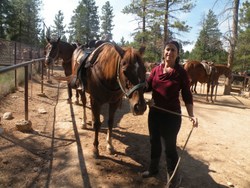
I was travelling, hiking, horseback riding alone.  

There are some really great things about doing all that with other people – especially people you love and find interesting. But there are also some really great things about going it alone.

For me, anyway, I find that I think more and I talk to strangers more when I’m alone. And, usually, first I think more and then I talk to strangers more so the conversation can be simple, “how ya’ doin’; where ya’ been; where ya’ from; where ya’ goin’ next” conversation but it can also be “I’ve been thinking about how people must’ve lived and felt back when this area was pretty much unpopulated. What do you think they were like?”

And then there’s alot more just plain eavesdropping on other people’s conversations. Something to keep in mind when you see someone sitting alone who looks like she’s reading a book.

And that’s what this blog post is about. The wholesome people who visit and live in the Western States of the US of A.

The teenagers who actually speak to older people and actually listen to them with respect.  

The waitress in Hurricane,Utah, who works to pay for the upkeep of her horses and the couple in Springdale who spoke to me about past vacations – all hiking, camping or skiing with their entire family – and the mountain marathon runner from Southern Utah University who chatted with me in Dixie National Park while she waited for her teammate to show up and pass her the baton. She mostly spoke about her college organization’s volunteer activities for children with special needs and her upcoming wedding.

In Bryce I spoke with an elderly couple from Minnesota as they rested on a  bench along the sunrise hike trail. They were with a group of 12 retired  couples, all with recreational vehicles, who were travelling together across the United States. As we talked, another couple in their group came along and we all shared hiking experiences in between long minutes of companionable silence.

At Hoover Dam a woman from South Carolina struck up a conversation with me about the ingenuity and work ethic that went into the Dam Project.  Later, over coffee, she told me about the two children from Guatemala she had adopted when they were 3 and 5 and how proud she was to be at her younger son’s college graduation in June. She showed me pictures of them with her hiking in the mountains near their home. I traveled in Guatemala a few years back and she pondered the wisdom of, perhaps, making a trip there with them. None of them had been back since she brought them to the plane upon adoption.

There were many others who made me proud to be an American and gave me renewed hope for the future of the land of my birth.

It’s true that many of the conversations made me sad for an America whose economy is not only bad but unimproving and sadder about the resulting disappearance of the optimism which typified my youth and university days. Several people spoke of losing their jobs and securing a new position more than a year later…at a lower salary. A few mentioned that our children’s generation is the first to have no hope for a better life than that of their parents…or even equally good.

As an Israeli I nurtured an inward smile at the disillusionment with President Obama which I heard over and over again from Democrats, Republicans, those who voted for him and those who voted against. But as an American I despaired together with them in the reasons for their disillusionment – the high rate of unemployment, family businesses closing down, a “new” health plan which leaves so many worse off than before. (I continue to be shocked how many Americans make significant life decisions based on where they can find the best health care coverage.)

If you’re old enough to remember, there was a human interest show of heartwarming and nostalgic vignettes about simple Americans on CBS news in the olden days.  It featured Charles Kuralt and lasted for a quarter of a century, airing for the last time in 1992, just five years before Kuralt died in 1997 from complications of lupus at the age of 62. The popularity of the show surprised the decision-makers at CBS and even Kuralt himself.

I met some people worthy of a couple of minutes of Mr. Kuralt’s time on my recent wanderings and it’s a great feeling knowing that so many of them are still out there almost 20 years after Kuralt closed up shop.

Might I dare to hope that they make up the majority of Americans?

Good news for your brain

The good news is that we can change the actual physical structure of our brain to make our lives easier, with less anxiety, less fear and less negativity.

The bad news is that it takes attention and effort…and the job is never done.

Recently I came across Dr. Rick Hanson, neuro-psychologist, www.rickhanson.net, and listened to the first two parts of a four part series of lectures called “Taking the Good” (www.audiodharma.org) about positive thinking research primarily out of UW/Madison’s Waisman Institute for Integrative Health (www.investigatinghealthyminds.org).

While the purists among us might want to read/listen to the research at its source, I found Dr. Richie Davidson’s rendering dry, unnecessarily long and boring, while Dr. Hanson takes the same information and makes it interesting and easy to listen to and comprehend.

The short version, without all the science about neurons, neuro-transmitters, and impressive-sounding names of brain sections, (which is fascinating and definitely worth listening to) is that we can create and fortify new neuro-pathways with mental exercises.

That while we’re wired to live by an emphasis on negativity (those laid back, it’s-all-good type animals and humans became someone’s dinner while the fearful, careful, anxiety-ridden became our grannies and granddaddies), we can carry out exercises in positive thinking 2-3 times a day for a couple of minutes each time, and thicken right up our left frontal lobe, creating a life of more personal comfort, altruism and even stave off Altheimer’s.

As some Canadian neuroscientist said “the neurons that fire together, wire together.”

Used to be we thought our brain cells died off all the time leading inexorably and inevitably to a feeble old age. Turns out that we do, indeed, lose 10,000 brain cells a day (and 10,000 for every alcoholic beverage…yikes!). But we can also add new brain cells and, actually better yet, expand the ones we have left.

Hanson describes it sort of like this – When there’s a forest fire, after awhile there are lots of little saplings. A decade later those saplings haven’t become an equal number of big trees. They’ve thinned out. The remaining trees, though, are not only way taller but have branched out with their branches reaching to each other in an”arborization” effect.

That’s what our brain cells do. But only through brain exercise.

Luckily, we all get lots of brain exercise without making a conscious effort. There are billions of synapses that send trillions of messages daily. Wiggle your big toe and you’ve sent hundreds of thousands of messages in a flash.

Our brain never rests. Not even when we’re asleep.

But there’s brain exercise and there’s brain exercise.

Wiggling your big toe is great but research has shown that meditation is greater.

What do I, with my daily meditation practice,  have in common with a Tibetan monk who lives in a monastery and a Christian contemplative nun who lives a life of service? We all have three areas in our brains which light up like a campfire when seen on an MRI slice. The area responsible for executive decisions, the area where enjoyment of reward shows up and the left front lobe with self-awareness and positive sensations.

Aside from the usual meditation practice of quieting thoughts to be present in the here and now – what Hanson calls stage one “let it be” and stage two “let it go”- research has shown that a practice of stage three “let it in” can make those brain changes to improve our lives vastly.

What do we let in? We let in positive thought to counter our great-great-grandparents fear of the tiger who doesn’t exist (we still don’t want to ignore the tiger who does exist) and antidote thought to counter holes of lacking from our early development. And we practice both daily to keep those neurons firing and wiring.

Positive Thought Practice

1. Choose a positive experience from today or yesterday and think about it

This can be something as small as a kind word from someone, completing a task you’ve set for yourself like washing the car, or as huge as getting a raise or getting pregnant.

2. Move the experience from your mind to your body

Let your thought become the feeling associated with it. Does it translate into a smile? A feeling of an expansion in your chest? A relaxation of your brow and other face muscles?

3. Let the thought and feeling sink more deeply into you and stay with it for a minute or two.

We have a tendency to have negative thoughts pop up to the surface. “Yeah, but washing the car is something I should do much more regularly.” “Yeah, well, the job won’t last because I probably won’t be able to fulfill her expectations.” Just note what comes up and bring the positive thought and feeling back into the foreground.

Antidote Thought Practice

We all have at least one narrative of “not enough” from our formative years. Not enough love. Not enough recognition. Not enough power. And it becomes a theme for how we react to our lives and the events and people in them.

A meditation practice can help us slow down, take a deep breath, and respond differently.

Neuroscience has now shown that we can also do exercises to change the physical structure of our brain to direct our reactions toward a new neuropathway.

1. Think of the hole of whatever was lacking (most of us know what it is but if you don’t, just choose “not enough love” since that’s a generic fallback that’s true for almost all of us) and then choose an experience from today or yesterday that shows the exact opposite and think about it.

If your particular hole has to do with not having been seen/recognized by your family of origin or your peers, you might think about a conversation with someone wherein they really “got it”.

Or if you felt powerless, perhaps you can call to mind a few of the decisions you made today which were totally your own.

Let the hole remain in the background while the positive opposite stand firmly in the foreground.

2. Move the positive experience from your head to your heart; from thought to feeling. Like the “positive thought practice” but take along the hole of lacking in a much smaller dose.

3. Let the thought and feeling really sink in and hold it inside for a minute or two. Note all the thoughts that arise, often thoughts of negativity, and the feelings, often of sadness, getting choked up, or of fear or anger.

The hole may gape ever larger and threaten to swallow up the positive. Pay attention but return it firmly to the background.

I’ve been talking about all this to the women in my Monday night yoga and meditation group. A few of them have taken it to heart and are trying to do their brain exercises 2-3 times a day. It will be interesting to see if a few months of it make a difference, or as Hanson says, the difference that makes a difference.

And now I have to go…it’s time for my brain exercise.

Rebellion in the Meditation Hall

The woman who organizes the annual 4-day silent retreat that I go to also organizes one-day retreats from time to time. I always go if I’m in the country. She lets us know way in advance so it’s no problem freeing up the time.

It’s held in a lovely meditation hall with a wall of windows looking out into an undeveloped meadow. If I wander out onto the front porch during walking meditation I can see a quiet paved alley between the houses and gardens which has seemingly untamed bushes and other green growing things along its stone walls.

The day is organized extremely well. In fact, truth be told, I have a feeling that the mindfulness instructor is a little bit obsessive compulsive. There are laminated notes here and there, including over the sinks in the bathroom and on the inside of the stall doors, with mindfulness messages.

This time there was also a covering over the big clock high up on the front wall which was a picture of a clock with the 12, 3, 6 and 9 in the right places but with the word “NOW” over the clock’s hands.

(how irritating is that?) – (foreshadowing)

There are always between 20 and 30 retreatants and this past Friday was no exception. Some are repeat offenders like me and their faces and habits have become familiar to me. Most are people I’ve never seen before. The hall is spacious enough for whoever shows up.

The day is basically set up in 3/4 hour meditation sessions, one right after the other, of sitting, walking, sitting, mindful eating and walking, sitting,  and a few minutes of small group talk to break the silence.

The sitting meditations are the noisiest I’ve ever experienced. She guides…alot. We’re silent. She’s most definitely not.

Okay, many of the people participating are beginners. I get it. From the very first retreat I wondered at how little silent meditation goes on, but the pickings are slim in Jerusalem so I’m grateful for the opportunity to experience the power of meditating in a group from time to time.

Grateful. Grateful. Grateful.

That’s me repeating a mantra of gratitude for the opportunity to sit mediation with the power of a group. And I really continue to be quite grateful.

On the other hand, this is where she was guiding us to be and where the rest of the group seemed to be and this is where I was hanging out….or maybe here…and moments of                                                                              here.

All of a sudden, it just seemed so serious and heavy. In the walking meditation, I kept looking around at everyone. They resembled nothing so much as zombies.

And then there were the handful of people who chose to cover up with a blanket and sleep during the mindful eating and personal walking meditation – in the middle of a very sunny, very pleasant day. Typical escape behavior, right? I started asking myself…”Jeez, who wouldn’t want to escape all this heaviness?” and wondering if it wasn’t just a tad depressing in the meditation hall.

I was thinking about my own meditation and yoga class. Did people sometimes go in search of a thick rope and a stool when they leave? Yikes!

For awhile I tried to come back to my breath like a good retreatant. I tried to take notice of my thoughts as they arose and let them go. I tried to focus on the sounds in the room to be in the here and now of it all. But my mind was

unruly and wild.

And I was liking it alot.

I was liking how my thoughts wandered to the yoga mat and to my backyard and to my daughter-in-law and granddaughters’ arrival in Israel later in the day. I liked how the sun felt on my closed eyes when I sat on the porch (mindfully) eating my lunch. I felt my heart smile at my (judgmental and sarcastic) thought about the clearly healthy cardboard-looking dark crackers, seeds and grapes my fellow-retreatant was eating on the porch and felt joyful at the decidedly un-organic rice and chicken in my own bowl.

When we broke into our small group at the end of the day there was that awkward silence there often is when breaking silence at a silent retreat. So I opened up with what I think of as my guilty pleasure smile and said, “I was rebelling in the meditation hall.”

Blank looks. “Rebelling?” they asked.

“Yep,” I continued. “I felt myself kicking out with my feet and pushing out with my elbows at the structure and direction of it all. I had thoughts and didn’t let them go. I looked around even though we’d been told not to lift our eyes to the height of people’s faces.”

They didn’t know quite what to make of that. I didn’t either. It just was.

The conversation moved off in a different direction. I continued my rebellion by commenting to myself that the man to my left, who I’d judged to probably be a bit of a cuckoo, was actually quite normal, nice and interesting.

My thoughts drifted as my partners spoke, thinking how women are so much more verbal and so often seem to dominate sensitive conversations with verbosity. I was wishing the other woman (with whom I became friendly at the 4-day retreat and have gotten together with since) would read my mind and create a comfortable space for the two men to speak.

Even before I collected my stuff and headed for the car I’d about decided that my rebellion in the meditation hall experience was one of the best meditation experiences I’d had in a long time.

After all, after twenty some odd years on the cushion I’ve pretty much got that focusing on the breath thing down. I’ve noticed about a gazillion thoughts and watched them float off like clouds in a blue sky, like the water truckin’ on down the river as I sit on the bank, like the birds flying overhead and continuing south to Africa for the winter months. You name the metaphor, I’ve pinned it to my thoughts as I let them go.

And go the do.

But the strength of the rebellious mind – now there’s a meditation experience I can’t remember ever having had before in quite this joyful way. Noticing that is noticing SOMETHING. Noticing my happiness in rolling around in it like a pig in…mud…and lustily rolling around in it some more.

Well, it felt great.

Meditation teachers refer to this phenomenon as ‘monkey-mind’ because it’s similar to the way a monkey will swing from tree to tree tasting a banana from each one before dropping it and moving to the next tree. Like these monkeys, we often jump from thought to thought without ever really being in the present moment.

But, hey! Bananas are one of my favorite fruits.

Who’s Giving and Who’s Receiving?

Okay, so the people in my exercise class at the Day Care Center for the Elderly in Jerusalem don’t quite have this one down yet…

A friend of mine was over a week or so ago saying that she felt she wasn’t contributing to the world and wanted to do something to help someone somewhere. I suggested volunteer work and mentioned that I’d seen a few volunteer opportunities in the newspaper that morning. We agreed that I’d look for the information and she’d get back to me.

Looking back over the possibilities, three jumped out at me. Two involved 3-4 hours a week gardening – one on the grounds of a hospital and one in the Botannical Gardens – and one gave several options of activities to lead at an Adult Day Care Facility.

My friend never got back to me for the information but I decided to check them out for myself. The gardening options got ruled out because of timing and logisitics (maybe the Israeli summer sun was a contributing factor in dampening my enthusiasm) so I made an appointment to meet with the social worker at the Adult Day Care Center just a 5 minute walk from my yoga teacher’s house where I do yoga every Thursday until 11 a.m.

The Bet Frankforter Adult Day Care Center is in a beautiful, old, former residence made out of lovely Jerusalem stone. There are three groups of elderly people who take the shuttle provided for them from their homes to the center every day. Each group is comprised of about 20 or 25 men and women and each group has a different level of physical capabilities.

The social worker, Tzillah, is a British olah (immigrant) who has been living in Israel for 30 years. Her Hebrew is heavily accented and not all that fluent. It’s easy to live in Jerusalem and get by with English.  She was warm,  enthusiastic and clearly in love with the people who participate in activities at the Center.

The Assistant  Director of the Center, Efrat, is a younger Israeli woman who radiates patience, commitment and, yep,  mindfulness. With a desk full of tasks, she didn’t appear the least bit distracted in her answers to Tzillah’s questions or mine. She had that enviable ability to be fully present for the person or issue of the moment.

Tzillah took me downstairs to watch a young Arab man lead the less mobile group in exercise activity. The room was full of people happily participating; each one doing what he or she could. The exercise wasn’t strenuous, to say the least, and I found myself wondering if I could fill 45 minutes with such minimal movement.

I agreed to start the very next day. Tzillah and Efrat were both extremely appreciative and happy and hustled me into the Director’s office – another woman – this one dressed quite elegantly – who greeted me so graciously I felt a bit embarrassed at my small commitment of 45 minutes a week.

To be honest, there is a bit of an “old people’s smell” and feeling to the building, beautiful as it is. I began to wonder what I’d gotten myself into. I remembered one of my social work practicums which was in geriatrics. Every single person I met in the first week of my practicum, barring none,  was no longer longer alive by the end. Not that I had a hand in their demise, but it was still a bit disheartening.

That night I made a playlist on my iPod especially for the new exercise experience. Tzillah had said that they prefer quiet background music and, indeed, that was what the morning’s volunteer exercise instructor had on.

But I decided that, hey, these folks are old but not dead.

I started out with some quiet but cheerful music to do some pranayama exercises (which I’d call breathing exercises for them). A little Mamas and the Papas and a Beatles instrumental piece or two. And then I kicked into 20 minutes of salsa tunes. Decided to finish up with some quiet sitar music so should I decide to be way out there, I could do some guided imagery with them. (Hmmm…could they hear?)

When I got there the next day I found my class sitting at tables drinking coffee. Uh oh. Wrong place? Wrong time? I headed back upstairs to ask someone what was up and was accosted by a couple of octogenarians…”Are you the new exercise teacher? Come with us!”

Come with them I did and within seconds they had the tables cleared away and the coffee cups disappeared and my group was ready to begin.

They loved the pranayama. They loved the salsa music. They corrected each other putting a hand on a leg “No, not that leg. The other leg.” They smiled and answered when I asked if something was too hard or if they understood what I meant (I’ve taught dance, aerobics, yoga and meditation for decades and rarely heard so much as a mumbled reply).

They closed their eyes and went with me to their very own “safe place” in a 5 minute guided meditation.

When we were done I asked them specific questions about the breathing, the exercise and the guided imagery and they were forthcoming in their opinions – but gently.

“The music was great. We always get a steady diet of boring around here.”

One man said that he planned to try to get back to his safe place that night if he had trouble falling asleep.

But mostly they were just happy and appreciative and friendly and welcoming.

I’d been having an off week. Feeling kind of blah. But I left there feeling a cheerful glow from inside. The smile didn’t leave my face as I left and didn’t leave my heart as I went along the rest of my day.

Today when I walked up the small mountain near my home I saw a beautiful blue butterfly fluttering. I stopped to watch it, waiting for it to rest somewhere so I could take a better look. When it landed on a prickly purple bulb and closed its wings I saw that from the outside it was a decidedly undramatic light brownish grey. Not at all something anyone would stop to look at. But when the butterfly once again took flight, the full majestic glory of that electric blue was quite breathtaking.

What a gift!

And such was the gift of the mostly chair-bound exercise group in that building that smells like old people. The unfolding of their hearts to mine and mine to theirs in return made me wonder who was doing the giving.


For Better or for Worse But Not for Lunch

My husband had an uncle who lost his job at some point. Apparently he couldn’t find another and couldn’t face the disgrace of not having a job. Every day he got up, got dressed like usual, took the lunch his wife packed for him and left the house as if he were going to work. Every day for years. Until he could “safely” say he was retired.

They say that men define themselves by their work and women don’t. I’m thinking maybe they had in mind an earlier age in time.

I think I basically retired.

I’ve never had a normal job – well, when I was pregnant with our oldest daughter who just turned 35, I worked for The State of Wisconsin updating licensing for nursing homes. You don’t get much more normal than that, I suppose. Punched a clock, checked paperwork all day and could’ve made more money working at MacDonalds.

But generally speaking, I’ve always had jobs where I’ve made my own decisions, kept my own hours on a per project basis and noone really knew what I was doing or where I was doing it.

When I was in college I worked for a labor union – long since defunct – whose regional offices were 300 miles away in Chicago and national offices were in New York. My job was to show a strike film to rank-and-file around the state of Wisconsin. In 6 months I might have shown that film 3 times. It’s a family joke to this day.

But I turned into a responsible person at some point and  worked harder and put in more hours in my self-devised frameworks than lots of people do in the places where the clock gets punched.  No dropping the pencil mid-sentence at exactly 4 o’clock for me.

I planned building projects and supervised them going up on virgin hills. I took SOS calls when electricity went out in the middle of the night or contractors threatened to walk off the job. I spoke to the press at the sites of terrorist attacks, political rallies and at dramatic turns of events of all kinds. I solicited philanthropic funds all over the world.

Wow! I’m even impressing myself!

And then, about two years ago, I stopped.

It didn’t happen in a day, or a week or a month.

I started screening my calls from the media, taking only those from the largest agencies that I couldn’t ignore. I started skimming the newspaper, checking only one or two news sites and only once or twice a day.

All those articles about lowering your tension levels by giving up reading the news? They’re true. Ahhhh! How nice not to know. And what do we know from reading the news anyway? As Mark Twain said, “If you don’t read the newspaper, you’re uninformed. If you do read the newspaper, you’re misinformed.” Wise man.

I had stopped taking on new clients several years previously  in theory. I turned theory into reality. Slowly but surely, my “current projects”  finished up and became past clients.

I’d begun listening to dharma podcasts and found myself, more and more, listening to them on my morning walk instead of listening to music. And the music I listened to at the end of the podcasts changed. Until one day, or over a period of several months, I came to the realization that the principles had been soaked up into the very fabric of my thinking, feeling and  behavior and the calming music had become my music default.

I found a yoga class I loved and found that yoga added to meditation added to dharma equaled a peaceful happiness that served me and all those around me well.

Sounds idyllic, right?

There was this one little cloud on the horizon. When people would ask that question “So, what are you up to these days?” I heard myself hedging. Making the 3 clients I still handle sound like a real job. Embellishing the help I give a friend who’s directing a big project in the Galilee and the Negev.  Hinting at a busyness that, in actuality, has more to do with travelling around the country to see my granddaughters than anything else.

Had I become Gershon’s Uncle Sam? Metaphorically taking the packed lunch off to “as if” work every morning? Was my definition of myself really that dependent on my work and the status of what I do as I perceive it in the eyes of others?

I practiced the other night answering that question differently. No hints of greatness or fame. Her: “So, what are you up to these days?” Me: “I’m doing alot of yoga and meditation.” Her: Those are the main things you’re doing?!?”

YIKES!!

Me: “Yep.”

Oh, so proud of myself. I did it. I stopped packing my lunch. I retired.

Now I just have to worry about how it’ll be when Gershon retires. You know the adage – “For better or for worse, but not for lunch.”

Here and Now in the Shuk

Thursday is one of my favorite days of the week.

When I open my eyes on Thursdays as 6 a.m. approaches, my body decides for me whether or not to head out on my usual hour walk through the misty valley and up the little mountain near my house. Lately I’ve been trying to remember to say the morning blessing of gratitude for waking up to another day and sometimes that 30 seconds is just enough to fight off the temptation to close my eyes and roll over again into that blissful morning slumber.

By 7:15 the house smells like fresh-ground coffee and there’s freshly sliced fruit on the table – the best in the world. My husband is the morning chef, like his father before him and our older son, who’s continuing the tradition.

After our morning schmooze, I’m out of the house by 8:30 to get to my weekly hour and a half yoga class in Jerusalem. After trying yoga about a dozen times in various studios from California to New York to Jerusalem, I’d about given up on it when I happened onto Rachel’s class. Wow! She does a holistic yoga which includes special breathing and stretches which ease my relatively inflexible body into delicious poses.

Most Thursdays I round up our younger son from the beautiful new Supreme Court Building where he’s clerking and we go to the nearby Mahane Yehuda Shuk for lunch.

Rafi lived just 3 blocks from The Shuk for his last two years of law school and acquired a love for The Shuk to rival my own. He and I wander The Shuk, buying a few things but mostly soaking up the sounds and the colors.

The one place we never miss is Oz the fish monger’s basta. Oz is the very quintessence of basterionarim. A grumpy middle-aged Sephardi guy who always has a 3-day growth of dark beard and a scowl on his face. Despite the demeanor, now that I’ve been buying fresh fish there once or twice every week for a year, he hurls endearments my way instead of insults.

Oz's Father Helps Out at Oz's Basta

“Where’ve you been, Mami,” he shouts when I’ve been out of the country for a few weeks. Or “I’ve been saving two of my most beautiful trout for you, Metuka Sheli.” (my sweet one)…and he has.

Further on is “my” spice man. The smells and colors…nothing compares. I often wonder how he supports his family selling 100 grams of mustard seeds and 200 grams of cardamon. But there he’s been for the past 30 years I’ve been coming to The Shuk. And like most of the basterionarim at The Shuk, he probaby inherited the basta from his father.

Most of the basterionarim in The Shuk have little education. Many of them did not complete high school. Alot of them are rich. Their day begins before dawn and they work hard all day. They’re as honest as the day is long (maybe a tad less honest with tourists). You can trust their word. They’re good to their clients…though they probably don’t call it customer relations.  Oz isn’t the only one who “saves” his best produce for his preferred customers. Sometimes they tell shoppers they’re out of something only to pull that same something out of the back room for their regular clients.

My husband markets fruit to wholesalers, some of whom also have bastas at The Shuk. We’ve gotten to know many of them very well and are invited to their family simchas (family events). Often there are tables and tables of just men…basterionarim. Their wives aren’t encouraged to go out alot but if they do come along they’re always amazing to look at. Dressed like celebs with the kind of high heels it’s suicidal to fall off of. Danskos are so much more comfortable but, oh!, those high heels are to die for.

One basta I frequent for vegetables is owned by an Arab man who is a 2nd generation basta owner. His son works alongside him every now and then – but rarely. We talked about it one day and he sounded a little bitter. He said that he’s not willing for his son to live the life he lives. In spite of his wealth, he said that he regrets not having an education, and is determined that his son (who loves The Shuk) will go to university and do something else with his life.

I get that. It’s a hard life. I’m happy that Rafi is clerking at The Supreme Court instead of getting up at 3 a.m. to stack fruit, dealing with thousands of people a day who want everything a little bit cheaper and falling into bed exhausted at the end of another 15 hours of physical labor.

But The Shuk is still one of the things that make Thursdays one of my favorite days of the week.

What a variety of colors , shapes, smells and sounds! What a variety of humanity passes me by as I wander! What an abundance of the blessings we find here on earth!

“Halva – al ha-sakin!” (halva slices cut fresh) “Agvania b’shekel!” (only one shekel for a kilo of tomatoes)

If I’m given my choice of the top ten places I want to be mindfully in the here and now, Mahane Yehuda is definitely on the list.

Silence is Golden


Let us be silent that we may hear the whisper of God…Emerson

For the past two years I’ve participated in a silent meditation retreat offered by the woman who brought Mindfulness Based Stress Reduction (MBSR) to Israel in 2002. It’s a very special time out of time.

My youngest son’s reaction to the concept of such a retreat says alot. After I told him last week that I’d be away again for 4 days in silence, and after a brief pause, he said that he couldn’t remember a time that he was silent for more than 2 hours while awake.

I remember about a decade ago listening to a tape cassette (remember those?) of a lecture given by Sylvia Boorstein about “right speaking”. She had people in the audience raise their hands if they’d broken a bone and then if it was still a source of pain. Then she had people raise their hands if they’d been hurt by other people’s words and then if that was still a source of pain. You can guess what the results were.

In that same tape, she gave an instruction which has stuck with me all this time and which I try to put into practice when I’m mindful enough to remember. The instruction is, before a thought is released into the air with words, to consider what my motivation is – is it good or not-so-good? Maybe it’s to make me look smart or perpetuate some other image I have of myself. Maybe to protect myself from potential  insult or getting hurt in some way. Maybe it’s to persuade someone to adopt my opinion or way of life.

Next – if the motivation is good  – what’s my goal and, given the situation in that moment, is there a possibility of reaching the goal?  Is the other person too angry, sad or stuck to be open to hearing what I have to say? Is there unpressured time to talk? Are there other people around who make it an inappropriate place to express my thoughts?

Someone in the audience said that it would take so long time to get through that process that noone would ever say anything. Her answer? And wouldn’t the extra silence be a wonderful thing?

Would it?

My youngest daughter spent 10 days in a silent meditation retreat in Thailand about five years ago. It was one of those strict silent retreats where people get up at 4 a.m.  to spend the entire day in silent sitting, walking, and working practice. The silence is only broken for a 2-hour chanting meditation practice and, every other day, the possibility of a half hour personal interview with one of the monks. She said that a number of people literally went crazy being left alone with their own thoughts and left the retreat.

As Anne Lamott says, “The mind is like a dangerous neighborhood. I try not to go into it alone.”

In the retreat this year, we broke silence in small groups each evening. It was a time for people to ask very specific questions regarding difficulties or confusion in their direct experience with the meditation retreat. No advice could be offered by other retreatants. No “Oh yeah, that happens to me sometimes and I usually…” Only the group leader commented and only with specific instruction how to deal with whatever issue was raised. Several people in my small group talked about how hard they were finding being alone with their thoughts for hours and hours.

One very articulate, attractive woman said that she’d thought the retreat would be a relaxing, peaceful holiday; that her life is good and her friends were jealous of her getting this special time away. She went on to say that it’s far more relaxing and peaceful at home and at work. She was unpleasantly surprised at how upset and anxious she was every moment of her “special time away”.

At the conclusion of the retreat, this particular woman said that it never got any better.

In most of our lives, should we be lucky enough to have time on our own, how many of us use it to think,  meditate, enjoy nature, to just be with ourselves? There’s iPad, iPod and iPhone. There’s TV, DVD, Kindle, podcasts and games online. There’s Facebook, Twitter and LinkedIn. There’s shopping and chatting, planning and making lists. And, if all else fails, there’s always the possibility of a well-deserved nap.

I have quite a bit of time to myself. In fact, easily 50% of my waking hours are spent alone. Probably more. I have a daily sitting meditation practice (well, almost daily) but, truth be told, I’m inordinately proud of devoting 20 minutes out of my 17 hour day to sitting on my meditation cushion. Hmm.

Tara Brach said in one of her talks that a famous Indian guru was asked if one has to be Hindu to meditate and his answer was, “I not Hin-du; I un-do.”

Hmmm. 20 minutes out of 17 hours (or 1020 minutes). What percentage of my day is spent in “un-do” mode?

About 2 weeks ago, I had a playlist of Donna de LoryJaya Lakshmi , Krishna Das, Lama Gyurme, Wah! and the like  on while doing an hour and a half of yoga and  meditation on my back porch. When I’d gotten my stuff organized to bring in the house, I was in the middle of a beautiful song so I sat down in a chair, put my legs up on a table, closed my eyes and let the sun bake my face and warm my bones while the song finished.

It was a beautiful feeling of “un-do”.

The next song came on. And then the next. And thoughts about the things I’d planned to do next came up.  I let them float by and basked in the un-do of the moment. No thinking. No planning. No doing.

It couldn’t have been more than half an hour until I was once again “on my way to somewhere else”. That place we spend so much time.

Looking back I see how rare that half hour is in my life. I vow to un-do more often and to cherish that time. But I also feel a huge amount of gratitude for the promise that such time holds for me. That I’m not (or at least am no longer) the people who went crazy and left the retreat in Thailand. That the 4-day silent retreat was a peaceful, relaxing holiday for me, though I’d compare it more to a mountain-climbing holiday than a stretch-out on the beach in Ko-Mak.

Some people are born with a natural appreciation for silence and solitude. I’ve nurtured my relationship with silence for the past 20 years. Today I can say that I’ve made good friends with silence. It’s a result of becoming good friends with myself.

LOVE AFTER LOVE

Derek Walcott

 The time will come

When, with elation,

You will greet yourself arriving

At your own door, in your own mirror,

And each will smile at the other’s welcome

and say, sit here.  Eat.

You will love again the stranger who was your self.

Give wine.  Give bread.  Give back your heart

to itself, to the stranger who has loved you

all your life, whom you have ignored

for another, who knows you by heart.

Take down the love letters from the bookshelf,

the photographs, the desperate notes,

peel your own image from the mirror.

Sit.  Feast on your life.

Bookmooch

I’m one of those people who can de-clutter my house and my life every day and always have more stuff lying around. I accumulate stuff like Pigpen accumulates dust. It’s like spontaneous generation.

You know how there are some “truisms” that seem ironclad? One of them for me is that I should have less stuff. I should toss out things that I don’t love, that I haven’t used in the last year (or is it the last 6 months? yikes!) and/or that doesn’t work.

I was happy to have that truism debunked a couple of weeks ago by someone who has debunking power with me. She said that she, too, was caught up in all the fascination with de-cluttering until she looked around at the “clutter” in her house and realized that most of it was simply a reflection of a wonderfully rich life filled with people she’s blessed with loving and being loved by.

Okay, that calmed my de-cluttering guilt quite a bit. But even a reflection of all that rich life has to have limits aside from the very furthest reaches of the walls of the house and every flat surface therein.

I’ve chosen the holy of holies when it comes to collections of baby boomers – books – to assuage my de-clutter urge. Granted, this may be easier for me than for some other people in a few ways.

1. None of my children read books in English when it comes to reading for enjoyment. So that seriously limits the number of people with whom I just have to share wonderful books I’ve loved.

2. Most of my friends either don’t exactly share my taste in books or they have ebook devices.

3. I, myself, have a Kindle and do most of my reading on that device so I accumulate far fewer books than I did before an extended period of travel which encouraged me to buy an ebook device in the first place. (Yes, even a committed bookaphile like me does abandon holding a “real” book in my hands for the comfort and convenience of holding an ebook device!)

And, yet, I find myself with anywhere from 30-50 non-resource books on my shelves at any given time. The number creeps up on me. Maybe the books clone in the dark while I’m asleep. I diligently de-clutter, give away, sell to the used book store for awhile and then I guess I don’t.

Along came the solution in the form of bookmooch.com. Very simple idea really.

You register the books you are willing to part with and, when other members of the site ask for them, send them off in the mail and gain credits. Once you have credits you can browse the books listed by site members (there are many thousands) and spend your credits receiving books from others.

Sure, you have to pay for postage on the books you send out but that costs alot less than a new book and, in Israel, even less than a used book. And – here’s the point – it’s de-cluttering par excellence. Books magically appear and disappear. I’ve now happily sent off 12 books – gone – poof! – off the shelves – and received 3 with 5 more on the way.

I even listed two books on my wishlist and one of those is on its way from the US to my post office box. A book I’ve been wanting to read for almost a year, but not enough to buy a new copy. (btw, if you have My Korean Deli, please let me know – i’m wishing for it)

Several years ago, one of my daughters-in-law introduced me to an organization dedicated to not buying new things. People sign up with a commitment to buy only used items all year long. She mostly tries to follow this philosophy and succeeds admirably. Manhattan being what it is, she’s even found some gorgeous furniture for her living room down in the basement of her building awaiting incineration or on the curbside out on the streets of the Upper West Side.

I like shopping for new clothes for my granddaughters, new girlie accessories for them, new clothes for myself, new gadgets…hmmm, shopping for new stuff in general, I guess…too much to give it up altogether.

But bookmooch.com is going on my list of three things to be grateful for today and that new blender I bought to make smoothies that I’ve never eaten before in my life and apparently am in no danger or eating in the near future, is going to my son-in-law who will actually use it.