But Nobody Died!

Our youngest son, Rafael, moved with his family to New Jersey last night. We don’t know how long they’ll be there. We don’t know why they moved.

Neither of their excellent jobs requires the move. They have a beautiful house here that they renovated just 5 years ago to their exact specification. Their garden is flourishing, as are their kids. All four kids have many friends and are happy here. They have an active social life with friends and with their siblings/cousins. The other grandparents live a 15-minute walk away, are retired, and are always happy to have the kids over, pick them up, and take them places.

The given reason is that they get itchy when they’re in one place too long. They seek adventure (in New Jersey? 😂) They seek a challenge when things are too settled and smooth. Our son fears getting stodgy (he’s 42). At 40, having made partner at the most prestigious law firm here, he quit to do something else. He didn’t want to get stuck in a rut.

I sort of get it. I was that way myself. But once we had kids, I reframed my need for change into something more compatible with having first one and then, within 7 years, five kids. I changed professions six times; just about every 2 or 3 years. I wrote a few books. Once the kids were a bit older we traveled…a lot.

And, of course, the biggie – we moved from the US to Israel.

Rafael and his family moved to the US once already. They spent 5 years in Silicone Valley. He’s a hi-tech lawyer so that made sense. It provided him with the lift he needed to become one of the younger partners in his law firm. We missed him. The 10-hour time difference and 16-hour flight were brutal. But it made sense. And once was enough.

This move makes less sense to us.

Of course, we’re ten years older.

My in-laws were devastated when we moved our own young family to Israel. My mother-in-law literally keened and wailed when we parted at the airport. But, we felt, we were moving toward something. It was an ideological move. It was living our dedication to Zionism. We still feel that way.

What kind of ideology could possibly warrant a move to New Jersey – the state Americans love to mock? Clearly (to us) they are moving away from something and not toward something.

I get that, too. Living in Israel is not for the faint of heart.

Although it has one of the strongest, most stable economies in the world, wages are relatively low, real estate is ridiculously priced out of most young families’ reach, and many families struggle to get through the month. None of this applies to Rafael, who is blessed with financial stability.

Israel has been at war from the moment the state was established in 1948. Sometimes the war is more volatile and sometimes less, but it’s a constant threat. Our neighbors make no bones about hating us and have consistently made clear their goal of destroying our state and killing us all. The past two years, since the atrocities of October 7th, have been traumatic for every single family in Israel, and continue to be so.

Hard times, however, seem to strengthen Israelis’ resolve, not weaken it.

The divisiveness in Israeli society over politics and religion seems to be more of a factor in people leaving Israel than the war. The exaggerations and fears on each side lead to a lack of tolerance that feeds on itself.

For those of us who left comfortable lives in the US (or other Western countries) to live in Israel, we take a dim view of those who leave. It would be more accurate to say that many of us look upon it as betrayal of an ideal; betrayal of the country. In addition, given the current ugly anti-Semitism in the world, we believe that Jews should be aware today more than ever that Israel is the place for Jews to live.

We worry about our children and grandchildren’s safety. We worry about our grandchildren being taken out of a place where they are like most everybody else – it’s not an issue – and put in a place where they are ‘the other’.

We believe that our son and daughter-in-law have a tremendous amount of talent and skills to give to our country, and that our country needs people exactly like them.

And, perhaps most of all, I’ll miss being able to drive an hour whenever the spirit moves me and enjoy a good cup of coffee and great conversation with my youngest son. He’s the best! I’ll miss all the many special things about each and every one of those four delicious children. And, yes, sometimes, of course, I feel that strong twinge of sadness and loss in my heart.

Tisha B’Av is the day that our first two holy temples were destroyed. The date is commemorated with a 25-hour fast and special prayers. When tragedy strikes and someone is very sad we might say she has on her Tisha B’Av face.

That’s the face I see on many of our friends lately when considering our son’s departure with his beautiful family.

And, ironically enough, I want to console them.

“But nobody died! They’re only going to New Jersey!”

As hard as it is for us to imagine, they’re off on what they see as an adventure for their family. We made our choices. Some of them were great and some not so great, but they were ours to make. And if they turned out to be not so great, we readjusted and reframed and began a new adventure. Or at least I hope you all did, because we sure did. Why be stuck when life is so fleeting?

I, personally, believe they’ll be back in a couple of years. After all…New Jersey. And in the meantime, how fortunate that in this day and age there’s Facetime and WhatsApp and convenient flights.

They’re a happy, successful, healthy couple with four amazing, funny, quirky, interesting, healthy kids. We’ve had them near us for five blessed years and, G-d willing, we’ll have them near us again one of these days.

So chin up, friends, no Tisha B’Av faces, please.

Do We Really Get It?

All told, we’ve been in India almost a year. We’ve spent over two months in Kerala, four months in Rishikesh, and a week to ten days in Hampi, Meysore, Delhi, Goa, Mumbai, Varanasi, Darjeeling, Khajuraho yogashram, Kaziranga, Puri, Shimla, Dharamshala, Dalhousie, Chennai, Pondicherry, Auroville, Bandhavgargh, Rambagh, Jim Corbett, and the Andaman Islands.

My partner has been learning Hindi off and on for 7 years. Between his Hindi and Google audio translate we’ve had many conversations with people about their lives and their opinions about many issues – geopolitical, philosophical, sociological, religious, and how they view the future.

We’ve observed familial interactions, public and less public behaviors, hygiene and eating habits, changing clothing preferences, and acceptable and less acceptable commercial activities.

We’ve experienced the kindness, patience, and acceptance of Indians in many different situations from driving to waiting in line to communication difficulties to cultural misunderstandings.

When asked how many children an Indian has they will invariably give a number that reflects only male children. Mothers as well as fathers respond in this way. Sexist? I don’t think so. It seems that in traditional Indian families (and in spite of rapid and visible change it’s estimated that over 90% of Indian marriages are still arranged marriages) sons remain in the nuclear family home after they marry. Their wives become subservient to the matriarch who travels with them on vacations and sets the tone for parenting. Daughters move on to their spouse’s family. They are only temporarily part of their parents’ lives. I’ve come to believe that is why they’re not included in the natural spontaneous reply about the number of children in the nuclear family.

Is this belief accurate? Maybe. Maybe not. One thing I’ve learned is there’s no point in asking for clarification. Such requests are met with puzzled expressions followed by acceptance of my theory regardless of its accuracy or inaccuracy.

Here’s a much more prosaic, but much more day to day question I’ve been asking in vague euphemistic terminology since our very first visit in 2016. Why don’t Indians, especially women, use toilet paper? It’s excellent for the ecology of every country and certainly one with a billion and a half people, and yet… What’s the deal? It’s all well and good that our tushes and other intimate places are actually cleaner after that spritz from the bidet but what is it about walking around wet that doesn’t annoy them? And is it even hygienic?

They’ve learned that foreigners need toilet paper. Hotels provide small rolls of it and are happy to replenish it as frequently as their patrons allow themselves to make the request (we tend to buy our own to avoid the issue altogether). But when asked why they don’t require it themselves I’ve been met with puzzled expressions and literally no answers, They don’t understand why I do require it but accept it and I don’t understand why they don’t require it but still ask from time to time.

The nearest things I’ve received to an answer have been (1) the concept of the comfort of dry being preferable over damp is a Western concept (really?!?) and (2) you can carry a small towel to dry off, keep it in a small plastic bag all day and wash it in the evening (a nice solutionbut I doubt Indian women actually do that).

That may be similar to something an Indian friend of ours said recently. He owns an amazing guesthouse literally 50 meters from a pristine Arabian Sea beach. He’s made lots of improvements over the past few years. Indian tourists are accustomed to ordering their meals and eating in their rooms. They seem to prefer it. It might be a question of the chicken and the egg. Maybe at one time hotels didn’t have restaurants. So our friend didn’t have a restaurant but realized that the (mostly foreign) guests preferred not to eat in their rooms so he added a really nice place to eat.

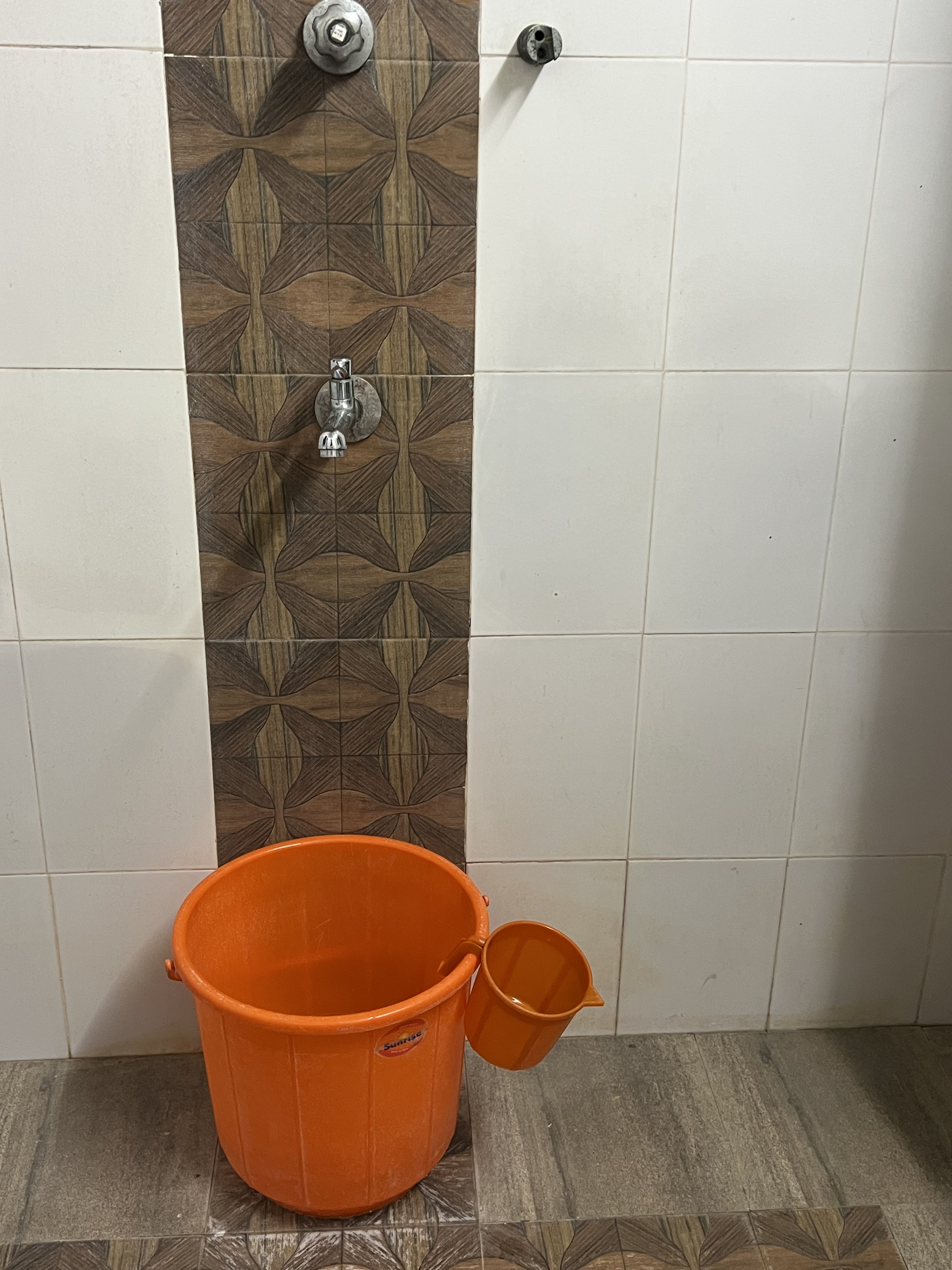
His showers had no hot water. Granted it’s quite hot in Thumboly Beach and the locals see no need for hot water but others do. As a result, he decided to arrange hot water and told us he had done so. In most Indian showers there’s a shower head and also a faucet beneath it about a foot annd an half off the floor with a bucket and plastic cup below it. Turns out he set up water in the lower faucet and not in the shower head.

When we laughed about it with him he said something quite true and profound. He said that one of the differences between Israelis and Indians is that Israelis look at something and immediately start figuring out ways to improve upon it while Indians look at the same thing, accept it as is, and immediately figure out a way to live with it. There are pluses and minuses in both approaches.

And what about respect for personal space, acceptable noise levels in public places or in hotels late at night, what it means to be a couple, the relative merit of avoidance or honesty in confronting legitimate disagreement or misunderstanding; the cultural differences go in and on.

Even when we think we get it we have to keep asking ourselves if we really get it.

There’s no escaping the fact that part of the joy in being in India is the adventure of the Western shrug of shoulders or the Indian wag of the head. The humor in “I don’t know.” The puzzled expression followed by a smile.

You aren’t in Kansas anymore, Dorothy. And ain’t that grand?

South India Revisited 2025

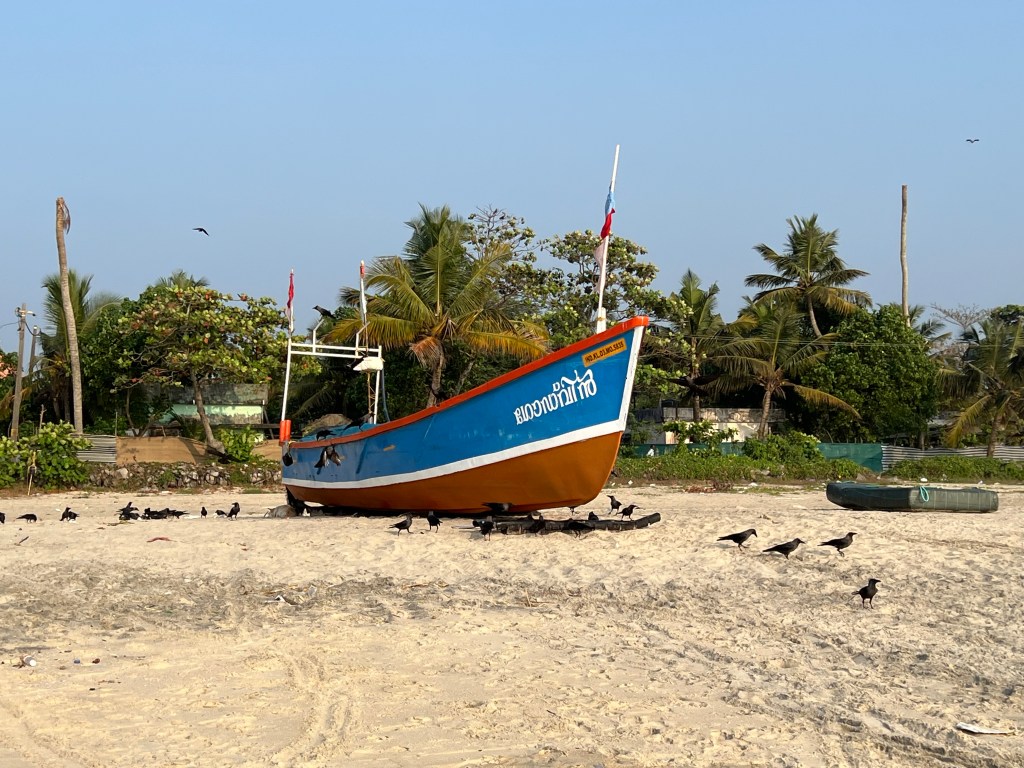
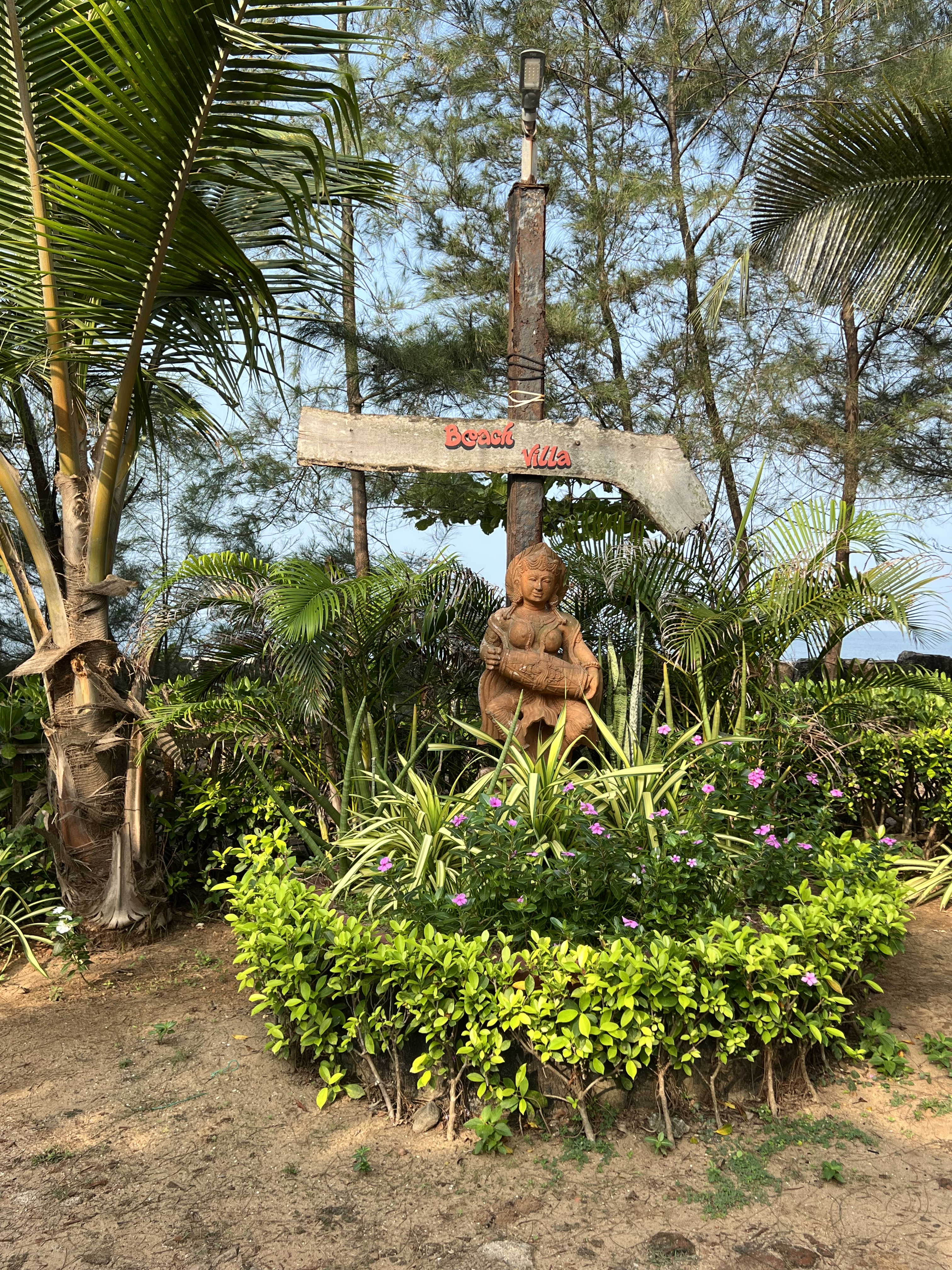
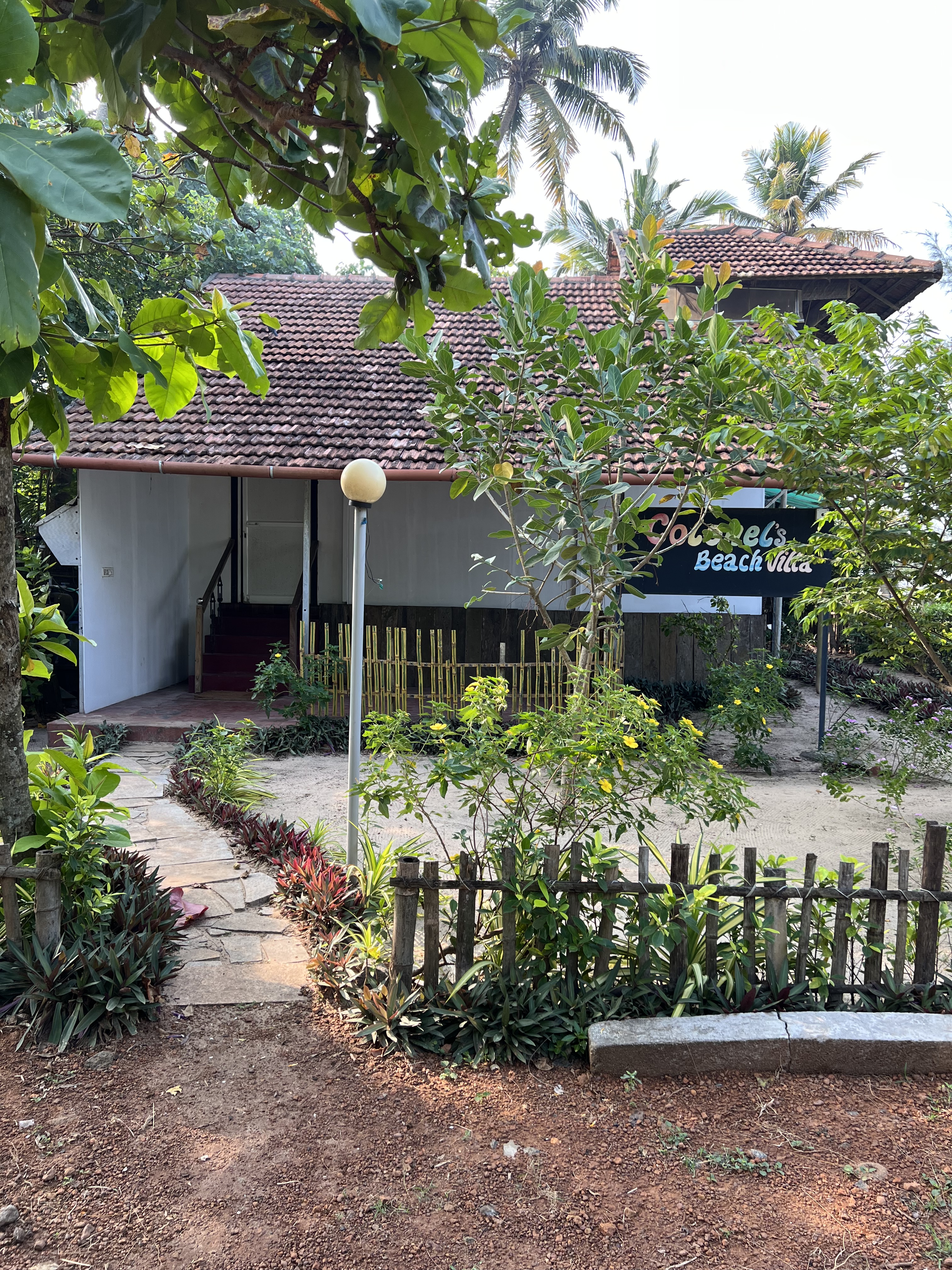
Our third week in the small fishing village of Thumboly Beach, half an hour by tuk tuk to Alapphuzha (aka Alleppey) about an hour from Kochi (aka Cochin). Our third time here at Colonel’s Beach Villa. It gets better every time and harder to leave.

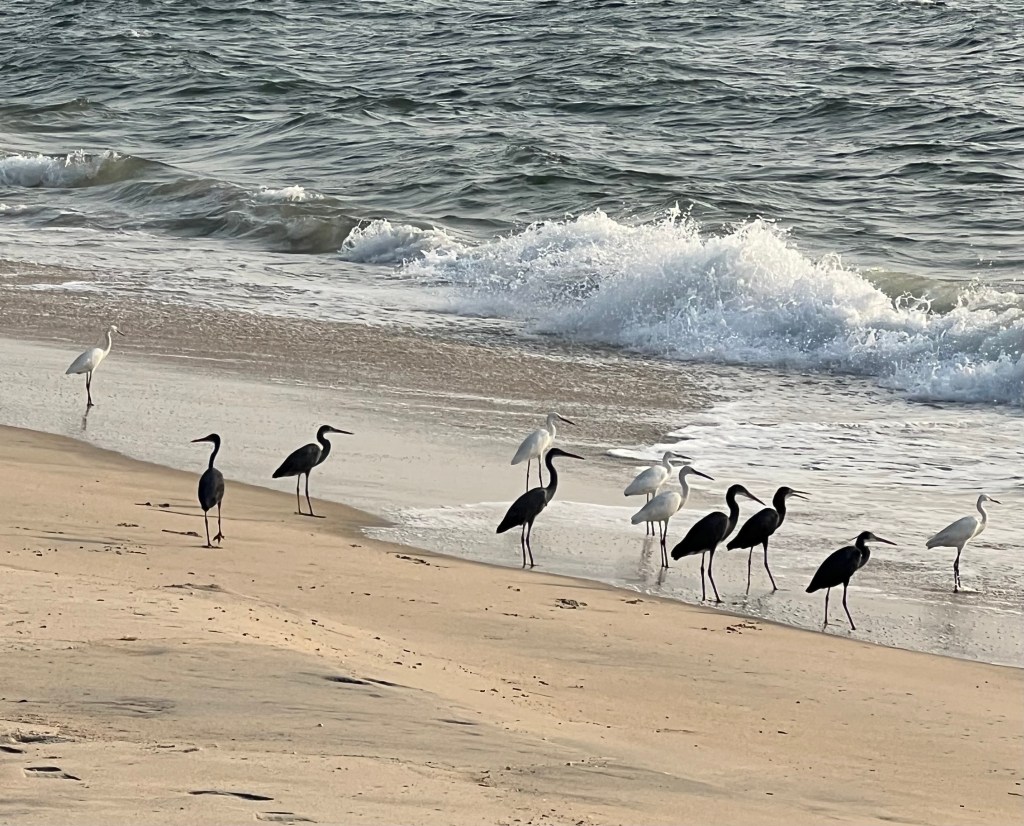
Our room has an upstairs balcony that looks out onto The Arabian Sea. The sound of the waves provides constant companionship – gentle in the morning and more forceful from afternoon on into the night.

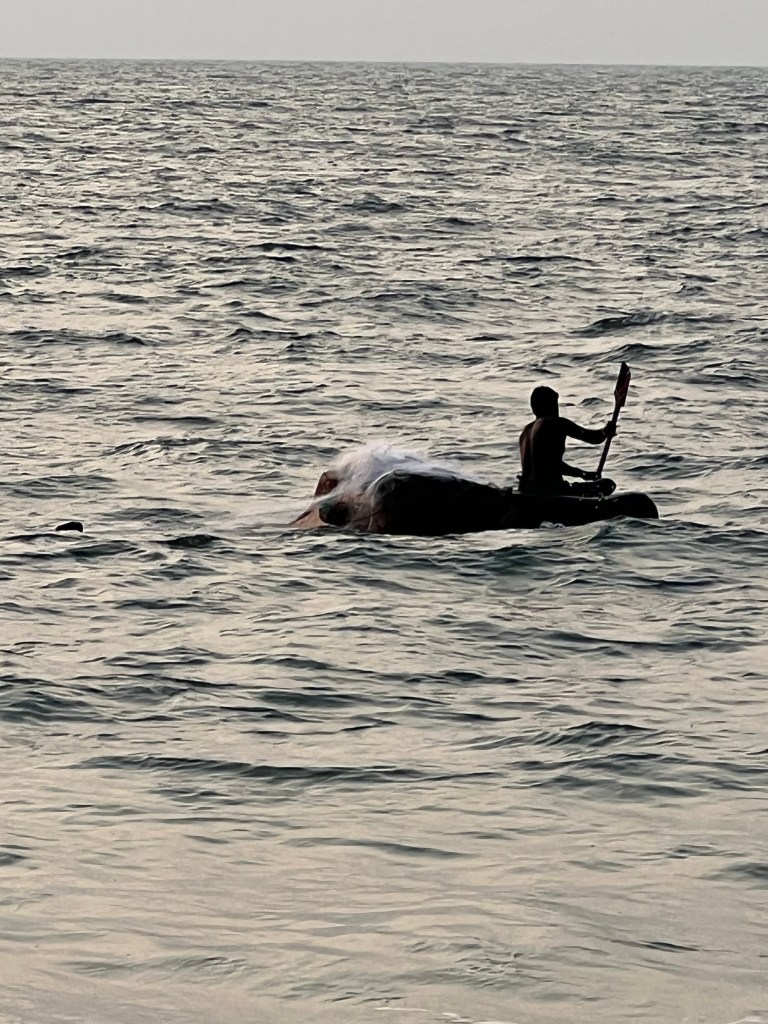
My partner goes out around 6 every morning to watch the fisherman carefully removing their catch from their nets. It’s a careful process. Some days there might be over 50 kilo of sardines and some days maybe a paltry kilo or two. Dogs and crows wait patiently nearby waiting for the rejects to be thrown their way.

Later in the day, after a delicious, simple vegetarian breakfast, and after reading and chatting on the balcony until the day cools off, we go for a walk around the village or take a tuk tuk to Alapphuzha.

People in the village have become familiar with us. They smile warmly and speak with us in the limited English they know. When I hurt my arm and had a bandage on it they seemed to all know about it and expressed concern. We stop in to say hello to Tomas at his market and Elsbet at her small store. The people at the corner fruit store let us know if they have pineapple because they know how much we like it.

Villagers are quite laid back. Many women walk together in pairs or more in the cooling day holding umbrellas to protect them from the sun. They wear light long dresses with slits up the side and leggings underneath. Most women do not work outside their homes and the daily socializing is a pleasant part of their day.


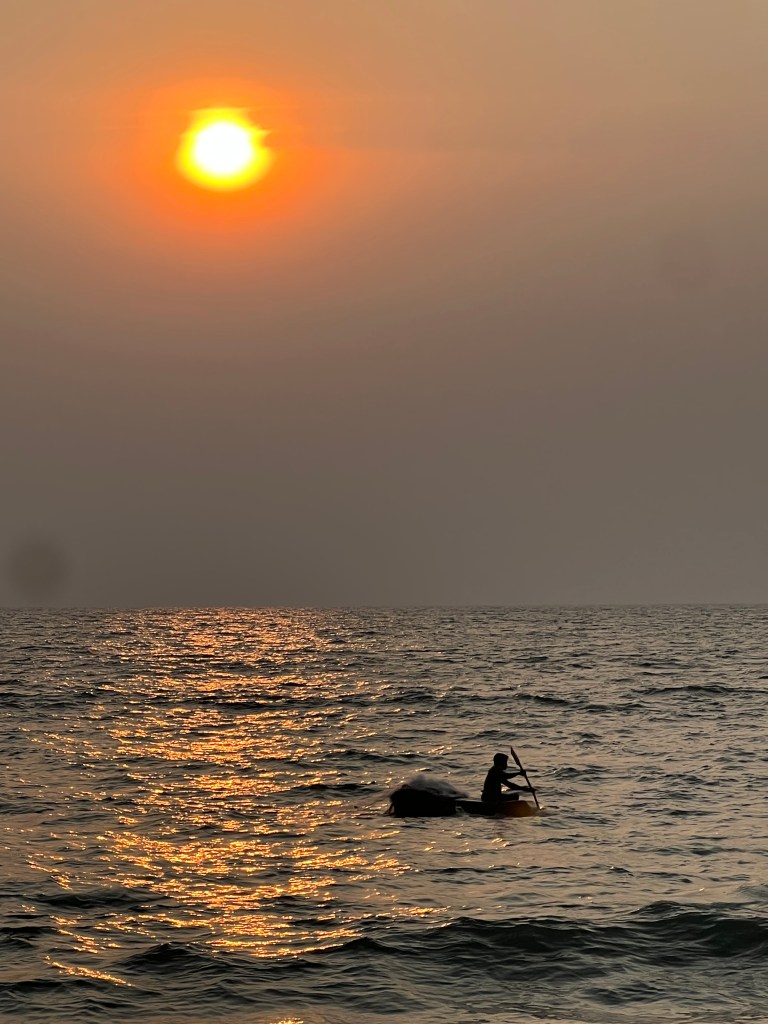
Many men can be seen sitting together on plastic chairs or on the sand under trees on the beach playing Rummy. They go out at 4 am in their small boats, fish until 6, gather their catch from the nets until 7, and then take their share of the day’s catch to sell on the nearby highway.

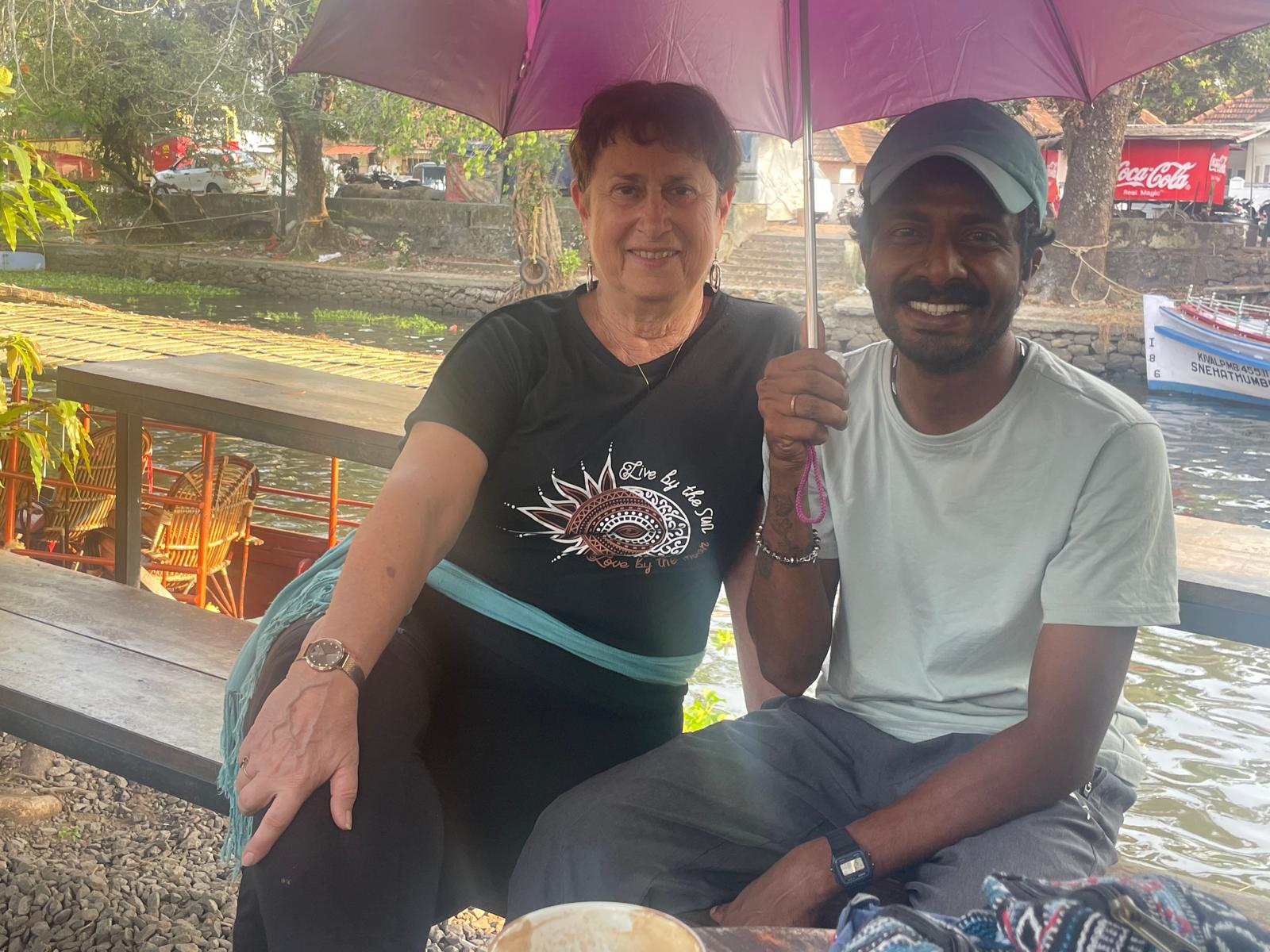
The guesthouse calls their tuk tuk to take us to Alapphuzha when we go there. He charges less than the tuk tuks we might flag down in the village. He drops us off in the commercial area where we like to absorb the colorful atmosphere and sometimes pick up a few things. There are aromatic spices, fresh garlands, fresh fruit and vegetable stands, kitchen shops, clothing shops including places to choose material, get measured, and have clothes made and ready in 24 hours. There’s an excellent bookstore and our favorite coffee shop by the river. We always stop in to say hello to Raul there, have a good cup of coffee and some fresh cold cut up watermelon.

The two young men from northeastern India – a 3 or 4 day train ride away – who do just about everything around the guesthouse are very quiet but have warmed up to us. They make us special little treats when they can. They know how we like our tea and coffee and when. They’re happy to see us in the morning and when we come back from our wanderings. Our customs, especially our Shabbat observance, are unusual for them. But they accept and adjust to everything with interest.

The serenity of The Arabian Sea, the beautiful garden, and the peaceful nature of the people provide the perfect background for my yoga practice. A small patch of red cemented patio just outside my door, shaded by a outhanging is just the right size and atmosphere. Teaching for 15 years, I often feel a staleness creep into my practice. Time spent in Southern India always inspires me to change it up, deepen it, renew the spirituality of it.

No hot water comes out of the shower head. At first we were taken aback. What?! No hot water for our shower? There’s a bucket and a big plastic cup inside. Hot water comes out of a spigot into the bucket. Cold water from the shower head to soap up and hot water from the cup in the bucket to wash off the soap. What!?! But we’re ENTITLED! Get with the program. This is India. You’d be surprised how quickly the system makes perfect sense in this climate.

Adapt. Adjust. Accept. And be pleasantly surprised when a cabinet shows up after you mention it’d be nice.

The city can be a cacophony of people and vehicles but absolutely serene and clean compared to Delhi.

It’s difficult to explain my love for Southern India and this area specifically. I wish my words t could make you smile and feel as happy as I feel when I’m here.

In a world so full of strife, confusion, fear, aggression and diviseness, Southern India is full of the opposite of all that. A local friend here thinks it’s because there have been no wars here for centuries. The culture looks askance at hostility and unkindness. Perhaps. Whatever the reason, I wish I could package this place and gift all of you with it.. .

To each her story; to each his unique voice

Marie Renee lives outside of Geneva in a small village and bicycles to work every day. Her husband is one of three people whose job it is to administer the village. Their two children are grown and live close by. She speaks with them daily and they meet for a chat frequently.

A charming story of a life well-lived.

Travelers tend to reveal the cracks in their narrative to other travelers sharing their breakfast table morning after morning or their view of the sea from the balcony.

As it turns out, Marie Renee’s husband began experiencing burn out last year. Discontented and unhappy, he disturbed the calm waters of their life. Marriage counseling for them and a psychologist for him and Marie Renee found herself with a husband trekking alone in South America and an empty house. Her inner voice guided her to a course of daily yoga and Ayurvedic massage in Southern India.

The morning she shared her last breakfast with us before leaving for home she talked about what her future looked like from here. She emanated a gentleness and calm as she expressed hope that her husband would come home happier and healthy. I think I could hear love in her tone. Her voice was confident when she said that she’d be alright and she’d be back.

Talk to yourself as you would to someone you love.

After our three year absence we came back to find Vijay still the go-to guy at our beach guesthouse. His wife and nine year old daughter stay with his in-laws near the northern border of India with Bhutan while he works in Southern India. He shops and cooks, arranges transportation, supervises repairs, and makes sure all guests have what they need. His English is rudimentary but his cheerful desire to communicate overcomes most people’s reluctance to attempt real conversation with those whose language they barely speak.

The train ride home at the end of the season takes three days and he travels sleeper class, the lowest class of travel, with wall-to-wall people, no air conditioning, inedible food, and increasingly disgusting bathrooms. He gathers his small family and they return to their own home for the six weeks he can stay with them before returning to work.

This is his life. The life he’s chosen. He’s loyal to his job and is grateful to be able to support his family.

If you concentrate on what you don’t have you’ll never have enough.

A month ago tall, willowy Lillian buried her almost-90 year old father in the Christian cemetery a five minute walk from our guesthouse. It wasn’t easy plowing through all the bureaucracy involved in burying a French citizen – a tourist – in India. She’s hoping that having her father buried in India will make it easier for her to remain in India for longer periods of time without the necessity of leaving for a day every 30 days. And, anyway, she has no family left in France to be uncomfortable with her father being buried so far from home.

Never married, an only child with no children of her own, she has no ties to France…or anywhere else. She had one aunt but she’s dead, as is her mother. She’s basically alone in the world.

She first came to Thumpoly Beach in 2019 and has been back four times. After her first time she began to organize small groups to come on yoga and Ayurveda retreats. She became friendly with the owner and his family and today they are more family than she has ever had.

When she returned to France after her first visit she tried many yoga studios but ultimately arranged daily yoga online with her teacher from Thumpoly Beach. She was unable to explain her dissatisfaction with the yoga in France other than to say “It wasn’t like yoga in India.”

She plans to return to France to take care of her father’s affairs and settle the technicalities of renting out her apartment to a neighbor. As quickly as possible she’ll return to this seaside guesthouse to begin as permanent a life here as the Indian government will allow.

Come home to you. It’s where you belong.


From Here to the Sun and Back Sixty Times

Human knowledge grows at a phenomenal rate. Think of the world as understood in Medieval days and as we understand it today. No need to go so far back. Think of the average Western household in Ozzie and Harriet’s time and your own household.

My partner, who could be called antagonistic toward maneuvering through life via screens, came home one day not too long ago decrying how much even he relies on screen technology in the course of his day. He checked the best route into the city with Waze to avoid as much traffic as possible. He parked his car using the Pango app. He received and acknowledged orders from clients via WhatsApp. While waiting for an appointment he got caught up with local, national, and international news online. He called me from his cell phone to mine to kill time in traffic on the way home.

And traveling? How did we manage when we started traveling to out of the way places 30 years ago? No booking.com, Airbnb, TripAdvisor; no Facebook groups of like-minded people offering tips or asking for information. No Uber or Ola to find and get us to hole-in-wall locations at a reasonable price. No google to locate pure veg restaurants.

Okay, all that technology is amazing. It makes our lives so much easier and so many things more accessible. And it also, of course, has huge downsides and creates many distressing societal issues. But this isn’t about that.

Human knowledge doesn’t begin and end with technological advances like those.

The medical world has now advanced to allow for many previously terminal cancers to become chronic cancer; cancer with which, with continuous treatment, people can live a quality life for decades. Prosthetics moveable by thought. I could go on but I don’t really know even a minuscule percentage of all the incredible innovations in the world of medicine.

And what about all the new information coming from the James Webb Space Telescope? It can see what the universe looked like around a quarter of a billion years (possibly back to 100 million years) when the first stars and galaxies started to form. Astrophysicists are scratching their heads wondering how their science could’ve gotten so much so wrong now that the telescope is providing new information.

The study of the cell – that most basic of components in the biological world – has changed so much over the past few decades that today we know that if the DNA from the cells found in one human body were stretched out in one continuous line it would reach the sun and back sixty times, Sixty. Six-oh. We didn’t even know DNA existed before the 1860s. It wasn’t known to be the carrier of genetic material until 1944 and became a reliable profiling mechanism only 40 short years ago.

Amazing, exciting, miraculous advances in human knowledge.

And yet…

Yesterday I tuned into day three of The Dalai Lama Global Vision Summit. I happened to choose Dr. Joe Loizzo’s talk about ethical leadership. I got as far as his call for every person on the entire planet to commit to becoming an ethical leader. Certainly I agree that each of us can and should develop leadership skills in our lives but, seriously!?! If the prerequisite to improving the unfortunate state of a world in conflict is for every single person on earth to become an ethical leader, it just ain’t gonna happen, bubba.

I mean look at us.

In the United States you have the cancel culture, a city proposing that each household pay $600,000 to help pay reparations to people who were never enslaved by a state which never had slavery, part of another state wanting to secede from that state to join a neighboring state, and people afraid to express their opinion for fear of being fired from their jobs. And in one 45 hour period, in one state, there were three mass shootings resulting in nineteen dead.

In England there have been three heads of state in three years. In Spain the birthrate has plummeted to 1.23%. In France the divorce rate is over 50%. The crime rate continues to rise in the Baltic countries. In France a man was found not guilty of a brutal murder of an elderly Jewish woman by reason of marijuana smoking.

In India, Muslims in the state of Kashmir continue to fight for independence. A recent reactivated Sikh movement has begun demanding their independence in the state of Punjab. The Muslim minority in the southern state of Kerala is quietly taking over local political positions.

In Israel political, social, and judicial reform has provided an opportunity for those interested in strengthening social and religious divisions. Extreme and violent language has become acceptable on both sides of any given issue. Defamation of character, personal attacks, and demagoguery are representative while, unsurprisingly, compromise is less and less of an acceptable option.

Humanity seems to be like the proverbial snake swallowing its own tail

We can create, investigate, research, change, and vastly improve our physical reality. But what good is it ultimately if we tear ourselves apart as human beings inhabiting a common earth?

Contrary to what many of us have come to believe when our phones have achieved the capability of supplying so much of our needs, no (emotionally healthy) human being is an island. We do, in fact, inhabit a common earth. And one of animals’ basic instincts is, pardon the expression, not to shit in their own home.

People! We’re unloading a lot of crap in our own homes. And it will not end well for us.

How about trying this? The next time you’re faced with a person whose opinions are not your own, take a breath, think to yourself that she, too, just like you, is a human being who wants to be happy. First and foremost, a human being. Immediately afterwards, who wants to be happy. Choose to distance yourself from her if you must, but treat her with the respect and, if it’s not stretching it too much, caring, that could provide for a gentler, less threatening world.

As far as human knowledge has taken our understanding so far, we only have one world. And if there turns out to be others we would do well to practice protecting the one we know about or we’ll just destroy any others we discover.

Differing Realities

I’ve been teaching meditation in one form or another for the past 20 years. During that time I’ve listened to hundreds, maybe thousands, of hours of dharma talks given by insightful teachers. I’ve been a member of meditation groups – presently a wonderful group of people from the west coast of the USA on Zoom every other week – pretty much consistently for decades. I’ve read dozens of books about mindfulness, awareness, no self, here and now, letting go, equanimity, and lots and lots of other catchwords and phrases. You know the ones.

All this is to say that from many different sources, I’ve received the magnificent gifts of self-knowledge and the possibility of inner serenity during tough and not-tough times. I’m hugely grateful to all my many teachers, those who call themselves teachers and those who don’t, who give of themselves so generously and to God for giving me the time and resources to take advantage of it all. As my husband and I often say when thinking of our bountiful lives – We couldn’ve been born under a bridge in Mumbai.

But it’s only recently that the light went on over my head concerning not only the reality of being born under a bridge in Mumbai – having few material resources and few possibilities of their attainment – but living in a reality that doesn’t allow for integrating those catchwords into one’s life.

It came about one evening after teaching a Raja yoga class (which includes a segment of meditation). I stood talking to one of my students, a particularly beautiful young woman who looks startingly like a well-known gorgeous movie star. She’d obviously lost some weight from her already-very-thin frame and had black circles under her eyes. Her entire affect was one of misery. As it turns out she was caught up in the turmoil of what she saw as a terrible injustice on the part of the employer at the job she’d just left. She felt that, while she’d left the company, others were still suffering the injustice and she was struggling with the idea of suing the company. It took me a few questions to realize that, in fact, it had nothing to do with her directly anymore. I kept thinking surely I must be missing something.

She said that she hadn’t been sleeping and had lost her appetite; that she couldn’t stop thinking about the bad behavior of her former employer. I suggested that she might focus on her supportive husband, healthy scrumptious kids, and her new (more appropriate) employment. We spoke about the possibility of letting the drama and injustice go. She said she’d think about it, but I could tell she wasn’t happy with the direction our conversation had taken.

Since she only comes to my classes sporadically, I noticed that I hadn’t seen her in a while but didn’t think much of it. I wished her well in my heart and hoped that she was able to make peace with not championing those who had remained with her former employer.

About a month later she got in touch with me. She’d been on a 10-day silent retreat. Her first.

She said that when we’d had the conversation about her former employer she’d been very angry with me. She thought my idea of letting the injustice in her former workplace go was surrendering to unethical behavior and part of the larger problems in the world. (in the world!! no less). It was only very far along into the retreat that she felt what she called a clarification which was like the lifting of a heavy fog. She realized that the entire issue of the injustice wasn’t her issue at all; that her inability to see what was clear to me lay in her having always been responsible for her siblings and even her parents in her dysfunctional home. She needed to take care of everyone around her to feel okay about herself. Once she recognized that she was able to let it go. She felt a huge physical relief as if a suit of armor had been lifted from her body.

Of course, I was happy for her and hopeful that she would continue to safely investigate her feelings. I know there’s a lot of inner disquiet and deep fragility there. But I was also chagrined at my cavalier projecting onto others with catchwords and phrases I never stopped to consider might be out of the realm of possibility for some of them.

I know better than that on so many levels, and, apparently, know less than that on others.

I began to look more carefully at other concepts I act as though are healthy, positive, and accessible to all, with a more discerning eye. Is this one really accessible to all? And that one?

It’s all fine and well to talk about relinquishing our narratives and not letting them be in control of our present lives, for instance, but is that accessible to everyone in the present moment of their lives?

Easy to talk about being grateful and satisfied with what is, but how does that resonate with someone who never experienced the unconditional parental love that encourages an ability to feel that one has enough, that one is enough?

And what about letting go, being joyful at the happiness of others, and oh so many others?

I’m embarrassed to say that I seemed to operate on the belief that saying it’s possible, telling stories and legends about people who have integrated such things into their lives, could shine a light bright enough to make it come true for my students. But while I like to think that it could and did for many of them, I will be making amends/changes to accommodate those for whom it’s not part of their reality…yet.

My reality is an ever-changing thing. Nothing in this life is permanent. So why in the world should my ever-changing reality be anyone else’s reality. For the most part, even in our uniqueness, we share quite a bit of similarity to those in our general milieu, but not enough to assume….well, anything.

You know what they say about people who assume…

Here and Now in the Land of Polymyalgia Rheumatica

Here are some things we all know:

Nothing lasts forever.

Attitude makes all the difference.

Sleep makes moving in the world possible.

Family, friends, and neighbors – love – make us stronger.

And, yet, sometimes when bad shit happens, we just want to curl up under a comfy duvet with a good book, ignore the phone, ignore all the things we know will make us feel better, and WALLOW. Does it make anything better? Nope. Does it at all change the bad shit? Unh unh. Not a bit. Do we know it’s counter-productive even at the very minute we’re doing it? Yep. But there it is. We’ve all been there.

So I’ve had an image of myself for a very long time. Maybe since I was seven years old. Dysfunctional family. I’m the youngest. Given/took on lots of responsibility from the age of seven. I’m not complaining. It was quite empowering. It was a process that has served me well all my life. And as I aged that image stuck with me. Healthier and more flexible than my cohorts. Quicker, more energetic, more adventurous. Sure, my body was creaky and achy in the morning, but it didn’t prevent me from doing all the stuff I wanted to do.

And then…Polymyalgia Rheumatica. Otherwise known as WAKE UP CALL.

One day teaching six yoga classes a week and driving all over tarnation to visit grandkids. The next day taking 20 minutes to get dressed using strategies that would make a contortionist proud. Legs didn’t lift on their own. Shoulders didn’t rotate on their own; or otherwise.And the pain? We won’t even go there.

Two weeks of that. Googling MS, ALS, and every other dire possibility. To be honest, I didn’t really wallow all that much. Scared myself silly but not a lot of wallowing. A few minutes every morning when I contemplated maneuvering myself out of bed. Sometimes in the middle of the night when the pain of turning over in bed woke me up.

But, here’s the thing. Not just writing a post to rehash the last one.

All those things above that we all know? They’re all true! And they add up to another thing we all know about – resilience. The capacity to recover from difficulties; the ability to spring back; elasticity.

After two weeks, I received a diagnosis and could take MS and ALS off the table (whew!). Uncertainty is such a basic and inevitable part of life, but sometimes it’s more challenging than others. Weird as it sounds, I made my peace with dire diagnoses and death during those two weeks. Glad I can pack them away for now but also glad to have done the work.

All my life I’ve been super careful about medications and medical interventions in general. Recreational drugs are one thing. Drugs that ruin your liver, lead to dialysis, or send you out into the streets looking for opioids are another. Aches and pains? One ibuprofen, maybe a couple of times a week. Torn meniscus? No surgery for me; I’ll treat it with yoga, thank you very much.

So here’s reality staring me in the face in the form of steroids. Steroids! Yikes – the boogeyman of medications. They eat away at your bones. Lead to mood swings. Water retention. Moon face. Can cause skyrocketing sugar levels.

On one side, all those side effects and a lifetime of avoiding medical intervention. On the other side decreased pain and increased mobility.

Not even close.

It won’t last forever. I’m relishing in every minute of walking, slowly, carefully, avoiding stairs, in the glorious autumn weather. Sure, the steroids make sleep elusive but on the 3rd night when I’m so exhausted that I actually sleep for 4 or 5 hours straight, wow!, living takes on a new meaning. I hired a cheerful, energetic cook, to free up my good hours for other things and happily peruse the refrigerator feeling like I live in a restaurant.

I can laugh at the list of 11 medical appointments coming up over the next 5 weeks. Hell, I can laugh at anything.

In Buddhist philosophy, there are lots and lots of lists. One of them is a list of five obstacles. The fifth is considered the most difficult. The fifth is doubt.

I spent a bunch of time during that first two weeks, and occasionally during the past week as well, standing, huffing and puffing, in front of that fifth obstacle. Taking deep breaths. Gauging its height. I gathered 20 years of dharma talks and yoga poses and psychology books, the love and support of family, friends, students, and neighbors, the lessons of my own strength and possibilities learned early in my dysfunctional home, the belief in the meaning of life and God’s plan, took a running leap and now find myself on the other side of doubt.

It’s a tricky disease, this Polymyalgia Rheumatic. Some people are on steroids for a year and wean off them and are fine – maybe an occasional flareup. Some people are on a low dose of steroids for years, or until they die (of something else).

I have good days and not-so-great days. I take advantage of all those things we know. I thank goddess for resilience. And I invite doubt for a nice Indian tea from time to time.

Addled, Afflicted, and Astray

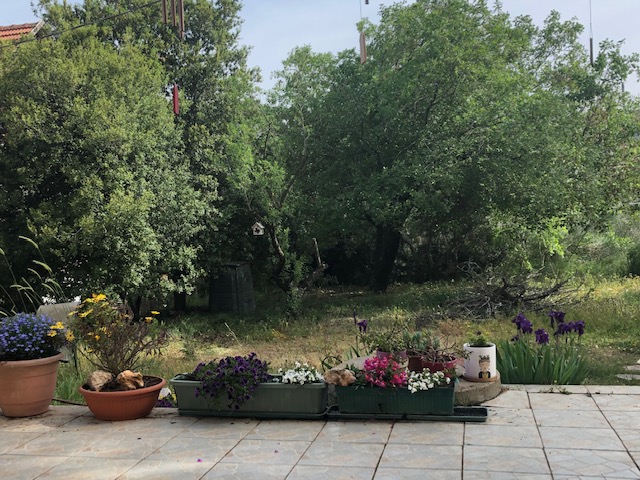
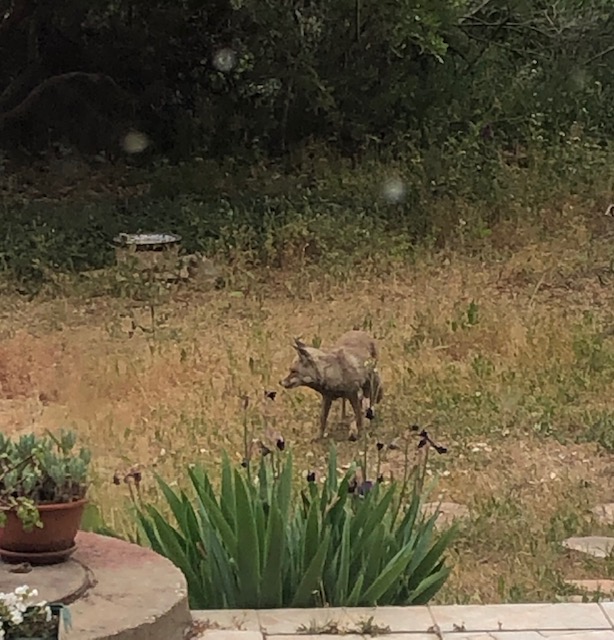
I live in a pastoral, peaceful community of 1000 families. Forty years ago, I’m told, there were no birds because there were no trees. Today my partner and I sit outside on our back porch, eat our breakfast of fresh fruit and freshly brewed coffee and tea, and watch dozens of birds eat theirs – the pieces of bread I scatter for them in our backyard every morning – before they drink from their bird bath or take leisurely baths. Sometimes a fox makes a brief visit, too. Idyllic.

The Corona pandemic is over in Israel. Stores and schools have been open for a while now. We haven’t been required to wear masks outside for weeks. In another week we won’t be required to wear them inside, either. During the various times when it was advised that people over 60 remain at home, teenagers in our community brought us the food we ordered from the community grocery store, and were happy to be able to help.

Recently Hamas, with differing excuses, renewed their shelling of our cities. Thousands of rockets were shot off indiscriminately toward residential areas, sending children and their parents rushing for bomb shelters. In some places, they had 15 seconds to get there before the rockets fell. Luckily, or by the hand of God as some people believe, we’ve developed a device to prevent 90% of the rockets from falling to the earth.

Here in our community, we have been an oasis of serenity, even as rockets fell and Arabs burned Jewish cars and synagogues in Lod, Acre, and Yafo. Communities where Jews and Arabs have been trying for over a decade to share neighborhoods in experiments of true co-existence, the veil of illusion was brutally torn away.

As anyone who watches television series or isn’t totally cut off from the news knows, the US is consuming itself like a snake devouring itself from its tail. Black protests, complete with vandalism, theft, and, in some cases, violence; Asians coming out of the closet concerning the decades-old prejudice against them, triggered by the murder of Asian spa workers. Whites feeling marginalized; any action on their part is wrong. Anti-semitism on the rise. Jews feeling it’s unsafe to walk on the streets of America wearing a kippah (Jewish head covering), and being assaulted in places as far-flung as New Mexico.

Books are being censored. History is being rewritten, People are being canceled.

“Politically correct” reigns and woe be unto the person who uses the wrong pronoun.

George Floyd, killed by police officers while resisting arrest, was found to have fentanyl in is system to the point of intoxication. His autopsy also revealed recent methamphetamine use at the time he was arrested for allegedly trying to pass a counterfeit $20 bill. He had advanced heart disease including an enlarged heart, one artery 90% blocked and two others 75% narrowed. Excessive force was used in restraining him, which, along with the other factors, resulted in his death.

George Floyd was made a martyr for the cause of Black Lives Matter. Of course they matter. No more or less than the lives of all other people. George Floyd may represent the hundreds of Blacks stopped unnecessarily by police officers, treated with suspicion and hostility, who are fearful for their lives during such stops. But does anyone really want to raise their children to think of a repeat criminal, convicted of eight crimes between 1997 and 2005 as a hero? A man who served four years in prison for aggravated robbery during a home invasion?

In what universe is every Black person in prison a victim while Jews running for shelter from falling rockets are aggressors? In what universe is a pandemic a worldwide government conspiracy and the vaccine to prevent further spreading of the virus an extension of that conspiracy? In what universe are children who come home from school with a barely passing grade met with “Good Job!” by the parents? In what universe is the murderer of an elderly woman beaten and thrown out of her window acquitted because he was under the influence of marijuana at the time? In what universe are people arrested for violent crimes released on their own cognizance immediately because it would be discrimination against the poor to require them to post bond? In what universe are crimes against Blacks hate crimes while crimes against Jews are not?

It’s a universe which is addled, afflicted, and astray. Where reality is what the media reflects instead of what we actually experience; where a person’s word is no longer the truth as she knows it but as she wants you to believe it to be. Where anything goes if you can sell it, and you have no responsibility for the consequences. Where nothing is expected to last – not jobs, appliances or relationships. Instant food, instant gratification, instant success, or move on.

Lots of people are saying what a tough year it’s been. I’m reminded of the two arrows – the first one is the inevitable pain in life such as a pandemic. The second arrow is self-inflicted suffering like societies consuming themselves like a snake eating itself from its tail.

How bad will things get before we wake up to the absurdities? I hope I live to see it. I also hope the damage done in the meantime won’t be too horrendous.

Loss and The Two Arrows

There are a bunch of things that no one tells you about aging. Or maybe they tell you but it goes in one ear and out the other. Not relevant. Things that register in the way the laws of physics register – ya da ya da ya da.

As I turned 60 and even more after 65, I became aware of the physical aches and pains that go along with aging and, in my case, are the price for having jumped and danced around and, taking advice from The Eagles, taken my body to the limits for decades. I remember an orthopedist once telling me to keep teaching hip hop, hiking, and doing whatever I loved because ultimately even sedentary people have joint aches and pains…but they have a lot less fun getting there. I totally agree. Even on the mornings that my knees wake me up with a call for help.

It’s some of the other things about aging that I never gave much thought to (or any).

  • finding conversations of people under 40 uninteresting
  • having read every permutation of book and movie plots ad nauseam
  • being cold (or hot) when no one else is
  • losing friends to illness, lack of mobility, or death
  • aging differently from significant people in my life

YIKES!!

It turns out that an inevitable part of aging is loss and grieving for those losses. Big losses and small losses. And some losses are harder than others; not necessarily the “big” ones.

We all do it differently. And it all looks different on other people.

I remember having no regrets at 50. Ha!

I remember letting go of hip hop and aerobics in the blink of an eye. Didn’t seem like fun anymore. Traded my spandex for yoga pants happily.

I remember not even entertaining the notion of a sedentary life requiring programmed exercise. Counting steps? Furthest thing from my mind.

I remember a time when illness and death weren’t even a tiny part of my thoughts.

I’d read about (other, much older) people complaining that many of their friends had fallen by the wayside one way or the other. I’d heard them extolling the virtues of cultivating younger friends to combat loneliness. Scroll up – in one ear and out the other.

My partner “lost” his mother 10 days ago. My mother-in-law died. She wasn’t a nice person. Not a good mother. A narcissist. She was lively and charismatic and loved to be the center of attraction, but her children and friends paid a heavy price. She had dementia for the last five of her 93 years and didn’t recognize my partner or his sister who, in spite of a complicated and challenging relationship, made sure her last years were comfortable. If emotions were rational, no one would mourn her death. But if emotions were rational they wouldn’t be called emotions.

emotion – derived from the Latin term emovere;

to agitate or stir up. The affective aspect of consciousness

My parents are both long gone. My father died thirty years ago and my mother about twenty. Fortunately for me, I made my peace with both of them while they were alive. They weren’t partners in the process, but the possibility of relating to them with equanimity in life was a blessing.

My partner wasn’t so fortunate.

Watching his mourning process has been thought-provoking and, yes, emotional. A loss of innocence. A loss of possibility. A loss of the luxury of avoidance. A recognition of the loss of reconciliation. A loss of the comforting delusion of immortality.

My mother had bi-polar disorder. The shadow of her disease lurked everywhere. Sometimes it blotted out all joy and normalcy; sometimes it was a vague and disquieting sadness in our house. It was always a sense of waiting for the other shoe to fall. I was entrusted with her care from a very young age. I gained confidence and self-esteem that’s served me well throughout my life. I also harbored resentment and fear of chaos in the world.

I used to imagine myself a very small figure, wrapping my arms around my knees, head bowed, before a huge Mr. Clean-type genie, rising out of a magic Aladdin’s lamp, arms folded, scowling down on me. I didn’t understand the image or why it recurred so consistently and persistently throughout my life.

Imagine him with a turban, beard, and ferocious expression

The image vanished, never to return again, once I worked through my relationship with my mother. It was a loss I recognized with gratitude. I forgave my mother, without her permission, and realized one day that I felt a loving, empathetic sadness for her; a brilliant woman whose life was taken from her by a crippling disease no one understood at the time. A tragic loss. No second chances.

Not so with my mother-in-law.

The frightening image my partner has of her is his to tell, not mine, but he has one no less frightening than mine.

It’s difficult to accept that a person can be unkind, cruel, and totally lacking in compassion. How much more so when it’s your parent; the person entrusted with your care, emotional and physical? It’s tempting – no, imperative – to search for an underlying reason to shed a more sympathetic light on such a parent.

He searched. We searched. The round of reasons we tried to fit into the square peg bulged and defied imagination.

Ultimately, the physical loss of his mother grew into the loss of innocence. The first kind of loss is met with a simple grief. She was, after all, turning 93 two weeks later and hadn’t been herself for years. The second kind of loss is far deeper and creates a grief that is painful at any age, but magnified at 70, after so many years of pretending, ignoring, excusing, and hoping.

Two of our sons were at their grandmother’s funeral to support my partner and express their respect for family ties. When I talked to our older son before he left to meet us at the airport, he asked how his father was doing. I explained that he had many unresolved issues with his mother and now they’d never be resolved. I added how important it is to confront unfinished business with a parent in life. Hint, hint. (He moved on.)

There’s a lot of loss involved in aging. Loss of a parent. Loss of freedom from pain. Loss of mobility. Loss of long term friends. Loss of mental acuity. Loss of hearing. (Shall I go on?)

A Buddhist parable addresses the problem of suffering. It describes the two arrows in every difficult situation in life. The first is the arrow of pain, in this case loss, and the second is the arrow of suffering. The first is inevitable but the second is optional. It’s the arrow we shoot into our own hearts with our reaction to the inevitable losses that come with aging.

So many circumstances are beyond our control. My mother’s disease; my mother-in-law’s nature.

We can only prepare ourselves by nurturing our souls. By taking a deep dive into ourselves and becoming familiar with the particles of a higher power which exist inside each of us. By honing our ear to hear the pure voice of equanimity which resides there.

Many years ago I weighed the option of starting a hospice center. I had a conversation with the man who created a small hospice center in Jerusalem. At the time he was in his early 80’s. He exuded empathy and kindness. We spoke after I took a tour of the center with a staff member. I was surprised to see that each of the rooms had two residents. I asked the founder of the center if it was disturbing for the residents to witness the death of their roommate. His answer equally surprised me. He said that with the work done with the residents, every death since the center’s inception had been peaceful, and inspired serenity in those who witnessed it.

Choosing equanimity isn’t a one shot deal, and it’s not easy. It takes diligence and practice and work. Committing ourselves to the effort doesn’t ensure total success, or success every time. But to quote a poet by whom many of our lives have been enriched, Mary Oliver,

“Tell me, what is it you plan to do with your one wild and precious life?”

India to Israel: Corona Again

For those of you who read my last post – yes, we made it home – by hook or by crook and by the hair on our chiny chin chins.

For those of you who remember the days when people used to kiss the tarmac when they arrived in Israel – for security reasons it’s no longer possible, but the feeling was certainly there for us on March 19, in these times of Corona.

We spent 27 hours getting home from India on Ethiopian Airlines and didn’t even grumble about it. Seventeen hours in Addis Ababa? No complaints. A long line in the airport (several times) to have our temperature taken? That’s fine, thank you. Rowdy passengers (my partner calls them ‘enthusiastic’) unrestrained by the crew? Peachy.

The main thing was to get out of India and back home.

Things changed literally from every morning to every evening and then again the next morning. Prime Minister Mod’i, like many of the world’s leaders, proclaimed increasing restrictions from announcement to announcement, the difference being that he is responsible for 1.5 billion people – 17% of the population of the world! A critical mistake on his part could very well mean millions of Corona deaths; maybe tens of millions.

Within days all pending visas were canceled, and India closed its borders to foreigners. Within twelve days the skies were closed – no flights in or out.


One by one, the 29 states in India began closing their borders to foreigners. After that, one by one, they began requiring all foreigners present within each state to leave.

Cab drivers began to refuse foreigners. Guest houses did as well. The railway system shut down. Over a period of 10 days, intercity buses were canceled. Foreigners asked to leave their lodgings had limited options for travel elsewhere. Some began sleeping in the streets.

Within ten days Mod’i enforced a one day lockdown from 7 a.m. to 9 p.m. Four days later he proclaimed a nationwide lockdown…period. Anyone who’s experience the open market in Delhi or the crowded streets in Mumbai can imagine how eerie a sight that was.

By March 25th all domestic flights were canceled.

The Israeli embassy started organizing private buses to transport stranded Israeli citizens to Delhi and Mumbai to be close to an international airport for extraction.

In Israel, the restrictions of movement are barely enforced. In India, the police canvassed the streets beating non-complaint people with sticks.

We reserved flights with 5 airlines. They began canceling the day before take-off until we were left with Aeroflot and Ethiopian Air. We chose Ethiopian because Europe seemed unreliable with Russia announcing the closing of its borders for the day of our flight. After trying to get confirmation that our flight would still fly, calling Aeroflot offices in Israel, India, and Russia – including a conference call with a friend in Israel, me in India, my friend’s sister-in-law in Russia, and an Aeroflot agent in Moscow – the confirmation was still shaky.

We arrived in Israel at 3 a.m. Two friends had left one of our cars in the airport parking lot (one drove his own car to return both of them back home). No one spoke to us at the airport. No one asked us any questions or took our temperature. No one asked how we planned on getting home even though we were officially in quarantine once we touched down on Israeli land.

Go figure.

Our friends in Israel stocked our fridge and freezer. They decorated our home with welcome home posters. We even had daily visits with several of them on our back porch – six meters from us and on their own chairs. Friends are the best! We found out later than one of them called one of our children to enlist her aid in convincing us to leave India.

My Corona symptoms disappeared once I’d spent a few hours in my own home.

Friends we made in India were in touch with us – some more than once. They were all in lockdown but doing fine. Of course, none of our Indian friends are homeless or live in slums with collective toilets and corrugated roofs. They expressed happiness that we made it home, and, interestingly, appreciation for our sensitivity to India’s needs by leaving them to cope with Corona on their own.

We can’t go out for another eight days, not even to a pharmacy or grocery store, or to get exercise within 100 meters of our house, like others can do. But we’re fortunate in so many ways – first and foremost that we are healthy, and our children and grandchildren are healthy – and then:

  • We spent five months together in India and became even closer so that being together in our home with very limited contact with the outside world is not at all a hardship
  • We have a spacious house and even a yoga studio
  • We have a comfortable back porch with a large, lovely backyard
  • We live in a community where the youth are happy to help and have organized to do shopping and bring it to people’s homes
  • We have neighbors who pick up our garbage from the end of our front walk to throw it away.
  • We have enough income to survive these crazy times if we budget ourselves properly

Of course, we worry along with the rest of the world, listening to the horrific statistics of deaths and illness. Personally, I keep busy with yoga, meditation, reading and binging on tv series. All day I have a Pollyanna-ish feeling that all will be well soon, only to be brought down to earth when I listen to the evening news.

We check in with our children and grandchildren, with our friends and our siblings when the level of worry rises too high.

And we pray, along with other inhabitants of our beautiful earth, that we’ll emerge on the other side of this crisis more grateful for our lives and our many blessings, and with renewed commitment to ease the friction, poverty, and distress in the world.

If nothing else has taught us how interconnected we are, surely the map of COVID-19’s progress throughout the world is proof.