Then sweeps far round with power not shown before,
And on his crystal plain does all but soar.
Yet is his pastime brief; the solar heat
Grows strong; again the lapsing waters meet,
And to dull, plodding earth confine his daring feet.
I fell in love with the free skating clips shown endlessly in the weeks leading up to the Olympics in Milano Cortina. Specifically I was mesmerized by Ilia Malinin, Alysa Liu, and Maxim Naumov. I watched spellbound as they executed quad axels, back flips, and splits in the air all to beautiful music. I had fun watching Ilia’s creative performance inspired by Hope by the rapper NF two years ago.
And then…the Olympics.
Alysa Liu took the gold with a breathtaking performance after years off the ice to experience normal life focusing on school, socializing, and traveling to Nepal. (Good for her!)
Maxim Naumov, the emotional favorite, didn’t win a medal but he won the hearts of all who watched his tribute to his parents/coaches who were killed in a plane crash just one year ago. His winning a place on the Olympic team was an odds-defying accomplishment.
Ilia Malinin was the perfection everyone expected in his short program, performed to the music of a video game (Prince of Persia).
And then came the men’s single free skate event; the one so many of us were waiting for. To see the “Quad God” thrill and enchant us.
He chose to use his own voice and his own message for the music; something never done before. When interviewed prior to the big event he spoke about the importance of being 100% committed and focused when following a dream with a need to excel. His practice run through, while lackluster, was technically pristine.
When Ilia walked onto the ice for his big event, his demeanor seemed strong but once he took his first fall it all fell apart. His concentration was lost. He fell again. He popped three jumps (unexpectedly reducing the number of rotations while in the air – often caused by fear, nerves, or technical errors). It was clear he was in his head and not on the ice.
We’ve all been there.
We’ve all taken on a task, a job, an outing, a relationship, an educational goal and lost our focus. We’ve all fallen, “popped” our expectations, disappointed ourselves and others. Sometimes it’s a small, even inconsequential loss – a missed deadline at work, picking up falafel for the dinner there’s no longer time to prepare. Or it might be a bit larger – the forgotten birthday of a grandchild. It might have small consequences – hurt feelings, losing a client, having to take an exam over. Or it might have big consequences – a broken leg, divorce, going bankrupt, coming in 8th place instead of taking home the Gold at the Olympics.
Generally speaking, these kinds of losses are a result of being in our heads and losing focus of the task, job, outing, relationship, or goal of some other kind; just as Malinin explained his failure on the ice. “All the traumatic moments of my life really just started flooding my head.” He noted that “negative thoughts” flooded his mind, leading to a freeze response.
Sound familiar?
“I’m not good enough.”
“It won’t be good enough.”
“I fell last time I tried to hike this kind of trail. I won’t make it this time either.”
“I’m not really what he’s looking for. This relationship is doomed.”
Whether or not we could succeed at the task, job, outing, relationship, we’ve made it much less likely when we open the gates of our minds to these thoughts.
We fall. We pop. We disappear into a narrative that erases our potential…and our joy.
While the first Noble Truth states that “Life is suffering.” The third Noble Truth encourages us by telling us exactly how to calm or even eradicate that suffering. And again here we can learn a lesson from Ilia, emulate his reaction to his loss, and reduce our suffering in the face of inevitable loss in our lives.
He explained that he’d decided to treat the experience (of loss) as a “lesson in humility” and vowed to “regroup for the future.”
I know a man who is currently lost in the loss of his 90+ year old father. He’s lost focus. He’s taking on strange new habits including absences from his family for odd stated reasons.
I know a young woman who has created a huge loss in her life based on events that may or may not have happened 30 years ago. The reality of her life today is covered over by a thick fog – suffering – that she is unable or unwilling to relinquish.
I’m blessed to know many, many more people who are able to let go of narratives of loss which have dominated their minds in a way that’s created chaos and suffering.
May we all precipitate curves on curves anew
May we find the courage to return to our true center
Our youngest son, Rafael, moved with his family to New Jersey last night. We don’t know how long they’ll be there. We don’t know why they moved.
Neither of their excellent jobs requires the move. They have a beautiful house here that they renovated just 5 years ago to their exact specification. Their garden is flourishing, as are their kids. All four kids have many friends and are happy here. They have an active social life with friends and with their siblings/cousins. The other grandparents live a 15-minute walk away, are retired, and are always happy to have the kids over, pick them up, and take them places.
The given reason is that they get itchy when they’re in one place too long. They seek adventure (in New Jersey? 😂) They seek a challenge when things are too settled and smooth. Our son fears getting stodgy (he’s 42). At 40, having made partner at the most prestigious law firm here, he quit to do something else. He didn’t want to get stuck in a rut.
I sort of get it. I was that way myself. But once we had kids, I reframed my need for change into something more compatible with having first one and then, within 7 years, five kids. I changed professions six times; just about every 2 or 3 years. I wrote a few books. Once the kids were a bit older we traveled…a lot.
And, of course, the biggie – we moved from the US to Israel.
Rafael and his family moved to the US once already. They spent 5 years in Silicone Valley. He’s a hi-tech lawyer so that made sense. It provided him with the lift he needed to become one of the younger partners in his law firm. We missed him. The 10-hour time difference and 16-hour flight were brutal. But it made sense. And once was enough.
This move makes less sense to us.
Of course, we’re ten years older.
My in-laws were devastated when we moved our own young family to Israel. My mother-in-law literally keened and wailed when we parted at the airport. But, we felt, we were moving toward something. It was an ideological move. It was living our dedication to Zionism. We still feel that way.
What kind of ideology could possibly warrant a move to New Jersey – the state Americans love to mock? Clearly (to us) they are moving away from something and not toward something.
I get that, too. Living in Israel is not for the faint of heart.
Although it has one of the strongest, most stable economies in the world, wages are relatively low, real estate is ridiculously priced out of most young families’ reach, and many families struggle to get through the month. None of this applies to Rafael, who is blessed with financial stability.
Israel has been at war from the moment the state was established in 1948. Sometimes the war is more volatile and sometimes less, but it’s a constant threat. Our neighbors make no bones about hating us and have consistently made clear their goal of destroying our state and killing us all. The past two years, since the atrocities of October 7th, have been traumatic for every single family in Israel, and continue to be so.
Hard times, however, seem to strengthen Israelis’ resolve, not weaken it.
The divisiveness in Israeli society over politics and religion seems to be more of a factor in people leaving Israel than the war. The exaggerations and fears on each side lead to a lack of tolerance that feeds on itself.
For those of us who left comfortable lives in the US (or other Western countries) to live in Israel, we take a dim view of those who leave. It would be more accurate to say that many of us look upon it as betrayal of an ideal; betrayal of the country. In addition, given the current ugly anti-Semitism in the world, we believe that Jews should be aware today more than ever that Israel is the place for Jews to live.
We worry about our children and grandchildren’s safety. We worry about our grandchildren being taken out of a place where they are like most everybody else – it’s not an issue – and put in a place where they are ‘the other’.
We believe that our son and daughter-in-law have a tremendous amount of talent and skills to give to our country, and that our country needs people exactly like them.
And, perhaps most of all, I’ll miss being able to drive an hour whenever the spirit moves me and enjoy a good cup of coffee and great conversation with my youngest son. He’s the best! I’ll miss all the many special things about each and every one of those four delicious children. And, yes, sometimes, of course, I feel that strong twinge of sadness and loss in my heart.
Tisha B’Av is the day that our first two holy temples were destroyed. The date is commemorated with a 25-hour fast and special prayers. When tragedy strikes and someone is very sad we might say she has on her Tisha B’Av face.
That’s the face I see on many of our friends lately when considering our son’s departure with his beautiful family.
And, ironically enough, I want to console them.
“But nobody died! They’re only going to New Jersey!”
As hard as it is for us to imagine, they’re off on what they see as an adventure for their family. We made our choices. Some of them were great and some not so great, but they were ours to make. And if they turned out to be not so great, we readjusted and reframed and began a new adventure. Or at least I hope you all did, because we sure did. Why be stuck when life is so fleeting?
I, personally, believe they’ll be back in a couple of years. After all…New Jersey. And in the meantime, how fortunate that in this day and age there’s Facetime and WhatsApp and convenient flights.
They’re a happy, successful, healthy couple with four amazing, funny, quirky, interesting, healthy kids. We’ve had them near us for five blessed years and, G-d willing, we’ll have them near us again one of these days.
All told, we’ve been in India almost a year. We’ve spent over two months in Kerala, four months in Rishikesh, and a week to ten days in Hampi, Meysore, Delhi, Goa, Mumbai, Varanasi, Darjeeling, Khajuraho yogashram, Kaziranga, Puri, Shimla, Dharamshala, Dalhousie, Chennai, Pondicherry, Auroville, Bandhavgargh, Rambagh, Jim Corbett, and the Andaman Islands.
My partner has been learning Hindi off and on for 7 years. Between his Hindi and Google audio translate we’ve had many conversations with people about their lives and their opinions about many issues – geopolitical, philosophical, sociological, religious, and how they view the future.
We’ve observed familial interactions, public and less public behaviors, hygiene and eating habits, changing clothing preferences, and acceptable and less acceptable commercial activities.
We’ve experienced the kindness, patience, and acceptance of Indians in many different situations from driving to waiting in line to communication difficulties to cultural misunderstandings.
When asked how many children an Indian has they will invariably give a number that reflects only male children. Mothers as well as fathers respond in this way. Sexist? I don’t think so. It seems that in traditional Indian families (and in spite of rapid and visible change it’s estimated that over 90% of Indian marriages are still arranged marriages) sons remain in the nuclear family home after they marry. Their wives become subservient to the matriarch who travels with them on vacations and sets the tone for parenting. Daughters move on to their spouse’s family. They are only temporarily part of their parents’ lives. I’ve come to believe that is why they’re not included in the natural spontaneous reply about the number of children in the nuclear family.
Is this belief accurate? Maybe. Maybe not. One thing I’ve learned is there’s no point in asking for clarification. Such requests are met with puzzled expressions followed by acceptance of my theory regardless of its accuracy or inaccuracy.
Here’s a much more prosaic, but much more day to day question I’ve been asking in vague euphemistic terminology since our very first visit in 2016. Why don’t Indians, especially women, use toilet paper? It’s excellent for the ecology of every country and certainly one with a billion and a half people, and yet… What’s the deal? It’s all well and good that our tushes and other intimate places are actually cleaner after that spritz from the bidet but what is it about walking around wet that doesn’t annoy them? And is it even hygienic?
They’ve learned that foreigners need toilet paper. Hotels provide small rolls of it and are happy to replenish it as frequently as their patrons allow themselves to make the request (we tend to buy our own to avoid the issue altogether). But when asked why they don’t require it themselves I’ve been met with puzzled expressions and literally no answers, They don’t understand why I do require it but accept it and I don’t understand why they don’t require it but still ask from time to time.
The nearest things I’ve received to an answer have been (1) the concept of the comfort of dry being preferable over damp is a Western concept (really?!?) and (2) you can carry a small towel to dry off, keep it in a small plastic bag all day and wash it in the evening (a nice solutionbut I doubt Indian women actually do that).
That may be similar to something an Indian friend of ours said recently. He owns an amazing guesthouse literally 50 meters from a pristine Arabian Sea beach. He’s made lots of improvements over the past few years. Indian tourists are accustomed to ordering their meals and eating in their rooms. They seem to prefer it. It might be a question of the chicken and the egg. Maybe at one time hotels didn’t have restaurants. So our friend didn’t have a restaurant but realized that the (mostly foreign) guests preferred not to eat in their rooms so he added a really nice place to eat.
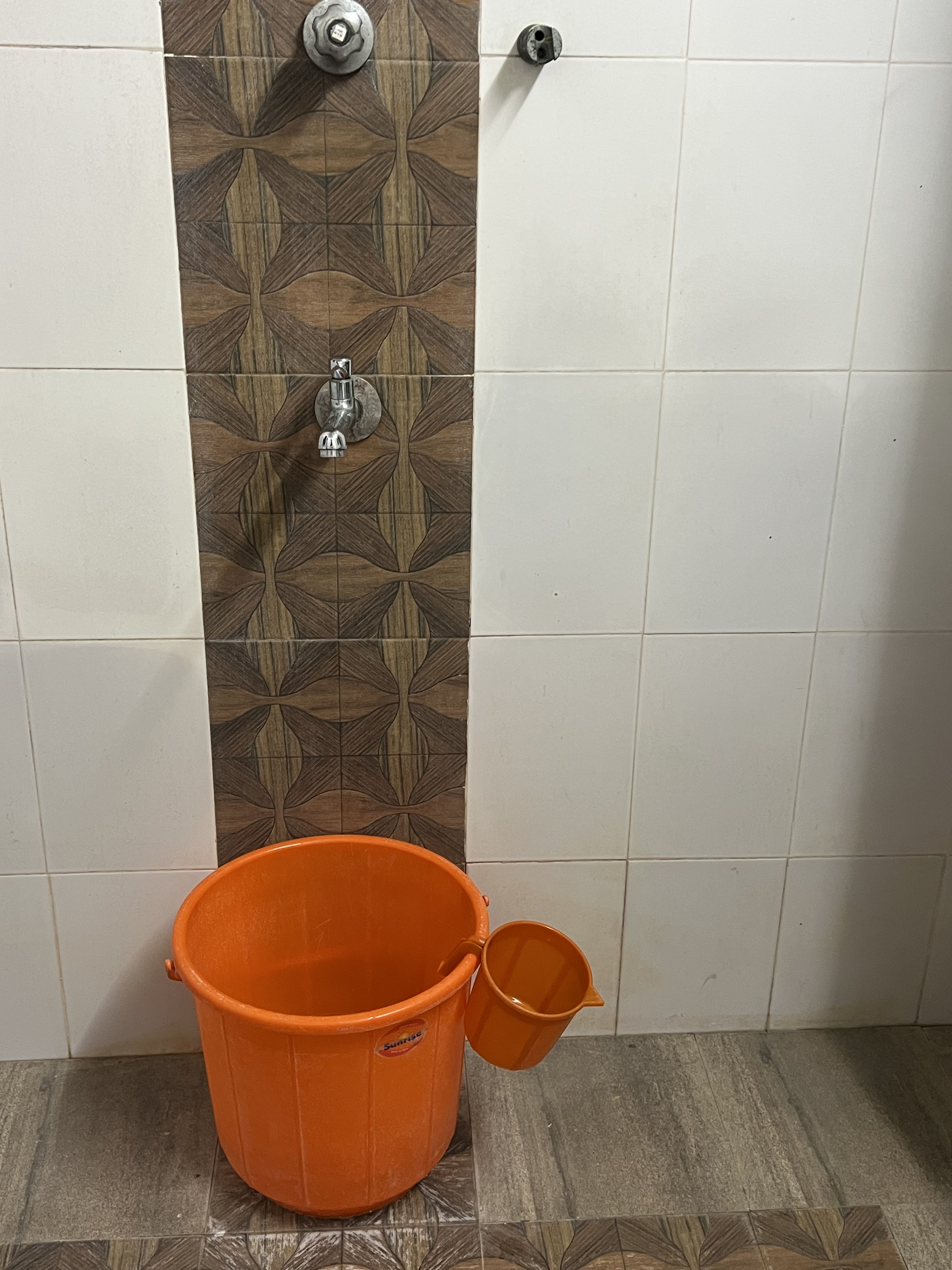
His showers had no hot water. Granted it’s quite hot in Thumboly Beach and the locals see no need for hot water but others do. As a result, he decided to arrange hot water and told us he had done so. In most Indian showers there’s a shower head and also a faucet beneath it about a foot annd an half off the floor with a bucket and plastic cup below it. Turns out he set up water in the lower faucet and not in the shower head.
When we laughed about it with him he said something quite true and profound. He said that one of the differences between Israelis and Indians is that Israelis look at something and immediately start figuring out ways to improve upon it while Indians look at the same thing, accept it as is, and immediately figure out a way to live with it. There are pluses and minuses in both approaches.
And what about respect for personal space, acceptable noise levels in public places or in hotels late at night, what it means to be a couple, the relative merit of avoidance or honesty in confronting legitimate disagreement or misunderstanding; the cultural differences go in and on.
Even when we think we get it we have to keep asking ourselves if we really get it.
There’s no escaping the fact that part of the joy in being in India is the adventure of the Western shrug of shoulders or the Indian wag of the head. The humor in “I don’t know.” The puzzled expression followed by a smile.
You aren’t in Kansas anymore, Dorothy. And ain’t that grand?
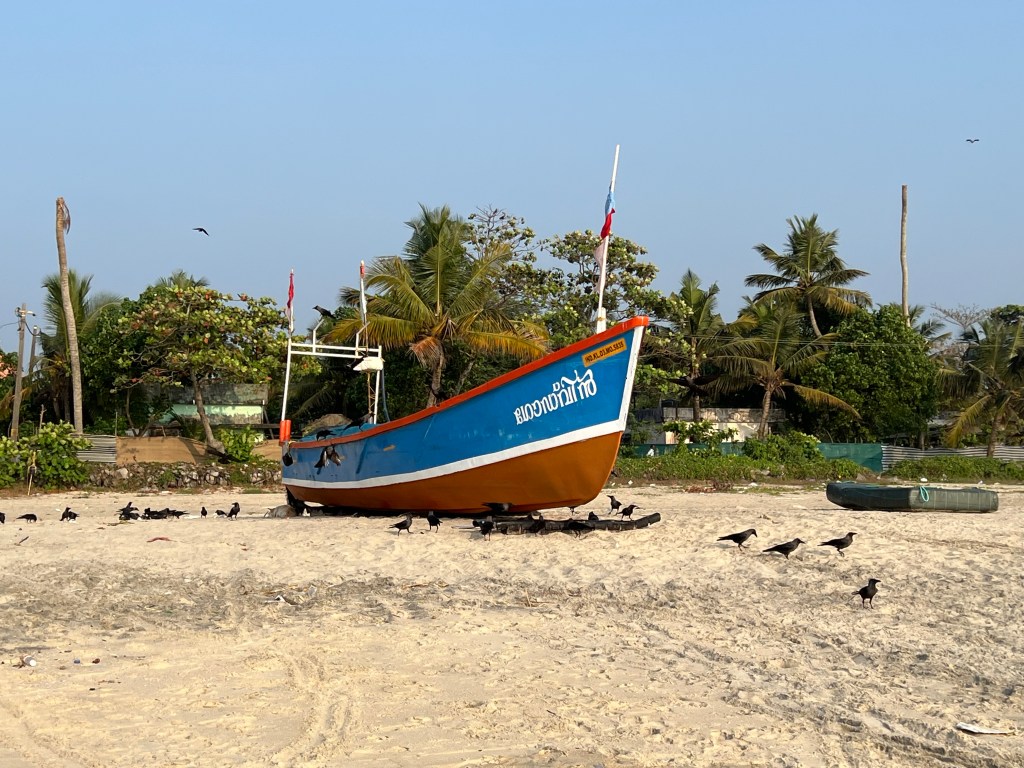
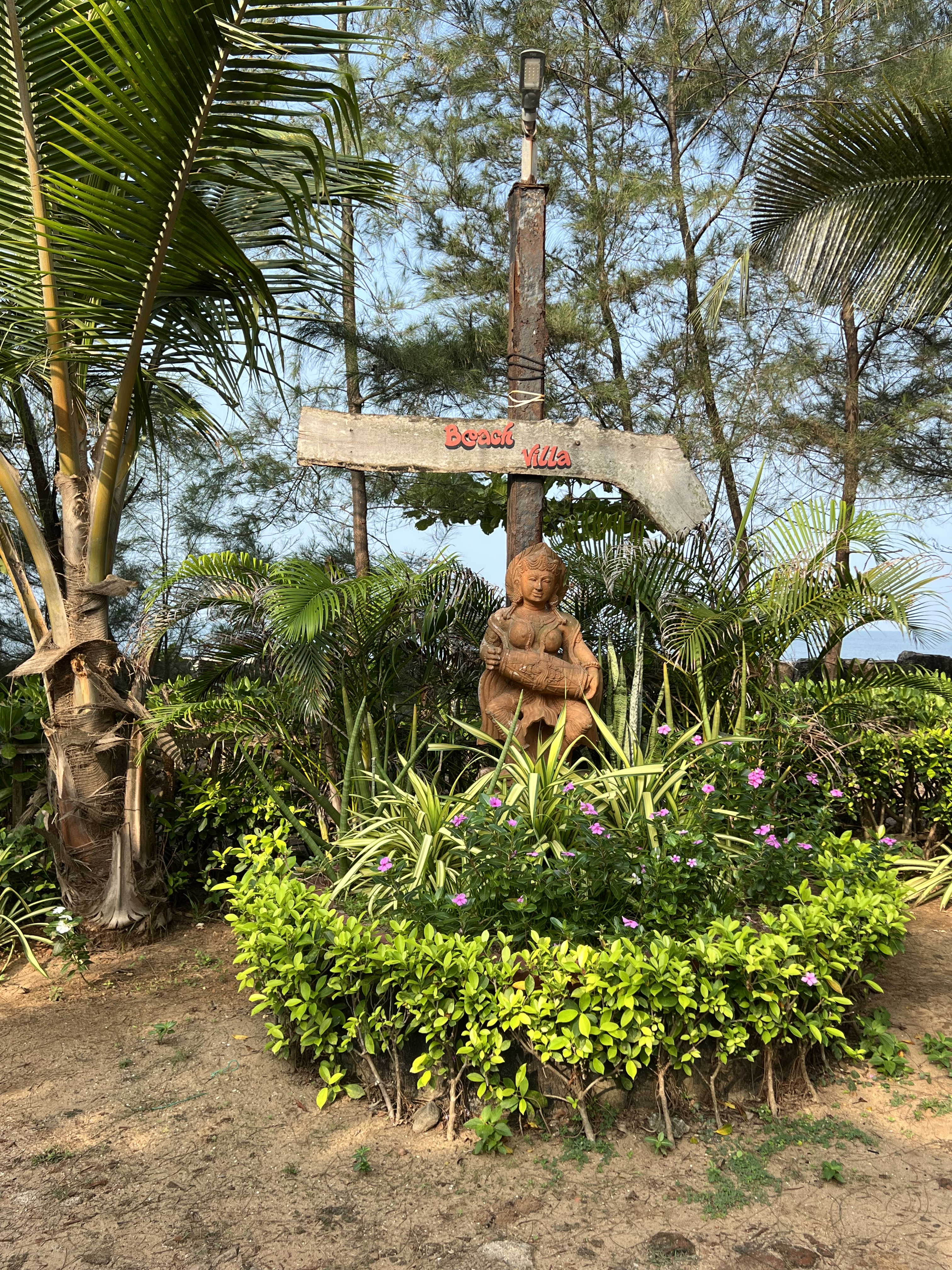
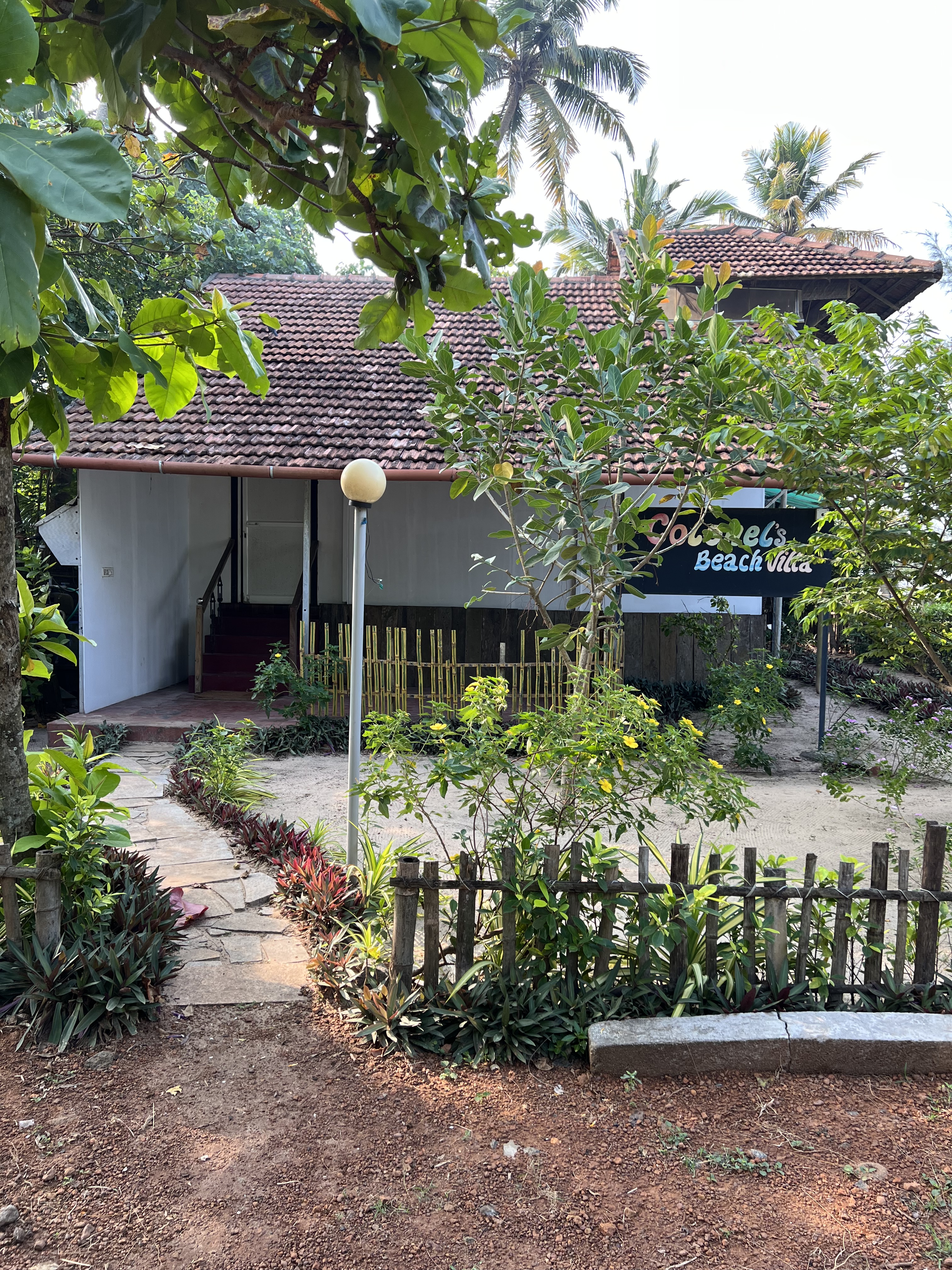
Our third week in the small fishing village of Thumboly Beach, half an hour by tuk tuk to Alapphuzha (aka Alleppey) about an hour from Kochi (aka Cochin). Our third time here at Colonel’s Beach Villa. It gets better every time and harder to leave.
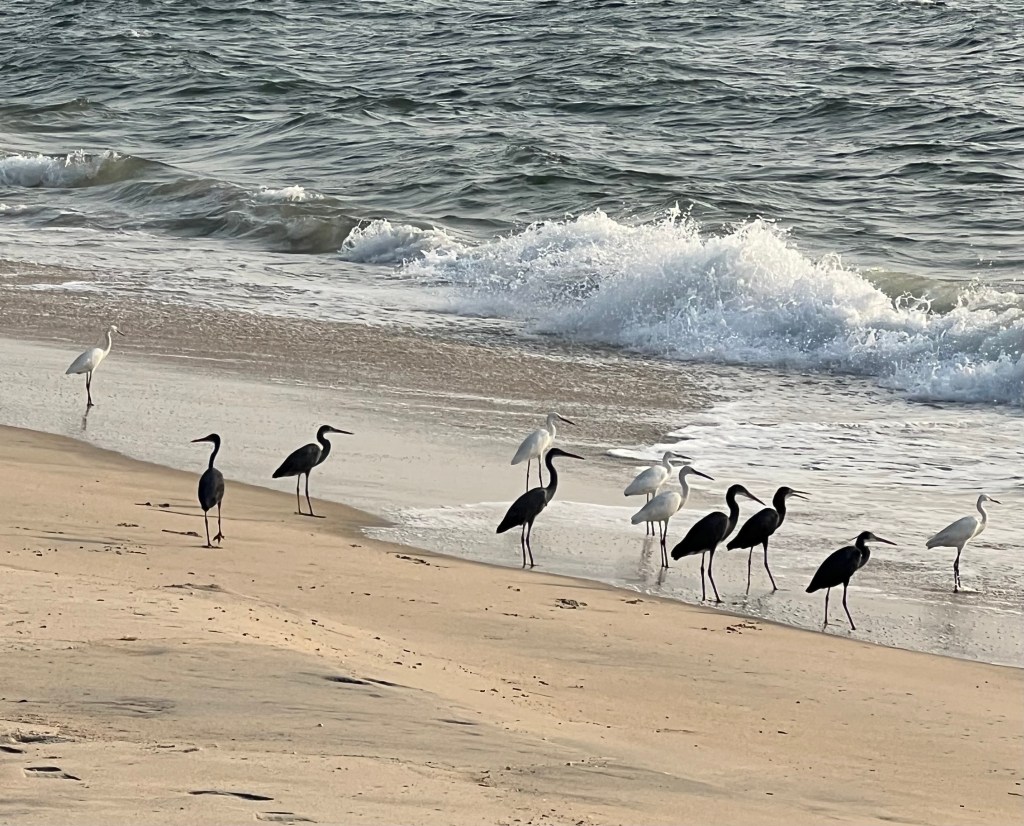
Our room has an upstairs balcony that looks out onto The Arabian Sea. The sound of the waves provides constant companionship – gentle in the morning and more forceful from afternoon on into the night.
My partner goes out around 6 every morning to watch the fisherman carefully removing their catch from their nets. It’s a careful process. Some days there might be over 50 kilo of sardines and some days maybe a paltry kilo or two. Dogs and crows wait patiently nearby waiting for the rejects to be thrown their way.
Later in the day, after a delicious, simple vegetarian breakfast, and after reading and chatting on the balcony until the day cools off, we go for a walk around the village or take a tuk tuk to Alapphuzha.
People in the village have become familiar with us. They smile warmly and speak with us in the limited English they know. When I hurt my arm and had a bandage on it they seemed to all know about it and expressed concern. We stop in to say hello to Tomas at his market and Elsbet at her small store. The people at the corner fruit store let us know if they have pineapple because they know how much we like it.
Villagers are quite laid back. Many women walk together in pairs or more in the cooling day holding umbrellas to protect them from the sun. They wear light long dresses with slits up the side and leggings underneath. Most women do not work outside their homes and the daily socializing is a pleasant part of their day.
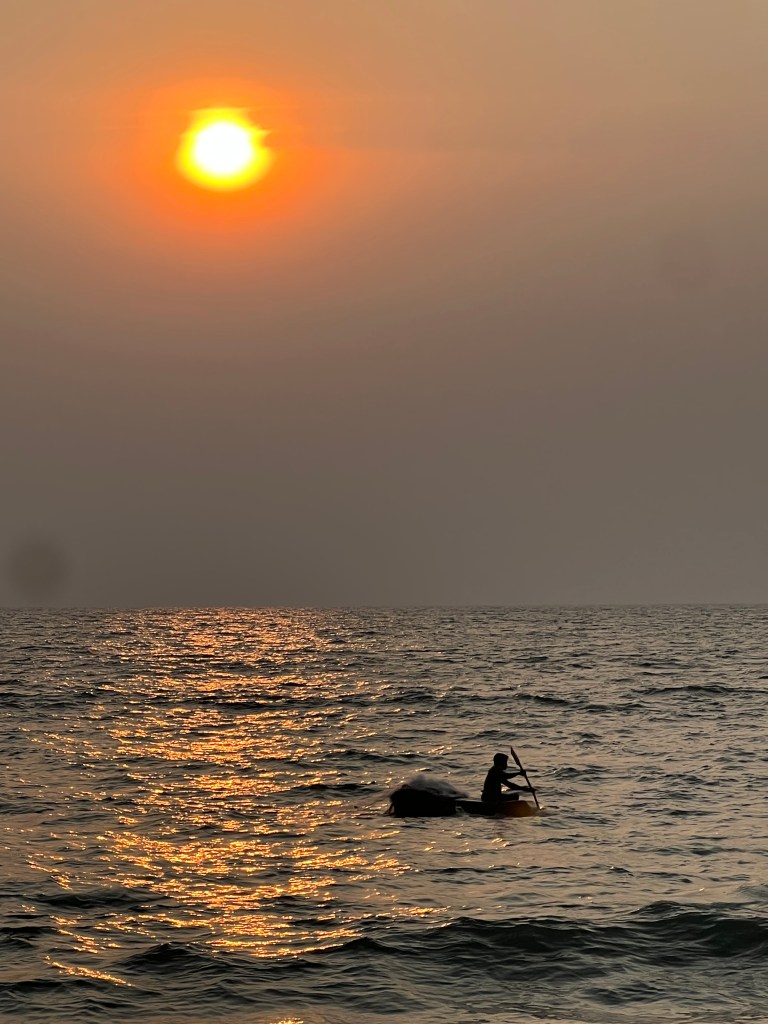
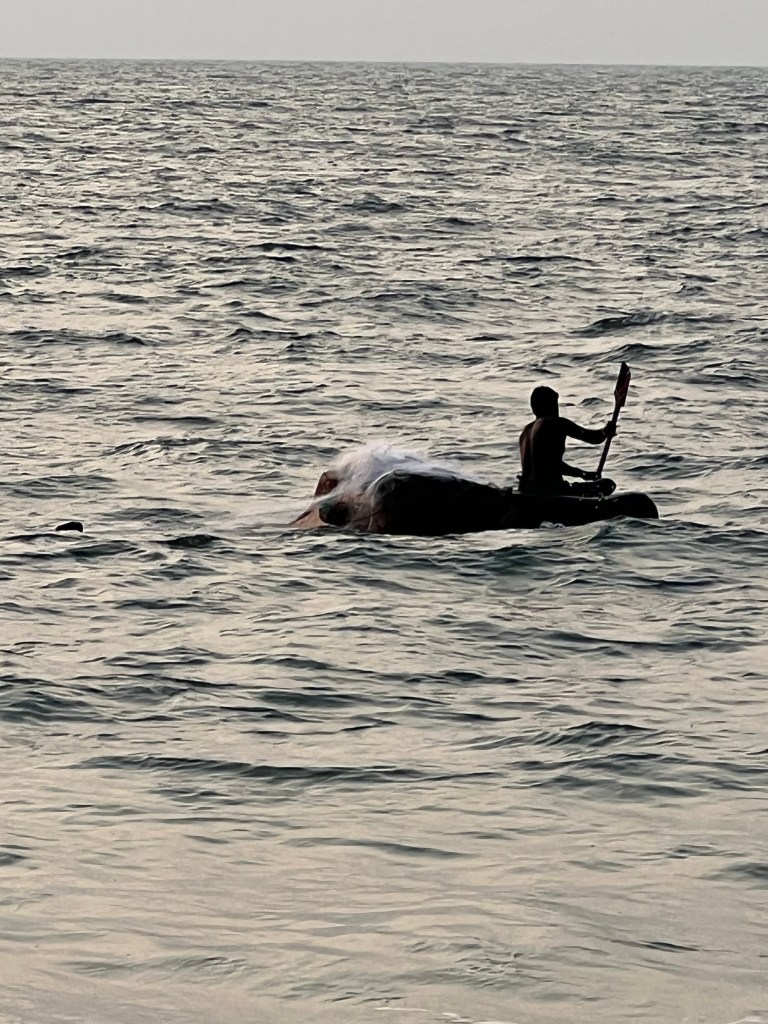
Many men can be seen sitting together on plastic chairs or on the sand under trees on the beach playing Rummy. They go out at 4 am in their small boats, fish until 6, gather their catch from the nets until 7, and then take their share of the day’s catch to sell on the nearby highway.
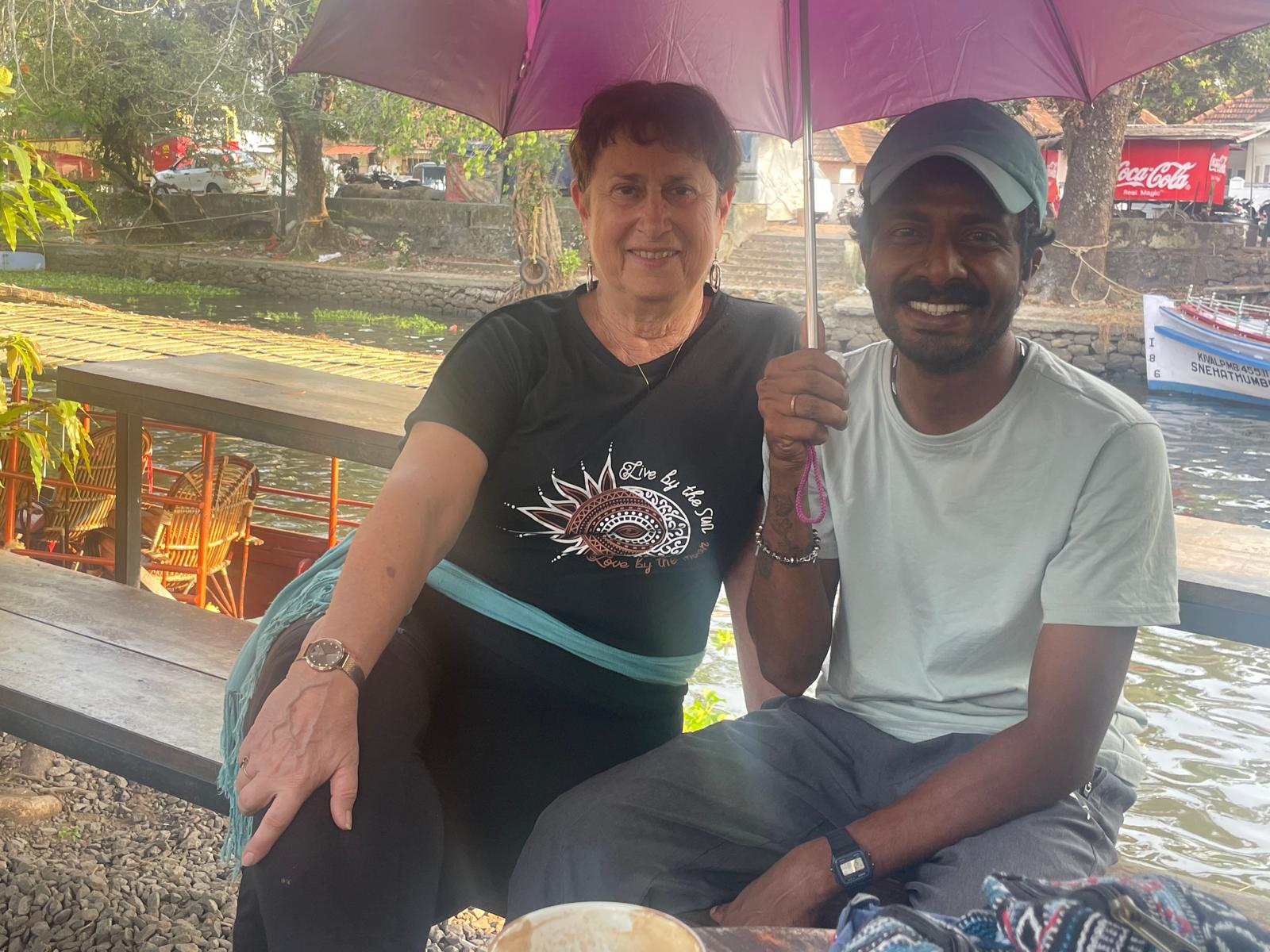
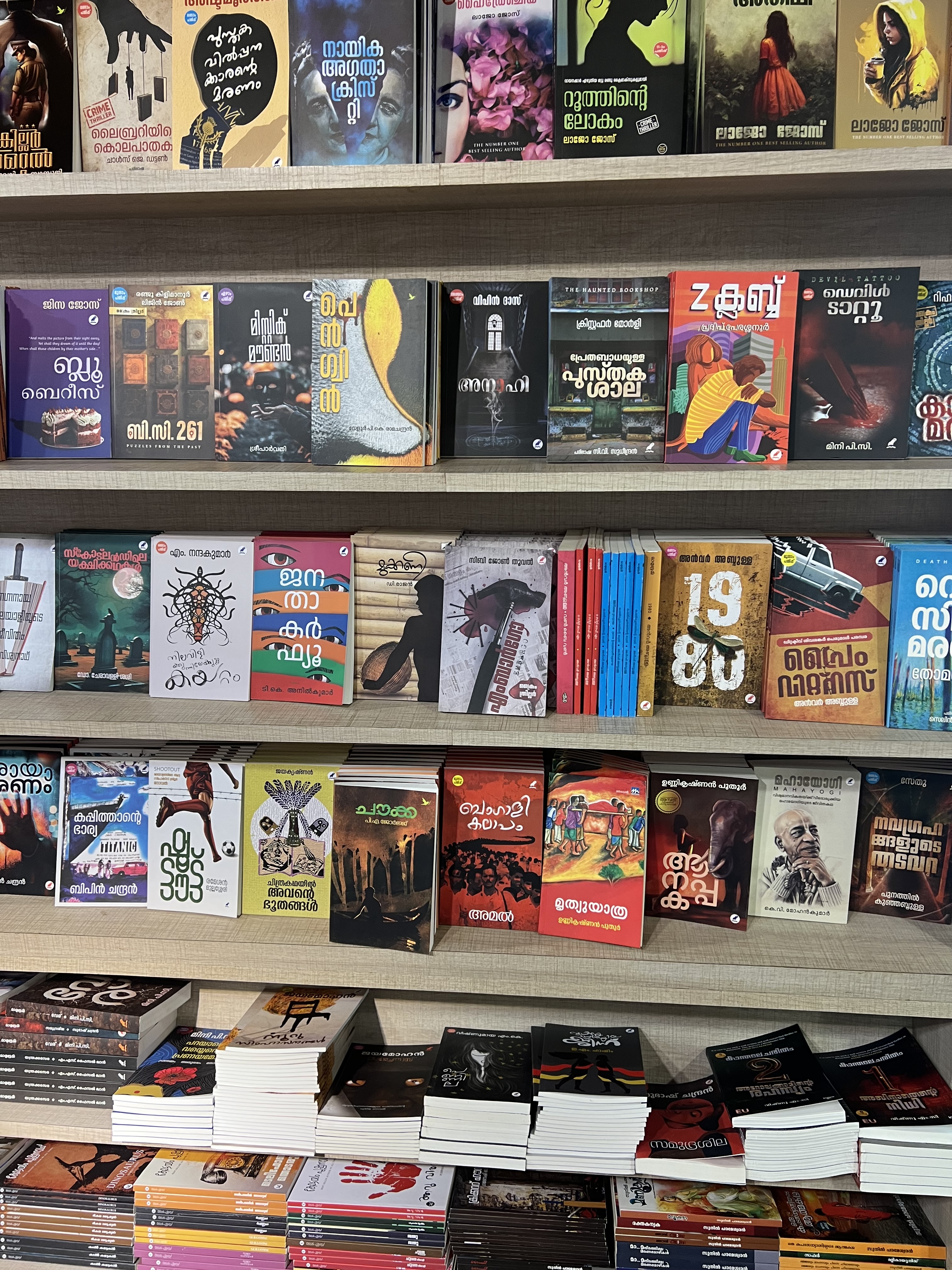
The guesthouse calls their tuk tuk to take us to Alapphuzha when we go there. He charges less than the tuk tuks we might flag down in the village. He drops us off in the commercial area where we like to absorb the colorful atmosphere and sometimes pick up a few things. There are aromatic spices, fresh garlands, fresh fruit and vegetable stands, kitchen shops, clothing shops including places to choose material, get measured, and have clothes made and ready in 24 hours. There’s an excellent bookstore and our favorite coffee shop by the river. We always stop in to say hello to Raul there, have a good cup of coffee and some fresh cold cut up watermelon.
The two young men from northeastern India – a 3 or 4 day train ride away – who do just about everything around the guesthouse are very quiet but have warmed up to us. They make us special little treats when they can. They know how we like our tea and coffee and when. They’re happy to see us in the morning and when we come back from our wanderings. Our customs, especially our Shabbat observance, are unusual for them. But they accept and adjust to everything with interest.
The serenity of The Arabian Sea, the beautiful garden, and the peaceful nature of the people provide the perfect background for my yoga practice. A small patch of red cemented patio just outside my door, shaded by a outhanging is just the right size and atmosphere. Teaching for 15 years, I often feel a staleness creep into my practice. Time spent in Southern India always inspires me to change it up, deepen it, renew the spirituality of it.
No hot water comes out of the shower head. At first we were taken aback. What?! No hot water for our shower? There’s a bucket and a big plastic cup inside. Hot water comes out of a spigot into the bucket. Cold water from the shower head to soap up and hot water from the cup in the bucket to wash off the soap. What!?! But we’re ENTITLED! Get with the program. This is India. You’d be surprised how quickly the system makes perfect sense in this climate.
Adapt. Adjust. Accept. And be pleasantly surprised when a cabinet shows up after you mention it’d be nice.
The city can be a cacophony of people and vehicles but absolutely serene and clean compared to Delhi.
It’s difficult to explain my love for Southern India and this area specifically. I wish my words t could make you smile and feel as happy as I feel when I’m here.
In a world so full of strife, confusion, fear, aggression and diviseness, Southern India is full of the opposite of all that. A local friend here thinks it’s because there have been no wars here for centuries. The culture looks askance at hostility and unkindness. Perhaps. Whatever the reason, I wish I could package this place and gift all of you with it.. .
After seven and a half months of planning and reserving flights, cars, hotels, and activities, we were on our way to our month-long road trip in America. Ten-month-long war in Israel notwithstanding, flight cancellations all around us, our El Al reservations held firm, and we woke up in Boston at a hotel near the airport on July 16th.
We reserved Premium Economy seats for every flight; something we never would’ve done even as little as five years ago. With age comes compromise. We arrived in Boston well-rested and likewise in Rapid City, South Dakota, after two flights; Premium Economy on all. Worth every penny. Of course, if you don’t have it, you can survive Economy, even in your 70s, and if you’re addicted to travel as we are, it becomes a moot point. But the extra comfort meant starting our vacation without needing a rest day after each flight. In fact, minutes after we landed in Rapid City we were at the Alamo Rental Car counter to pick up our comfy Hyundai Elantra and hit the road.
The Rapid City airport is tiny compared to most of the mega airports we’re used to. Delhi, Chicago, Houston, Miami, Rome, Tel Aviv. The two men staffing the Alamo Rental Car desk provided foreshadowing for our entire trip. They received us with smiles and kind words. They offered us maps, listened to our plans, and made helpful, gentle suggestions. They offered basically all the cars on the lot (not all that many) at no extra charge and only reluctantly waved goodbye when we drove off.
I’m always a little surprised that there is such a thing as rental cars. Mostly brand new cars in perfect condition. I get it that insurance will cover any damage we manage to do but they don’t know us. At all. Maybe we’re the worst drivers EVER. If they’d spent a few days driving the highways in Israel they’d probably charge a lot extra for Israeli drivers. But, no, they happily waved goodbye and we were on our way.
Our first Walmart experience had me laughing at my partner. He’d actually never in his life been in a Walmart. Yes, he was born and raised in the United States. He lived there until he was twenty-eight and has been back for visits many times over the past decades. And, yet, he’d never been to Walmart. He was in shoppers’ heaven. Despite having been on two flights that day, he wandered the aisles in amazement. We stopped in to buy a cooler, ice, and basic food for the next week. We ended up checking out every aisle, from appliances to clothing, to shoes, to over-the-counter medications. Of course, being a man, we walked out with only a cooler, ice, and food for the next week, but he also walked out with a new-found respect for that American icon, Walmart. We were to visit Walmarts in several cities over the next month.
An hour later we arrived at our hotel which boasted a view of Mount Rushmore from our room Unh hunh. You know how that goes. If you walked to the end of the outside balcony and stood on tiptoe, craning your neck around a corner, you could vaguely make out the famous foursome in the distance.
No matter. We were psyched.
At the front desk, we learned that in half an hour there would be a nightly flag ceremony. Half an hour. Yikes! We’d been traveling since about ten o’clock a.m. and it was seven-thirty p.m. My partner wanted nothing more than a shower, food, and sleep. But – a flag ceremony! – come on, dude. We’d be leaving the next morning after seeing as much of Mount Rushmore as we could absorb. He’s nothing if not a great traveling companion. We were in the car quick as a flash and on our way.
If you’ve never been to Mount Rushmore: it’s in the middle of absolutely nowhere. It’s not on the way to any place you want to be unless your Great Aunt Martha lives in South Dakota. And nobody’s Tante Shoshana lives in South Dakota or any state within three states of South Dakota. For some reason, it found its way onto my bucket list decades ago so here we were.
And if you ever do find yourself there for some very mysterious reason, DO NOT MISS THE FLAG CEREMONY!!!
It was amazing. Moving is too small a word. Thousands of people every night during the tourist season, and they are all – each and every one – patriots. They’re proud Americans. They stand for the National Anthem (and seem to know all the words) and even for America the Beautiful, with hand on heart. When there’s a call for anyone who’s served in the military or has a family member who’s served in the military to come down to the stage, the stage is filled to overcrowding with people.
This is Trump Country. It’s the other America. It’s an America with which my partner and I are not familiar.
It’s an America where a teenager offered me her hand (unasked) to help me rise from the stone wall seating. Where children behave and sit or stand quietly while adults speak. Two things, sad to say, we didn’t see in Boston or Florida, later during our trip.
We both learned new information about Washington, Lincoln, Jefferson, and, especially, Teddy Roosevelt.
.
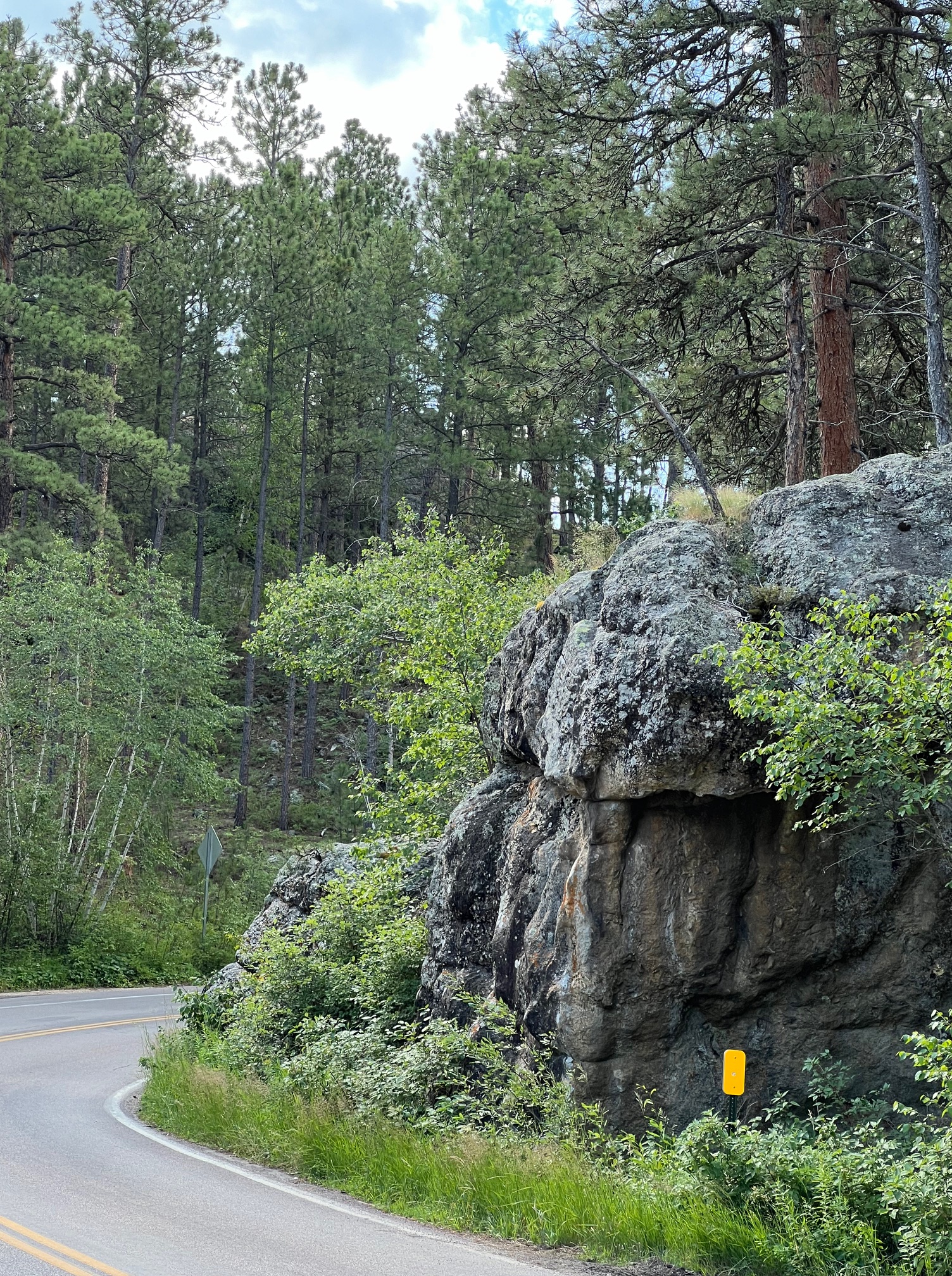
The next day at breakfast at a diner one of the owners suggested we drive the back way into Mount Rushmore. He was as friendly, without being intrusive, as the Alamo Rental Car staff, and we took him up on his recommendation. It was one of the most beautiful, impressive pieces of road we traveled. Beautiful forest on either side of us. A quiet, windy road through the Black Hills with two short tunnels. One of the tunnels framed Mount Rushmore in the distance.
Breathtaking.
We spent another hour or so wandering around Mount Rushmore and then headed to our next stop – the nearby Crazy Horse Memorial.
A short half-hour away, we parked and climbed on a mini-bus to go up the gravel road to see Crazy Horse chiseled into the mountain. Only the head of the famous (or infamous) Oglata Lakota warrior and one of his arms – pointing ahead – is finished. Commissioned by Henry Standing Bear to be sculpted by Korczak Ziokowski in 1948, the Native American Nation refuses any financial support from the United States government on principle. Not hard to understand given their history. The constant lack of funding has made it challenging to employ enough workers to make serious progress over the decades.
Considerably larger than each of the heads of the four presidents depicted in Mount Rushmore, perhaps 4-5 times as large. It is an impressive undertaking.
Crazy Horse fought at the Battle of Little Bighorn – Custer’s Last Stand – and surrendered to US troops the following year. In yet another broken promise by the US government, he was killed by the military guard after surrendering.
It seemed only fitting to continue on from there to the Battlefield of Little Bighorn. But it was time to rest a bit so we slept overnight at a motel with little cabins in the town of Buffalo,
So far the trip had been everything I’d hoped…and more.
We met our daughter and her three children at the Delhi airport after they’d spent the weekend in Agra seeing the Taj Mahal. We flew together to UDAIPUR, a small, pretty city in the Rajasthan District. UDAIPUR is known as a romantic honeymoon location, home to the lovely Lake Pichola and impressive City Palace. My partner and I were there 7 years ago on our first trip to India and thought it would be a good place for children’s activities.
Rajasthan has its own rich history of colorful dress, dance, and music. We were sure the kids would love the cultural evening with the live Rajasthani music and groups of women dancing with bells on, fire pots on their heads, and especially the young woman dancing while balancing 10 colorful pots on her head. We were wrong. Luckily it was only an hour.
The next day we fared a lot better. All but one of us really got into the 3 hour art workshop where a patient, sweet, talented artist helped us each paint our very own miniature. Our daughter and granddaughter both created truly beautiful miniature paintings. My partner’s peacock and my dancing elephant weren’t bad but revealed that we needed a bit more instruction. Our youngest, a very active 7 year old, showed more focus and attention to detail in his prancing horse than I’d ever seen.
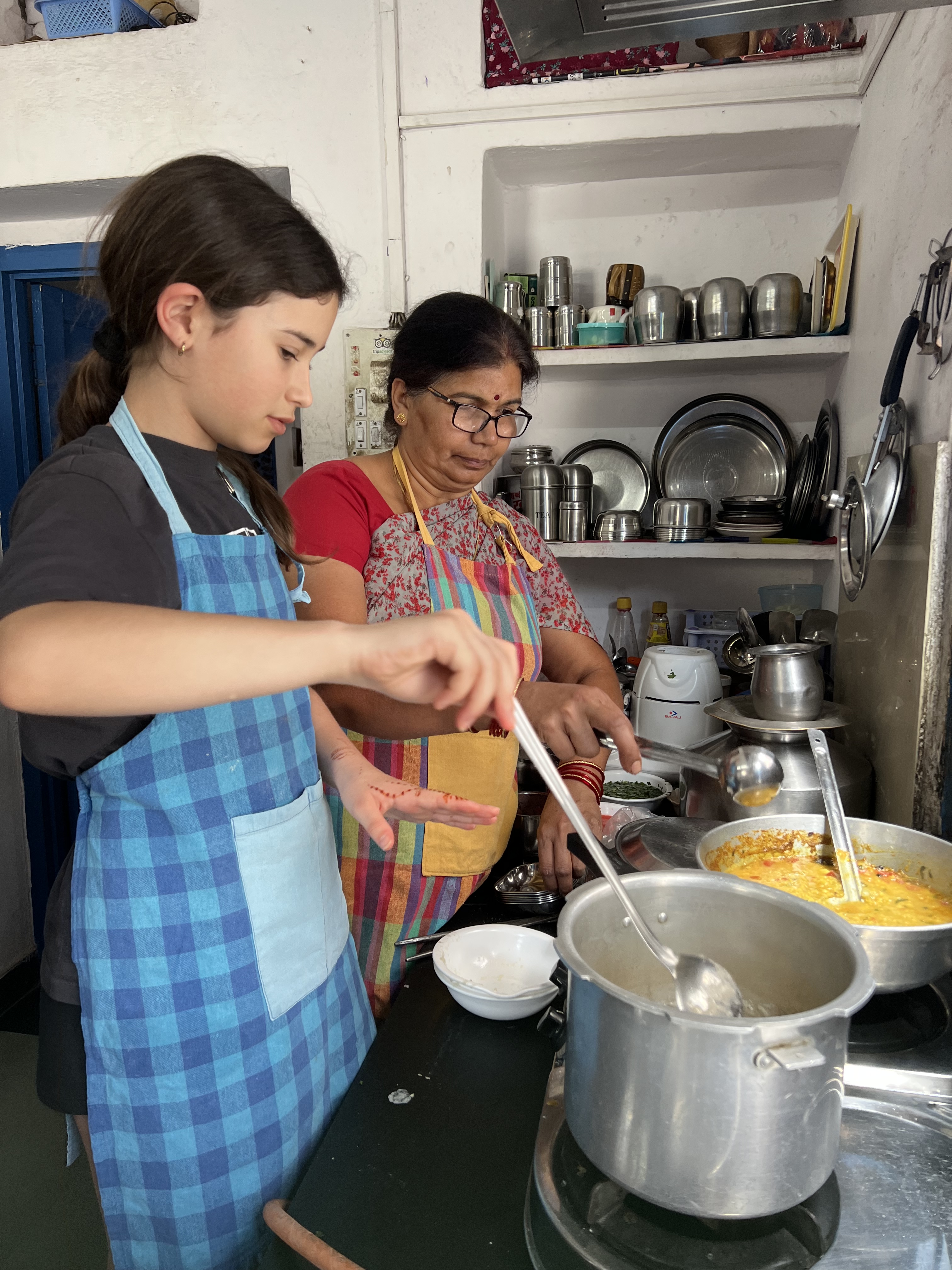
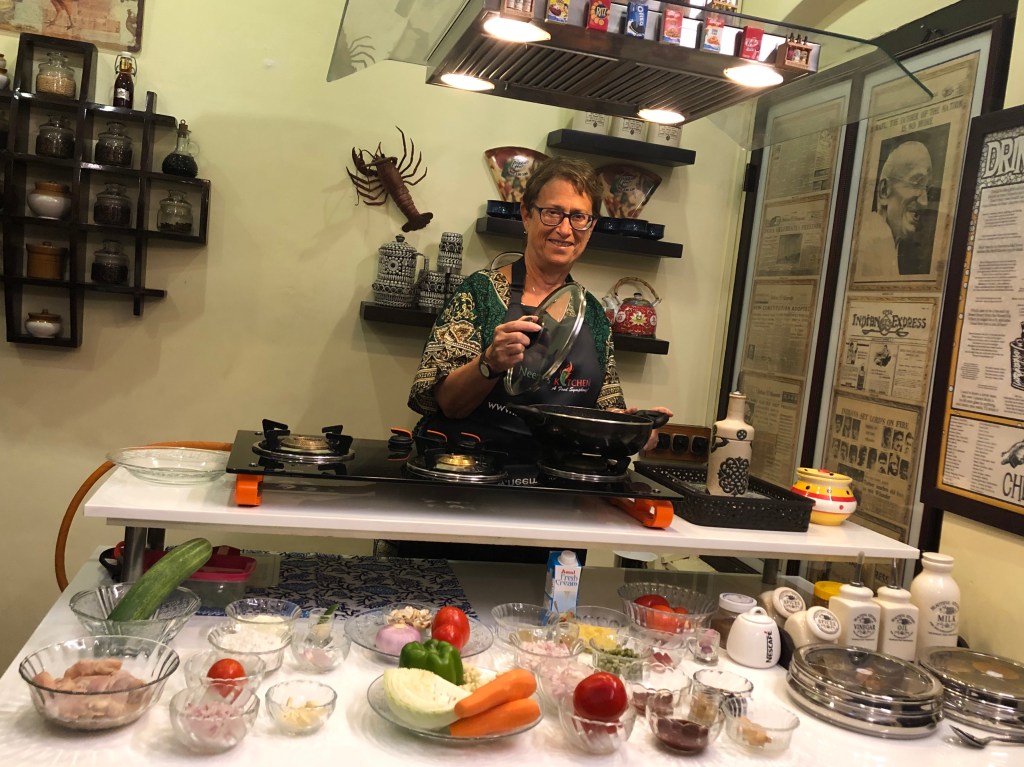
The 3 hour cooking class was a hit with all of us. It was very hands on – from the chopping to the kneading to the measuring and mixing of spices, to the frying…and, of course, the eating. The shy cook started off embarrassed that her English might not be good enough, but once she warmed up (and it’s hard not to warm up to these three kids!), she totally took over the instructions from her (very good looking) son, Gautam.
But the day none of us will ever forget is the day of the village tour.
My partner and I had taken a cab and driver out into the countryside 7 years previously. Our driver took us to several cottage industries – hand stamped textiles, pottery, a country art school for miniatures. We didn’t remember the names of the villages so after reading the glowing reviews of “Salim’s Day Village Tour” we decided to put our motley crew in Salim’s hands and follow wherever he led.
Salim, a devout soft-spoken Muslim, showed up dressed all in white in honor of the Muslim holiday of Ramadan. He brought another auto-rickshaw in addition to his own. We all piled in and off we went in the shimmering 35 degrees heat (95 degrees Fahrenheit).
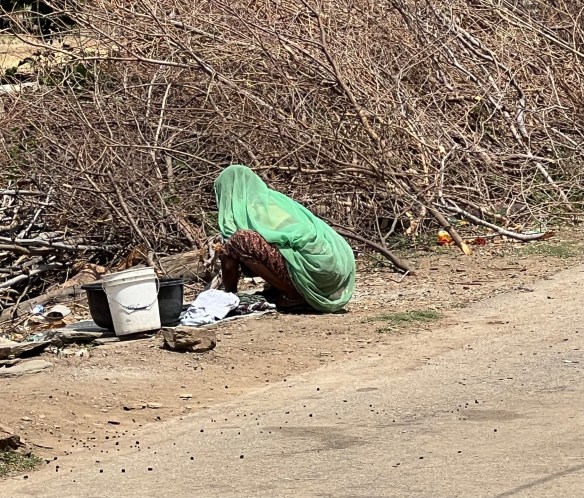
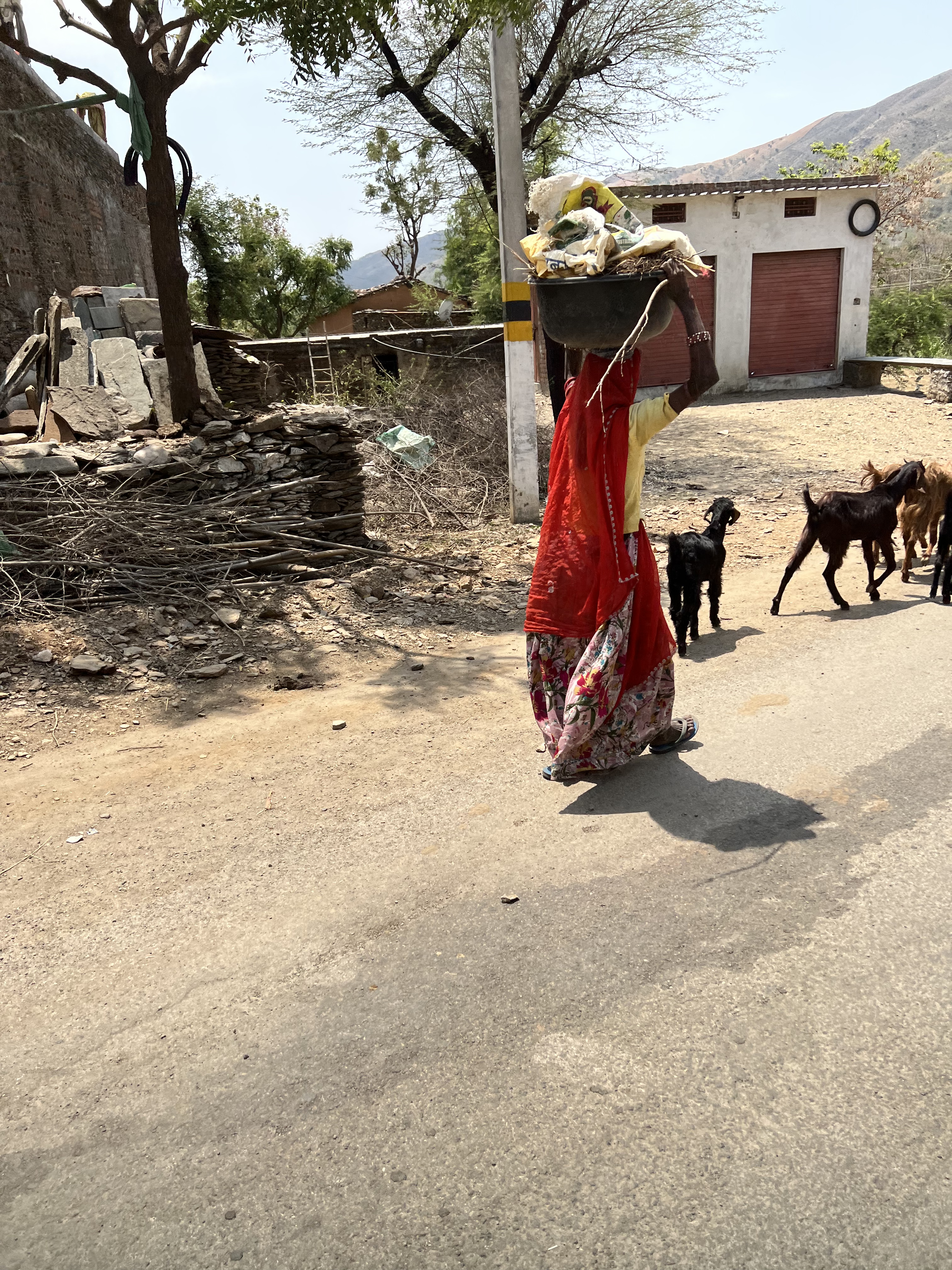
About half an hour later he pulled onto a dirt and gravel road and then turned again onto a rocky path where he parked after another 100 meters. Our first sight was of two women in the distance washing clothes in the small creek. The second was a woman, also dressed in a traditional, colorful sari, with a stack of cow patties balanced on her head.
We followed Salim into a lean-to where five men of varying ages sat on a flat stone area and several women stood by a counter leading into a small hut. It turned out that the father of the woman of the house had died and they were celebrating his life according to their Hindu custom. Somewhat similar to the Jewish shiva, but not exactly an act of mourning since they believe that while his physical manifestation is gone, his (much more important) essence remains.
Oddly enough, one of the ways they honor their guests is to give them cigarettes. Maybe to hasten their reunion with the recently departed? There were giggles from the women and guffaws from the men when my daughter took one of the cigarettes and lit up. Indian women do NOT smoke. But my very white, very light haired daughter differs from them in so many ways that a puff on a cigarette didn’t offend.
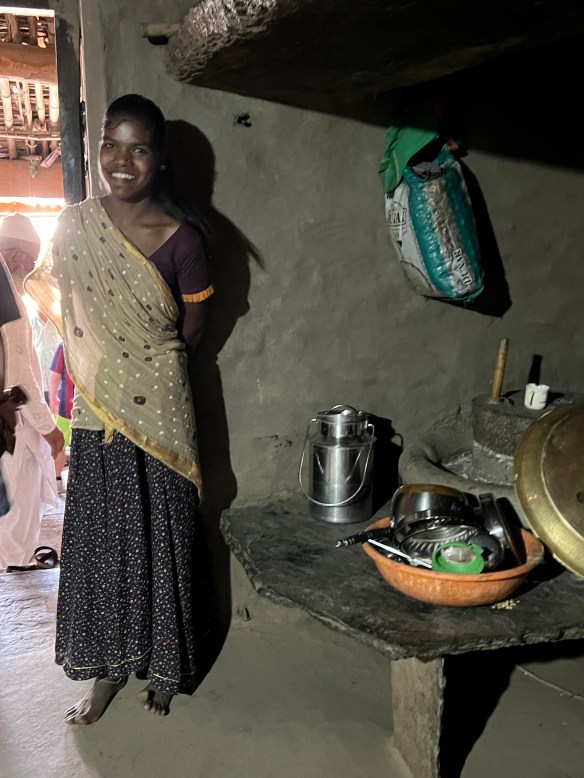
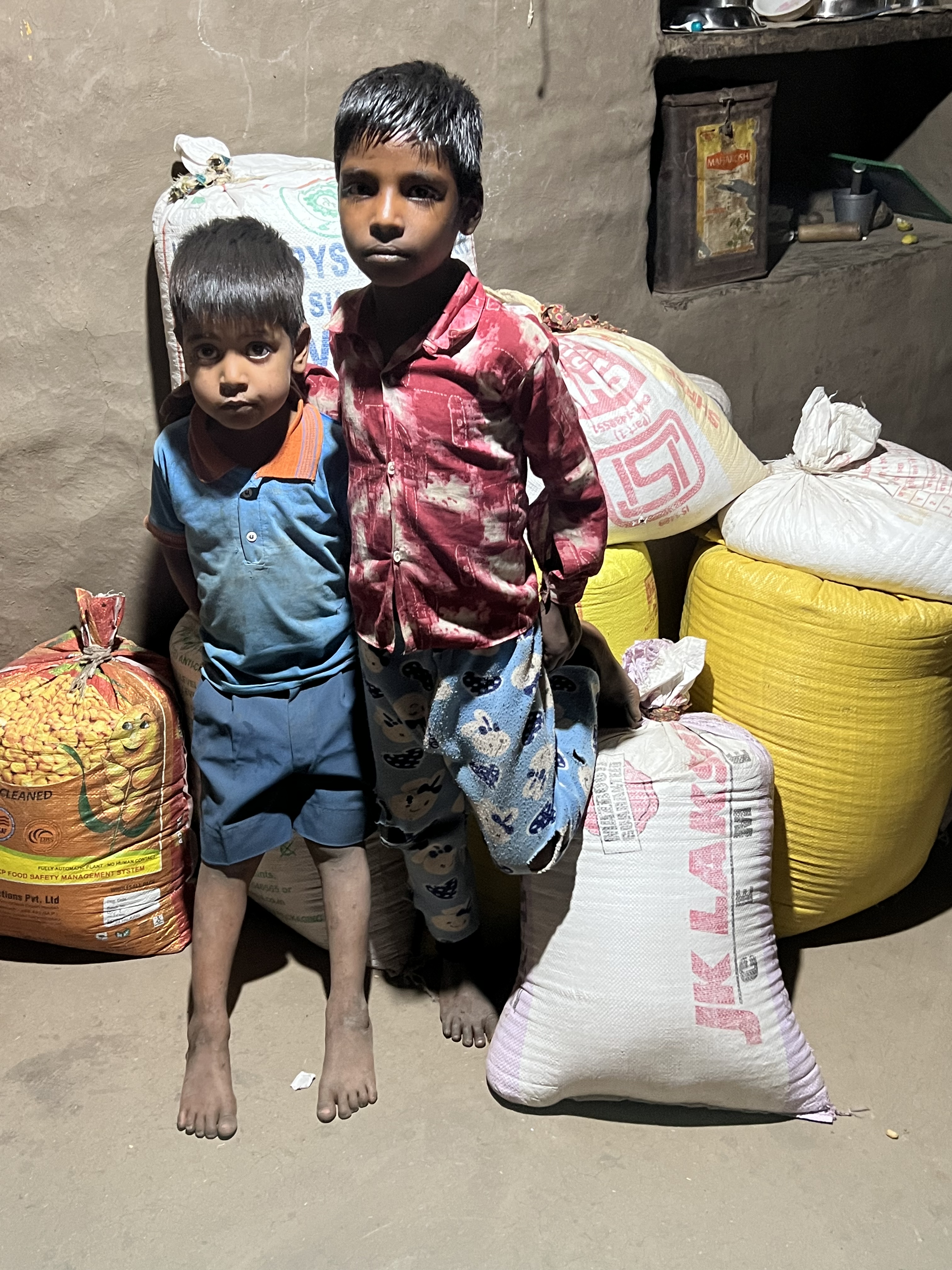
We asked to see inside their one-room home and they happily acquiesced. One of the young women whisked off the covering from a large pot to show us the gas burners (my daughter told us later that a mouse came barreling out). Inside it was quite dark. There were big sacks of flour and rice along one wall. There was one bed with pots, pans, metal plates and cups on it. Salim explained later that the couple sleep in the bed and the children, in this case three, sleep on mats on the floor. There was no bathroom; it’s presumably outside.
We asked if there was electricity and a man pointed the one bare, unlit, bulb hanging in the entranceway.
After our goodbyes we moved on to a day care center not too far away. There were about 15 gorgeous three and four year olds inside.
To say the cramped space was dark, dirty, with virtually no toys doesn’t come close to giving an adequate description.
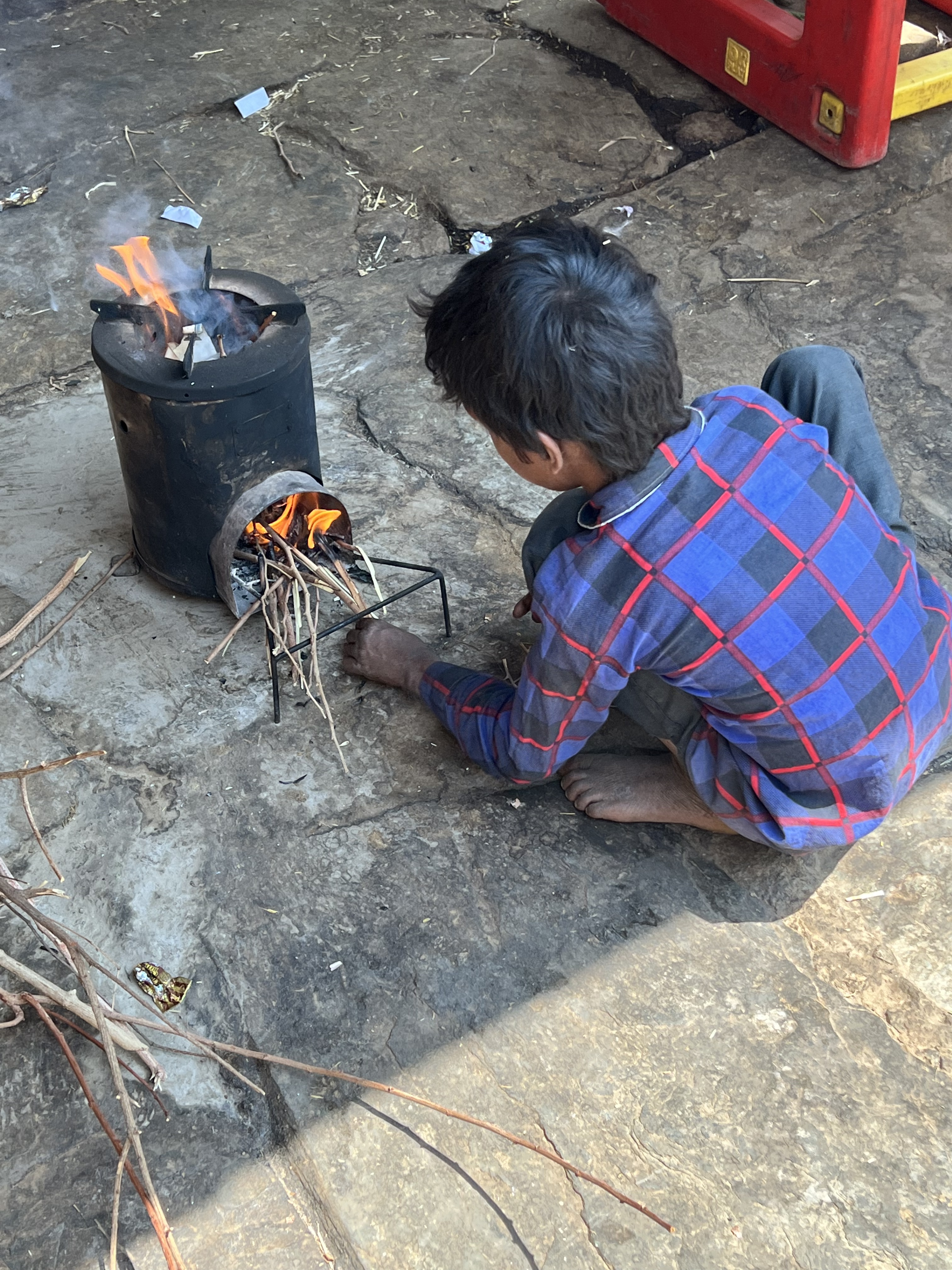
At one point a boy, who looked to be 8 or 9 years old, set fire to some kindling stuffed into a canister-looking contraption. We basically stood with our mouths open contemplating how many safety measures were being ignored while the smaller children heedlessly walked around the open flame. The lone day care worker put a pot of soup on top and began to prepare the children’s lunch.
Salim had recommended we bring candies. Our grandchildren had a great time handing out candies to the youngsters both inside the day care center and walking around the village. They were surprised that when they offered a candy to a child who, as it turned out, had already received one, she declined to take a second. What kid does that!?
By this time we were all drooping from the intense heat and more than ready to head back to our hotel. It wasn’t only because of the heat, though, that it was so quiet in the tuk-tuk on the ride back. There was a lot to think about.
We arrived at the gates to the 42 acres (over 160 dunam) surrounding our hotel. The turbaned guard called a buggy to come get us: goddess forbid we should walk the 150 meters to the entrance to the hotel. Along the way we saw peacocks roaming the grounds freely, smelled the fragrance of the beautiful flowers, and heard the splashing of many fountains.
Truth be told, we don’t usually stay in such elegant surroundings where there are so many impeccably dressed, beyond pleasant staff constantly bowing namaste in our direction over prayer hands. Our daughter is more accustomed to 5-star hotels and it’s actually much easier to enjoy a vacation with children, one of whom is a teenager, when they’re comfortable.
Inevitably at the dinner table when we talked about our impressions of our day, and after the grumbling about the schlepping around in too much heat for way too long, we all expressed our dismay at the parity between the lives of the villagers and the vacationing Indians sitting at the tables around us.
Almost 70% of the one and half billion people who live in India live outside the cities. As in most developing countries, every year people move to the city for employment or other ways of bettering the lives of their family – about 2% annually in India. The already overloaded infrastructure of the cities – Delhi with almost 33 million people, Mumbai with over 21 million, Bangalore with almost 14 million – is hard put to cope with more.
Prime Minister Modi, since his election in 2014, has instituted several programs to encourage villagers to remain in their villages. His government guarantees 100 days of employment to every villager who’s eligible. A gift of 150,000 rupee ($2000) is given to each village homeowner for home improvements, primarily to fortify roofs and walls to withstand monsoon season. 600 million toilets were purchased for the villages in the first five years of the present government .
And, still, the parity is huge.
We talked about the Indian trait of acceptance and the joy in the villagers’ children’s play. We talked about the bountiful nature of our own lives and how, even so, we so often strive for more and better. One of us reminds us of the pride in one man’s voice when he pointed out that his daughters were home visiting from college. So along with acceptance there can be a desire for change.
We conclude our conversation as so many of them end – knowing that we can only ever get a small peek into the depth and vastness of this amazing country called India.
None of us will ever forget these two weeks of ours as a family in India and this day will always stand out.
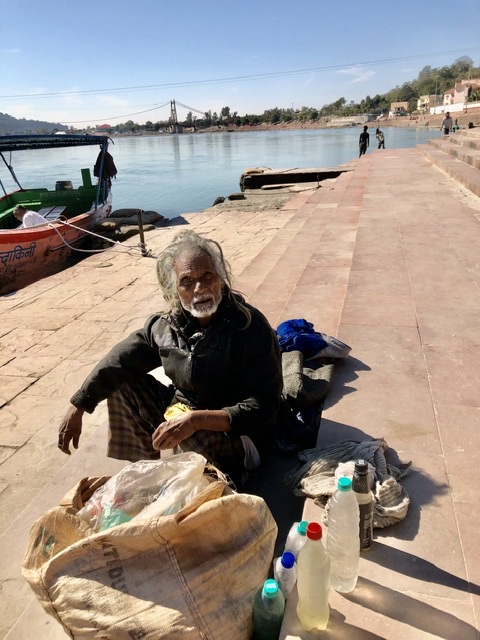
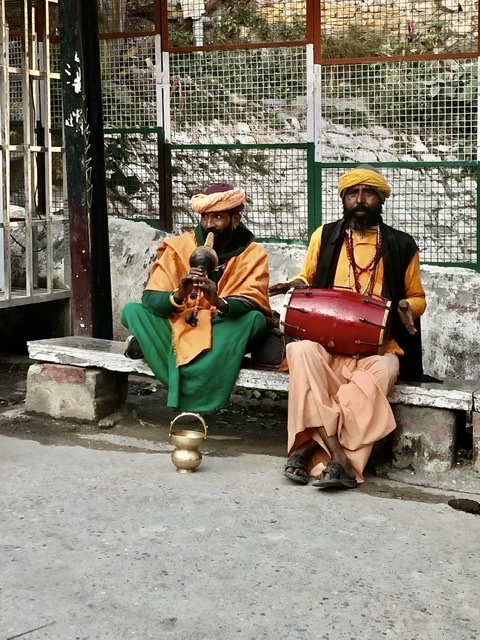
Rishikesh is one of seven holy cities, Sapta Puri, in India. Aside from being alcohol-free and vegetarian, the city is a spiritual center, pilgrimage location, yoga and meditation center, and home to many Sadhus.
A Sadhu is a religious ascetic who has renounced the worldly life. He often lives on the street, with only the essential belongings for survival – his clothing, turban, towel, sandals, and beggar’s bowl. He is dependent upon the good will of others to provide him with enough money to buy sustenance-level nourishment each day.
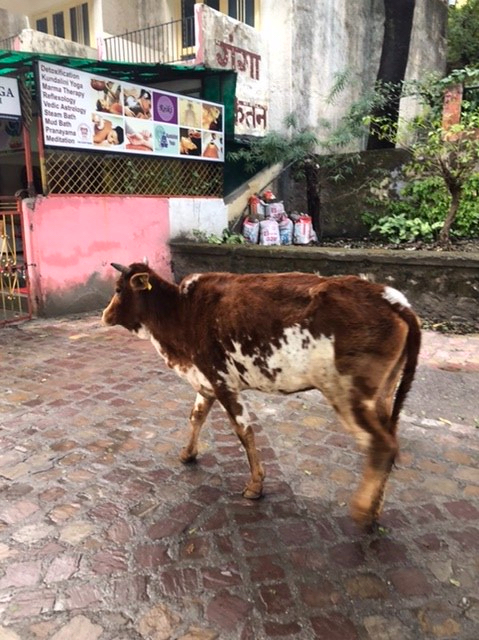
On my way to yoga in the morning, after crossing the Ram suspension bridge, which is blessedly motorcycle-free at that time of day, I meet only cows, dogs, and Sadhus, all waking up after a night spent outside.
Sadus may be said to be at one side of the spirituality-materialism spectrum. As I wait for my sweet yoga teacher, Gagan, to arrive on his motorcycle, sharing the pergola which overlooks the Ganges with the same Sadu each time, I can often hear a passing Sadu chanting quietly or not at all quietly.
“Ram. Ram. Ram. Ram. Ram. Ram. Ram.”
Though they’ve renounced family, home and worldly endeavors and accoutrements, I’ve noticed that they tend to hang out in twos, threes, and fours – a social group of sorts – and they gather their few belongings safely around them or cover them with a tarp on a nearby bench. Some take advantage of government incentives and work at ashrams where they receive food and shelter in return.
As my yogi says, human nature is one of collecting: things, acclaim, friends, knowledge, money. Another distinction between other animals and the human animal.
We ate dinner with a group of 20 strangers in Delhi not too long ago. Nice people. Friendly. As travelers are wont to do, people spoke freely about their lives, philosophies, travels, and families. The two men who sat closest to us got into a long conversation (with my partner) about their various, and, it turns out, multitude of real estate investments all over the world. The ones they sometimes live in, the travails of having renters, the value and tax issues of different locations.
Neither was Bill Gates but neither was a Sadu either.
We’ve been in India for over three months now. It’s a long time to be out of mainstream living. With each day that our work commitments, family and friend socializing, and community presence gets further away, our bonding to each other and our investigation of personal values and beliefs becomes more intriguing. There’s more time spent observing, thinking, integrating and softening.
It could be that the inherent nature of India is friendlier and more conducive to this transformative process. It could be that an extended period of free time would create the possibility of this process anywhere.
In India specifically, as we travel, meeting other travelers, shopkeepers, restaurant and guesthouse staff, yoga practitioners, musicians, and language teachers, we can’t help but observe their everyday life and that of passersby. Some of them become a regular part of our day for the week, two or three that we are in their vicinity. We seem to be seeing the spirituality-materialism spectrum in real time.
Spirituality is in the air.
From JP, the owner of our guesthouse near Munnar, who gets up at 4 am each morning for 20 minutes of yoga, to the shopkeeper in Rishikesh who closes his shop at 10 pm, bends down 3 times to kiss the step in front of his shop door, touches the doorframe and then his forehead before getting on his motorcycle to head home, to the clearly well-to-do middle-aged Indian couple who travel to The Ganges to dip themselves in holy water annually, to my lovely harmonium teacher who has a smile for the pesky monkey who pushes open her door when she shakes her head in that ubiquitous, multi-meaning Indian wag and says “He, too, is one of the gods’ creations.”
The human nature of collecting is evident, too.
The same people mentioned above charge money for their goods and services. In general, they unabashedly charge foreigners more – sometimes shocking attempts to charge 10 times more. A Sadu might complain about a donation of 10 rupee (“But a chapati costs 20!”). One South Indian man we befriended had a candid conversation with us about his constant efforts to accumulate more wealth. The yogi with whom I practiced four years ago didn’t charge money (he reluctantly accepted my ‘donation’ of $75 for 10 classes) and this time made his charges clear before we began (less than $6/class).
So where does each of us choose to be on this spirituality-materialism spectrum?
Does being a Sadu, at one side of the spectrum, preclude a bit of materialism? Does being Jeff Bezos preclude a smidgen of spirituality? (btw, did you know that there is not one woman on the list of the top ten richest people in the world?)
Gagan believes that it’s easier for those who have wealth to take on spirituality. Perhaps this originates from his vantage point as a Sikh yogi whose path of relative poverty and practice was inherited, clear from the age of 10. Perhaps he envisions those who have large bank accounts as having the luxury and ease to choose to invest time in introspection and seeking spirituality.
It seems to me, from my vantage point of never having had to concern myself with the possible absence of my next meal or a roof over my head, that it’s easier for those who have not been educated to chase ever-improving material circumstances to take on spirituality.
Clearly Gagan and I bring different life experiences to our sense of things.
Seane Corn is one of the most famous (and wealthiest) yoga teachers in the world. Her net assets are reported to be over 20 million dollars. Not anywhere near Bill Gates’ estimated 100 billion dollars, but still not too shabby. While her exhibition-type, extreme style of yoga is not my cup of tea (maybe I just wish I could have her flexibility), I’ve admired her for years for her tireless work for altruistic causes. Her organization, Off the Mat into the World, offers yoga practitioners the opportunity to volunteer to build community centers in Africa, train young people to teach yoga and meditation in their villages and towns, and offer online courses for leadership initiative. A vegan, Seane teaches 250 days out of the year, and, when not teaching, calls a tiny yurt in Southern California home.
Miriam (not her real name) is a talented artist, living in a rural area of Israel. Her husband of 25 years is most often in the US where he teaches religious studies in a small community where there would be no religious learning if he didn’t offer it. They have little in the way of material wealth, other than the modest, heavily-mortgaged home Miriam lives in, and, sadly, have no children. Their daily lives are committed primarily to the deepening of their spiritual lives and sharing what they believe are their God-given talents – painting and teaching. Miriam offers half-day and full day retreats for women, providing spiritual, artistic and nutritional nourishment, charging on a sliding scale according to means. Her walls are covered with her beautiful original works, into which one can gaze, imbued with Kabbalist and/or personal spirituality.
(not Miriam’s work)
Most of us are neither Seane Corn nor Miriam. We’re neither millionaires nor Sadhus. Some of us may not give a second’s thought to spirituality or ethical behavior or the meaning of life; others may think about it fleetingly or in depth once a week, or at random times. All that stuff has been in my thoughts for as long as I can remember. Sometimes it led me to political activism, sometimes to volunteer work, sometimes to prayer, sometimes to regrets, sometimes to books, sometimes to an open heart. I’ve been blessed with 3 months of unrestricted time, a partner who’s happy to listen to and share philosophical thoughts, and surroundings that welcome it all.
We live in an age of moral subjectivism, relative realities, political correctness – some may be tempted to call it an age of wishy-washiness. We hear that there’s no objective right or wrong, better or worse, too much or not enough. It’s all what you choose for yourself. The glorification of the individual, regardless of…well, pretty much anything.
But, hand on heart, don’t we all actually know what having enough looks like? I’m guessing it doesn’t resemble Jay Leno’s collection of cars or Imelda Marcos’s shoe closet. It most probably isn’t even reflected in most American’s refrigerators or leisure time. I’m a member of a FaceBook group of people traveling in India. Recently there was a post about whether or not to tip in India, and how much. Some of the responses were eye-openers. From ‘Indians don’t tip.’ to ‘It’s good enough to round up.’ to ‘They earn so little that 10 rupee significantly increases their income.’ (10 rupee is the equivalent of 15 cents) Seriously, guys!? Then there’s the feeling that we’re too busy to walk the breast cancer marathon or visit the aunt who’s broken her hip or volunteer at the literacy group downtown.
We each choose our own path, even though sometimes it doesn’t feel like it. We have internal voices that may sound a lot like one of our parents, our seventh grade teacher, our partner, our eighteen-year-old self, our rabbi, our neighbor, or all of those people and others besides. Voices that narrow our choices to, well, theirs. Or what they wish they’d chosen.
Confusing…and noisy. Hard to hear our own internal voice with all that racket going on.
Gagan shared his own belief about all this choosing, whether it’s about spirituality, materialism, or how much time to look at a screen of some sort. If you never regret your choice, your choice is good. (I wish you could see his expression and hear his voice as he says that.)
When I pushed him…what about an addict who ends up dying from his addiction?
The answer – If the addict dies with no regrets, then the choice is good.
Say whaaaat!?
That’s going too far for me, but I get it when he elaborates and adds that trying to guide someone else’s path is like trying to steer a passing car. Unless the driver pulls over, stops, and asks for directions, your shouts will just make you hoarse.
I’ve spent many hours perfecting work and making deadline only to find that the client didn’t bother to provide necessary material – and didn’t care. I’ve spent money and time fulfilling a promise that the person on the receiving end, it turned out, didn’t value much, or may have even forgotten. I’ve worried about people’s “wrong” decisions that turned out not to be so disastrous in the long run, or even had their positive aspects.
So if I believe people are happier with spirituality in their lives, authenticity, or altruism, or other people, I choose to resign as one of those internal voices that points it out.
I’ve chosen to integrate those attributes into my life and to respect your right to choose to integrate some, all or none of them into yours.
Suspend the usual platitudes and accepted opinions of the social groups to which you’ve assigned yourselves. Mission accomplished? Now read on.
We’ve seen many beautiful animals over the past 10 weeks in India.
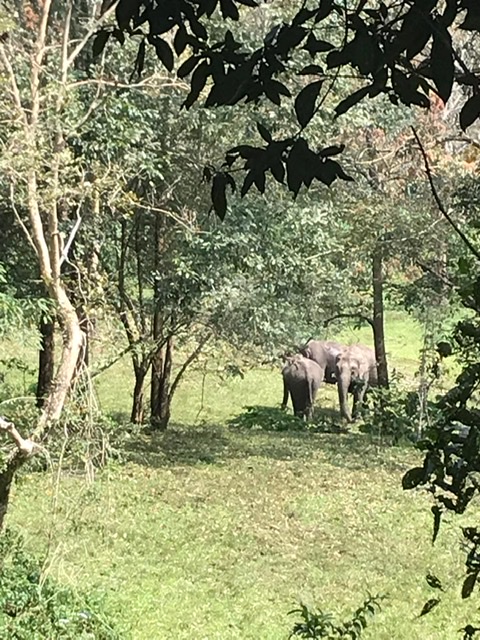
India really knows how to create and maintain national parks the way they should be. The kind where tourists are only allowed in a tiny percentage of the park lands and animals live in the rest according to their natural instincts and behaviors, without threat or fear of their main predator – us.
As it turns out, India also really knows how to create and maintain zoos the way they should be. The kind where the animals have enough space to live their lives as comfortably as possible, while being protected from their precarious reality out of captivity.
Of course the Saraus Crane, that very tallest of birds, might prefer to fly free, and that Bengal Tiger might prefer to roam the tropical and subtropical rainforests chasing prey, but their natural habitats are, sadly, disappearing or have become too dangerous for them.
We humans have been responsible for many of the causes of extinction and the threat of extinction for many members of the animal kingdom (though certainly not all). We have become one of the major causes of their comeback, too.
Wolves and buffalo, verging on extinction in the ‘60s, have made a valiant recovery as a result of protection laws passed in the ‘80s. Severals kinds of frogs, antelope, birds, turtles, and leopards have been saved from extinction by zoos. Yep, zoos.
Seeing wild elephants from a safe distance in Periyar Park creates a very different visual than seeing elephants in the Mysore zoo. That difference makes it tempting to condemn the zoo concept.
But that condemnation could paradoxically lead to the extinction of a large number of animal species.
I admit to some of my very best memories being the Macaws at the clay lick in the Amazon, the playful Otter family in their natural waters near Sandoval, the Blue Boobies on the cliffs in the Galapagos, the warm weather Penguins in the Patagonia plains…you get the picture.
But I’m happy that the Golden Lion Tamarin, once almost extinct, is thriving in captivity so that my grandchildren can get acquainted. Same for the California Condor and other majestic beasts.
Sometimes generally accepted ideas need to be re-thought.
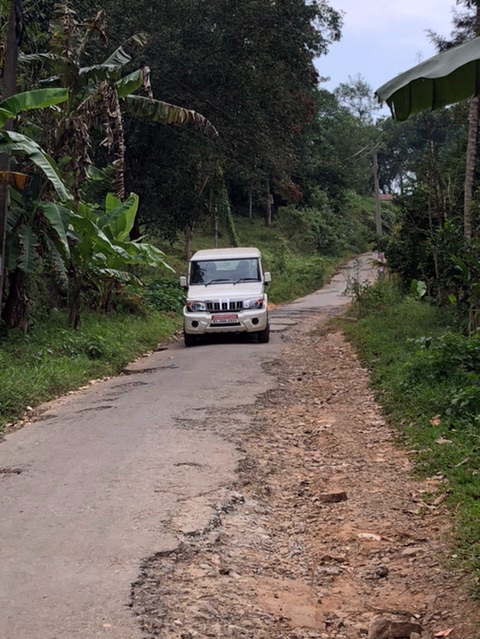
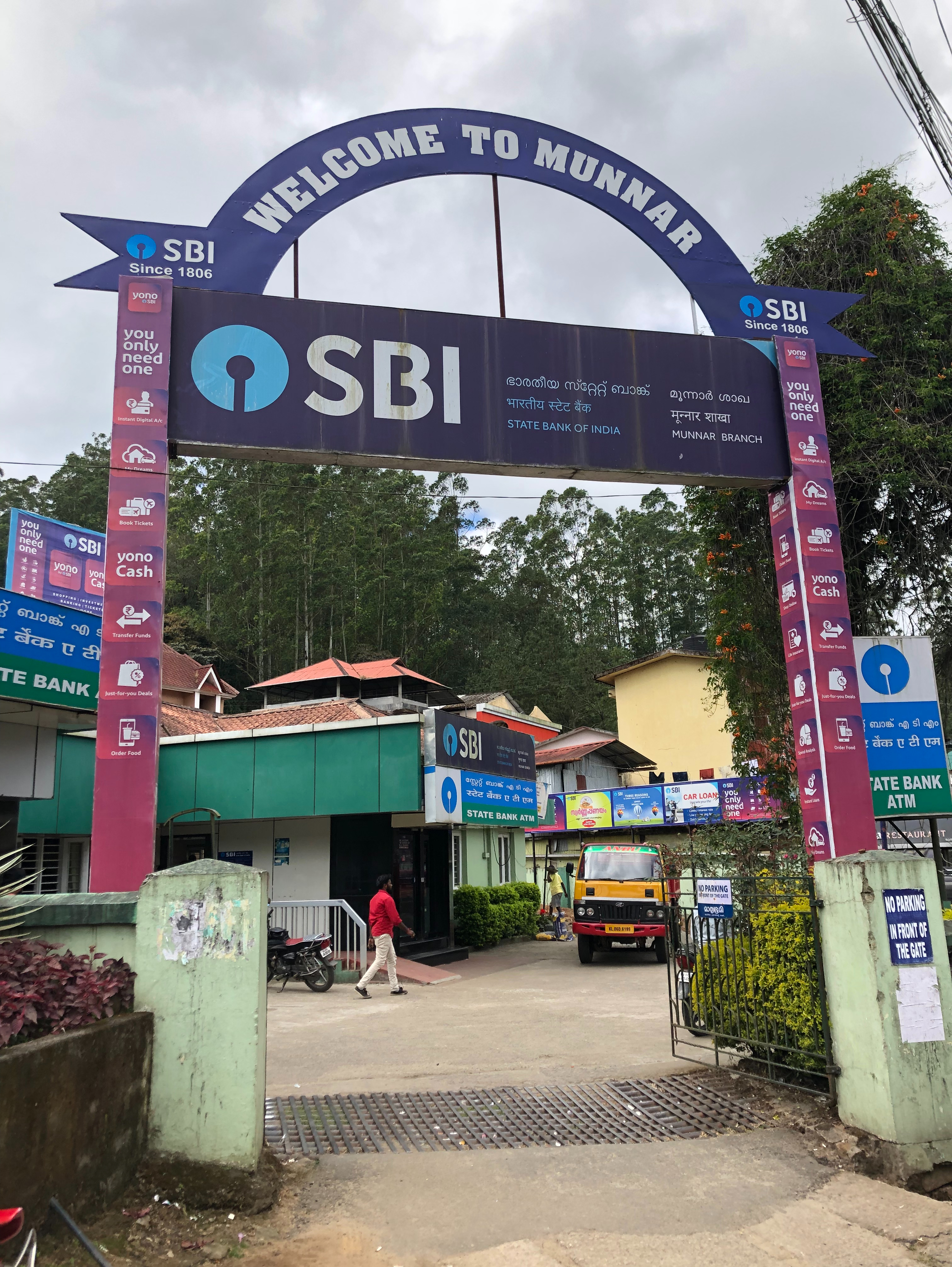
Yesterday was a travel day. Yep, we ventured out of our little piece of heaven. Traveled forty minutes on the sometimes barely existent road in a tuk-tuk to Munnar – the big city in these parts – town of 38,000 inhabitants.
Our plan for the day was to check out Munnar and then go on a TripAdvisor tour called The Tea Trail which included a visit to the Lockheart Tea Museum and Tea Factory as well as a visit with the tea pluckers as they’re called, and the chance to pluck some tea and follow it through until it turned into a cup of tea. We should’ve been suspicious right away since, the tea process being what it is, there’s no way our freshly picked tea leaves could turn into a cup of tea within an hour.
But all in good time.
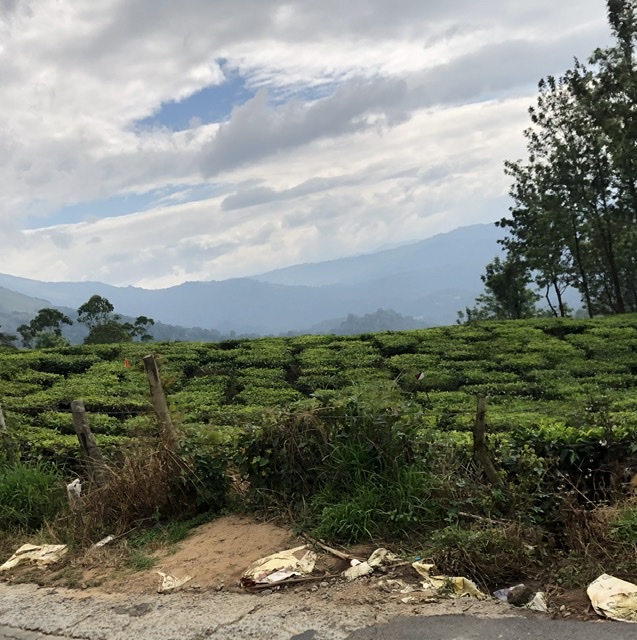
The twisty, uphill road into Munnar, aside from being narrow and deeply rutted at least half the time, was breathtaking not only because of the near-collisions but also the fantastic views of the tea, which grows all over the place in extremely well-ordered glory, under a dramatic sky with clouds wisping around and in front of mountain peaks.
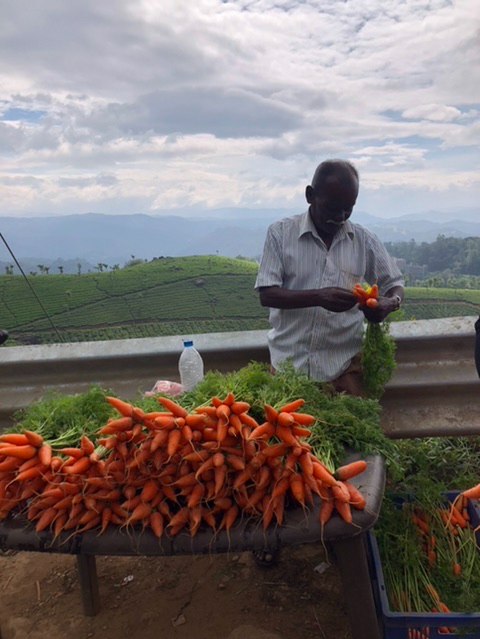
And then, suddenly, and for no apparent reason, there was this.
Why carrots? Who knows. But they were incredibly fresh and their color was the brightest I’ve ever seen. Tempting to buy but we had nothing imaginable to do with them so we sadly gave them a pass.
After a discussion about our finances just days ago, we’d decided to be more cautious with our spending (read“my” for “our” and “I” for “we”). But within minutes I’d bought handmade chocolates for one sister’s upcoming birthday and a mini-kurta and smaller box of chocolates for the other. This necessitated our third post office experience – the oddest and funniest yet. But that will appear in a much later post with tips for the traveler to India.
There’s a saying that everyone you meet is your teacher. Way back in Mumbai we had a young man guide us through the Mumbai markets. He was sweet but not much of a guide. We didn’t learn anything about Mumbai markets but we did learn little tips for getting along in India. One of the most useful of his instructions concerned bargaining – always start with an offer of 1/3 the asking price. Sounds insulting but it’s right on the mark. You get a feeling when the seller is finished and really won’t go lower. The final price will be 1/2 to 2/3 of the original price and everyone will be happy.
Our tuk-tuk driver from Munnar to the pick-up point for the tour started at 300 rupee ($4) and ended up taking us for 200. It was a 25-minute drive similar to the one from Ayursakthi Riverdale to Munnar – bumpy, with hairpin turns. He dropped us off at 14:10 for our 14:30 tour. It was a beautiful location overlooking the tea fields. We’d brought warmer clothes so the chilly mountain air didn’t lessen our enjoyment of the luscious green surrounding us.
At 14:40 there was still no sign of our guide/car and TripAdvisor wasn’t answering emails so we began walking the 500 meters downhill to the Lockheart Tea Museum through the enchanting (enchanted?) Eucalyptus tree forest.
My partner’s knee had started giving him grief in the morning. Downhill aggravated his discomfort more than uphill. He’s very fit – a gym fanatic – and definitely not a complainer, but at some point I waved down a tuk-tuk to take us the rest of the way, fuming at TripAdvisor and planning my scathing review of the tour we’d paid for.
At the museum and factory there was still no sign of TripAdvisor other than their stickers all over the place. The cashier spoke no English but the word TripAdvisor gained us free entry. We bumbled along on our own in the amusing museum with its silly relics – like ‘an English bathtub’ and a rusty old iron – and fascinating photos. Once again we found ourselves wondering about British rule. Every photo showed a work crew or social group with at least 15 Indians to every Brit. How in the world did they control India for 300 years?
As we sat at a picnic bunch overlooking the plantation, pondering the lovely view, TripAdvisor and other questions, a woman came running over and asked if we were with the French group. We said ‘no’ and once again tried to explain that we were a TripAdvisor ‘group’. She turned a puzzled face to ours.
No French. No TripAdvisor. No worries. She herded us to the factory entrance where a pleasant man with excellent English said he’d been told we’d arrive at 10 (Eureka!), which was later corrected to 13:00, but happily agreed to guide us through the factory if we would just put on little blue crime-scene booties.
The tour was very interesting. Who knew?
Turns out that all tea – black, green, and white – (white?!) – Orange Pekoe, Earl Gray and Chai – is made from the same tea plants. Black tea is made from the lower leaves, green tea from the top two leaves only, and white from the lone bud between the top two leaves.
Black tea is more processed, going through three drying stages, one of which lasts either 30, 60 or 90 minutes, a heating process, and one of three grinding options. Green tea is processed far less and white tea is barely processed at all.
Black tea is ground fine, finer or even finer, while green and white tea are not ground at all.
Finally, the death blow to my teabag drinking days, we saw that black tea, in its final stages, is separated out by color-sensitive cameras into leaves, stems and fiber. Some tea is packaged with only tea leaves while other are packaged with a mixture of leaves, stems and fibers. It’s the second kind that goes into teabags.
Ugh!
The stems have no flavor but add color. The fiber adds bulk. The first is labeled ‘Orthodox’ tea and the second is ‘CTC’ tea. I never noticed that on boxes of tea but I’ll be looking for it.
When we had a tea tasting experience at the end of our tour we could definitely discern the difference. The CTC tea had a very bitter aftertaste and the taste in general was less pleasing. Sadly, the white tea, which is coveted, has the most health benefits, and is very expensive, was flavorless.
On to the fields where we were too late to meet the all-female tea pluckers. Yes, that’s what they’re called, though it may be a translation from some other language.
Turns out you have to arrive by 13:00 to actually meet those plucky women who are paid the equivalent of $5.65/day to pick 27 kilo of black tea with machines or 400 grams of green or white tea by hand. Pick less than 27 kilo and the per kilo rate drops. Oddly enough, a lower per kilo rate is paid for every kilo over 27, also. Go figure.
Pluckers who are permanent employees are given free lodging but we couldn’t figure out why some workers are eligible while others are not.
22.4 million tons of tea are bought annually in the world. That’s one heckuva lot of tea. China is first in the world of tea production with India a solid second and many other countries, like Sri Lanka, trailing behind.
The Lockheart Tea Factory sells tea to Twinings, Tetley and other tea brands. We might be able to see their export name, Harrison, on some boxes. I’ll be looking for that, too.
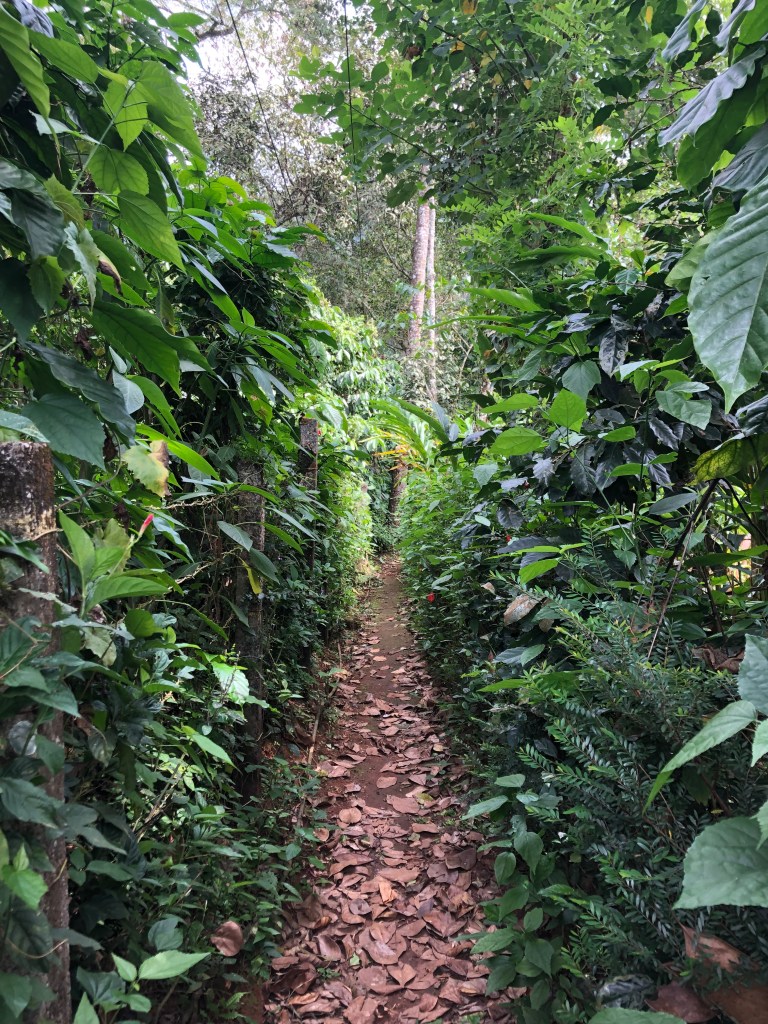
The lovely woman who accompanied us in the tea fields lives seven kilometers from the factory. She takes a short cut through the forest, which reminded us of the children we saw in Peru walking home from school up into the mountains. She laughed when we exclaimed at her daily journey saying that she’s still fat. While I found her pleasingly rounded, I wouldn’t have called her fat. Indians don’t find that a derogatory term, though, and use it freely about themselves and others.
She kindly arranged a tuk-tuk to come get us, realizing that my partner’s knee was bothering him. She negotiated a price and we were off. The young driver was truly a maniac on the road, even more than usual, but we negotiated with his sweet brother (picked up along the way) a good price to wait for us while we ate dinner and then drive us back to Ayursakthi Riverdale.
Weighed our options ⚖️ – possible death on the road, good price, possibility that none of the other many many tuk-tuk drivers would be willing to risk life and limb on that road at night – and confirmed the deal.
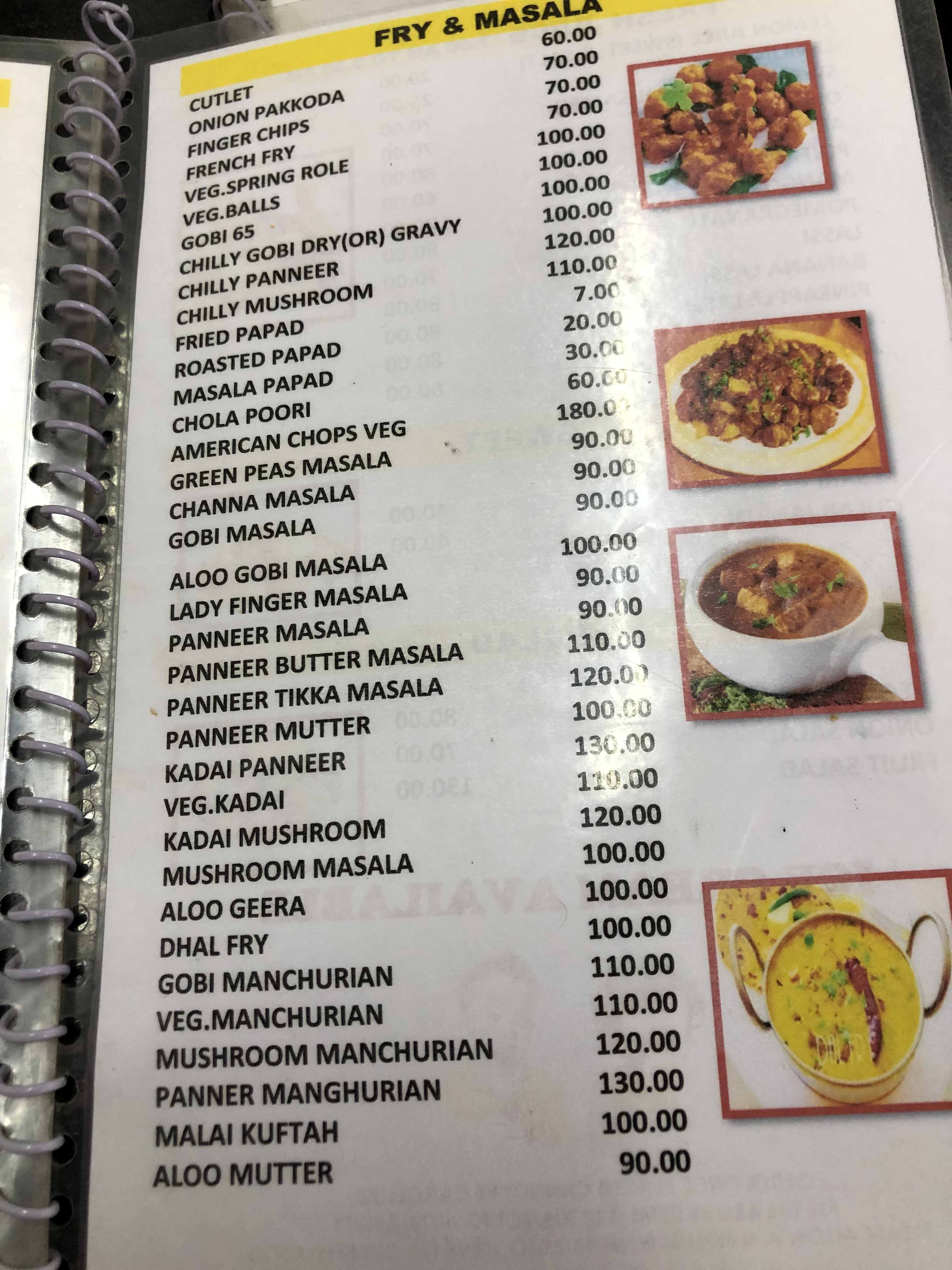
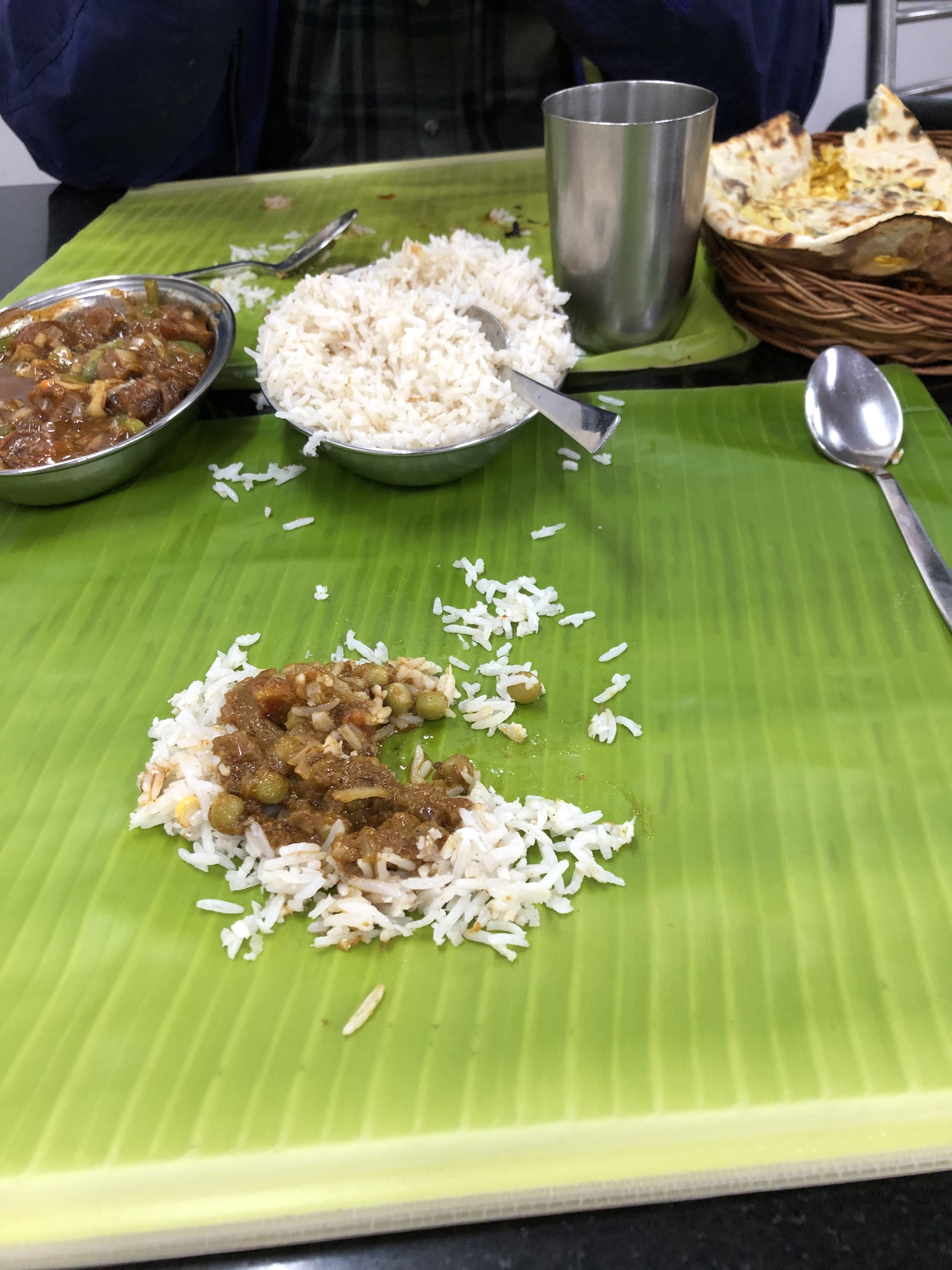
He took us to a pure veg restaurant where we had what was very possibly our best meal yet. Manchurian Mushroom, Green Pea Masala, Coconut Rice, Garlic Naan, Coffee and the best Masala Chai I’ve had so far – all for a total of about $6.50. Our dinner was served on big banana leaves.
No forks in sight.
Indians eat with their hands – actually one hand;their right – which is why only foreign tourists get forks in many restaurants and why there’s a sink or two in the restaurant. Washing one’s right hand is essential after the meal. Before the meal is optional.
Some foreign tourists emulate the eating with the hands thing. I have to admit, I don’t get it. Adopting customs that are pretty, like wearing a kurta, or practical, like the Indian version of the bidet, is nice. Using a banana leaf instead of a plate is genius. Roll it up & throw it out after dinner. No dishes to wash! But foregoing forks? Really? A bit silly, imo.
Lessons learned from our Munnar Tea Outing:
1. It only takes 3 minutes to steep tea leaves and is well worth the wait.
2. The Lockheart tea trail tour is great! Do it! But it’s done just fine without the commission to TripAdvisor and the added hassle of trying to hook up with them. Go on Monday – the only day the manual plucking of green and white tea is done. Get there before 13;00.
3. Pure veg restaurants probably prepare better veg meals than restaurants that provide veg and non-veg options.
4. Locals know the better restaurant choices. Ask them.
This trip started out as one of those ‘round the world’ tickets where you have to keep traveling in one direction – east or west – and can’t cross any specific ocean more than once. I must’ve played with that planning tool on the Star Alliance site for twenty hours or more over the course of several months.
Tel Aviv – St. Petersburg – Mumbai – all over India – China – Bora Bora – Alaska – Oregon Coast – California – Salt Lake City – Mount Rushmore – The Badlands – New Mexico – San Antonio – Fort Lauderdale – New York City – Toronto – The Bay of Fundy/Nova Scotia – Iceland – Tel Aviv
Juggling weather, direction, time.
How much is too ambitious? Australia, yes or no?
Should we rent an RV to travel around the US? A car with motel stays? Flights for the long bits?
But then the time came to make real decisions like renting out the house for the year and what to do with my yoga studio and my husband started hemming and hawing. There were hesitant chords of concern about leaving our lives for so long. I tried to ignore them. Gloss over them. Treat them like background noise.
A year. Twelve months.
I had to admit to myself that it was sounding like a really REALLY long time to me, too.
The house wasn’t the problem. Neither was the studio. Though I love both.
It was the kids, the grandkids, and the friends who have become no less our family in the 30+ years that we’ve shared a life.
So twelve months became ten months became six months and here we are with the second month of our six-month trip drawing to a close.
In this technological era, it’s pretty easy to keep in touch with people. We share our amazing surroundings and the interesting people who inhabit them with a WhatsApp group for our English-speaking friends daily. We post on FaceBook for our Hebrew-speaking friends or send separate WhatsApps or emails. We send messages to our family WhatsApp group, too, and keep in touch with them with video WhatsApp weekly when we can find a strong enough WiFi connection, or with audio WhatsApp when we can’t.
We spoke with our youngest son and his wife yesterday from an isolated snack food kiosk in the jungle as they drove home from an office party in Silicon Valley, California.
We remember the days, not too long ago, when we sat in Internet Cafes, paying for the internet per minute and waiting endlessly for the atrociously weak and slow connection. Then there was Ko Mak, an island in Thailand, where we had to hike an hour to the other side of the island daily for the only internet connection because I had left Israel in the middle of interviewing candidates for a position and had to go over resumes.
Earlier there just was no internet – impossible for our grandchildren to envision – so we made the occasional phone call when we could.
It seems that most of the important people in our lives are healthy and major crisis-free so far during this trip.
Before we left we knew that one friend was scheduled to have a small, probably cancerous, tumor removed from her kidney, and after we left we received the good news that all had gone well with her surgery.
One granddaughter had an ugly eye infection that seemed to linger endlessly. Endlessly finally came to an end after way too long a time for my taste. Her swollen-closed eye then returned to normal.
The worst of it so far has been a shocking but benign head tumor with sudden, unexpected, surgery that’s meant weeks of rehab for a neighbor who’s like a younger sister to me. That was a tough one because I knew that my presence could’ve been important for her morale, but, thankfully, her recovery seems to be going well.
Life is full of surprises – big and small; pleasant, unpleasant and neutral – and they don’t cease when we’re far away from our usual haunts.
So here’s the deal.
Relationships with people are one of the most important ingredients in the tasty soup of life. There’s our relationship with ourselves; our inner world. The one we take with us wherever we go, whether it’s to the living room or to India. Then there are all the others.
The ones we choose; the ones we’re born into; the ones we birth; the ones we marry into; the ones we grow into because of circumstances; the ones who are part of the landscape of our lives.
There are even relationships we’re semi-unaware of until they’re brought to our attention.
There are close relationships and casual relationships. There are close relationships that become casual sometimes and casual relationships that become close at others.
There are relationships that take us by surprise and relationships like old slippers – comfy and constant.
But there’s one reality of important relationships that my husband has pointed out to me many times – they have a past, a present and a future. If one of those elements is missing, the relationship is a like the one with that second grade teacher you had in elementary school. She may have been one of the most significant people in your life when your were seven but she’s only a fond memory today.
Anyone who knows me knows that I’m a relentless technological freak. I love the newest, the most creative, the most surprising new concept, gadget or app. I’m that person that buys the out-of-the-box FaceBook solution for neck tension and was one of the first to contract out administrative projects to freelancers online fifteen years ago. I never give up communicating with people in the Mayalayam spoken and written on my translation app in spite of dozens of puzzled expressions. I trust Uber and Waze and UpWork.
I prefer email and WhatsApp to phone calls or personal business meetings. If you WhatsApp me, chances are you’ll get an immediate reply sixteen or seventeen hours out of twenty-four, even from the tropical jungle of Kerala.
And yet.
I’ve learned to embrace another reality about relationships.
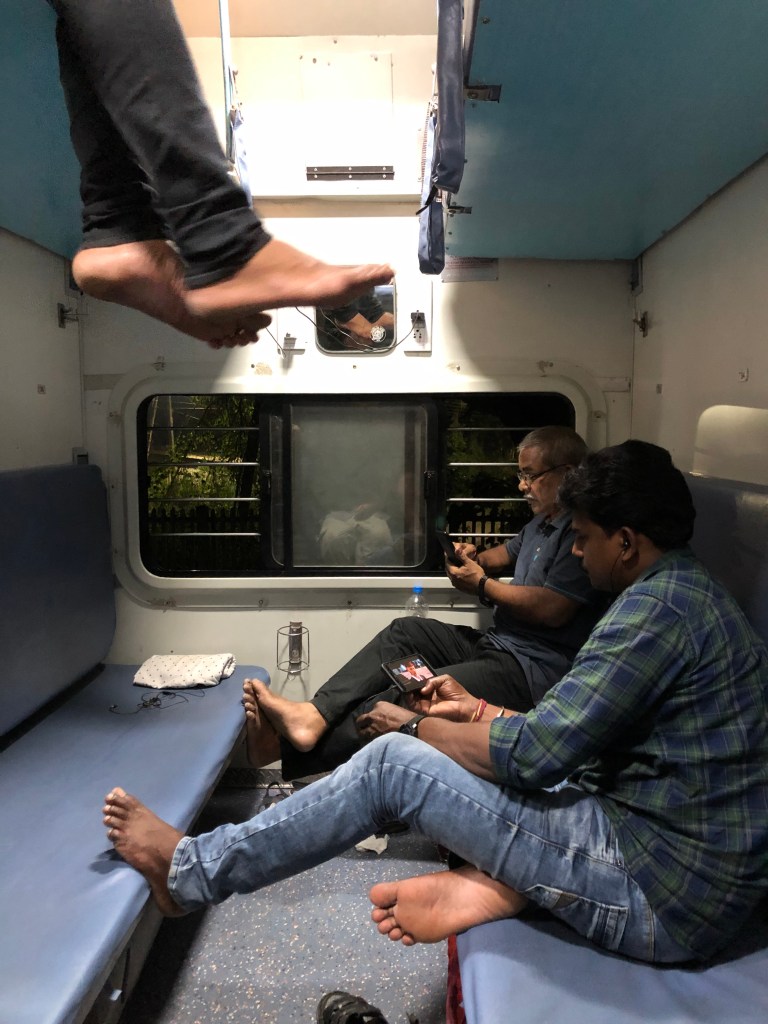
The important ones cannot, ultimately, be sustained with technology. They can be maintained temporarily in a loving electronic space when watered sufficiently – pardon the mixed metaphor – but they will eventually rise from the lower berth to the 3rd tier berth of relationships and become your second grade teacher.
It’s true of best friends, of sisters, of kids, and probably most of all of grandkids, who have the disadvantage of being too young to have solidified any relationship enough to withstand the loss of perpetual physical proximity.
I love to travel. Someday I may not be able, physically, to climb into a train berth or even get on a plane to travel to another exotic location, but I’m guessing I’ll become an armchair traveler. Meanwhile, I look forward to the next four months in India, a week in Greece with my daughter and granddaughter in July, and am already planning to rent a little place for three months in Guatemala next winter.
But I won’t be fiddling with that ‘round the world’ Star Alliance again in anticipation of a year of travel. I have a feeling that I won’t even be looking at six months again. I’m so happy that we grabbed the opportunity to take this incredible journey. I’m seriously enjoying every single day.
While I tend to feel ageless, I am aging. But that’s not the thing. It’s not fun to do many things I used to have fun doing but I’ve barely noticed that I’ve stopped doing them. I’ve moved on to things I may have once thought slow or unexciting and get a huge kick out them now.
The thing is that all the people I love are aging. Yep, even Alex, our youngest grandchild. And certainly our family-like-friends who have almost seventy years on her.
I want to be IN those important relationships. I don’t want a single one of them to become my second grade teacher and I don’t want to be theirs.
I’m so grateful that I’ve birthed, married into, grown into, chosen, and been brought by circumstances into relationships with multi-faceted, quirky, wonderful people whom I love and, wonder of wonders, love me back.
One of the best things about my life is that I’m fortunate enough to live in time that I can nourish both my love of travel and my love of relationship, if I can only remember to balance them and adjust to the times. After all, I could’ve been born under a bridge in Mumbai.
Happy Monday to all from 20 kilometers from the middle of nowhere.
































































 gettingoutalive