We’re leaving Thumpoly Beach later today.
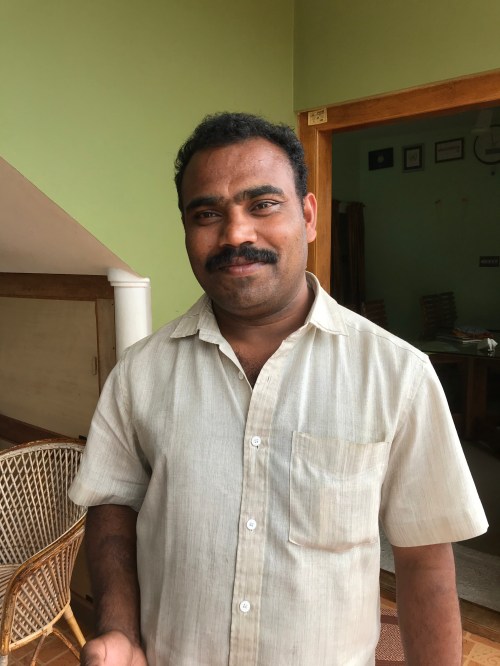
Yesterday I spent two hours happily painting with acrylics surrounded by paintings of local artists and classical music in a specially designated room in a local art gallery. The owner of the gallery, a retired professor of political science and engineering, provides this wonderful experience for any tourist fortunate enough to learn of the possibility and make a reservation. There’s no fee.
He explained as we shared a cup of (way too sweet) coffee that he left the university five years before the age of retirement because his wife left her teaching position and was at home. There was a hint of illness on her part but he didn’t elaborate and I didn’t ask.
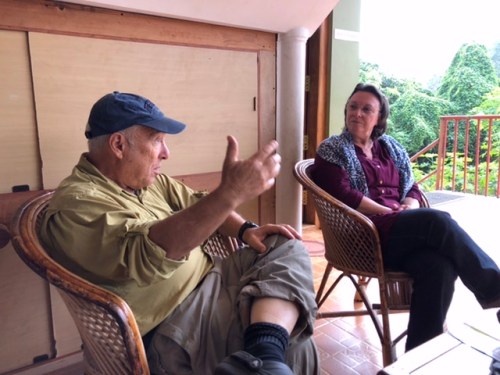
I sensed that the experiential opportunity he offers is an opportunity for him to socialize with people from all over the world now that he’s restricted to this lovely but insular fishing village. We chatted for an hour as he brought out spicy roasted cashews and cookies. A little politics (a big Modii and Bibi fan). A little religion (he’s Christian and fondly recalled his pilgrimage to Israel). A little economy (India has a vastly more reasonably priced medical system and price of living).
A man happy with his lot in life.
As I walked home I thought it could be very pleasant to be in Thumpoly for an extended visit and share afternoon tea and conversation with him from time to time.
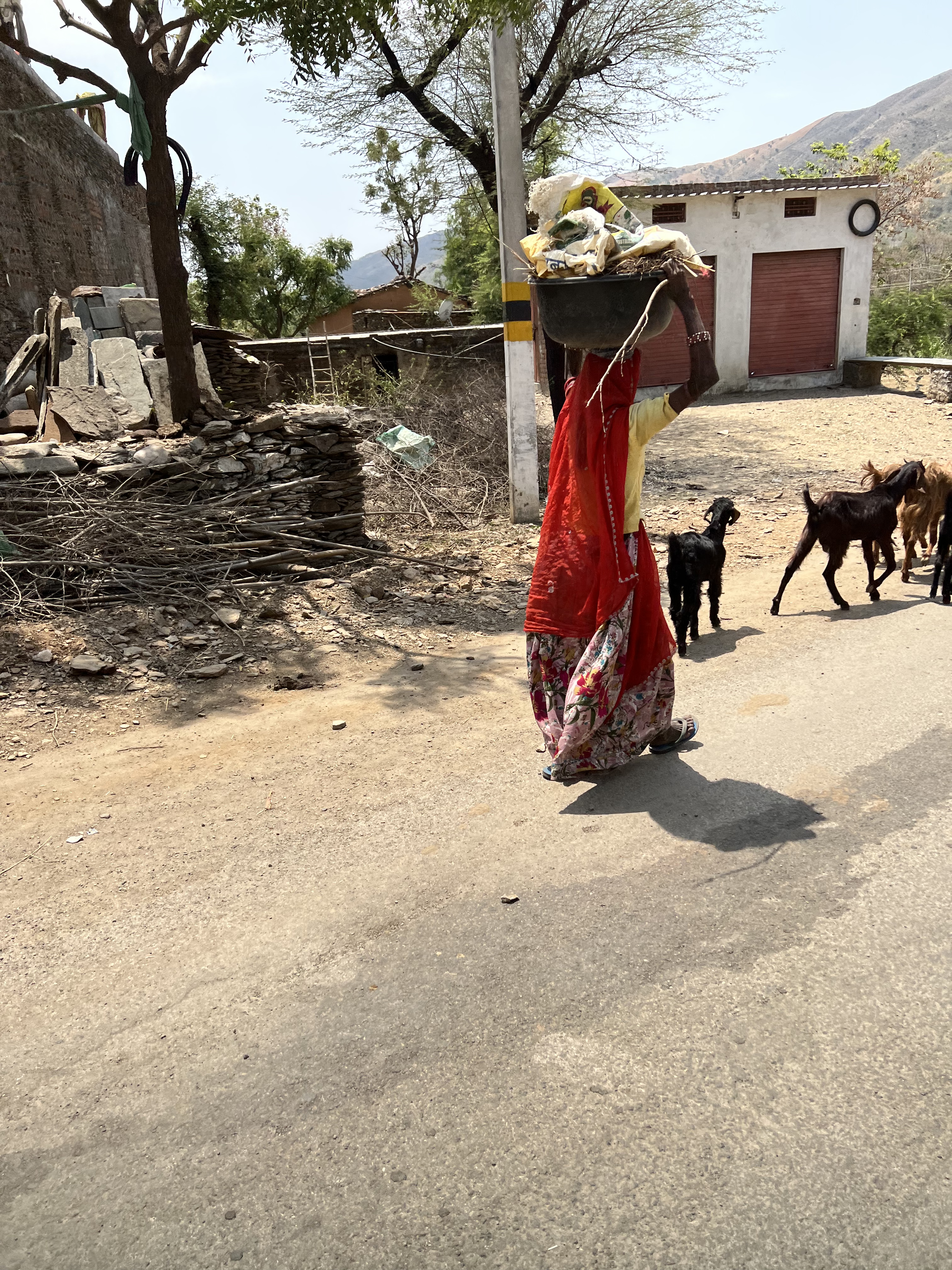
I recognized several of the women I passed in their colorful saris with an umbrella held overhead to protect them for the sizzling sun. We smiled at each other, wagged our heads and offered a soft ‘namaste’.
Most stores are closed for a few hours when the sun is at its hottest and only now, at five o’clock, people are again out and about.
My partner and I had agreed just that morning that, as wonderful as it is here, we were ready to move on. But as I gazed at The Arabian Sea and the young men strolling along the beach I realized that I’m a little sad to be leaving.
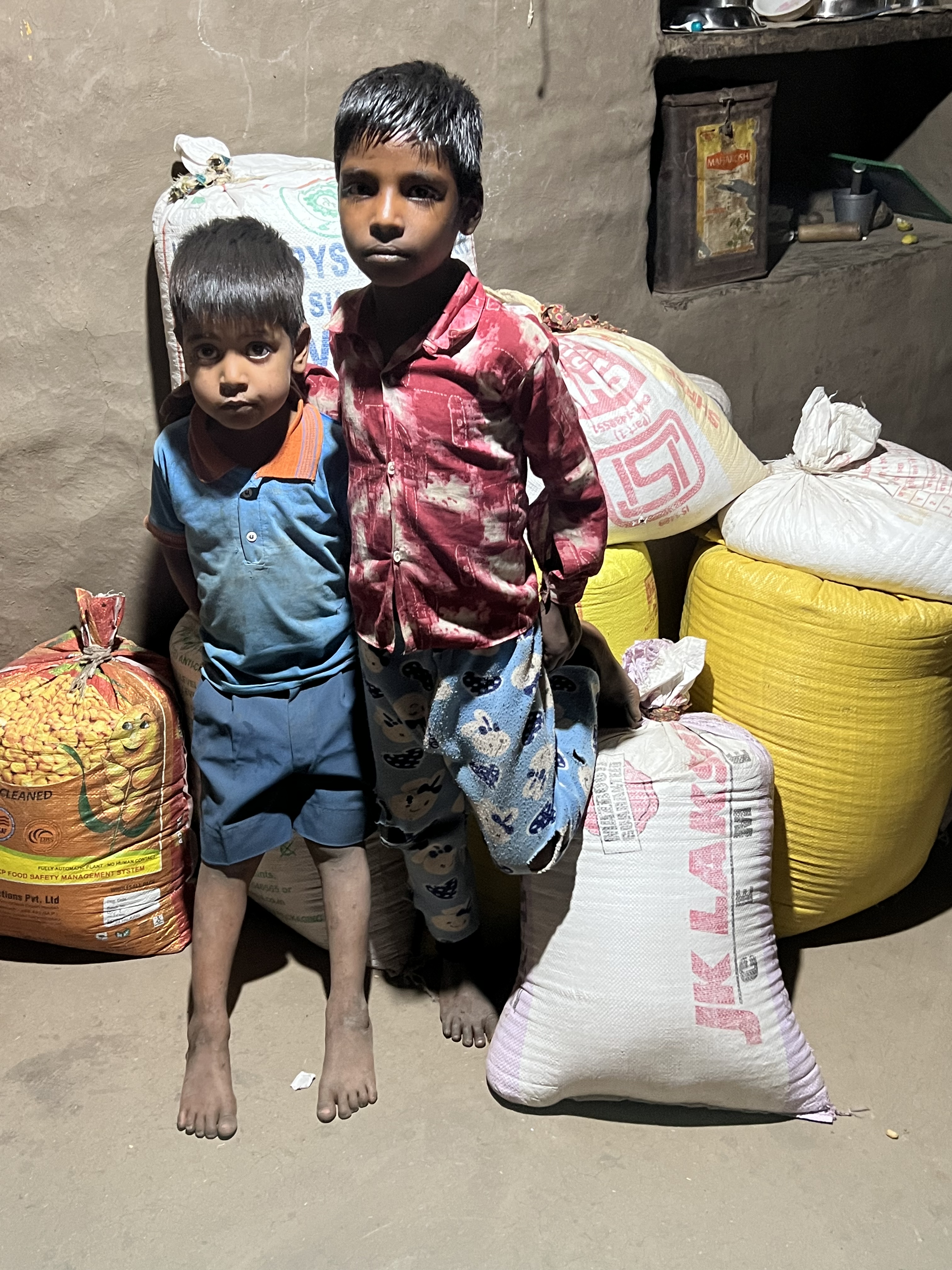
Every morning we see the fishermen heading out for another day of catching whatever they can – and it isn’t much this time of year. They throw their gill nets or small trawling nets and harvest what they can. A few shrimp. A crab or two. A kilo of very small fish if they’re lucky. Later in the day we see exuberant children walk by in their school uniforms. Inevitably they stop to say hello, ask our names (again) and inquire after our health.
In the late afternoon, when there’s more of a breeze, we see various village residents walking by on the dirt path along the shore in front of our balcony. No one is in a hurry. They seem to be enjoying the sea air and the crash of the waves as much as we do, even though they’ve undoubtedly lived here all their lives.
I suppose there’s gossip and intrigues here as there are everywhere; heartbreak, ill health, kids making life choices their parents don’t understand.
There are very big beautiful homes and tiny unkempt hovels.
But in general life here seems to have a gentle rhythm and people seem to smile much more than in the towns with which I’m more familiar.
Our friends here have two children, which is the norm. One, their daughter, was accepted into the engineering program at a prestigious university very far away. The other, their son, is finishing high school and plans to spend seven years in the army.
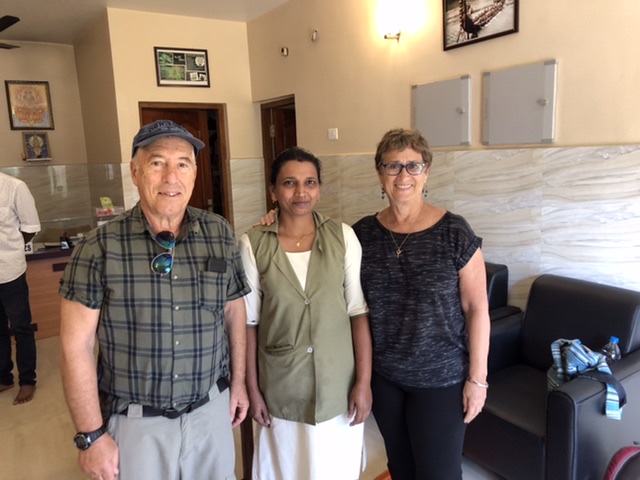
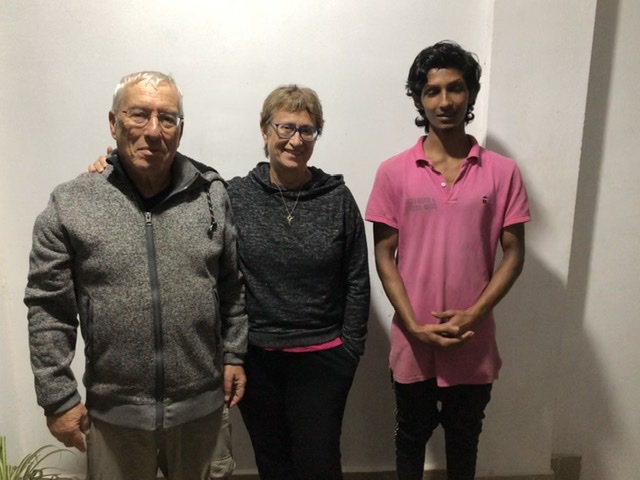
Our friend, Antony, raised in this village, the son of a fisherman, was a career officer, head of the anti-terrorist units fighting in Kashmir, and retired as a colonel, one of the wealthier residents of Thumpoly. His wife is a school principal who (in spite of her profession?) is almost always smiling and happy.
Antony and Teresa both give much of their time to the community. Whether from modesty or simply relaying this village’s reality, Antony has told us often that giving to the community is the norm and not the exception.
There are certainly downsides to life in this crazy patchwork of a billion and a half people, over 25 spoken languages, millions living in slums alongside the abundance of IT employment, jewelry production and export, and a caste system which refuses to die, just to name a few challenges.
At the same time, there is a gentler way of life and a serene inner beauty to those who have less, in many cases a whole lot less, but retain an appreciation for what they do have.
So, yes, I’m a little sad to be moving on, even while I look forward to better physical conditions and an evening cocktail.
Ah! The contradictions of life.
Tag Archives: gratitude
From Here to the Sun and Back Sixty Times
Human knowledge grows at a phenomenal rate. Think of the world as understood in Medieval days and as we understand it today. No need to go so far back. Think of the average Western household in Ozzie and Harriet’s time and your own household.
My partner, who could be called antagonistic toward maneuvering through life via screens, came home one day not too long ago decrying how much even he relies on screen technology in the course of his day. He checked the best route into the city with Waze to avoid as much traffic as possible. He parked his car using the Pango app. He received and acknowledged orders from clients via WhatsApp. While waiting for an appointment he got caught up with local, national, and international news online. He called me from his cell phone to mine to kill time in traffic on the way home.
And traveling? How did we manage when we started traveling to out of the way places 30 years ago? No booking.com, Airbnb, TripAdvisor; no Facebook groups of like-minded people offering tips or asking for information. No Uber or Ola to find and get us to hole-in-wall locations at a reasonable price. No google to locate pure veg restaurants.
Okay, all that technology is amazing. It makes our lives so much easier and so many things more accessible. And it also, of course, has huge downsides and creates many distressing societal issues. But this isn’t about that.
Human knowledge doesn’t begin and end with technological advances like those.
The medical world has now advanced to allow for many previously terminal cancers to become chronic cancer; cancer with which, with continuous treatment, people can live a quality life for decades. Prosthetics moveable by thought. I could go on but I don’t really know even a minuscule percentage of all the incredible innovations in the world of medicine.
And what about all the new information coming from the James Webb Space Telescope? It can see what the universe looked like around a quarter of a billion years (possibly back to 100 million years) when the first stars and galaxies started to form. Astrophysicists are scratching their heads wondering how their science could’ve gotten so much so wrong now that the telescope is providing new information.
The study of the cell – that most basic of components in the biological world – has changed so much over the past few decades that today we know that if the DNA from the cells found in one human body were stretched out in one continuous line it would reach the sun and back sixty times, Sixty. Six-oh. We didn’t even know DNA existed before the 1860s. It wasn’t known to be the carrier of genetic material until 1944 and became a reliable profiling mechanism only 40 short years ago.
Amazing, exciting, miraculous advances in human knowledge.
And yet…
Yesterday I tuned into day three of The Dalai Lama Global Vision Summit. I happened to choose Dr. Joe Loizzo’s talk about ethical leadership. I got as far as his call for every person on the entire planet to commit to becoming an ethical leader. Certainly I agree that each of us can and should develop leadership skills in our lives but, seriously!?! If the prerequisite to improving the unfortunate state of a world in conflict is for every single person on earth to become an ethical leader, it just ain’t gonna happen, bubba.
I mean look at us.
In the United States you have the cancel culture, a city proposing that each household pay $600,000 to help pay reparations to people who were never enslaved by a state which never had slavery, part of another state wanting to secede from that state to join a neighboring state, and people afraid to express their opinion for fear of being fired from their jobs. And in one 45 hour period, in one state, there were three mass shootings resulting in nineteen dead.
In England there have been three heads of state in three years. In Spain the birthrate has plummeted to 1.23%. In France the divorce rate is over 50%. The crime rate continues to rise in the Baltic countries. In France a man was found not guilty of a brutal murder of an elderly Jewish woman by reason of marijuana smoking.
In India, Muslims in the state of Kashmir continue to fight for independence. A recent reactivated Sikh movement has begun demanding their independence in the state of Punjab. The Muslim minority in the southern state of Kerala is quietly taking over local political positions.
In Israel political, social, and judicial reform has provided an opportunity for those interested in strengthening social and religious divisions. Extreme and violent language has become acceptable on both sides of any given issue. Defamation of character, personal attacks, and demagoguery are representative while, unsurprisingly, compromise is less and less of an acceptable option.
Humanity seems to be like the proverbial snake swallowing its own tail
We can create, investigate, research, change, and vastly improve our physical reality. But what good is it ultimately if we tear ourselves apart as human beings inhabiting a common earth?
Contrary to what many of us have come to believe when our phones have achieved the capability of supplying so much of our needs, no (emotionally healthy) human being is an island. We do, in fact, inhabit a common earth. And one of animals’ basic instincts is, pardon the expression, not to shit in their own home.
People! We’re unloading a lot of crap in our own homes. And it will not end well for us.
How about trying this? The next time you’re faced with a person whose opinions are not your own, take a breath, think to yourself that she, too, just like you, is a human being who wants to be happy. First and foremost, a human being. Immediately afterwards, who wants to be happy. Choose to distance yourself from her if you must, but treat her with the respect and, if it’s not stretching it too much, caring, that could provide for a gentler, less threatening world.
As far as human knowledge has taken our understanding so far, we only have one world. And if there turns out to be others we would do well to practice protecting the one we know about or we’ll just destroy any others we discover.
Whatever happens, I’m satisfied
In Israel parents teach their children a saying very early on in life – Whatever happens, I’m satisfied. It rhymes in Hebrew and expresses a futile hope on the part of parents that it will nip complaining in the bud.
Pretty ironic since Israelis (and maybe Jews in general) are among the most, ahem, discerning (read critical, judgmental, complaining) people I’ve come across in my extensive travels. And I am one, so I’ve had plenty of experience.
On the positive side, perhaps that’s why we’re the start-up nation with more technological and medical innovation than any other place on earth. That squinting one-eyed gaze at everything around us and thinking…hmmm. I could do that better.
On the not-so-positive side, it’s a pain in the rear end to be so often surrounded by people who are almost never satisfied with the way things are. The food in the restaurant is never quite right even after an order reminiscent of Jack Nicolson in Five Easy Pieces (I’ll have omelette plain, with a chicken salad sandwich on wheat toast, no butter, no lettuce, no mayonnaise, hold the chicken). The room temperature is too cold or too hot. The teacher doesn’t pay enough attention to my kid or singles her out for special (not good) treatment.
I wasn’t feeling great the other day. Stuffed up, headache, scratchy throat, didn’t sleep well. Here I am in southern India. Home of Ayurvedic medicine. Decided to get an Ayurvedic massage. For the uninitiated, this involves total nudity and more oil than a Mediterranean diet calls for in a lifetime.
The very sweet young woman spoke no English – zero – and my Malayalam is pretty rusty. There was absolutely no possibility of any request whatsoever. None of the usual massage direction – harder, softer, higher, lower. Nada.
As I lay there swimming in oil I thought THIS is the opportunity of a lifetime to fulfill that Israeli saying – Whatever happens, I’m satisfied.
I found thoughts popping up about how I might prefer this, that, or the other thing she was doing but they disappeared as quickly as they arose. They were irrelevant given our mutual lack of communication skills.
Ultimately, after she wiped off a lot of oil and I pulled my shift over my head – this not being my first rodeo I knew that less is more is the rule when committing to a Ayurvedic massage – I showered and crawled back into my stuffed up, scratchy throated, headachy nest and realized my headache was gone, my throat a bit less scratchy, and that prickly low grade fever feeling had disappeared.
I woke up this morning with more energy than the past couple of days. Had a peaceful, flexible hour on my yoga mat, and sat down to ponder the potential of “Whatever happens, I’m satisfied.” She knew what she was doing and any direction from me would have just gotten in the way.
It’s a continual conundrum in my mind. This contentment with what is versus the striving for improvement.
What do you think?
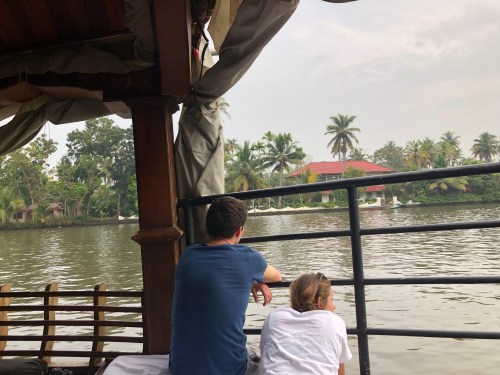
PS The above photo was taken from this very balcony three years ago. The most peaceful place on earth, Thumboly Beach
Mediating with Being Old
I just completed a 67-hour mediation course. The moderator/lecturer, Golan, was a charismatic guy in his early 50’s with vast experience and captivating stories about mediations he facilitated over the years. I wondered at the outset if I would be able to sit for five hours straight each Monday night without fidgeting and wishing I were elsewhere. Golan made the time fly. I didn’t have to do yogic breathing even once during the 10-week course.
One of the crucial concepts in mediation is the ability to differentiate the needs of the people in conflict as opposed to their positions, or presenting issues.
Eleven neighbors have entered into the mediation process regarding the parking lot between their houses where there are seven legitimate parking spaces. There are often clashes between people parked in legitimate spaces and people who park along the side of the lot making it difficult for those parked in legitimate spaces to extricate their cars. The eleven families have, between them, fifteen cars. As it turns out, two families do not have a car, one family has a driveway in which they park one of their two cars, one family has a driveway in which they park both their cars, one family does not park their two cars in the lot, and three families park only one of their two cars in the lot. One family parks two cars in the lot. Three families park one car each in the parking lot.
Have you seen this problem on a math test?
In case math wasn’t your thing, the eleven neighbors want to park nine vehicles in seven legitimate spaces.
Looks like a pretty cut-and-dry issue. Until it becomes clear that less than 50 yards away there’s a large parking lot that is virtually unused. So what are the actual needs of the people involved that must be addressed before the group can come to an amenable resolution for all involved? After all, they’re neighbors in a small community who have a common interest – living in harmony with one another.

But what does this have to do with meditating with old age? And how can one meditate with old age anyway? It is what it is…isn’t it?
About seven weeks into my ten week course I found a small hole-in-the-wall Indian restaurant with a few tables outside on the cobblestone pathway. My partner and I, both Indophiles and aficionados of Indian food, were happy to find this place. The table was a bit unsteady on the cobblestones but we made do and had a great meal with lots of nostalgia. Getting up after the meal I rested my hand on the table for stability – stability from an unstable table? You can guess the results.
The cook stayed by my side until the ambulance arrived. The paramedics were extremely gentle and pleasant, in spite of the fact that they looked young enough to be in high school. My neighbor was one of the nurses in the orthopedic emergency room. The doctor was thorough and helpful. All in all, other than two weeks of being almost totally incapacitated with back pain, it was a smooth, fortuitous experience. It could’ve been so much worse.
Well-meaning friends encouraged me to sue the restaurant – never a possibility in my mind. Being in the middle of a mediation course, however, I did think about asking the restaurant owners if they would be interested into entering into the mediation process with me.
First I wanted to take myself through the mediation process of figuring out the difference between my presenting issues and my needs.
Issue #1: I was out approximately $700 for physical therapy, my deductible for the ambulance, and having missed teaching three classes. Not a huge sum but money.
Issue 2: I wanted to be reassured that the restaurant would correct for the instability of their tables on the cobblestones.
Need #1: I wanted to be seen as a person – not a fragile elderly person who lost her footing as a result of being old and unstable on my feet
Need #2: I wanted, as part of #1, for the restaurant to take partial responsibility for the objective elements of neglect which led to the injury.
Are you starting to get the point?
From the caring cook to the empathetic paramedics to the informative orthopedist in the hospital I thought I recognized that they didn’t really see me. They didn’t see a woman who teaches yoga eight times a week or drives six hours a week to visit with grandchildren, or who goes bowling, plays miniature golf, and spends months at a time in off-the-beaten-track places. For the first time in my life, I felt the invisibility that many elderly women describe. I felt small and irrelevant and “other”.
When I wrote to Golan that I’d only be coming to the simulation part of class because I’d had an accident, he had one kind of reaction. When I came to the simulation and mentioned that I was injured in a fall, his reaction was different. He thought it had been a car accident – happens to the best of us. A fall? Ah, elderly issues.
Clearly this may have all been in my head.

And that’s exactly the point. In life, as we all know, shit happens. The first arrow. Inevitable It’s our reaction to it that causes suffering…or not. The second arrow. Within our control.
In my recent revelations I realized that, yep, we can be in constant mediation with the aging process. Searching for our needs when hit in the face (or the back) with the issues. It’s an ongoing occurrence.
Not as easy as a one-time epiphany. Ah, yes, I can have a happy, peaceful old age through acceptance.
Oh yeah? What about when there’s a new challenge a few times a month? Or how about a few times a week? What about when it’s limited mobility? And how about the exasperation of the person who assumes you’re not getting his explanation of the electrical system in your home because you’re old?
The good news is that if you’re into the mediating process you’re well on your way toward living your life instead of killing time.
Or as Mary Oliver said, “What is it you plan to do with your one, wild and precious life?”

Travel Buddies: Ephemeral Windows into Other Realities
Every single person on the planet has a story. We never even walk by the vast majority of them. Then there are those we walk by without seeing; the ones with whom we have brief encounters without really listening; those who share our lives in some way but whose hearts we rarely see into; and, if we’re very fortunate, a few with whom we exchange intimate confidences.
There’s an interesting phenomenon, a side effect of traveling, that involves the instant and inexplicably deep personal connection between people who meet, share a few hours or days, and never meet again.
A special bond is perhaps forged as a result of similar cluelessness about surroundings & cultural behaviors, or lack of routine and familiar faces. Or maybe the freedom of absolutely zero preconceived notions or previous acquaintance. Tabula rasa.

There was the family from Latvia who shared a lodge with us in the Peruvian Amazon. She confided that they’d been having marital problems & were moving to Boston where her husband had been offered a professorial position. Maybe a change of place would improve their relationship. They were traveling with their children for a year before the new academic year. He was determined to go to a shaman in the jungle to experiment with a special hallucinegen and unpleasant about her reluctance to join him. In the end, they left their young children and their passports with us – people they’d known for two days – and headed into the jungle.
In the morning they still hadn’t returned. Thankfully, they straggled back a little before noon. Hungover but healthy in body if not in mind.
And so it goes. We tell each other things we haven’t told close friends. We trust each other with confidences, money, and apparently sometimes our children. We enthusiastically join in adventures we might have had trepidations about. We listen to, tell, and enjoy vastly different opinions, occupational stories and familial foibles unselfish-consciously. We laugh a lot.
Antony (no ‘h’ in the many Antonys in Kerala, even St. Antony, and if you see an ‘h’, it’s not pronounced. There is no ‘th’ diphthong there.) was born in a very small fishing village in Kerala. Son of a fisherman, Antony loves nothing more than being out on the water in a small boat, meeting with childhood friends, hearing the waves lap the shore or crash on the rock barrier near his home. He chose a different life, though. Antony went to the military academy and spent 24 years in the military, retiring from his last position as Colonel, in charge of the anti-terrorist unit in northern India. He’s a hero in his hometown, and elsewhere. He went on to establish three businesses in the area surrounding his fishing village, employing over 90 people. It keeps him busy and away from his fishing village and the sound of The Arabian Sea. He’s not particularly interested in money for himself. His wife, Teresa, manages their bank accounts, saving what’s needed for their two children’s university educations, and gives Antony a small monthly sum to fill his motorcycle with gas and buy coffee during the day. He established businesses because he recognizes that along with employment comes dignity for his friends and neighbors. He’s also one of fifteen men who meet monthly to play games, share stories, and put money into the kitty for anyone who might be in need. His home is open to people at every level of society and they are happy to join him there for a drink or just a visit. Antony decided long ago that at sixty he’ll retire, he’s 49 now, and give himself the gift of The Arabian Sea’s whisper in his ear every day. An eclectic man, he never ceased to catch our interest or raise thought-provoking questions for discussion – philosophical as well as ‘what if’s’. We felt honored to be invited to his nearby home for dinner with his wife and son (his daughter was away at preparatory exams). It’s clear how much his son admires him and what a loving father he is (he told us that his wife keeps the kids in line because he can’t tell them ‘no’). I’m sure he was a tough officer in the military – he’d have to be – but in civilian life he has mischief and the sparkle of laughter in his eyes and a huge heart filled with kindness.
Katie’s only daughter lives in Pondicherry. Katie wasn’t much of a Mom. She was a flight attendant for Air France for her entire professional life, flying here and there and rarely at home. Her ex-husband raised their daughter. Retired now, she spends several months a year in Pondicherry, resigned to never being able to make up for lost time with her daughter, but determined to be a part of her life. A passionate woman, Katie’s views about French politics control a large part of her life. In the streets every weekend in her yellow vest, her harsh political rhetoric intrudes in almost every conversation. Macron, and Sarkozy before him, are the devil incarnate. And, yes, she does use those words. Enemies of the people, proponents of a new world order that disenfranchises everyone but the wealthy, robbers of the private benefits and income of the middle classes and the poor. Her political anger seeps into her extreme watchfulness in order to protect her from being taken advantage of, even by our sweet, accommodating host in Thekkady. We invited her to join us for a quiet day of walking in nature, surrounded by cardamom, coffee, and tea plants. Calmed by the sheer serenity of all that green, her political persuasions faded into the background, only occasionally peeking out to make a brief appearance.
Nancee was born and raised in a house in the forest, 40 kilometers southeast of the Kerala city of Munnar. She lives there still, in her house surrounded by fruit trees and passion fruit vines, and walks the kilometer to work as cook and cleaner in a three-story guesthouse/hotel owned and run by J.P. A quiet, shy woman, her smile can light up a room. When we commented on how much we loved the passion fruit that showed up on our breakfast table after we requested fresh fruit, she brought us a bag of the most delicious passion fruit I’ve ever eaten. I come from a country known for its plentiful, extraordinary fruit – picked in the morning and in the market in the afternoon. Passion fruit is one of my favorite fruits, but I’d never seen passion fruit so big, firm and tasty. She’d picked them from the vines surrounding her home, along with large cocoa pods (interesting, but not so tasty). She acquiesced graciously to my request to watch her cook our breakfast so that I would be able to replicate it at home, only a little embarrassed at first to have me looking over her shoulder. When we left, after two weeks at Arusakthi Riverdale, she approached me hesitantly, hugged me fiercely, then joined her palms at her heart and gave me a small bow. We didn’t understand each other’s verbal language but the language of our hearts was loud and clear.
Rav Yonaton wears a mixture of Indian and Hasidic clothing, along with his long payot (side curls) and large kippah (skullcap). Born and raised in London, the son of a totally secular family, he moved to Israel where he became religious, married, fathered a son, divorced, re-married, lived joyously in poverty, and shared in learning Torah with his new South African wife. Waking up to the necessity of providing for their upcoming baby, he lucked into a job as a mashkiach (kashrut supervisor) for a Baltimore company and relocated to Jewtown, India, near Fort Kochi (Kochin). His wife joined him there with their month old daughter two weeks later. Ever enthusiastic, ever sensitive to the cultural and social realities around him, Rav Yonaton has endeared himself to the largely Catholic community. A nice mural of him walking with his daughter can be seen on the wall of one of the newer, more comfortable hotels. The Hindu family across from a memorial headstone for a Kabbalist from the 17th century, located in an alleyway, helps to make sure the memorial’s burning light never goes out and joins the Rav there sometimes when he comes to daven (pray) there. We looked forward to having a bit of chicken after over a month as vegetarians, but there were only small bits of fish in the rice for Shabbat. Rav Yonaton explained to us later that he prefers to respect the poverty of his neighbors and not stand out as having the more expensive chicken on his Shabbat table. His contract will expire in the fall and he has no idea if he will be returning to unemployment, but his infectious smile precludes worry about his family’s future. As he walks us back to our hotel after havdala (the prayer to end Shabbat) at his house, he greets and is greeted by most of the passersby, each in his own language (and there are many). Loving and loved, he has no worries.
Vita and Ben are getting married in June after sharing their lives for over seven years. They’ve moved to Stamhope Hill in London, where she is a researcher for an NGO whose task is to evaluate the work of other NGOs and he is a youth worker in an adventure camp. They clearly both love their work and each other. She never wanted to marry and, in fact, when he proposed for the umpteenth time while on a romantic vacation in Japan (and was confident that she’d say ‘yes’), she told him to ‘Fxxk off!’ After a 20-minute conversation about why he wanted to marry, she was convinced, demanded he re-enact his proposal and afterwards said ‘yes’. He’s into the whole large wedding in a spectacular venue thing and she’s going along with only minor irritation in her voice as she reacts to his telling us the plan. Why marry at this point? Children are definitely on the horizon. They share a beer or two with my partner as laughter gets more and more raucous. Vita and I bond more over morning yoga on the balcony overlooking a tropical jungle. Our own temporary piece of paradise. We all swap hiking stories from beautiful Periyar National Park. They’re younger than our youngest child but age differences disappear easily among travel buddies.
Viktor is a solo traveler from Yerevan, the capital of Armenia. Somewhere in his late 40’s or early 50’s, he shares in the lives of his nephews but doesn’t see children in his future. A businessman, he’s not exactly rich but wealthy enough to help his extended family wage a decade-long (losing) battle for his ancestral home against the municipality, and pick up and come to a meditation seminar after an online Sadh Guru meditation course. Because of jet lag, he overslept and arrived two hours late to the seminar where he was turned away – ‘The Guru gave explicit instructions that no late arrivals were to be admitted.’ Offered an alternative – a 3-day retreat at the Sadhu Guru’s ashram in Coimbotore – he decided to attend and extend his time in India. That’s how we got the opportunity to make his acquaintance in Morjim Beach, Goa. We learned a lot about Armenia – he’s a super patriot. His only regret about living in Yerevan is that no one there is into spiritual meditation, or at least he hasn’t found anyone. He and my partner talked together for hours about Armenian history and politics. We visited the local fish market together and chose a big fish to have our cook fix for us one night. The cook didn’t like the look of the one we picked out so carefully, jumped on his motorcycle with it, returned it to the fish market, where he purchased a better fish for us. It was totally scrumptious and we shared a wonderful evening together with the sound of the waves and a lot of shared stories. Having fallen in love with Goa (What’s not to love? Beautiful, empty, clean sand beaches and gorgeous sunsets.), he extended his time there and we bid him adieu before heading for Kerala.
Ruth and Dieter, an Austrian couple, joined us for several days in Thekkady. We have a love of pure veg South Indian food in common that made walking down the potholed road outside our guesthouse together to The Hotel Aryas a given. They are as adventurous as we are when it comes to experimenting with new dishes and more so when it comes to eating with their hands. They went on a 20 km hike in Periyar National Park the day my partner went on a 15 km hike and I read for a couple of hours before meandering the streets and shops of Thekkady happily NOT hiking for hours and hours. They were to leave for a tree house hotel close to Ayursakthi Riverdale the next day but when they heard our praise for our amazing guide, Raj, on our 5 km nature hike earlier in the week, Dieter, a botanist finishing up his PhD, couldn’t leave without joining us on a return engagement with Raj. It meant they had to spend an extra 2500 rupee (about $40) to hire a taxi to get to their next town because they’d miss their bus, but they were game. We were happy to share the experience with them. Raj didn’t disappoint and it was so much fun watching how excited Dieter was to learn all about the flora in Periyar. Raj knows the common name and scientific name for every flower, tree and bush. Ruth, an occupational therapist, has amassed tons of botany from her many years with Dieter, as I have gained knowledge of bugs and crustaceans from my years with my partner. It was a pleasure spending time with such a like-minded couple, in spite of their being Austrian, barely thirty years old, and being in India for the first time.
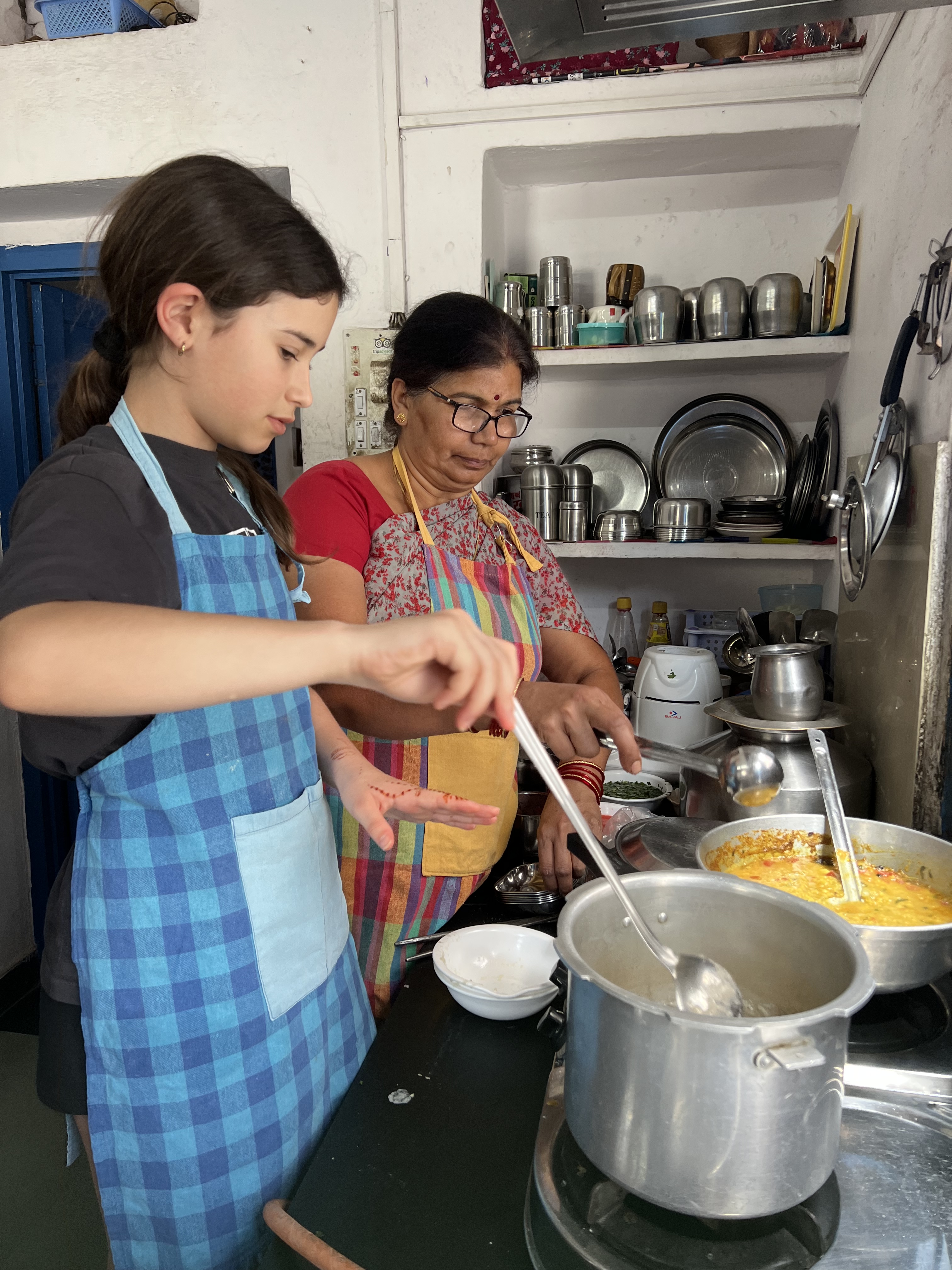
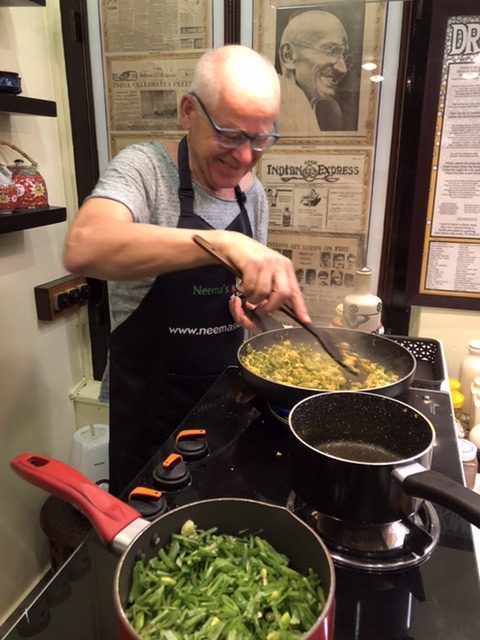
Neema taught me to cook South Indian dishes, including the masala dosa my partner loves so much. More importantly, she and her husband, Prasad, spoke to us for many pleasant hours about their India, their family, and their experience working with many tourists. A soft-spoken, gentle soul, Prasad actually worked for many years as the captain of a commercial line of ships. Neema spent her first five years of marriage (an arranged marriage, of course) traveling along with him, visiting ports all over the world, even after their daughter, Olivia, was born. It was a special privilege only the captain’s wife enjoyed. Once Olivia was a bit older, they settled down in Neema’s parents’ historical landmark home in Wypeen Island, just a short ferry ride away from Fort Kochi (Kochin). Neema’s parents live in the house as well, though we never caught sight of them. Prasad is well-read, andknowledgeable in many areas including history, Indian and world politics, world geography, ichthyology, a bit of botany, and many languages. As Neema taught me to cook, Prasad and my partner kept each other entertained. Prasad was the one to open up the, formerly unknown to us, history of Jews further north in Kerala. After cooking class, Neema put her feet up and we chatted about being mothers of independent, strong-minded young women, building a business which relies heavily on customer service, the trials & tribulations of developing and maintaining a social media presence, remembering to give back to the community, and, of course, where to shop for clothes and gifts close by for good prices and quality.
Raj Kumar is a member of the indigenous mountain tribe called the Munnan. To this day they live in small villages in the mountains with a king and village elders. When outsiders approach one of the villages, an elder meets them outside the borders of the village to decide whether or not to allow them to enter. The Munnan have control over Periyar National Park, though it’s technically a government park. The Munnan have always had control, considering it their tribal land. Of the the 357 square mile park only 118 square miles are accessible to tourists, in order to properly conserve the fauna and flora. As a result, elephant herds live in their natural age-old way, goddesses of their territory, are infrequently sighted, and make it clear with threatening noises and agitated behavior that they should never be approached from less than 100-150 meters. The park rangers are all Munnan. They guide small groups on nature hikes from 5-18 kilometers and carry out night patrols to be sure that poachers cannot harm the animals or protected flora, including sandalwood and mahogany trees. Raj Kumar was randomly selected to guide us on a 5 km hike. As we waited for a British couple, Peter and Sara, to join us, their hotel agent having asked if we agreed to add them to our private hike, Raj began to describe the park to us. We were immediately impressed by his knowledge, English, and ability to field queries. As we watched him pull the raft to shore for us to cross the small lake, he suddenly dropped the rope, patted me on the shoulder and said, excitedly, ‘Come! Come!’ He took off up a small hill and we took off after him. Once we hit the peak, our eyes followed his pointing hand across the water where a mama elephant and her baby were grazing. A beautiful sight that his sharp ears, hearing the older elephant cooing to the younger, made possible. We were to learn to trust his ears, eyes and instincts, which directed us to the huge Malabar Squirrel, two glorious Hornbill birds (who took off in flight and flew overhead, exhibiting their full colors and shapes), beautiful butterflies of many different colors, caterpillars of all sizes and monkeys high up in the branches (before they began throwing things at us). There was not a common name or scientific name of any flower, bush, or tree that he didn’t know and recite easily. He was happy to allow us to sit silently, without moving, for five minutes, at my partner’s request, in order to hear the increased sounds of forest birdsong and the noises of animals in the trees once their wariness disappears – a moving experience to try if you never have – but hold out for 20 minutes! My partner, a water biologist and ecologist with a PhD, and Raj, an autodidactic naturalist, found kindred souls in each other, swapping facts and vignettes from nature. Raj proudly told us, neither modestly nor arrogantly, that, though it was commonly believed that the jackal lived in Periyar, it had never been proven until he took a photo, at his own peril, after stalking a jackal for many hours. We arranged a second hike with him two days later and, had we stayed, would have been happy to go out with him a third and fourth time. There just seems to be no limit to the changes in the forest from day to day or to his understanding of nature’s glory.
Only a third of the way into our 6 month trip in India, I could add many more travel buddies to this already-too-lengthy post:
Abdul, our host, our twins’ age, who graciously took us on the worst road we’ve been on in India so we could have the day we wanted walking through quiet fields, unharrassed by tour guides or crowds, and was nonplussed when something important fell down from under his car after one particularly deep hole in the road. He found a piece of cardboard in the trunk and a tshirt and tied the cardboard under the car before happily climbing back into the driver’s seat and taking off. He explained one morning, with a chagrined smile, that his guesthouse, motorcycle, and junky car all belong to the bank – loans he hopes to pay off someday. A familiar cross-cultural story.
J.P., another host, perplexed that most days we just hung around the river behind the guesthouse or took the 8 km walk across the bridge, circling back through the small village. He never stopped asking eagerly if we wanted a tuk-tuk to go into Munnar each morning (we went 3 times during our two weeks there). He loved that he and I share a daily yoga practice and smiled with a small bow each time I came back in, though his own daily practice was long over (he does a half hour at 5 a.m.). When we left he gave us a brightly colored red and gold something or other (??) and said we would always be family. He’s since sent Whatsapp messages asking how our trip’s going and then wishing us a happy 2020.
Kavarappa maintains an art gallery on the third floor of his home on a sleepy residential road in Mysore. We found the Bharani Art Gallery online, hired a tuk-tuk to take us there, found the gate locked and no one around. Our driver called the number we found online and Kavarappa opened the gate and then the gallery for us. Some of the art was fascinating. My partner is contemplating buying a piece of Vedic art by a Finnish painter. Kavarappa then invited us into his home for coffee. The conversation was great and quite informative. He is Coorgi (Coorg is about 130 km from Mysore) and still has a coffee and pepper plantation there which, sadly, his two children will not take over from him. The way of things in India today.
The list goes on, but this post doesn’t.
One common denominator of travel buddy relationships is the desire of human beings to be really seen by other human beings. And it may be that reason that relationships are telescoped while traveling – because of their necessarily ephemeral nature.
The very sweet young waiter, who served us dinner for 13 nights, spoke almost no English but summed it up far better than I can explain it when he said shyly, as we departed the rooftop restaurant for the last time,
“Please remember me.”
The Writing Experience is one of Muditta
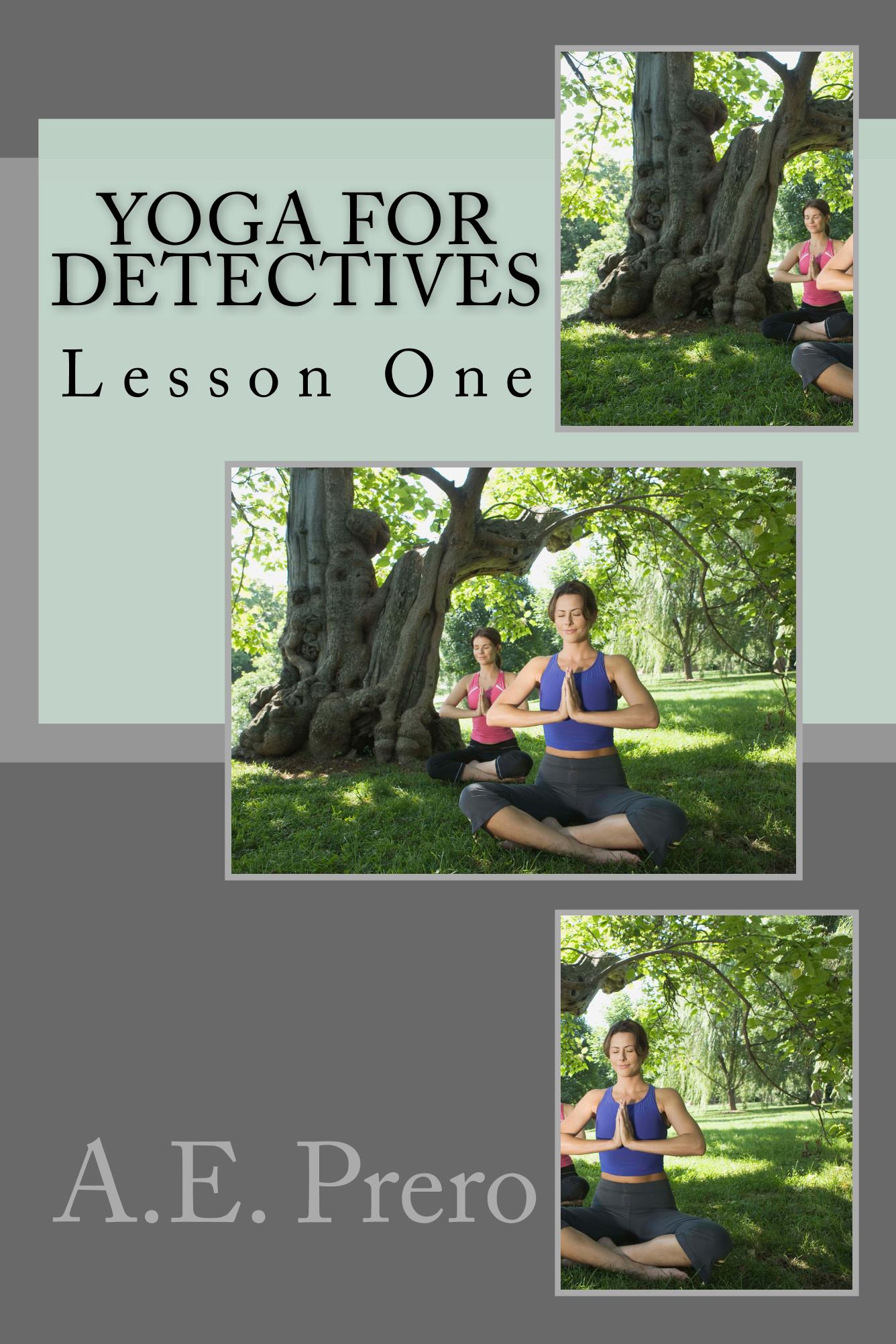
There’s a book on one of my book shelves that has my name on the cover.
Yep, that’s me. A.E. Prero. And that’s a book I wrote and published.
http://www.amazon.com/Yoga-Detectives-Lesson-A-E-Prero/dp/1512109371
It took me about 8 months to write it and another month to format the darn thing to turn it into a paperback book and, after my own feeble attempts, $50 to pay someone to format it for Kindle. And now, here it is, sitting on my shelf and the shelves of at least 25 other people, according to the Amazon stats.
Hand on heart, how many of you truly think you, too, have a book in you, if you could only find the time to sit down and write it? And maybe you’ll even do it someday. I’m here to tell you that it’s well worth the effort, even if that book inside you never makes it into a physical reality on your bookshelf.
Don’t get me wrong. I love having actual books in people’s hands which are the product of my imagination, time and self-discipline. Yay!
But, believe it or not, there are many other gratifying results from plowing through the entire process of writing a book.
Beginning to end.
Concept to character development to plot to consistency to description:conversation ratio to word usage to editing, proofreading and formatting….and maybe even marketing, though I haven’t begun the serious lifting where that’s concerned.
I’ve read some great books about how to write. Writing down the Bones is probably the best.
But Natalie Goldberg has others out there, and some different authors have offered some helpful ideas, too.
When I actually sat down to write, I realized that while much of what those people suggested had registered in my brain, it all became a mutant version once the spices of my own personality and imagination were added to the soup…and that was okay, even good.
I learned what I, as a reader, liked.
I pondered what made me pull out one book from a bookstore bookshelf and not another. I asked myself what it was about one first chapter that pulled me into reading a book as opposed to putting down another. I went so far as to correspond with one author whose first paragraphs in her many books never fail to hook me and ask if I could use her formula.
Wow! Now, THAT was a surprise.
After a few months, I could finally sit down to write even if I hadn’t:
- Washed the dishes,
- done the laundry,
- watered the plants,
- made dinner,
- cleaned out the studio,
- answered emails, phone calls and text messages,
- updated Facebook, or
- had coffee with every neighbor within walking distance.
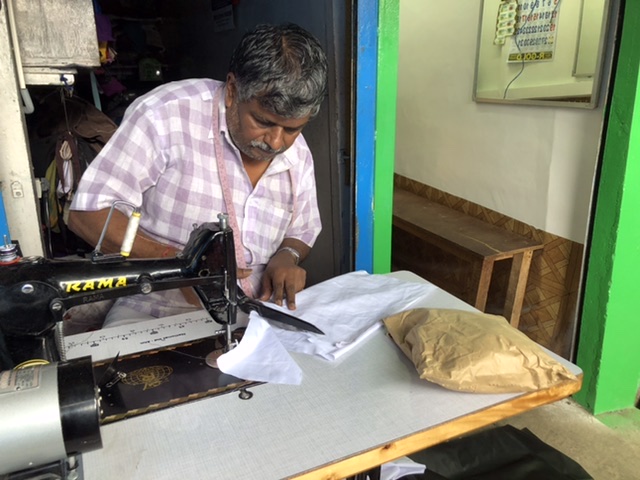
No, that’s not really my house but there were days when it felt like that…and I wrote anyway.
The further along I got with my book, the more I grew to appreciate the beautiful turn of a phrase or use of a word in the books I was reading. “Wow! How does she do that?”
The more I grimaced at a much over-used adjective or descriptive tool. 
The more I became enchanted with how one character became someone I cared about while another was just plain irritating.
You might think that the magic of the well-written, well thought-out book would be lost once the smoke cleared and the mirrors were revealed. But the opposite has been true for me.
Sure, there are some books I can’t look at anymore. I can’t easily fill time with just any old thing I find around the house, on my friends’ shelves or on the table at the doctor’s office. But I’ve developed a full hearted, deep, experiential response to other books.
I feel the author behind the words. And they become my friends as much as do the characters they skillfully develop. I’m happy for them for their work well done. Reading has become a double pleasure. Pleasure in the book and pleasure for the author’s success in having written a book which brings pleasure.

Natalie Goldberg
Gay Hendricks and Tinker Lindsay
And, isn’t that the real meaning of Muditta? Empathetic joy.
The happiness we feel when others succeed and are happy?
Writing has opened a whole new vista of Muditta in my life.


Scott Pratt