Resilience: Rising fom the Ashes of Disillusionment

This morning, as I prepare food for guests who will join us for a Shabbat meal, I listen to the wistful optimistic music of one of my favorite Israeli performance artists, Idan Reichel, and feel a choking sadness rise in my throat.

I’m constantly reminded these days of the deep belief of the primarily Left-wing residents of the communities near Gazan in the desire for peace shared by the Arabs living close by. In the face of years of rockets flying overhead from Gaza into Israel, voices of terrorists coming from below their floorboards, and violent demonstrations along the fence separating them from Gaza, still they remained steadfast in their conviction that ultimately, at the depths of their souls, if left alone to express their true selves, their neighbors would show their humanity and good hearts.

On Saturday, October 7, just one day after the 50th anniversary of the Yom Kippur War, Hamas terrorists infiltrated into Southern Israel after hacking into the observation equipment in the army bases closest to the border with Gaza and slaughtering the young women soldiers in the observation room.

Thousands of Gaza residents joined Hamas forces in a concerted attack from the air with hang gliders, from the sea, and on land with jeeps, small trucks, and on foot.

They caught Israel mostly unaware and unprepared.

Inexplicably, residents of the infiltrated communities called repeatedly for help from the army and police while locked in their safe rooms, but the first troops started to arrive only six-seven hours later.

By then it was too late for many people who were literally slaughtered – men, women, and children – many as they fought with whatever they had at hand to save their children.

Homes were burned to the ground, burning those inside alive.

Over two hundred people were taken captive into Gaza, including many infants, young children, Holocaust survivors, and other elderly.

The stories of the atrocities committed continue to surface, some with photos, videos, or heartwrenching phone recordings of those begging their relatives to come save them.

Scenes of thousands of young people, whose crimes were being Jewish and wanting to dance at a music festival, running for their lives, being chased by gunfire, caught by laughing terrorists who did unspeakable things to many of them.

Scenes burned into the memories of all who saw them.

Entire families in those communities, many of whom adopted a lifestyle combining John Lennon’s Imagine philosophy with the back to the earth movement of the late 60s, were wiped out. Many were slaughtered as they hugged each other on beds, on couches, or on the floor.

I never understood how they could believe in the basic goodness of people who sheltered murderers, celebrated terror in the streets, and expressed pride and joy in the deaths of their suicide bomber family members. I never agreed with their political views, believing them to be naive and with no foundation.

And yet for the past ten days every time I think of them, when I can see past the horrific pictures in my head, I mostly feel a sadness so deep that it knows no limits. The bursting of their dream, the disillusionment of people in their 70s, 80s, and 90s who have spent their lives committed to building a peaceful future with their neighbors.

I so wish they had been right.

Grief for 1300 people brutally murdered in one terrifying day. Grief for a way of life. Grief for a dream destroyed. Grief for humanity that we share our world with people who revel in cruelty beyond words and those who glorify them.

There’s a story told about a small African Blackwood tree uprooted by strong winds in Senegal which, separated from its family, fell to the ground on a rocky mountainside in Eritrea.

Somehow, over time, it managed to force roots into the rocks and began to grow. A pair of birds flying by noticed the little tree struggling to survive on its own and decided to make their nest on the fragile limbs of the tree. Over several years they raised several families of birds on the growing limbs which grew progressively stronger.

One day, the Blackwood asked the birds if, in their travels, they saw others of her kind, and was told that they had, indeed, seen a small forest of Blackwoods but it was several thousands of miles away.

One day a huge storm came to the Simien Mountains and once again the tree was uprooted. She fell to the depths of the valley beneath her mountain peak.

When the birds saw what had happened, they rescued their friend the African Blackwood. But before they could return her to her spot, she asked that they take her to her family in far away Senegal. They told her how hard the trip would be and how long it would take. They told her there was little chance she would survive such an undertaking.

The trip was in fact grueling. Though the birds made every effort to accommodate their friend’s needs, her roots began to dry out, her leaves to wither, and her spirit to falter. But after many days and weeks, they saw the African Blackwood forest below.

The birds lay her down gently on the forest floor. As they flew off, they looked down to see her embraced by several of the large Blackwoods and knew she would flourish.

I’m Not Your Son: You’re Not My Father

Four years ago James Blunt released a single called Monsters about his father’s life-threatening illness and his own relation to his father’s situation. A beautiful song with haunting lyrics, for some reason it escaped my attention until a young man named Iam Tongi performed it, struggling to sing through his tears, on America’s Got Talent earlier this year. Blunt’s father, Charles, diagnosed with stage 4 renal disease, received a transplant in response to the singer’s public plea for help and is doing well. Iam’s father, Rodney, Tongi’s musical mentor, died of kidney failure just months before the high schooler’s audition on AGT.

https://youtube.com/clip/Ugkx3u5ItnckHY_OfbO4WSGwkfpwL8ARPR-t

For me, the song reawakened feelings about my own experience many years ago with my father’s final illness and then death. It was shocking for me to realize that I was 39, a year younger than our youngest child, when my father died. I felt very grown up at that age, a mother of five, in a responsible position at work.

My father was a community rabbi, loved, admired, practically idolized by the people in his Texas congregation. Diminutive in height, maybe 5’6″ (167 centimeters), he was a giant in his personal stature of charisma, empathy, cleverness, and depth in his sermons and other teachings. Having grown up in Chicago in an ultra-Orthodox Satmar home, his ideological embrace of Conservative Judaism was anathema to his stern Satmar Rabbinical father. His adoption of Texas cowboy boots and, with time, a slight Texas twang belied his yeshiva background.

I was born the third daughter of three. It was a huge disappointment to my father that there would be no sons for him to sit and learn Torah with, in spite of his ambivalence, and a long love/hate relationship with traditional Judaism. He insisted for a while on giving me a boy’s name – back in the day when genderized names were the thing – but my mother’s wishes prevailed.

There was a period of time when he sat and learned Torah with me after school in the afternoons, time with him I cherished until family dramas of a different nature overcame us both.

I frequently accompanied him on shiva calls to grieving families in order to have more time with him. Our bonding during those drives stood us in good stead during the stormy years when my angry rebellion and his equally angry response drove us apart.

I left home just prior to my 17th birthday to join The Age of Aquarius in Haight Ashbury during the summer of peace and love in 1969. In the last minutes before my departure his final words to me were “If you walk out that door, I won’t have anything to do with you again.”

Five years later he danced at my wedding, a wedding he performed in my parents’ backyard. We took the opportunity to rekindle our mutual fan club of two, never actually talking about our estrangement, but expressing relief at reuniting.

Over the following years, he called on me many times to come take care of my mother so that he could visit his own mother in Israel or attend conferences or give lectures around the US.

We had ample time to share his regrets about his choice of vocation (he would’ve loved to be a political science professor at a top university) and his failure to make amends with his father before his death. We talked about my doubts about giving up a future in law in favor of moving to Israel, and my concerns about bringing children into a world of materialism and violence.

Two subjects we never discussed were his feelings about religion and his lack of skills as a father while we three daughters were growing up. I think we both sensed these topics to be too painful, possibly too divisive. to overcome.

Since his death, I’ve often wished we’d talked about both.

When he had his first surgery for lung cancer in the spring of 1991, I flew to Florida from Israel to be with him. Though my mother was often with him, he found excuses to her to leave us alone for quality time. We didn’t speak about heavy subjects. I remember him filling me in on his favorite television shows, mostly detective shows, and me sharing photos with him of my kids who were 9-16 years old at the time. We reminisced about their bar and bat mitzvahs he’d attended in Israel, talked about Gershon’s trials and tribulations in his orchards, about various people in his San Antonio congregation, and what was going on in their lives. I especially remember him talking about future trips he planned to make. He seemed optimistic that his illness was a blip in his life plan.

During the months between his first surgery and his final illness in the summer, we exchanged many letters. I’m so grateful today that this was before the age of emails and texting. My father was as eloquent in his correspondence as he was articulate as a speaker and teacher. In his beautiful cursive script, he shared his admiration for my life choices, his ultimate satisfaction with his own life, his worry about my mother’s life without him, and about my sisters. He wrote about being happy to have been able to say goodbye to people in Texas in a timely manner. He wrote sweet wishes for each of my children and expressed sorrow at not being able to watch them grow into adults and marry.

I flew in again, with a very heavy heart, when he was hospitalized for what would clearly be his final days.

Four days before his death he sent my mother on an errand and described a dream he’d had the previous night. In this dream, he was a very young child again, living in a railroad-type of apartment in Jerusalem. He could see from one end of the apartment to the other and described each room in great detail.

It was the first time he’d ever talked about his childhood to me. He related a simple, mundane memory of his mother scolding him for getting his shirt dirty outside.

On each of the three remaining days he again found an excuse for my mother to absent herself from the room and related another dream to me. In each dream he was older than the previous one. On Friday he described his wedding to my mother, where three rabbis – no less – performed the ceremony much to my maternal grandmother’s, an anti-religion atheist, chagrin.

I instinctively knew there would be no more dreams.

I recognized the process he’d been going through, as did he.

We spoke with my mother and the hospice team who were to help me care for my father in my parents’ home when we came home on Tuesday, but he and I exchanged understanding glances throughout.

When my mother and I left that afternoon I let my mother leave the room first and stayed behind to give my father, never a physically affectionate person, a hug. He gave me a squeeze with what energy he could summon.

We felt no need in those last days to discuss his mistakes and mine; we both understood them well enough. I felt no need to read him his rights and wrongs, felt so painfully as a child and then as an adolescent in a dysfunctional family with an emotionally detached father.

While I didn’t say to him that it was my turn to chase the monsters away, I think my reactions to his dreams said it as loud and clear as James Blunt and Iam Tongi.

When the phone rang that night, after the Sabbath had begun, though I don’t answer the phone on the Sabbath, I picked up.

Rabbi Amram Prero, 1915-1991

A complicated, magnificent life.

I miss you.

Dharamsala – Little Israel

Ever since I can remember there’s been a rite of passage of sorts for Israeli young people when they finish their army service. There’s even a name for it – the trip after the army. (in Hebrew it sounds a bit better). Two of our five kids took their respective turns with this rite of passage. Each spent a year traveling the world. Australia, New Zealand, Thailand, Laos, Cambodia, Vietnam, New York City.

But for the past decade, the destinations of choice have been South America and India.

India often includes Nepal and SE Asia but the main component is India, and the main components in India are Dharamsala as the gateway to the North and on into the Himalayas – Manali, Leh, and Ladakh.

There’s a window of opportunity to be in Northern India. Many of the roads, not the safest mountain roads even in the best of weather, are closed for much of the year due to snow and ice. We’d planned on making it up there on our second trip but Covid had other plans for us. On our current trip, we were finally in the right place at the right time.

At the risk of sounding like a yoga heretic, I wasn’t at all excited about the idea of going to Dharamsala. Many of my students have spent time there. After Rishikesh it’s THE place to go. In my mind, though, it was a mountainous town with steep climbs every time you go out of your lodging, and hundreds of yoga wannabees. It’s also known for its varied workshops but I wasn’t really in a workshop state of mind.

At first, we planned 10 days there but as the time to make final arrangements got closer the less I wanted to dedicate such a big hunk of time – if any – to it.

Dharamsala is divided into four sections; the city of Dharamsala, the lowest point, McLeod is next, home to The Dalai Lama and the Tibetan refugees, then Bagsu, and finally Dharmkot.

The Dalai Lama and I had a falling out many years ago, though he’s not aware of it. I was disappointed in his statements about the Arab/Israeli problem which reflected an appalling lack of knowledge of the history of the area. He’s since carefully avoided speaking about the issue so I suspect that he recognized his oversimplification of a complicated situation. Nevertheless, I wasn’t interested in trying to schedule an audience with him.

I was, however, interested in learning more about the motivation behind the arrival of thousands of young Israelis in Dharmkot and Bagsu every year. So we decided to spend five days of investigation in Bagsu.

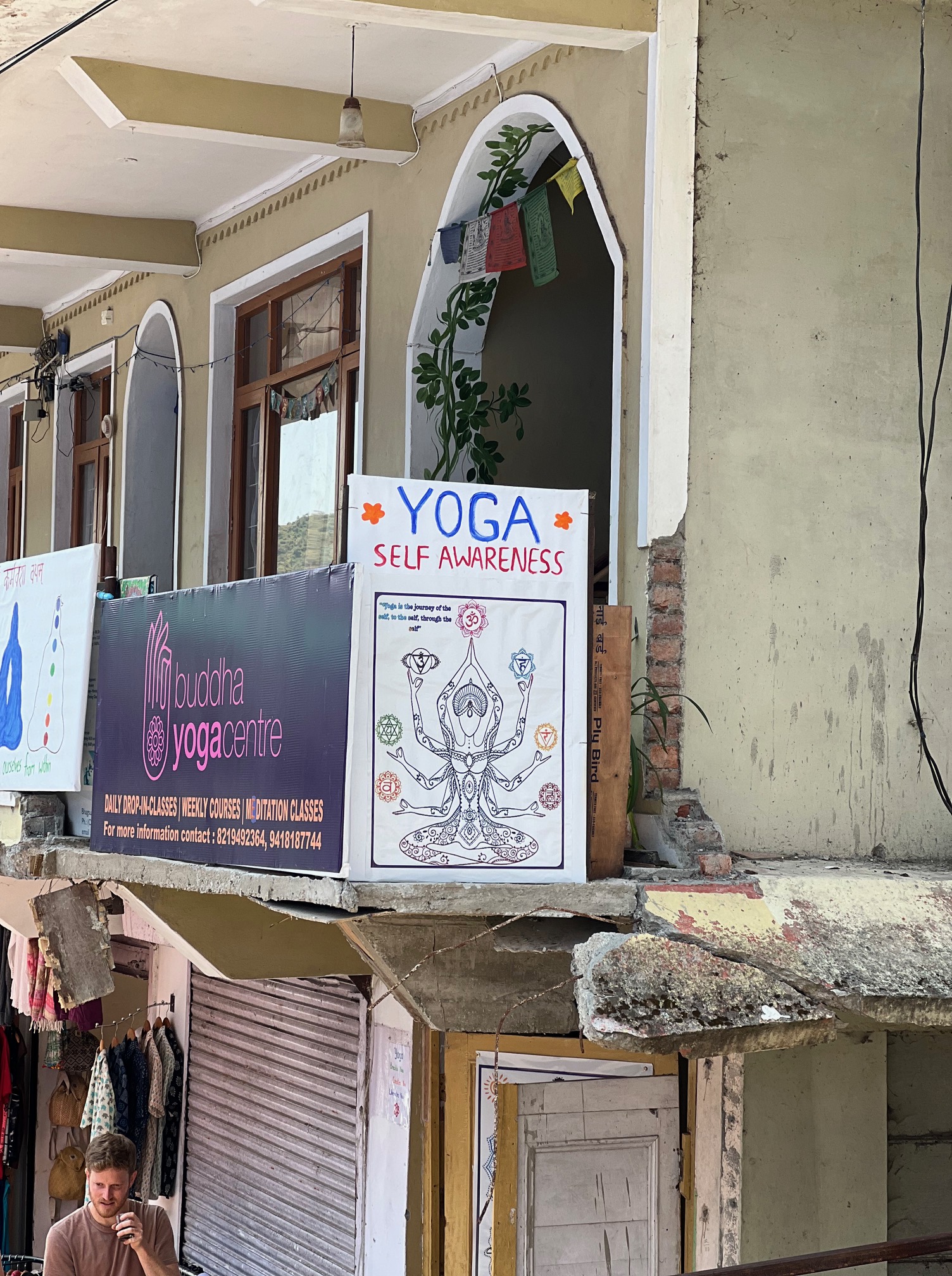
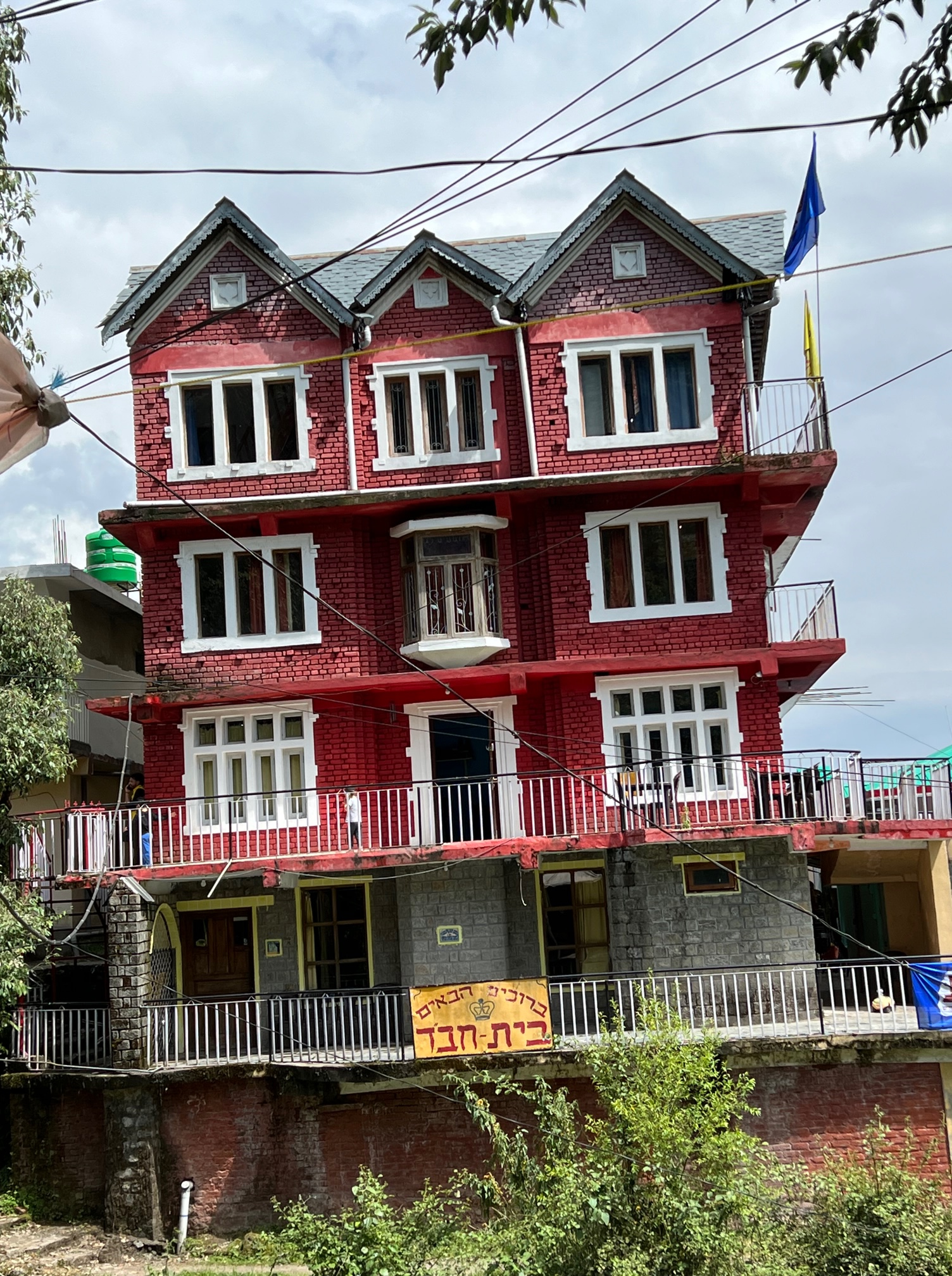
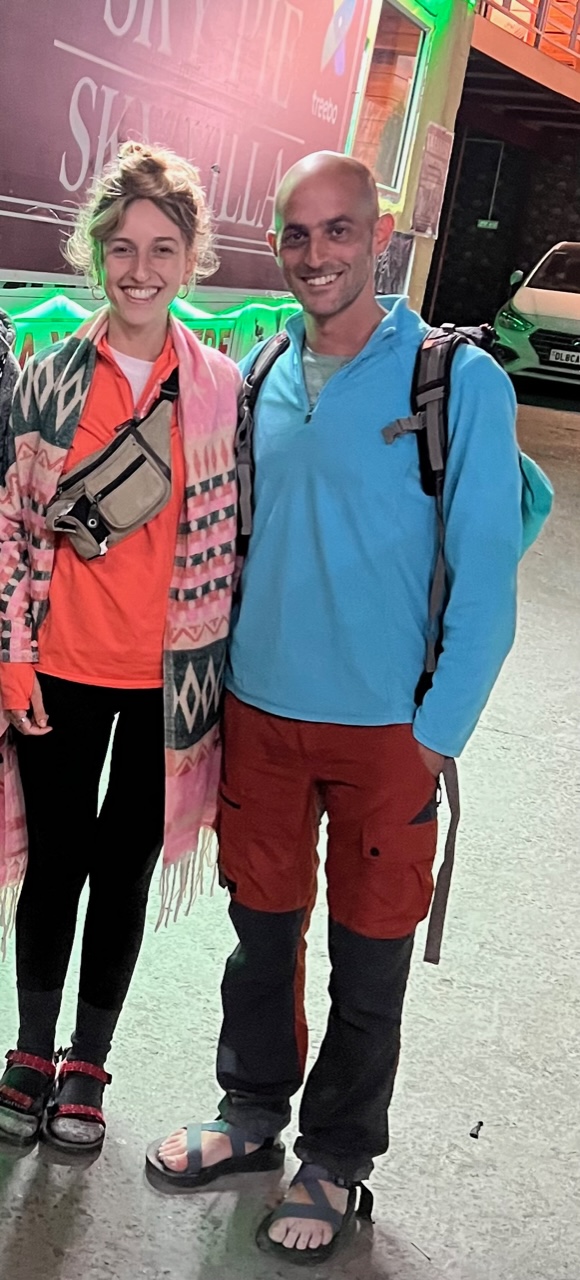
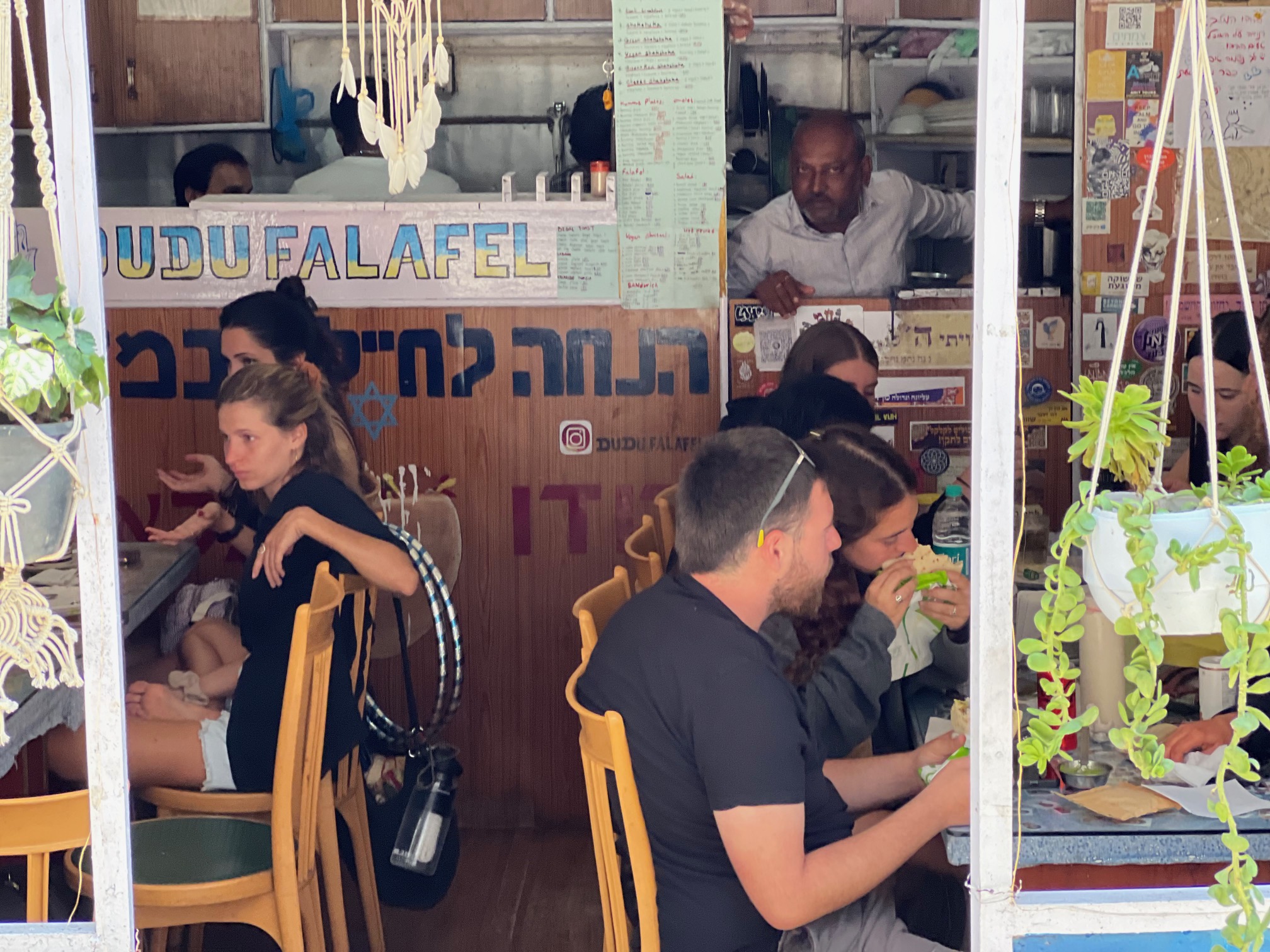
True to form but still a shock to our systems, the language heard most on the streets and in the shops of Bagsu and Dharmkot is Hebrew. The shopkeepers, restaurant servers, and hotel staff speak passable Hebrew. Many signs are in Hebrew. There are Israeli foods on the menus. There are two Chabad Houses, one in Bagsu and one in Dharmkot. Chabad provides a home away from home for traveling Jews, with kosher food, religious services, and a meeting place to schmooze with similar people, secular and religious.

When our youngest daughter was on her “trip after the army” she said she learned very quickly to keep her distance from other Israelis. It wasn’t a snobby thing or a dislike of her compatriots. She was interested in getting a feeling for the culture and people of the countries she was visiting. She said that Israeli young people tend to travel in groups of 12-14, speaking Hebrew enthusiastically (read: loudly), making it difficult to go places with narrow passages or restricted access and a challenge to get close to and speak to natives. She wanted to do volunteer work with families in need in Laos and in an institution for children damaged by landmines in Cambodia – acitivities not well suited for large groups.

As we traveled through India, even though we tend not to travel the “hummus trail” – the places most frequented by Israelis – whenever we saw Israelis they did, in fact, tend to be in groups and happily so.

But it wasn’t until we got to Dharamsala that we gained an understanding of the phenomenon.

As it turns out, people travel to India for several different reasons.

We, like our daughter, are interested in the many varied cultures and societies, the family structures, the generational trends, the various religions and religious practices, political positions, and how people get through the day, the month, physically, and financially. That dictates how we travel (on trains and other public transport rather than hiring a car and driver), where we stay (not in 5-star hotels too expensive for most Indians), and the destinations we choose. It means that my partner has been studying Hindi seriously and can carry on a bit of a conversation with Hindi-speaking Indians. (I rely on my excellent app) It means that over the years we’ve made friends in India with whom we now visit whenever we’re in the country.

There are people who go to India for spirituality. It’s in the very air people breathe there. For the hundreds of thousands of people who found and developed their inner spirituality in Buddhism or in India in general at one time in their lives, a few weeks in India revitalize and reinforce that equanimity and balance in their lives.

There are people who go to India for a variation of spirituality – inner peace, inner quiet, what’s called shanti in Hindi – an absence of the stress and tension of Western life. Although Indians drive like maniacs, hooting their horns for no apparent reason as well as when they’re passing someone with only 4 centimeters to spare, in other areas of their lives they project basic quiet happiness, peaceful acceptance, and interest without being intrusive. Coming as I do from a society where people not only drive like maniacs but exude an energy that vibrates like lightning, always running after the next thing, the better thing, rarely satisfied with what is, once I decompress during the first couple of days in India I can feel my emotional borders opening up, my natural curiosity blossoming, my breath deepening, my muscles relaxing. I sleep better. I feel lighter. My mind opens to all sorts of possibilities.

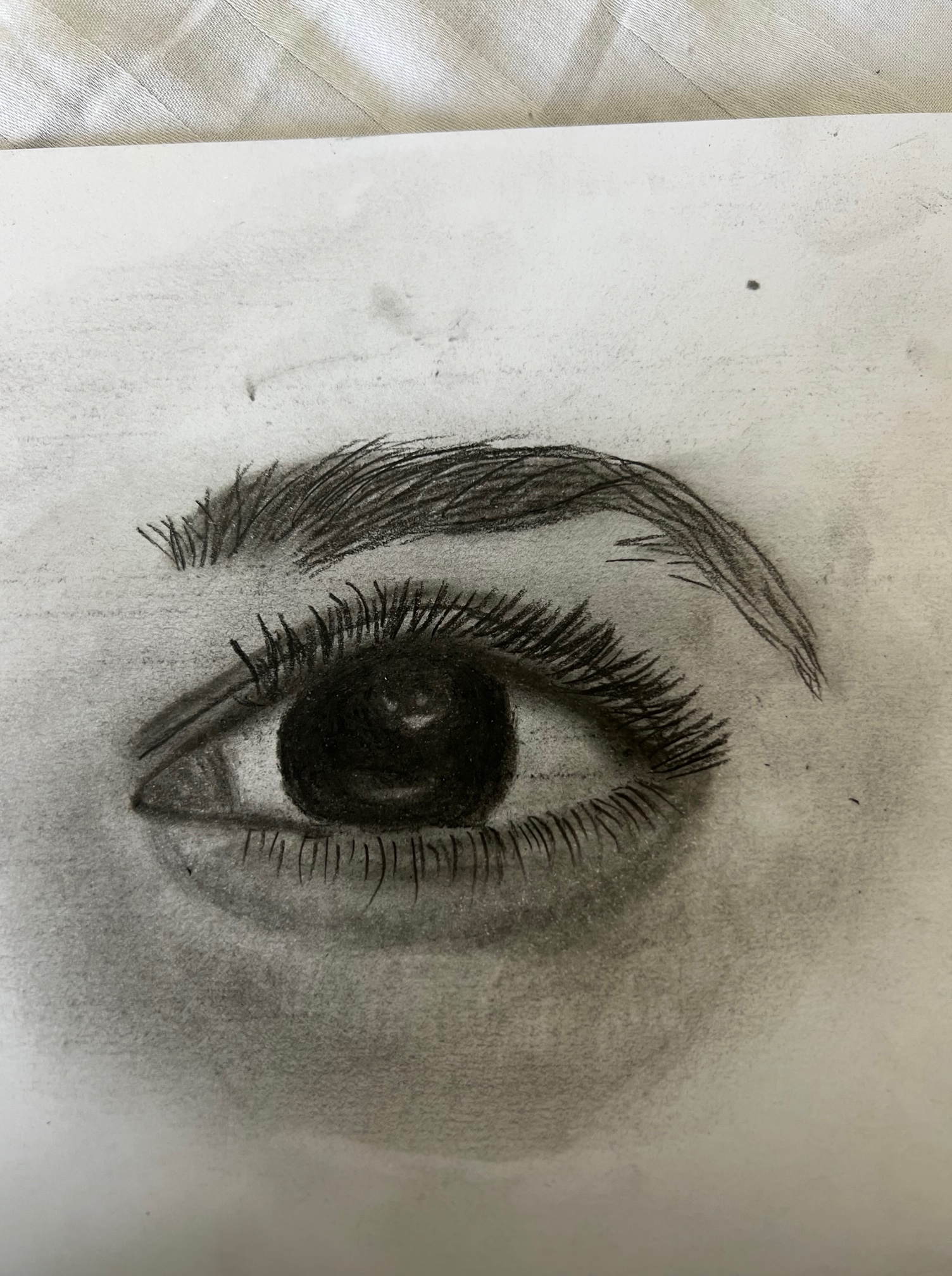
This time I learned to play the Indian flute, sketch, draw traditional Kolam chalk drawings and do hand and ear reflexology.

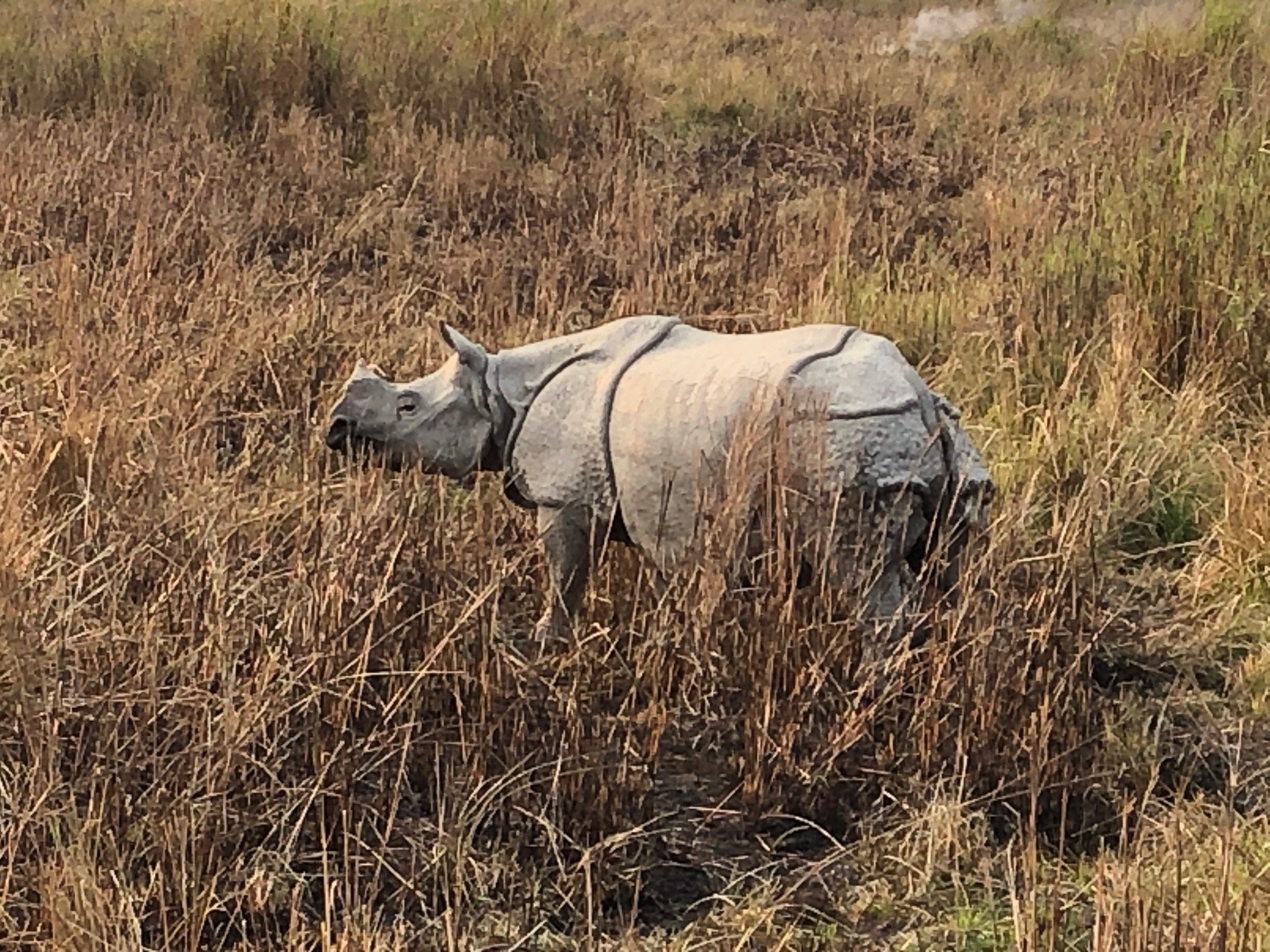
There are those who go to India for the incredible natural beauty found there. From the beaches of Goa to the heights of The Himalayas. There are one day easy hikes and two week treks with stopping points set up for spreading out a sleeping back along the way. There are awesome waterfalls hidden away, the sight of which is earned by days of climbing, lakes, rushing rivers, forests, all accessible to the strong of body and heart. There are tigers, leopards, bears, and the rare, verging on extinct, white rhinoceros of Kazaranga.

And then there are Israeli young people.

I’m sure there are Israeli young people whose motivation is found in one or more of the categories above but my impression after sitting and asking them and listening to their answers is that they’re in a category all their own.

They’ve just finished two years or more in a highly structured environment, the military, where they have little or no control over how they spend their time, how they dress, how they speak, when they sleep or eat. Not only two years with no control over their lives but, for many of them, a life interspersed with hours or days of danger and tension. Israel has one of the toughest military services in the world. Our country is always in a state of existence/non-existence and we rely heavily on these young men and women who spend at least two years training and guarding and protecting us every day. Without them our country would’ve ceased to exist long ago. It’s a heavy responsiblity to place on their young shoulders, but a necessary one.

Israelis at heart are a lively, joyful, energetic people. They don’t like discipline – in their families, in school, on the roads. They lack the spit and polish of the US Marine, the starched, ironed appearance of the British, the punctuality of the Germans. And yet they step up and serve for two years, suppressing (more or less) their tendency to scoff at authority.

And once it’s over – they’ve survived – they go to India.

India is so cheap, they can travel, spending the night in groups of 3 and 4 to a room, for a full year. No time restrictions. No dress restrictions. No family obligtions. They can wake up in the morning (maybe at noon or later) and decide to grab a sleeper bus to a place they’ve heard of from a fellow traveler…or not. And they can do all this in their native tongue with other young people just like themselves; who know what they’ve been through and where they come from. If the prices, accessible trasportantion, and natural beauty were available in a different country they might choose that country. It’s not India per se. Not the culture or the spirituality or the people of India.

They’re young people who have earned this amazing possibility to return to their exuberant selves.

Ultimately Dharamsala isn’t a destination I would return to. But I’m happy it’s there as a gateway to the North for these Israeli young people. And I loved getting to know some of them during our time there. We hear a lot about the Israeli “kids” who come to Northern India and sit around smoking dope. I’m sure those people are there, too, but the young Israelis we saw were wholesome in the way so many Israelis have managed to remain in this 21st century. Joyful. Caring. Patriots on a time out.

There’s plenty of time in life for school, work, building a family, all that serious stuff. And, yes, there’s a danger in getting carried away and not knowing when enough is enough, but the young people we talked to had plans for all that stuff. Later.

We worried when our girls took off for their “trip after the army” and now, two decades later, one is a partner in an accounting firm and one is a high school counselor. And we’re so happy for them that they had that time out of time.

The Enormity of Small Acts of Kindness

A long time ago, during our second trip to the Peruvian Amazon forest, I had one of those eye opening experiences. You know the kind when all of a sudden one conversation makes you awaken to a different reality?

A bunch of us were sitting around the breakfast table and I don’t even remember what I said but a middle aged plus guy from California, former hippie type who made a bunch of money, said to me, “Wait. So I don’t get it. Every morning you wake up with the thought that you’ll try to be a better person that day?”

He was genuinely perplexed and I had one of those ah ha moments when I realized that what I had assumed to be a given for most everybody just…wasn’t. Sort of like when I realized that not everyone takes the skin off chicken before cooking it. But a little more disconcerting.

So I don’t know how you’ll take what I’m about to write. Maybe you’ll think it’s weird. Maybe it IS weird. I’ve certainly thought, said, and done much weirder stuff, though, so here goes.

One of the places high on our list of places to go in India has always been Amritsar in the Punjab region. We almost made it last trip but Covid pushed us in a different direction – homeward. Most people go to Amritsar to see The Golden Temple, as did we. Perhaps the only difference is that we weren’t interested in going into the temple itself. Aside from the 90 minute wait in line in 40 degrees (104 degrees Fahrenheit), my partner doesn’t go into temples for religious reasons so I choose the temples I go to carefully as he waits outside.

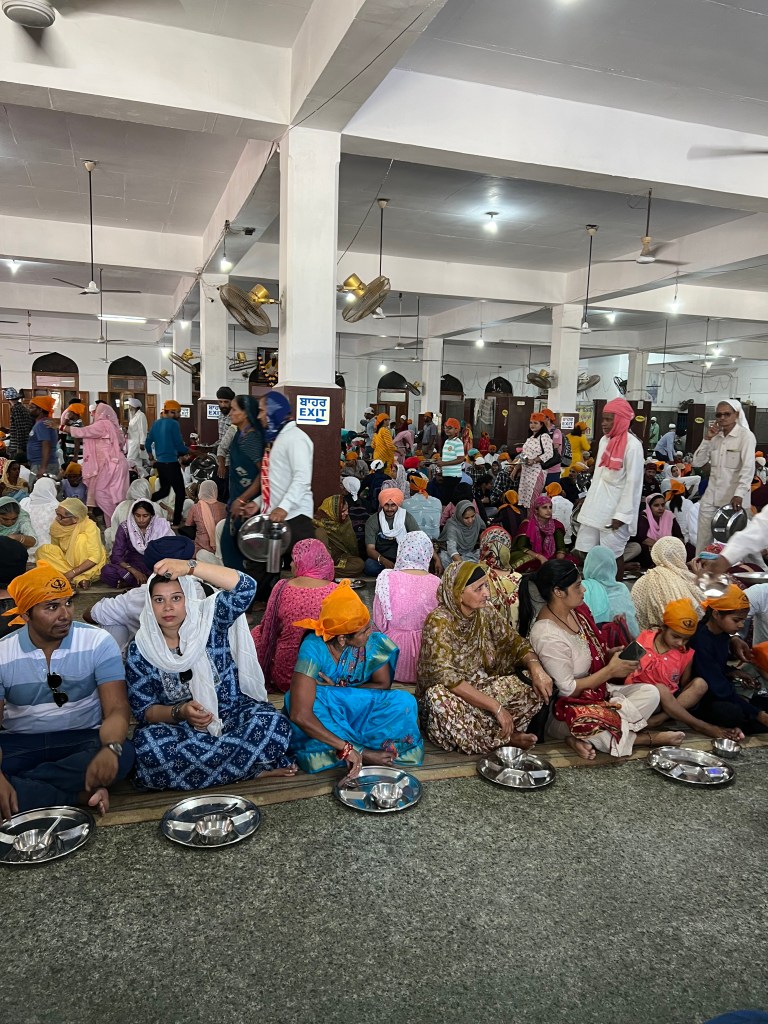
No, we wanted to volunteer in the langar hall which serves food for free to between 50,000-100,000 people every day. Open 24/7, food is served to whoever shows up, no questions asked, no judgement. Each “sitting” lasts 15 minutes. The food is simple but healthy – lentils, rice, chapatti (Indian flatbread), and water.

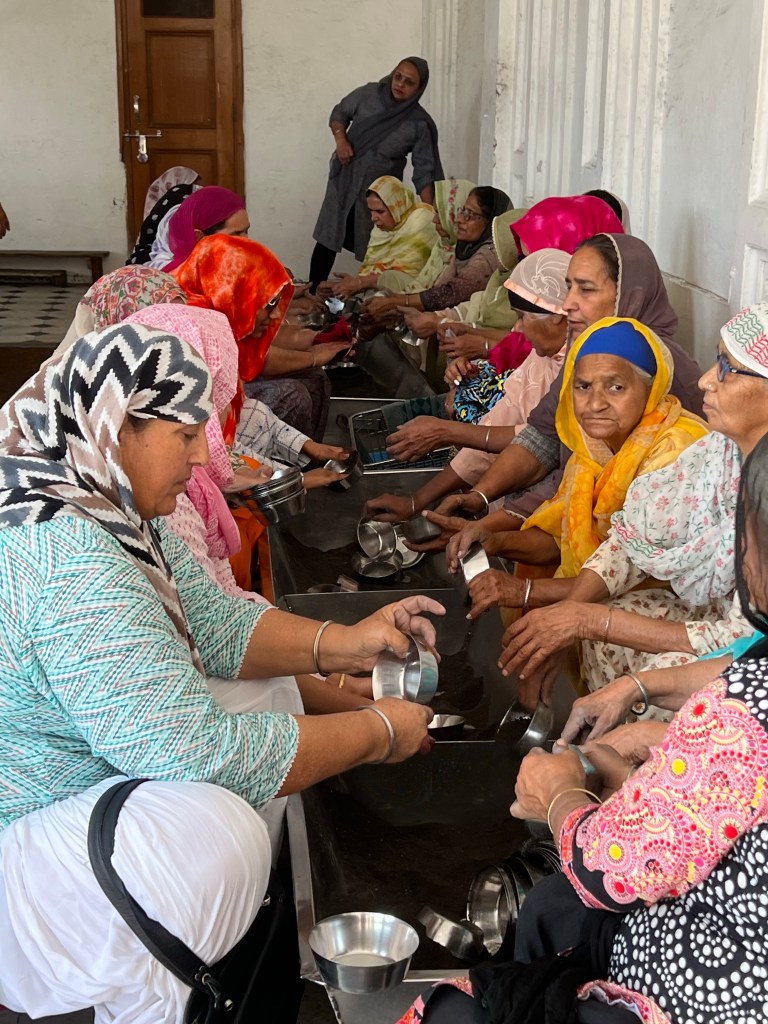
People wait on the long porch outside until they’re waved inside to collect their plates and cups and continue on to the hall where food is served. Women volunteers at various wash points sit in groups of six or seven washing the metal plates and cups

We told the Sikh at the entrance that we wanted to volunteer. It took a few tries before he understood. He directed us to Langar Hall. We got there, barefoot and after two foot baths, with our heads appropriately covered with orange material. The Sikh workers there tried repeatedly to push a plate and cup into our hands so we could join the others to eat.

What to do with these foreigners??

Each one pointed us up the next couple of stairs for the next Sikh worker to deal with us. The fourth or fifth turbaned guy realized what we intended and called a younger worker over who knew a few words in English. He beckoned us to follow him, which we did, up three flights of stone stairs at a very fast pace.


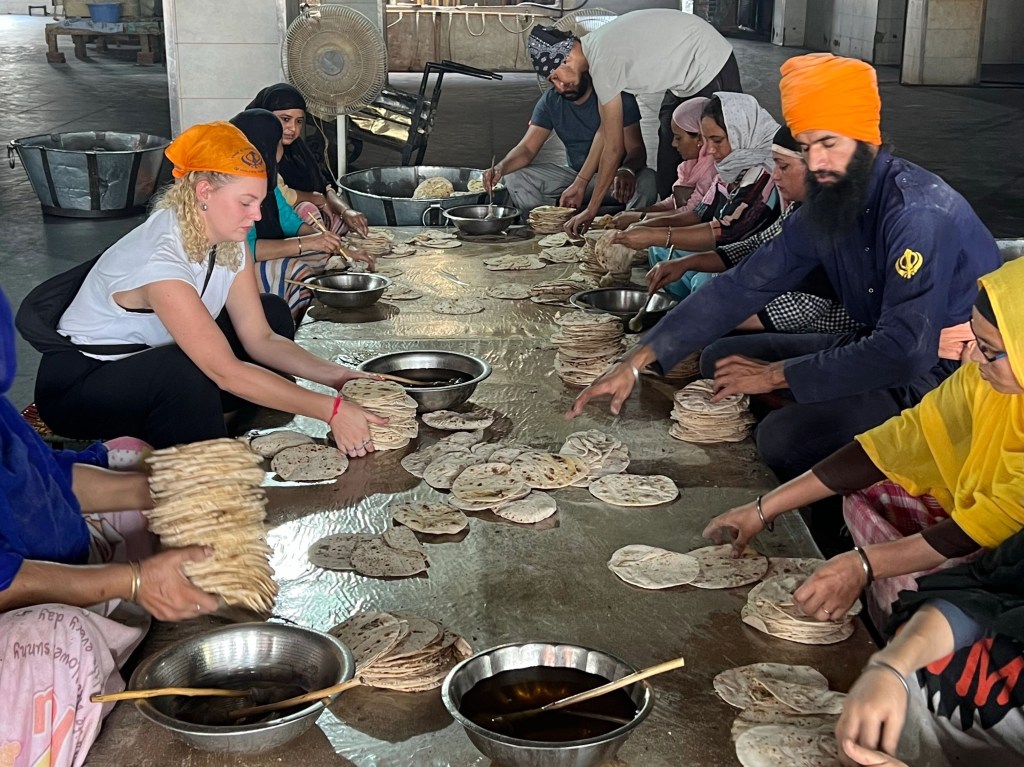
On the third floor he led us on a circuitous route which ended in a large room with 2 machines churning out chapattis and a low table where about eight women and a very stern Sikh man sat on low stools.

The room was stifling hot.

I was pointed to a designated stool and joined the women.

For the next two hours I schmeered hot oil on chapattis with a piece of cloth wound around and attached to a stick. A young man dumped the chappatis out of a basket onto the table straight out of the ovens. They were burning hot. I think the FBI will have a hard time finger printing me should they need to – my finger tips were scorched.

The chappatis came relatively slowly at first and I learned the routine and got into the rhythm. Then the lunch rush hour must’ve started because they started coming fast and furious. Remember Mickey Mouse carrying buckets of water in The Sorcerer’s Apprentice or Lucille Ball working in the bakery?

At first the other women were wary of the foreigner in their midst. But, like any group of women anywhere, it wasn’t too long before they were trying to communicate with me. At first the two women in charge of quality control, making piles of good chapattis and throwing misshapen or overly burnt ones in a bin, only sent a few chapatti my way. After 15 minutes or so they were throwing big stacks my way. Yep, I was one of the gang.

A young woman from The Netherlands joined us after about an hour, and then we were two.

The second day my partner decided to join in. He’d only watched the first day, feeling odd about the whole Sikh thing. We’d talked the evening after our first visit about how the Sikhs’ generosity of heart knows no bounds and makes no differentiation between foreigners, Hindus, Christians, or anyone else. I think he came out of the conversation feeling the beauty of the universality of it all.

In any case, we were already part of the work party by the second day, directed to stools and given our sticks and bowls of hot oil.

An Ayurvedic doctor joined us that day. My partner gained insight into the sad reality of many Indian families whose children emigrate and become Westernized and upwardly mobile and basically estranged from their families.

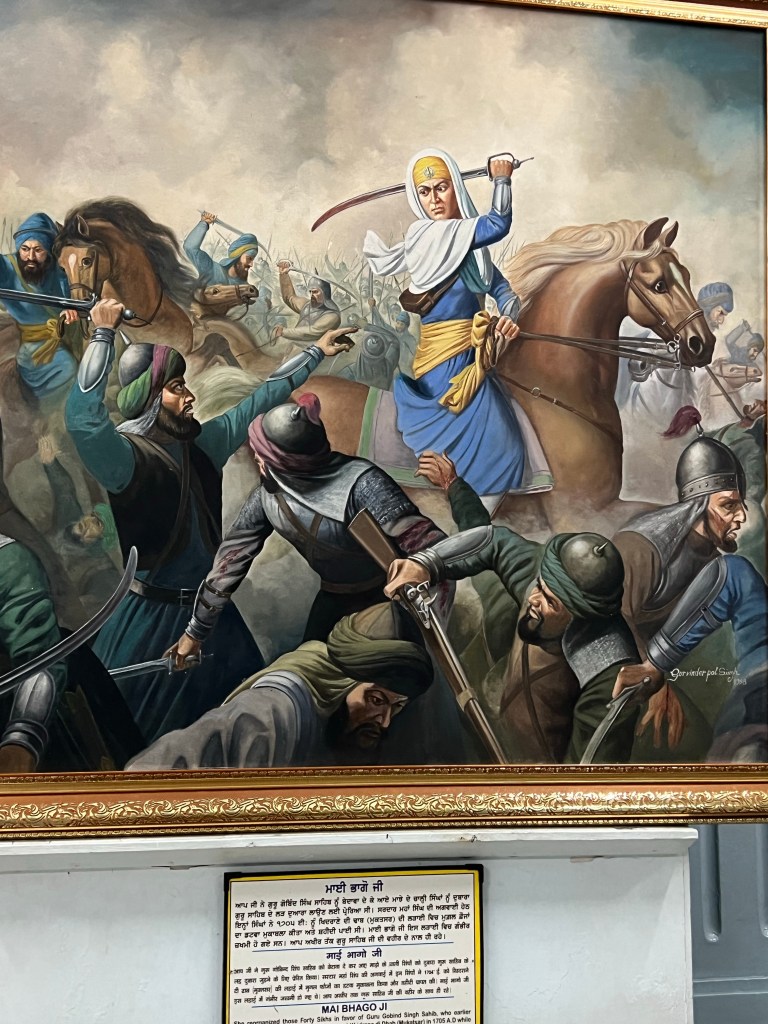
Before we’d found Langar Hall the first day we’d gone into the Sikh museum also within the temple complex. Sikhism has only been around for about 500 years. Their history is bloody and filled with martyrs killed in cruel and blood curdling ways.

To this day they carry a sword and are actually permitted to do so in public places, like banks and airports, by law.

It’s hard to reconcile their history of brutality with their unprecedented compassion and kindness shown in the Langar Halls in Delhi and Amritsar. Another if life’s inconsistencies.

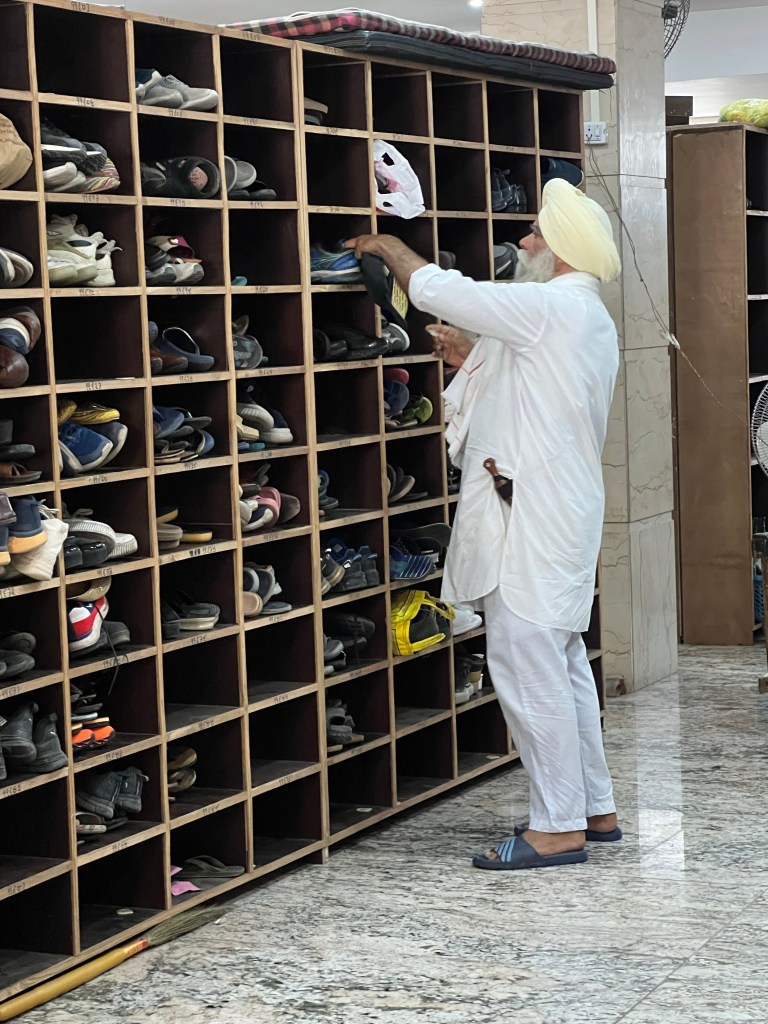
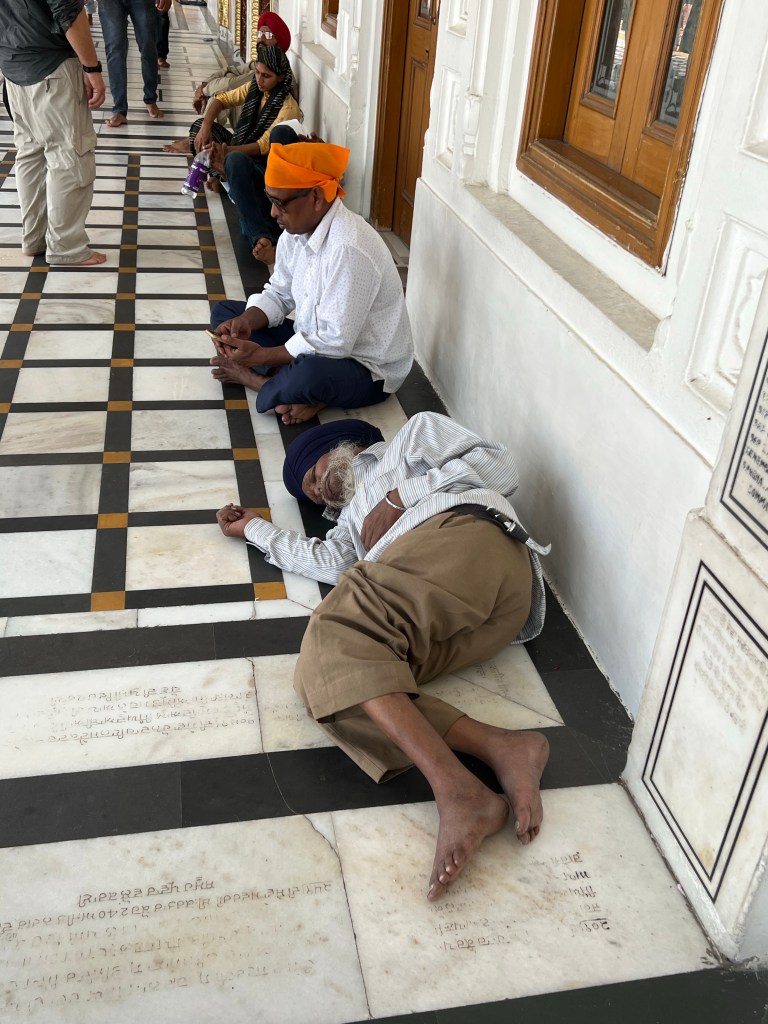
We left after redeeming our shoes, passing by hundreds of people resting or, unbelievably, sleeping on the hard granite floors. Another unique Indian experience.

As for our Californian Amazon traveling companion, “Yes, Paul, I do in fact wake up every morning with the thought of how I can be a better person.” It’s not a burden or a hardship. It brings me joy and fills me with gratitude that I’ve been blessed with a life which allows me to open my eyes and my heart to other people who share this often challenging world with me.

The heat of the chapatti room, the loud music, the scorching chapattis, the shy smiles of the other women, the knowledge that those oil schmeered chapattis would help fill the bellies of people who might otherwise go hungry…as my delightful yogi in Rishikesh would say…and that.

Traveling with Family – Part 2

Families are complicated. Large families are largely complicated. I used to think my own dysfunctional family – bipolar mother and clergyman father – was more complicated than most. Then I grew up.

My partner and I have five adult children and sixteen grandchildren. It goes without saying that each of the twenty-eight people in our family is a multi-faceted, quirky, fascinating person in her own right (we are 17 females and 11 males but I’ll be using all sorts of pronouns).

Just the fact that, to my mother-in-law’s great anger, we “turned our backs on the great country which gave us so much” and moved to Israel already sets us apart from mainstream USA. Add to that oh so many others of our personal traits and decisions and it becomes easy to see why I add the word ‘quirky’ to a list that otherwise applies to one and all.

But this isn’t about our family in entirety, just Tsippy’s family of 4 (not counting her soon-to-be ex-husband), and us.

As you read in Part 1, Tsippy is a successful career woman who has been raising her three children virtually on her own for the past two years. Her kids are 14, almost-12, and almost-8. Not particularly easy ages, but are there really easy ages? I think that might be a myth.

One of the things you didn’t read in Part 1 is that her oldest is a trans boy. There’s so much that entails. Heartache and joy, difficult challenges, serious crises and decisions, celebrated achievements, lots of introspection, acceptance, juggling, tears, eye-rolling, embarrassment, laughter, and, finally, and most importantly, love.

He and I are very close.

He doesn’t like a lot of people. He has no patience for bullsxxt.

He can take social situations like school (because he has to) and family gatherings (because he’s learned they’re theoretically healthy and relatives’ intentions toward him are good) but only in limited doses. After 3-4 hours he’s emotionally exhausted and needs alone time,

For whatever reason, he’s chosen me as “his person”. If his Mom is his coping strategy, as he’s told me, I’m his #2 (At least most days).

He agreed to come to India because I’d be there. I was flattered.

His almost-12 year old sister is the exact opposite socially. She has a gajillion friends, is a talented dancer, and a good student. She’s cheerful, physically affectionate (a great hugger), and has a killer smile. She drives her brother crazy and, at the same time, idolizes him. She’s ridiculously understanding of how hard his life is and the attention he requires from their Mom. She reminds her Mom that she requires attention, too…a lot.

The youngest is the kind of boy who wakes his Mom up every morning with “I love you, Mommy.” An amazing soccer player. Give him a soccer ball, pizza with lots of tomato sauce, and his Mom, and he’s good to go.

Add doughnuts to the list of things he loves

Tsippy herself is an inspiration. Many single Moms are. She’s learned the importance of balance the hard way – each of her kids’ needs, her own needs, work, home, friends, extended family, keeping up appearances and also not giving a crap, asking for help from the right people, accepting that she’s not in control of how a lot of stuff turns out – even the stuff she cares about the most.

So that’s the constellation, other than me and my partner. You’ve met us and gotten to know us here over the past umpteen posts. If you haven’t, you can go back and do your homework.

We met up with them after their 5 hour cab ride from the Delhi airport to Rishikesh. They’d slept in the car and were on a high. Excited about the cows wandering the streets, the kiosks with colorful clothes, jewelry, and bags of all sizes, and the diversity of dress and skin color of the people passing by.

They wanted to taste all the street food we saw and tell us all about their flights. Preferably at the same time. They tried on scarves and checked out the saris and salwar kameez. They only very reluctantly agreed to go to their hotel.

Food became an issue. We’d discussed it before the trip and prepared for it as well as we could. We chose restaurants with varied menus; Indian food but also pizza, chips (French fries), and cornflakes. The pizza and chips were a bit different than what they were used to so we often left 3/4 of every dish behind. They ate pringles, chocolates, rice, cornflakes, and doughnuts. Not a great way to sustain human life but it was only for two weeks.

They didn’t complain.

Not about the food, or the endless shopping, or the loud craziness on the streets, horns blaring, or the cow sxxt which required diligent attention, or the limitations we set on how much money they could each give to the ubiquitous (and deserving) kids and adults with their hands out and a sad look in their eyes.

There was very little bickering – much less than at home – and not many flare ups.

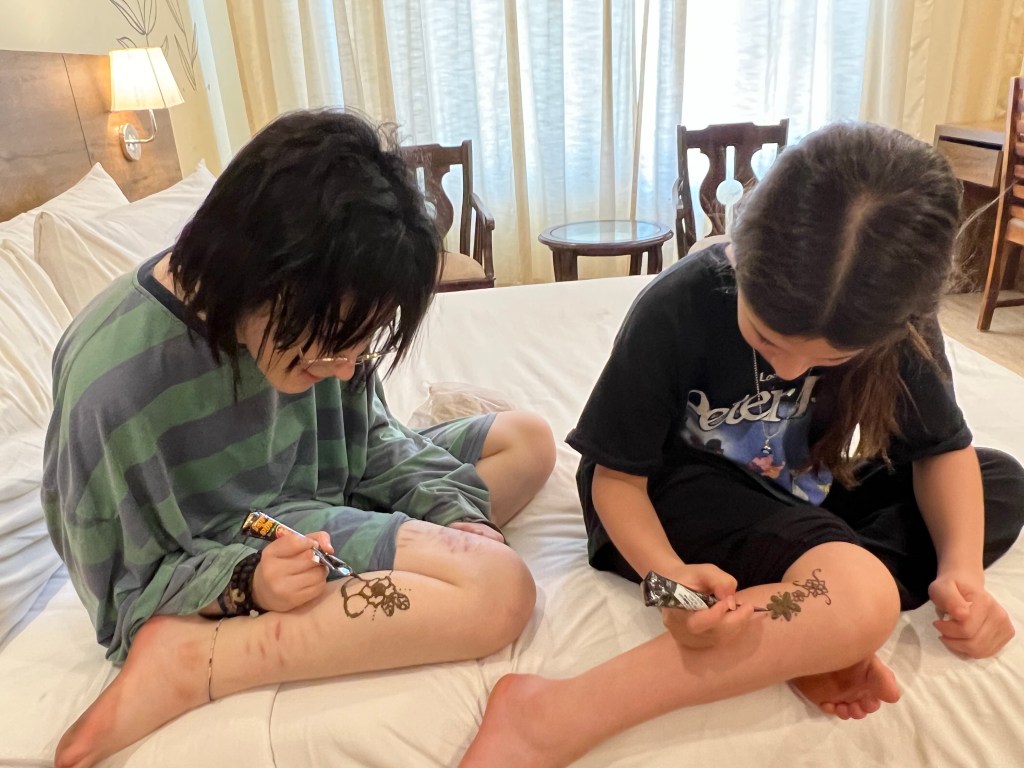
When the henna drawing on the oldest’s leg didn’t come out like he hoped, he took it out on his sister. Big time. Why? (what silly person asks a 14 year old why?)

So far so good…until it wasn’t

We all saw how much of an effort the oldest made to participate in all our activities. He really wanted to be a part of it all. Even the activities that strained his coping skills to the max. When his perfectionism ruined his pleasure in his miniature painting of a peacock during our 3-hour workshop, he barely mentioned it. He just set it down, wandered off, and found a place to sit with his phone.

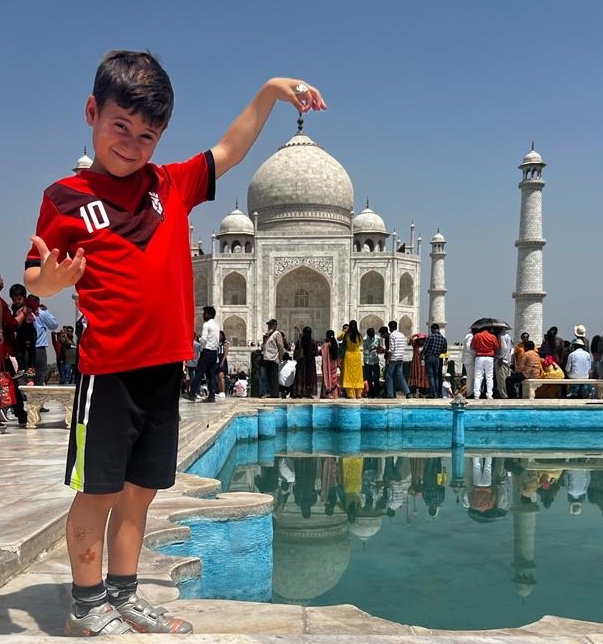
When he chose to remain in the hotel in Agra, Tsippy and the others went to the Taj Mahal on their own and had a great time taking goofy photos. No guilt tripping. Everybody was happy.

The youngest was patient (long suffering) as we shopped. He had his grandfather to hang out with. He got compensation with a long dip in the (very cold) Ganges. The oldest was happy to hand out candies to all the village children in compensation for what he defined as the day from hell (4 hours of extreme heat). The sandwich kid who has a VERY hard time making decisions was allowed all the time she needed, even when (inevitably) she decided not to decide.

There was a lot of give and take. A lot of mutually respecting personal boundaries and foibles. A lot of appreciation for our time together; even if it required taking a few deep breaths from time to time. Even when the oldest said at one point, admirably, “You know, I’m totally restraining myself from yelling at you for that very annoying comment.”

And it wasn’t only an amazing bonding experience for the grandkids.

My partner is quite religious. He observes all the rituals; keeps all the restrictions. Our kids aren’t religious and have always had a strained relationship with their father around these issues. They see him as inflexible and putting religion before his relationship with them.

He feels that because he’s “the religious one” and none of the kids observe the rituals and restrictions, if he doesn’t make a point of observing them when he’s with our kids and grandkids there won’t be any room for those observances there. No one will make sure there’s a space for him to do what he needs to do.

I see both sides and understand the behaviors but it’s mostly not my story to rewrite. I know that he puts his family above and before everything else in his life.

Of course if no one felt threatened the kids would make a respectful place for my partner’s religious observances in their homes, and he would be more flexible and make space for them not to observe while he does.

Easier said than done.

Our time in India with Tsippy and her family coincided with the Jewish holiday of Passover. Lots of restrictions and observances.

Tsippy and the grandkids were positive and respectful at the Seder and my partner was understanding and encouraging when they’d had enough and asked to be excused.

We found out which of the many Indian bread options are not made with wheat, and made the decision to eat kitniyot (legumes and rice) which are not considered “not kosher for Passover” but are, for the most part, not eaten by Ashkenazi Jews (which we are). That made it possible for us to eat with our family, and for Tsippy to say towards the end of the trip that his flexibility made her very happy and feel very embraced by him.

No words were ever more welcome.

It was two weeks of grace; of kindness, love, acceptance, and gratitude. It wasn’t without its sad moments; realizing (not for the first time) that we can’t create a bubble of perfection and ease for the people we love. But it was two weeks we’ll all remember for the bonds we made.

There’s talk of a trip together to the Serengeti.

Sad Westernization

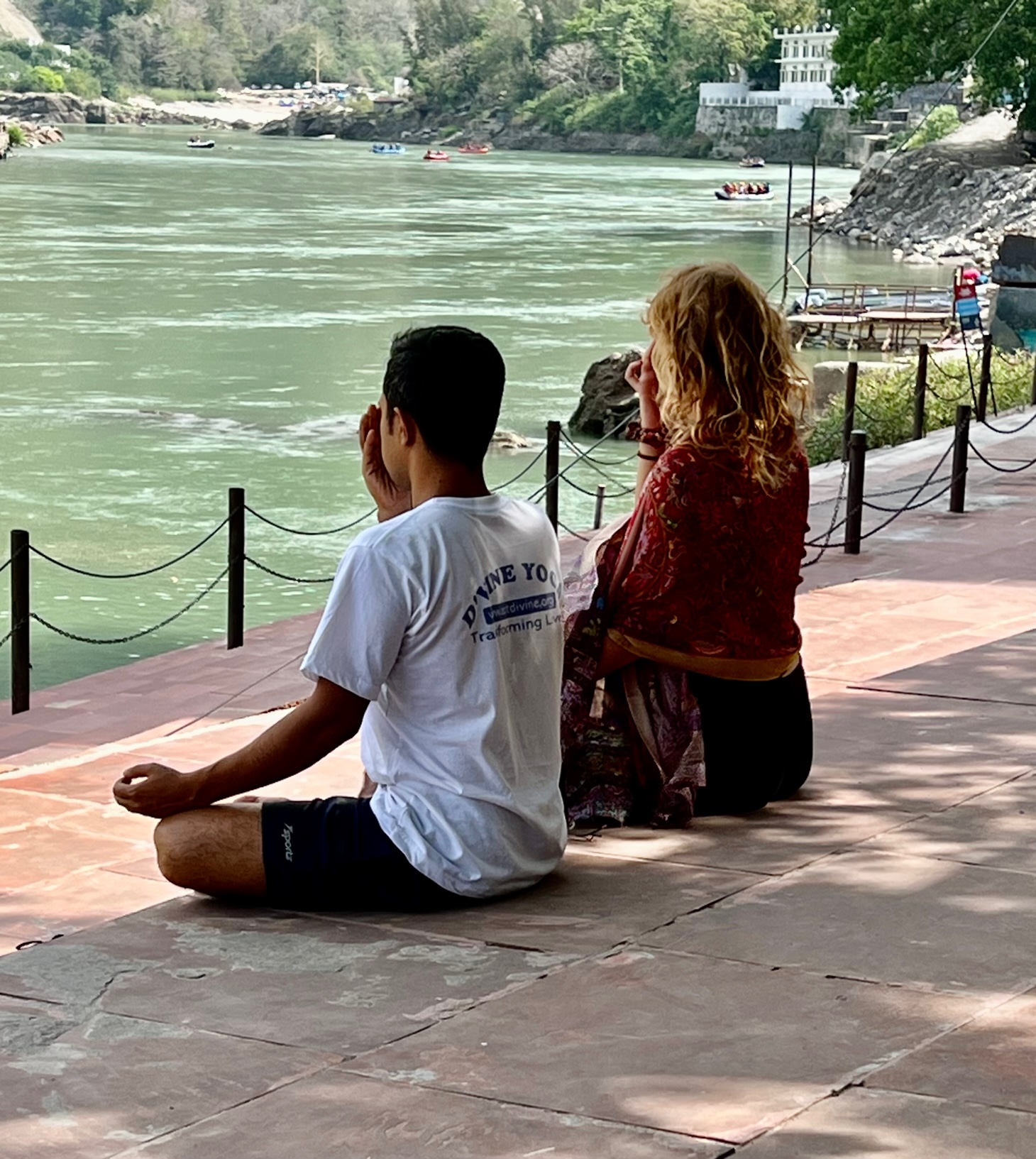
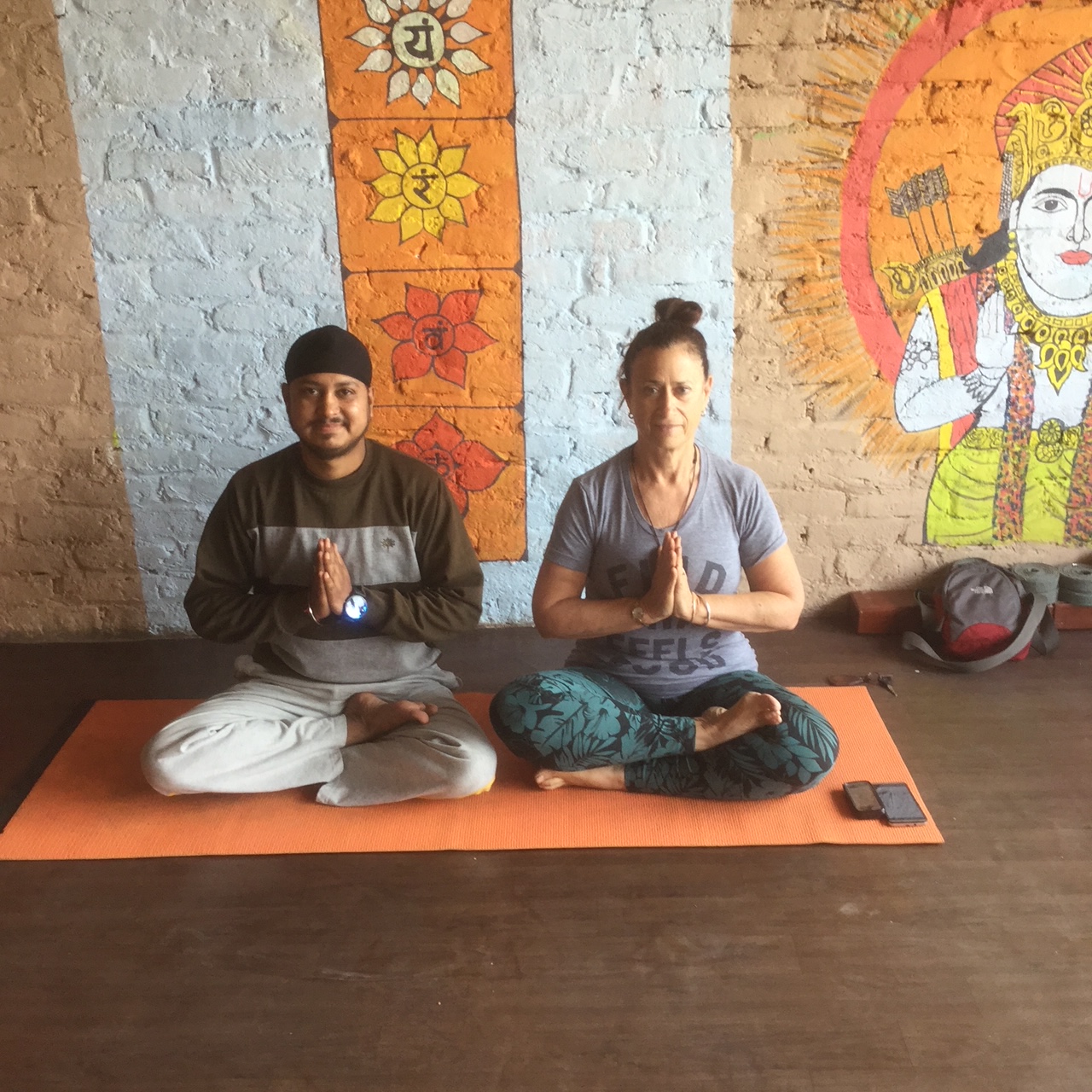
Seven years ago, before leaving home for India, I received the name and phone number of a yoga teacher in Rishikesh. I’d been teaching yoga for six years and thought learning with an Indian master might add something special to my practice. As it turned out when I arrived in Rishikesh, that particular yogi was traveling abroad but his phone was answered by a young Sikh yogi and, since one unknown Indian yogi was the same as any other for me, I made arrangements to do yoga with him every morning of our five day stay there.

The studio was a large room with murals on one way and a large window overlooking The Ganges on another. We climbed a precarious metal spiral staircase outside to reach the room.

My newly-discovered teacher was very young and had only been teaching a year longer than me. But he was very sweet and I realized long ago that if I open my eyes, my ears, and my heart, lessons can be learned in unexpected places from unexpected people.

We met for 3 hours every day for the five days I spent in Rishikesh.

He taught me a long series of poses called Pawanmuktasana especially suited to loosening and strengthening our joints. My husband still begins every workout at the gym with poses from Pawanmuktasana and I often integrate some of the poses in my classes.

We exchanged interpretations of philosophical issues even if we didn’t always understand each other perfectly.

We learned a bit about each others lifestyles and cultures.

When our time together came to an end I asked him him how much to pay him. He said there was no payment to be made. At my urging he agreed to accept whatever I wanted to pay. I’d asked around and paid him a bit more than what was being paid at studios in the area, still about a third of what I would’ve had to pay at any Western studio for 15 hours of drop in classes.

Three years ago I was in touch with him before our return trip to India. We agreed that we would meet again for classes. By that time I’d been teaching for ten years and lost my enthusiasm for trying other styles of yoga and other teachers. I’d taken a two year yoga and yoga therapy course to receive Western certification, been to a dozen silent retreats of various lengths, been to yoga festivals, marathon sun salutation sessions, and taught hundreds of classes. Out of respect, I agreed to take two classes a week with him. My partner took an additional three classes a week.

This time he was teaching in a small, dark room with inadequate ventilation to save money and told us up front that there was a required payment per session. He’d begun teaching a few foreign groups from time to time and realized that it was possible to increase his income.

The classes were lackluster and the short dharma talks he gave lacked the depth of the hundreds of hours I’d heard over the previous four years from so many talented teachers.

Before returning to India on our current trip I asked for his input about lodging near Beit Chabad in Rishikesh. We were planning to be there for the holiday of Passover and needed to have easy access to a Seder, food according to the holiday’s restrictions, and prayer. The iconic Laxman Bridge is no longer in use and staying across the river is no longer a practical option.

He was very helpful.

During our first month in India we were down south at beautiful Thumpoly Beach at our friend Antony’s place, then Kanyakumari, Pondicherry, and Auroville. From time to time we got WhatsApp messages from him asking about our trip. Odd, but okay.

We spent a week in Rishikesh as planned, where one of our daughters and her three children joined us before we all headed off to Rajasthan for a week. While in Rishikesh our former yoga teacher asked to come by a few times. Out of respect, we agreed. Awkward, but okay.

On our first full day back in Rishikesh we happily explored learning possibilities for our month visit.

And then received progressively angrier and hostile audio WhatsApp’s from our former yoga teacher.

Inexplicably he was under the impression that we would be doing yoga with him every day for a month. He’d set aside that time for us and put off other potential clients.

He’d told us his days were filled with lucrative online classes of people from the UK, US, and Israel. We never dreamed he was counting on us for his monthly income. We weren’t even positive we’d be in Rishikesh for a full month because many people said it gets too hot to go outside (it doesn’t).

We were confused at his assumptions, dismayed by his feeling that we’d used him as a travel agent and misled him, and taken aback at his claim to be losing a 10-15,000 rupee payment. We offered to meet three times a week but kept getting more angry audio WhatsApp’s. Eventually we stopped responding, as did he, and we thankfully haven’t heard from his since,

My husband found an excellent yoga teacher just a five minute walk away, not surprising since if you toss a stone here chances are you’ll hit a cow or a yoga teacher.

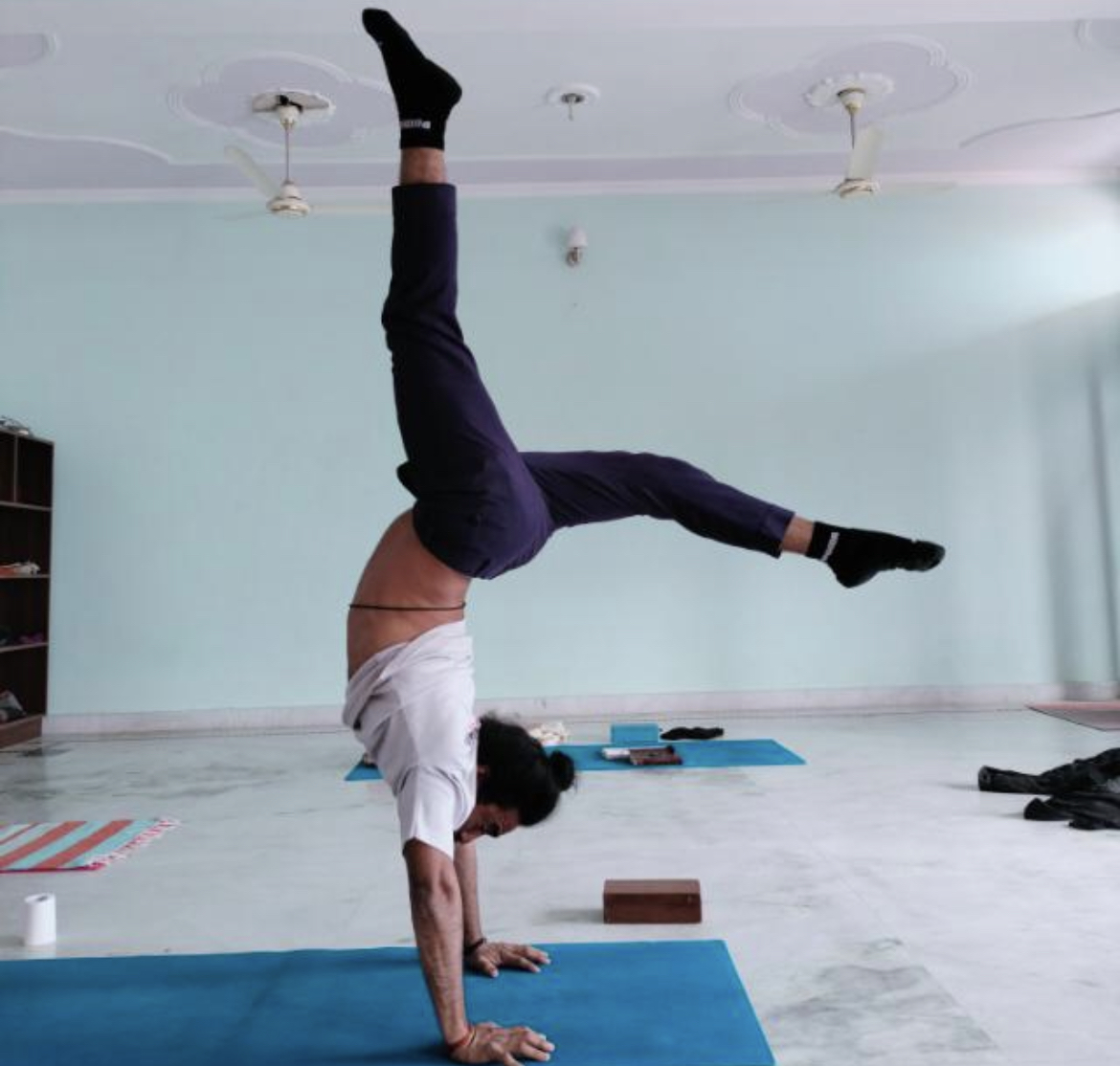
Our new teacher. He’s also teaching me Ayurvedic massage and reflexology.

My partner is taking Hindi classes daily from the same pedantic teacher he studied with three years ago. He’s actually speaking Hindi to people already. He practices like a demon.

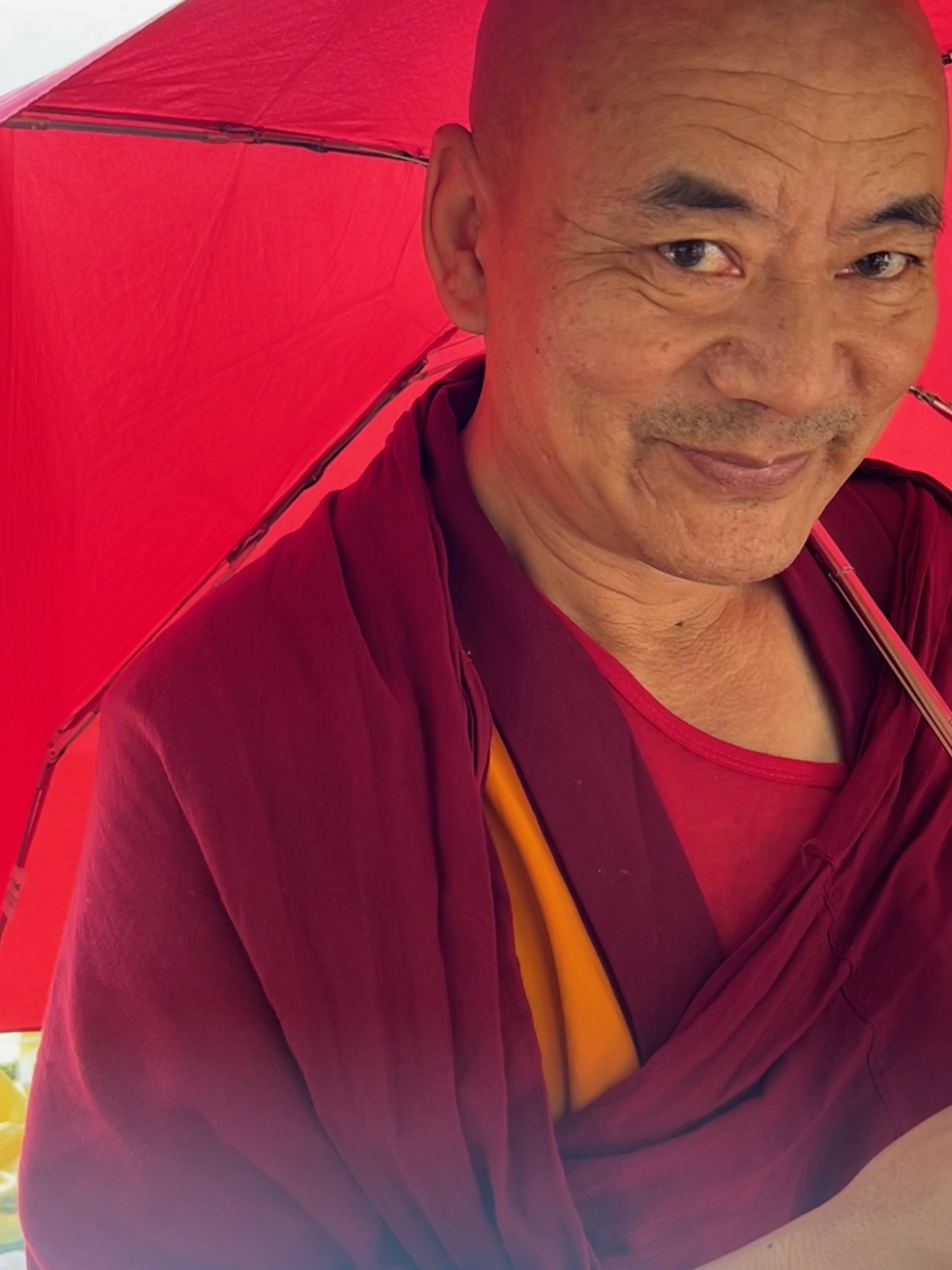
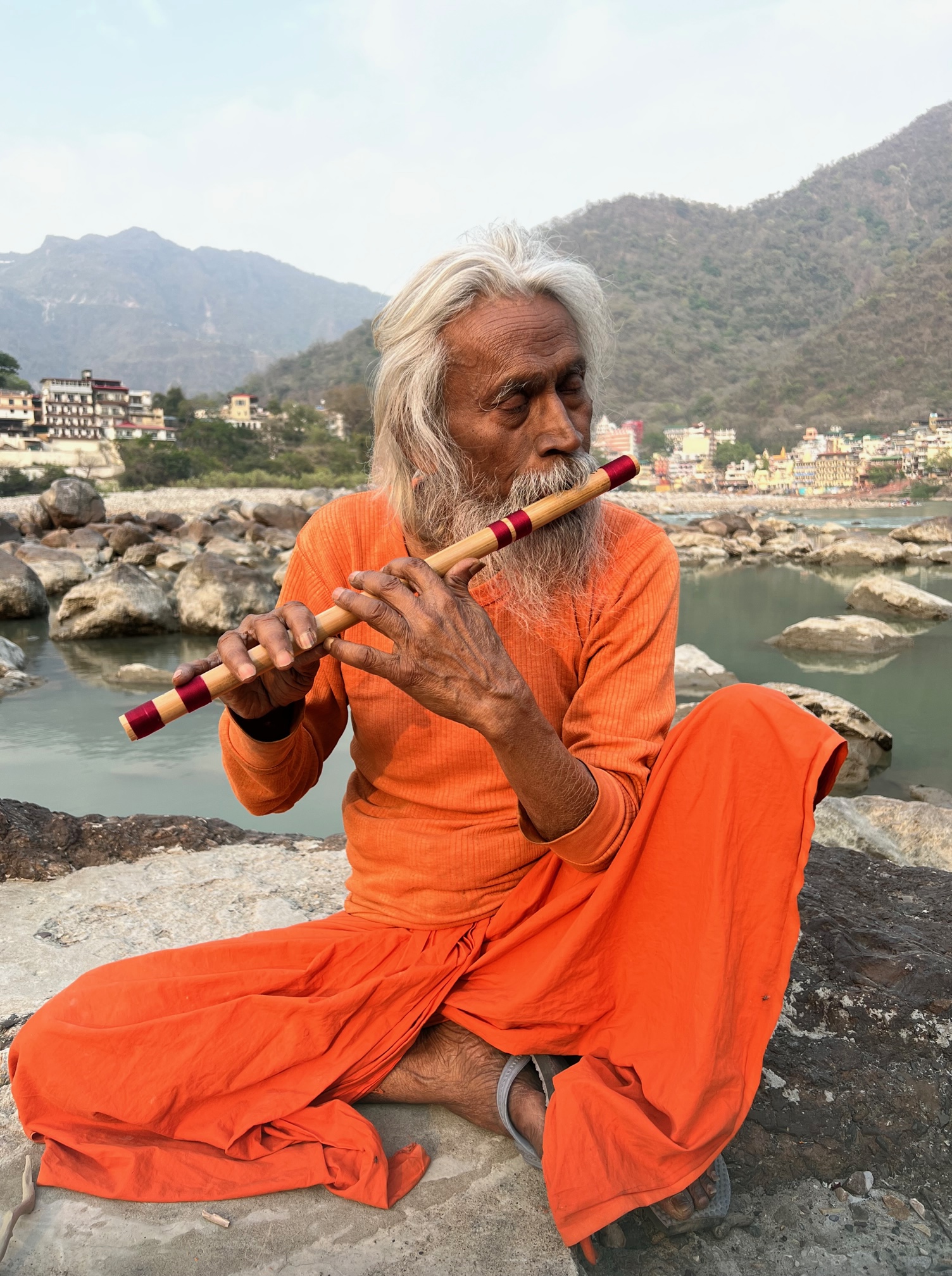
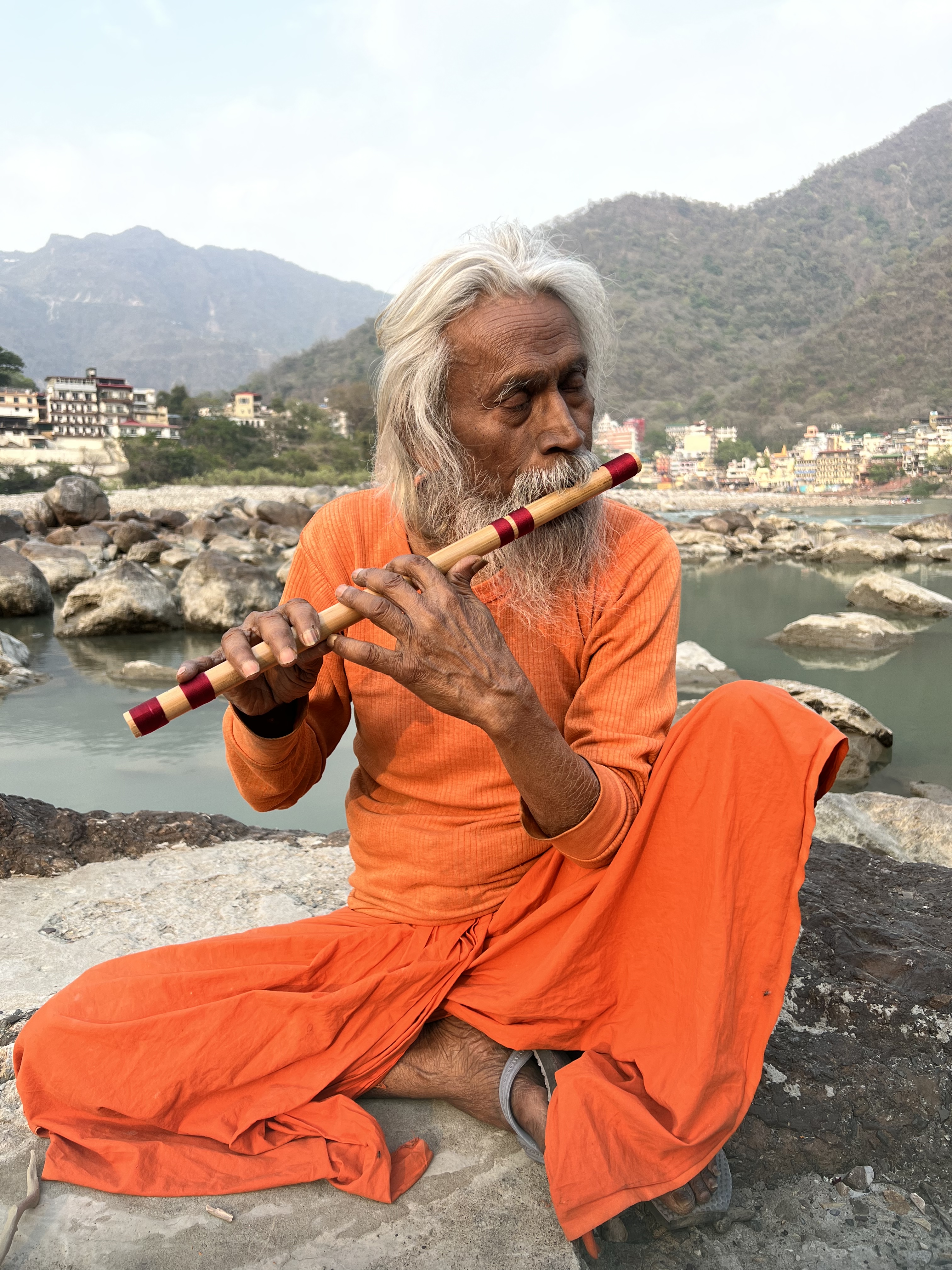
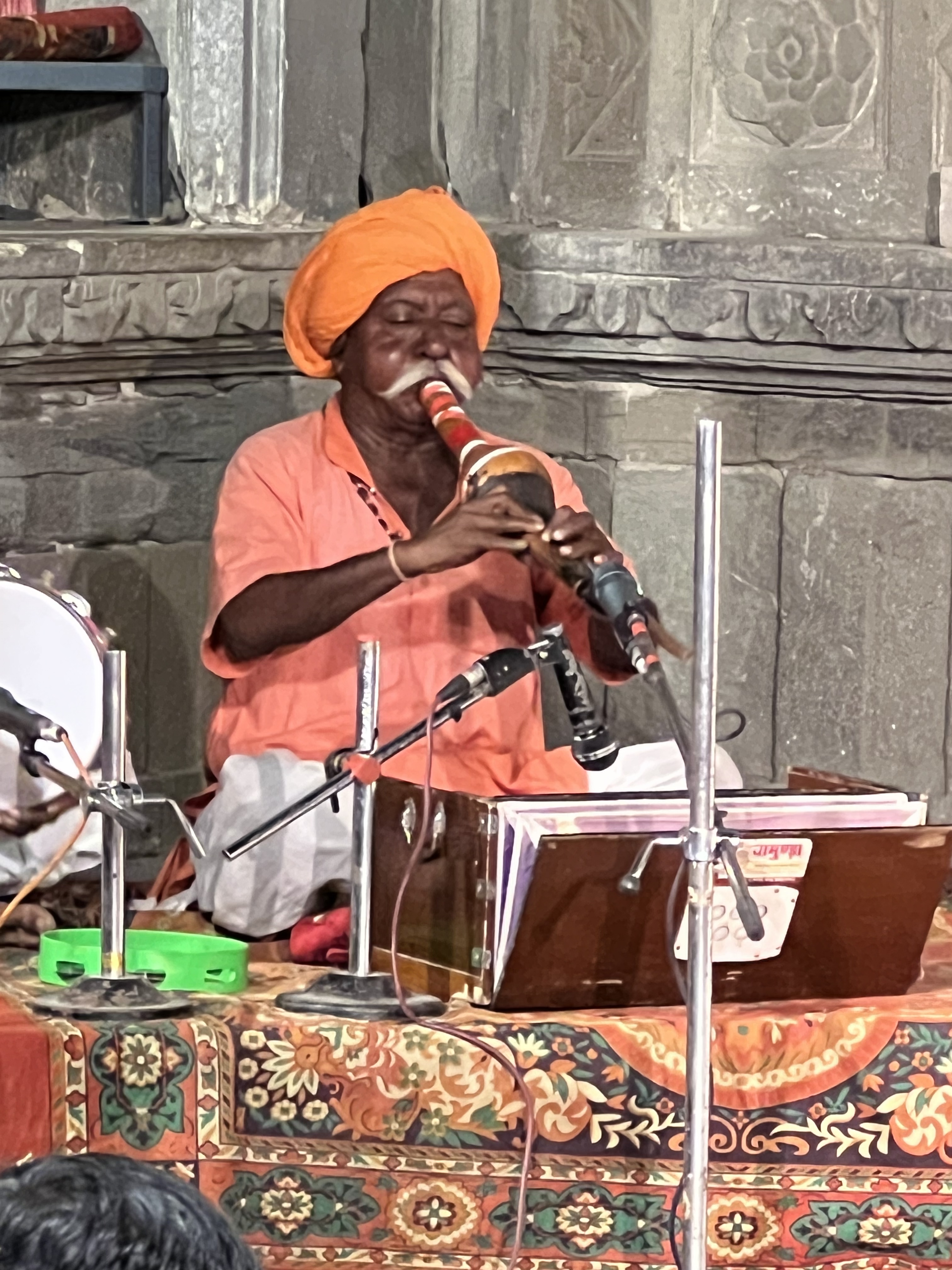
And I meet with a charming monk at a nearby ashram from time to time to learn to play the Indian flute, but mostly to listen to his stories, watch his expressive face, and soak in the atmosphere. He, also, by the way, refuses payment and is only willing to receive a donation according to what I feel is appropriate.

I feel sad when I think of the epitome of yoga I met seven years ago who taught yoga out of love and took payment only through Dana or Dan – personal giving from the heart.
I’m convinced that he became corrupted by his contact with foreign tourists and his online classes. He told us that he enjoys working with them since it doesn’t bother them to pay high prices. His Facebook is full of the new car he purchased and his many holidays. His messages to us were filled with ego and grasping.

Necessarily, in my opinion, the increase in the Westernization of yoga leads to a decrease in living and practicing according to the beautiful ideals of the eight limbs of yoga. It’s a huge challenge to combat that reality.

In my studio there are four teachers. Two of us are happy to charge little, encourage our students to attend class whether or not they’re able to pay, and remain flexible about keeping track of payment. One teacher lives with that approach comfortably but will probably be happy to earn more if she decides to work elsewhere. And one teacher constantly struggles with the studio’s approach.

They’re all excellent teachers. I feel that part of my role as the owner of the studio is that of helping all of us remain as much as possible within the healthy, self-nourishing framework of the philosophy of yoga. As I often remind them, and myself, we’re not an after school music lesson or drama group.

Being a yoga teacher is a commitment to a lifestyle.

Being a yoga teacher in this way is, first and foremost, a gift to ourselves.

It may be impractical and out of fashion in today’s world but I believe it still has a place that should be protected.

Udaipur: The Village Tour

We met our daughter and her three children at the Delhi airport after they’d spent the weekend in Agra seeing the Taj Mahal. We flew together to UDAIPUR, a small, pretty city in the Rajasthan District. UDAIPUR is known as a romantic honeymoon location, home to the lovely Lake Pichola and impressive City Palace. My partner and I were there 7 years ago on our first trip to India and thought it would be a good place for children’s activities.

Rajasthan has its own rich history of colorful dress, dance, and music. We were sure the kids would love the cultural evening with the live Rajasthani music and groups of women dancing with bells on, fire pots on their heads, and especially the young woman dancing while balancing 10 colorful pots on her head. We were wrong. Luckily it was only an hour.

The next day we fared a lot better. All but one of us really got into the 3 hour art workshop where a patient, sweet, talented artist helped us each paint our very own miniature. Our daughter and granddaughter both created truly beautiful miniature paintings. My partner’s peacock and my dancing elephant weren’t bad but revealed that we needed a bit more instruction. Our youngest, a very active 7 year old, showed more focus and attention to detail in his prancing horse than I’d ever seen.

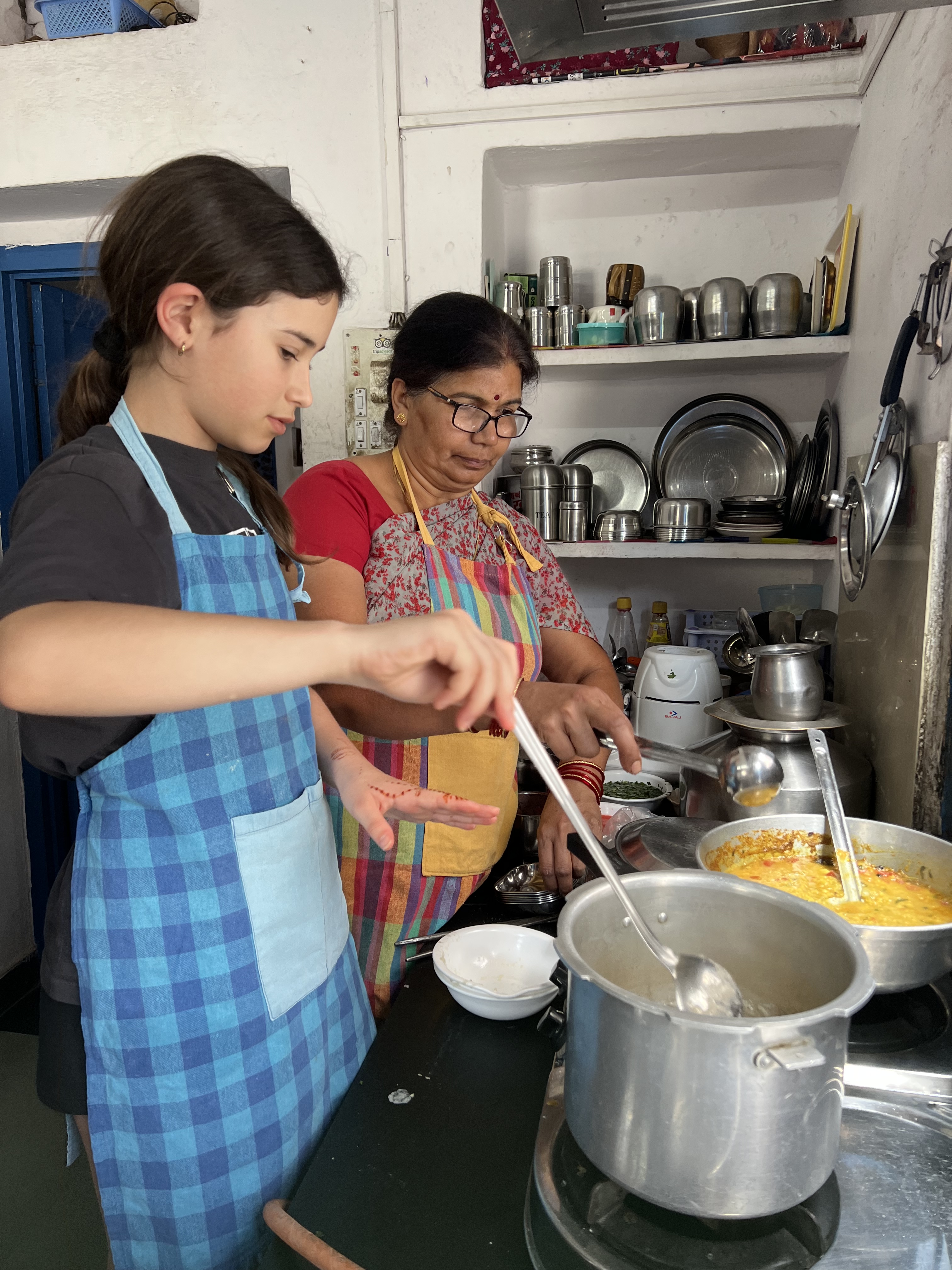
The 3 hour cooking class was a hit with all of us. It was very hands on – from the chopping to the kneading to the measuring and mixing of spices, to the frying…and, of course, the eating. The shy cook started off embarrassed that her English might not be good enough, but once she warmed up (and it’s hard not to warm up to these three kids!), she totally took over the instructions from her (very good looking) son, Gautam.

But the day none of us will ever forget is the day of the village tour.

My partner and I had taken a cab and driver out into the countryside 7 years previously. Our driver took us to several cottage industries – hand stamped textiles, pottery, a country art school for miniatures. We didn’t remember the names of the villages so after reading the glowing reviews of “Salim’s Day Village Tour” we decided to put our motley crew in Salim’s hands and follow wherever he led.

Salim, a devout soft-spoken Muslim, showed up dressed all in white in honor of the Muslim holiday of Ramadan. He brought another auto-rickshaw in addition to his own. We all piled in and off we went in the shimmering 35 degrees heat (95 degrees Fahrenheit).

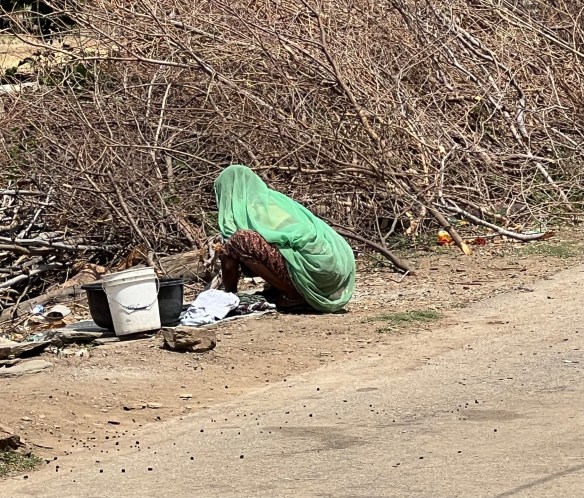
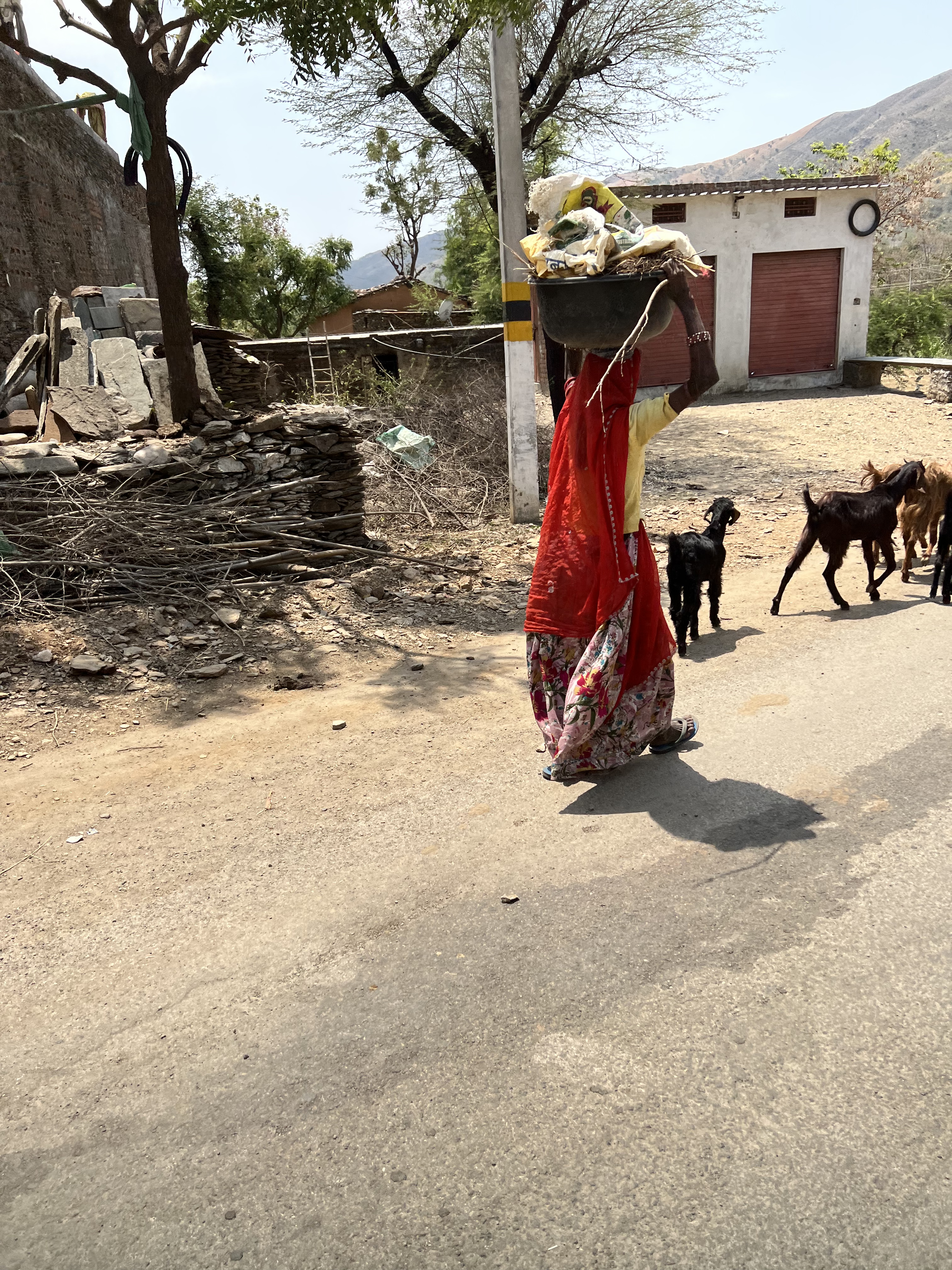
About half an hour later he pulled onto a dirt and gravel road and then turned again onto a rocky path where he parked after another 100 meters. Our first sight was of two women in the distance washing clothes in the small creek. The second was a woman, also dressed in a traditional, colorful sari, with a stack of cow patties balanced on her head.

We followed Salim into a lean-to where five men of varying ages sat on a flat stone area and several women stood by a counter leading into a small hut. It turned out that the father of the woman of the house had died and they were celebrating his life according to their Hindu custom. Somewhat similar to the Jewish shiva, but not exactly an act of mourning since they believe that while his physical manifestation is gone, his (much more important) essence remains.

Oddly enough, one of the ways they honor their guests is to give them cigarettes. Maybe to hasten their reunion with the recently departed? There were giggles from the women and guffaws from the men when my daughter took one of the cigarettes and lit up. Indian women do NOT smoke. But my very white, very light haired daughter differs from them in so many ways that a puff on a cigarette didn’t offend.
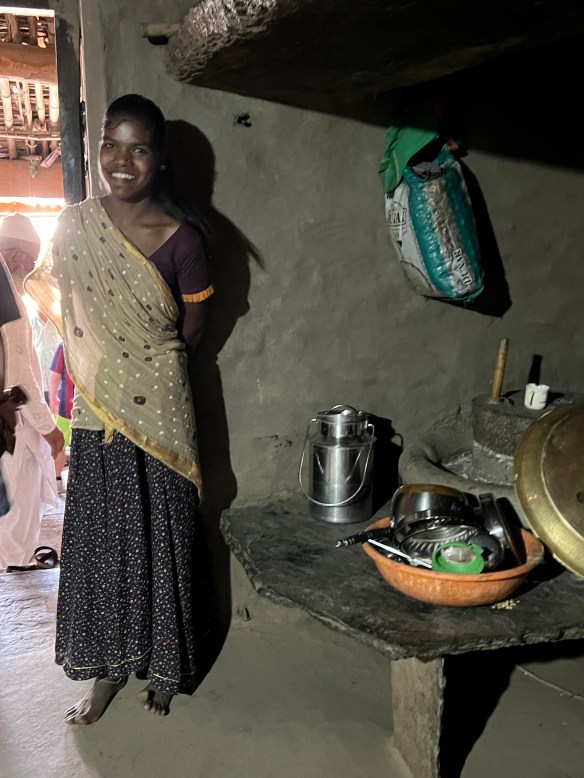
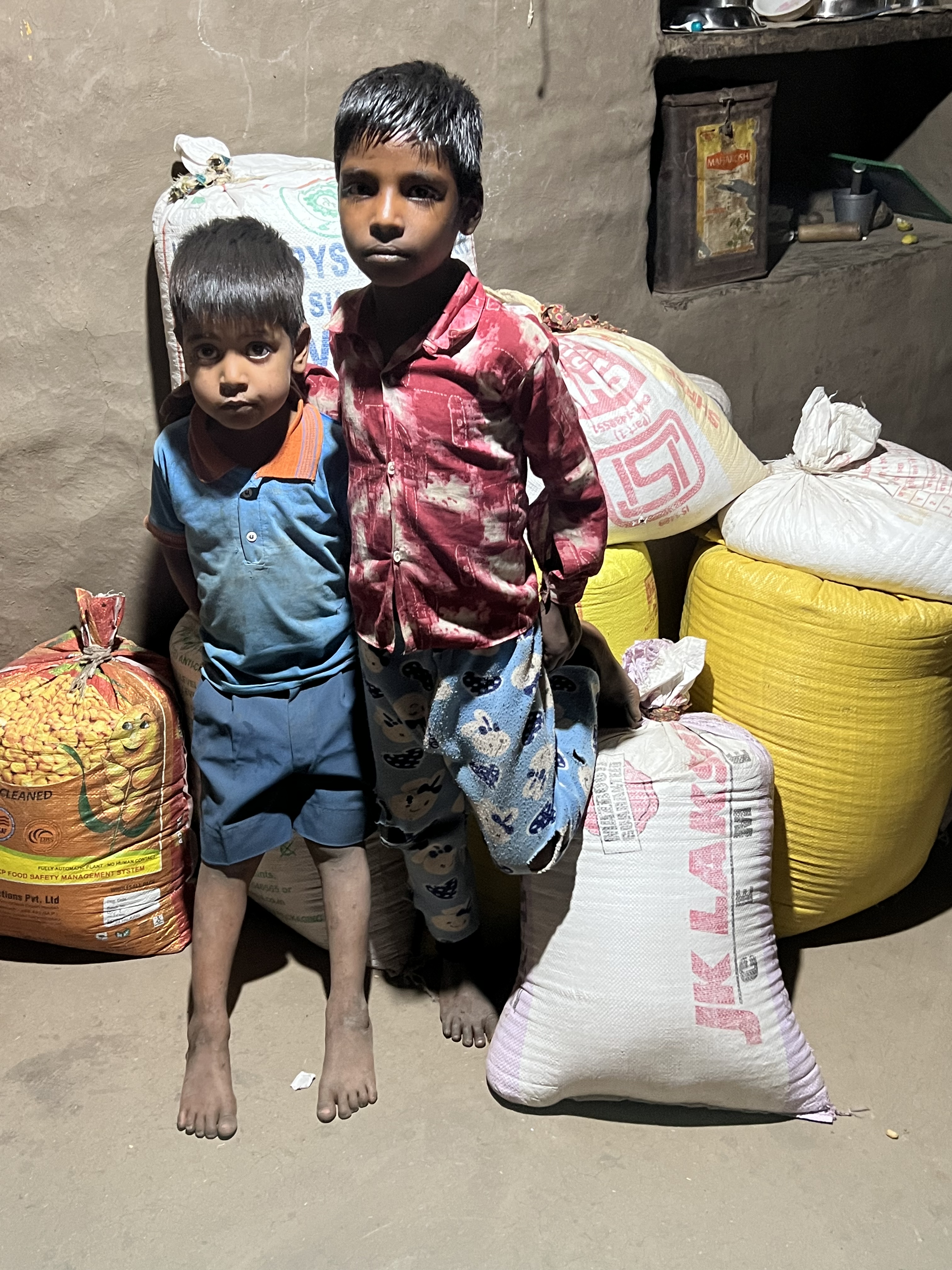
We asked to see inside their one-room home and they happily acquiesced. One of the young women whisked off the covering from a large pot to show us the gas burners (my daughter told us later that a mouse came barreling out). Inside it was quite dark. There were big sacks of flour and rice along one wall. There was one bed with pots, pans, metal plates and cups on it. Salim explained later that the couple sleep in the bed and the children, in this case three, sleep on mats on the floor. There was no bathroom; it’s presumably outside.

We asked if there was electricity and a man pointed the one bare, unlit, bulb hanging in the entranceway.

After our goodbyes we moved on to a day care center not too far away. There were about 15 gorgeous three and four year olds inside.

To say the cramped space was dark, dirty, with virtually no toys doesn’t come close to giving an adequate description.

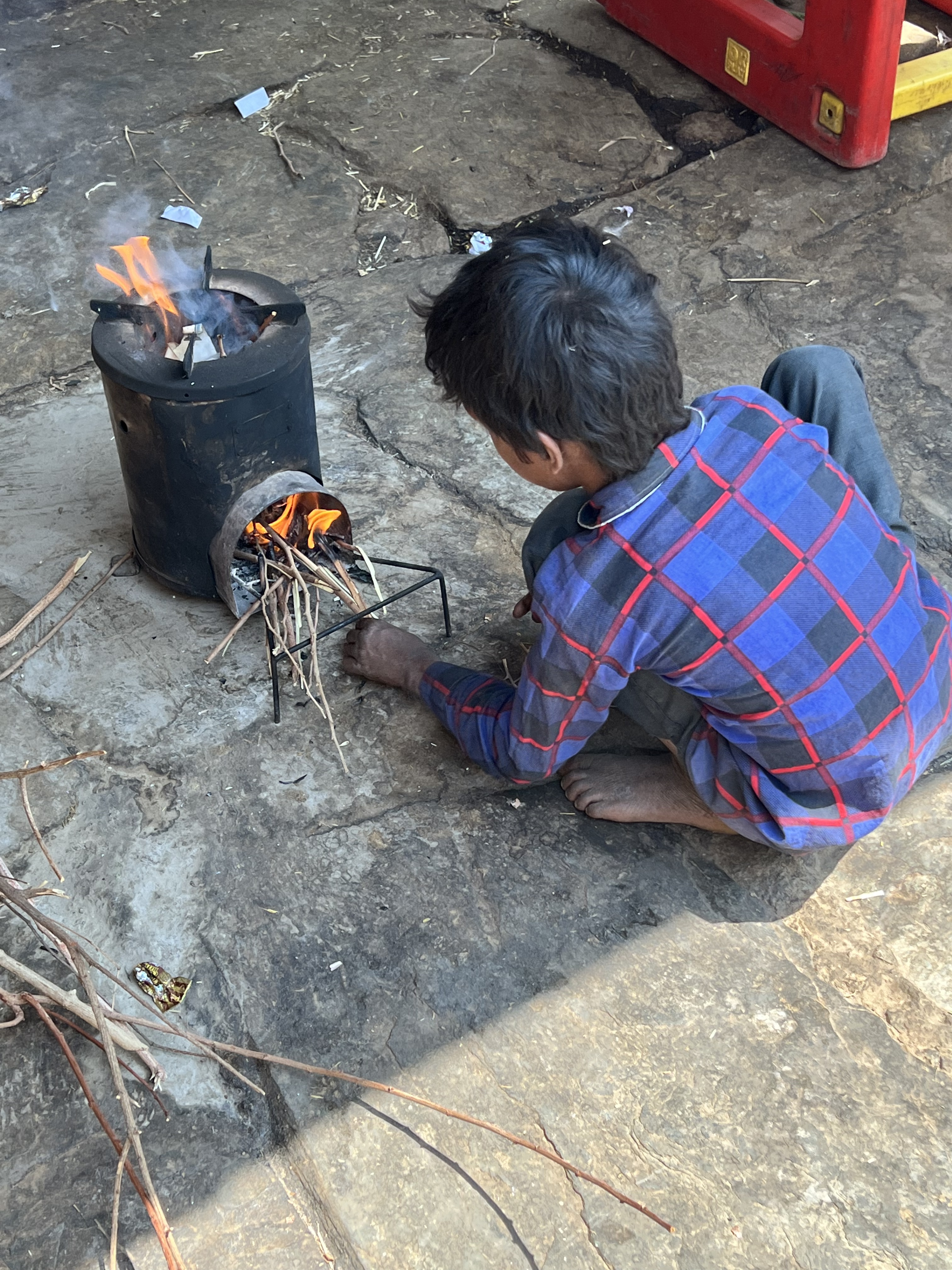
At one point a boy, who looked to be 8 or 9 years old, set fire to some kindling stuffed into a canister-looking contraption. We basically stood with our mouths open contemplating how many safety measures were being ignored while the smaller children heedlessly walked around the open flame. The lone day care worker put a pot of soup on top and began to prepare the children’s lunch.

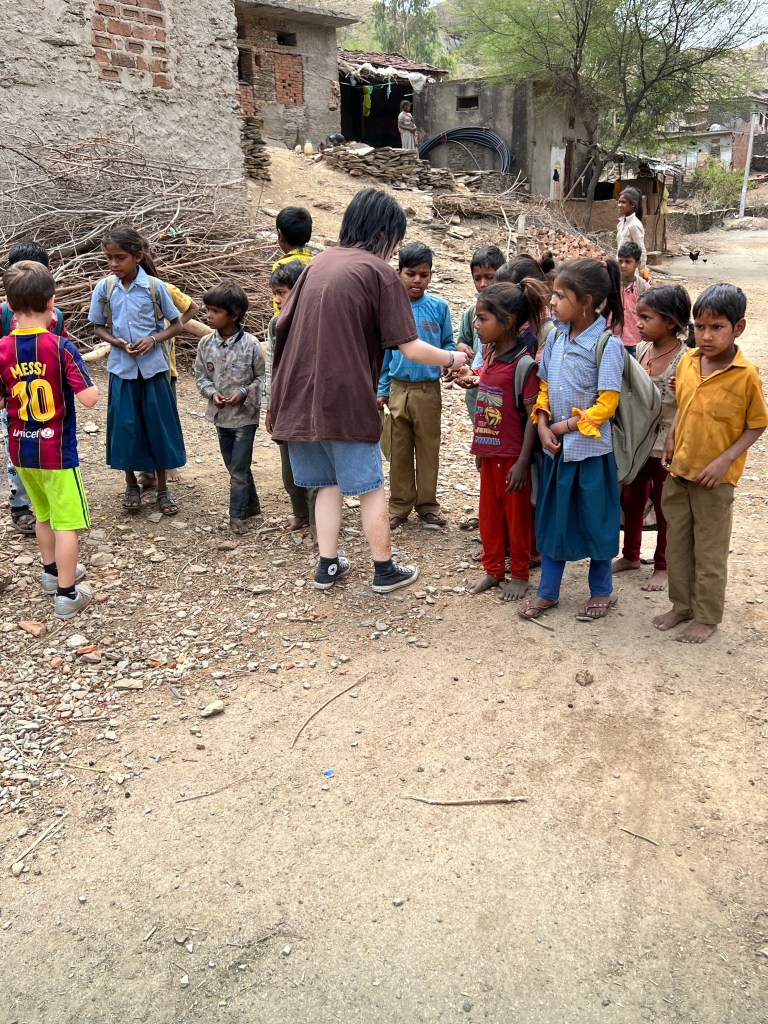
Salim had recommended we bring candies. Our grandchildren had a great time handing out candies to the youngsters both inside the day care center and walking around the village. They were surprised that when they offered a candy to a child who, as it turned out, had already received one, she declined to take a second. What kid does that!?
By this time we were all drooping from the intense heat and more than ready to head back to our hotel. It wasn’t only because of the heat, though, that it was so quiet in the tuk-tuk on the ride back. There was a lot to think about.

We arrived at the gates to the 42 acres (over 160 dunam) surrounding our hotel. The turbaned guard called a buggy to come get us: goddess forbid we should walk the 150 meters to the entrance to the hotel. Along the way we saw peacocks roaming the grounds freely, smelled the fragrance of the beautiful flowers, and heard the splashing of many fountains.

Truth be told, we don’t usually stay in such elegant surroundings where there are so many impeccably dressed, beyond pleasant staff constantly bowing namaste in our direction over prayer hands. Our daughter is more accustomed to 5-star hotels and it’s actually much easier to enjoy a vacation with children, one of whom is a teenager, when they’re comfortable.

Inevitably at the dinner table when we talked about our impressions of our day, and after the grumbling about the schlepping around in too much heat for way too long, we all expressed our dismay at the parity between the lives of the villagers and the vacationing Indians sitting at the tables around us.

Almost 70% of the one and half billion people who live in India live outside the cities. As in most developing countries, every year people move to the city for employment or other ways of bettering the lives of their family – about 2% annually in India. The already overloaded infrastructure of the cities – Delhi with almost 33 million people, Mumbai with over 21 million, Bangalore with almost 14 million – is hard put to cope with more.

Prime Minister Modi, since his election in 2014, has instituted several programs to encourage villagers to remain in their villages. His government guarantees 100 days of employment to every villager who’s eligible. A gift of 150,000 rupee ($2000) is given to each village homeowner for home improvements, primarily to fortify roofs and walls to withstand monsoon season. 600 million toilets were purchased for the villages in the first five years of the present government .

And, still, the parity is huge.

We talked about the Indian trait of acceptance and the joy in the villagers’ children’s play. We talked about the bountiful nature of our own lives and how, even so, we so often strive for more and better. One of us reminds us of the pride in one man’s voice when he pointed out that his daughters were home visiting from college. So along with acceptance there can be a desire for change.

We conclude our conversation as so many of them end – knowing that we can only ever get a small peek into the depth and vastness of this amazing country called India.

None of us will ever forget these two weeks of ours as a family in India and this day will always stand out.

Riding the Rails

Literally billions of people ride the Indian Railways every year – 8.086 billion in 2022. Established in 1836, it remains the most utilized form of public transportation between cities in India. Cheap, reliable, and relatively comfortable, passengers can choose between at least 3 classes of travel from non-air conditioned, usually very crowded, sleeper class to air conditioned first class (not available on most trains) with only one person per berth. Clean sheets and pillow cases are provided. There’s a small table and individual reading light in each berth. The seats revert into beds. Often there is a western toilet as well as an Indian “toilet” and the bathrooms are relatively clean, although often stinky.

The reservation process is tricky.

We were fortunate our first time in India to be taken under the wing of the young man who arranged for us to see tigers in Bandhavgarth. Though not at all his job, he walked us through the complicated process of opening our own Indian Railway account. As a result, we’ve been able to purchase train tickets online on every trip since. Most foreigners use the ubiquitous travel agencies where they can purchase train tickets for an added fee.

The status of a reservation is crucial.

We didn’t understand what all the abbreviations stood for at first and learned by making funny mistakes which thankfully didn’t result in us getting kicked off trains, but only because Indians have inhuman patience with how life rolls.

There are many levels of waiting list status. The final status only becomes available 3-4 hours before the train leaves the station. That’s why so many Indian families can be seen sitting, or even sleeping, on the platform floor. Often they’ve brought stainless steel closed pots with food for the long wait.

If a seat has not become available money is automatically refunded.

If one traveler receives confirmed status, all travelers in her party can board the train but they may not have an actual seat. They can sit on the berth of the confirmed traveler…or on the floor.

And then there’s finding the correct platform and your particular train car’s position. The train may stop for only 2 minutes and each train is ridiculously long. If you read Tamil Nadu or Mayalayam you may not have trouble reading the electronic sign but, even so, the platform may change. The final platform may only be announced (thankfully also in English though so heavily accented sometimes that it’s a challenge to understand) 10 minutes before the train’s arrival. Being old and very white, people often approach us to ask if they can assist us in standing in the right place. Indian kindness and gentleness is found everywhere.

Our first time in India we had to keep asking where to get off the train. There’s no announcement of stations. The stations are often not lit up so there’s no possibility of seeing the name of the stations at night. At that time there was no live online running status as there has been for consequent trips. Again Saptarishi, our guardian angel on our first trip, stepped in to save us on one overnight journey. He called us as 4 am to tell us to get off at the next stop. Sweet guy. Who knows where we would’ve ended up?

There’s a sense of accomplishment in learning the twists and turns of using the train system. And not only fanagling our way effortlessly through the process.

Also realizing that less is more. Each trip I’ve packed less so as to be more comfortable getting on and off trains as well as having more space around me in the berth. And that’s a useful skill for every aspect of travel, imo.

Also being with Indian travelers and having some interesting conversations- glimpses into their lives. Once a large group of university students traveling to various cities to see different types of city planning. Another time two middle aged couples – friends – taking an annual vacation together. A few days ago a young man whose job it is to be sure used linens are removed and clean linens provided.

On one of our first train trips a 50-something couple, both professors, returning home from visiting their son at college explained the Hindu relationship with god/dess statues and shared their views on arranged marriages versus “love marriages” (they were shocked to learn that ours wasn’t an arranged marriage).

Another benefit is being able to move around, stretch your legs, and even do a little yoga if you’re so inclined. India is huge – Rajasthan, one state out of 28 – is the size of Germany. A journey between cities might be a couple of days or more. Hiring a car with a driver is relatively inexpensive but not only are you in a pristine bubble, removed from actual India, you’re also stuck in a car for hours and hours, day after day. Sure, you can stop whoever you want, and you can stay overnight in nice air conditioned hotels along the way, but it just takes that much longer and is, imo, claustrophobic.

Did I mention the vendors who hop on the train selling tea, coffee, snacks, and meals?

“Chai, chai, masala chai, coffee!”

So far we’ve only been on two train trips and I’m not sure how many more we’ll take this time around.

I’m already feeling a bit nostalgic..

A Gentler Way of Life

We’re leaving Thumpoly Beach later today.
Yesterday I spent two hours happily painting with acrylics surrounded by paintings of local artists and classical music in a specially designated room in a local art gallery. The owner of the gallery, a retired professor of political science and engineering, provides this wonderful experience for any tourist fortunate enough to learn of the possibility and make a reservation. There’s no fee.
He explained as we shared a cup of (way too sweet) coffee that he left the university five years before the age of retirement because his wife left her teaching position and was at home. There was a hint of illness on her part but he didn’t elaborate and I didn’t ask.
I sensed that the experiential opportunity he offers is an opportunity for him to socialize with people from all over the world now that he’s restricted to this lovely but insular fishing village. We chatted for an hour as he brought out spicy roasted cashews and cookies. A little politics (a big Modii and Bibi fan). A little religion (he’s Christian and fondly recalled his pilgrimage to Israel). A little economy (India has a vastly more reasonably priced medical system and price of living).
A man happy with his lot in life.
As I walked home I thought it could be very pleasant to be in Thumpoly for an extended visit and share afternoon tea and conversation with him from time to time.
I recognized several of the women I passed in their colorful saris with an umbrella held overhead to protect them for the sizzling sun. We smiled at each other, wagged our heads and offered a soft ‘namaste’.
Most stores are closed for a few hours when the sun is at its hottest and only now, at five o’clock, people are again out and about.
My partner and I had agreed just that morning that, as wonderful as it is here, we were ready to move on. But as I gazed at The Arabian Sea and the young men strolling along the beach I realized that I’m a little sad to be leaving.
Every morning we see the fishermen heading out for another day of catching whatever they can – and it isn’t much this time of year. They throw their gill nets or small trawling nets and harvest what they can. A few shrimp. A crab or two. A kilo of very small fish if they’re lucky. Later in the day we see exuberant children walk by in their school uniforms. Inevitably they stop to say hello, ask our names (again) and inquire after our health.
In the late afternoon, when there’s more of a breeze, we see various village residents walking by on the dirt path along the shore in front of our balcony. No one is in a hurry. They seem to be enjoying the sea air and the crash of the waves as much as we do, even though they’ve undoubtedly lived here all their lives.
I suppose there’s gossip and intrigues here as there are everywhere; heartbreak, ill health, kids making life choices their parents don’t understand.
There are very big beautiful homes and tiny unkempt hovels.
But in general life here seems to have a gentle rhythm and people seem to smile much more than in the towns with which I’m more familiar.
Our friends here have two children, which is the norm. One, their daughter, was accepted into the engineering program at a prestigious university very far away. The other, their son, is finishing high school and plans to spend seven years in the army.
Our friend, Antony, raised in this village, the son of a fisherman, was a career officer, head of the anti-terrorist units fighting in Kashmir, and retired as a colonel, one of the wealthier residents of Thumpoly. His wife is a school principal who (in spite of her profession?) is almost always smiling and happy.
Antony and Teresa both give much of their time to the community. Whether from modesty or simply relaying this village’s reality, Antony has told us often that giving to the community is the norm and not the exception.
There are certainly downsides to life in this crazy patchwork of a billion and a half people, over 25 spoken languages, millions living in slums alongside the abundance of IT employment, jewelry production and export, and a caste system which refuses to die, just to name a few challenges.
At the same time, there is a gentler way of life and a serene inner beauty to those who have less, in many cases a whole lot less, but retain an appreciation for what they do have.
So, yes, I’m a little sad to be moving on, even while I look forward to better physical conditions and an evening cocktail.
Ah! The contradictions of life.

To each her story; to each his unique voice

Marie Renee lives outside of Geneva in a small village and bicycles to work every day. Her husband is one of three people whose job it is to administer the village. Their two children are grown and live close by. She speaks with them daily and they meet for a chat frequently.

A charming story of a life well-lived.

Travelers tend to reveal the cracks in their narrative to other travelers sharing their breakfast table morning after morning or their view of the sea from the balcony.

As it turns out, Marie Renee’s husband began experiencing burn out last year. Discontented and unhappy, he disturbed the calm waters of their life. Marriage counseling for them and a psychologist for him and Marie Renee found herself with a husband trekking alone in South America and an empty house. Her inner voice guided her to a course of daily yoga and Ayurvedic massage in Southern India.

The morning she shared her last breakfast with us before leaving for home she talked about what her future looked like from here. She emanated a gentleness and calm as she expressed hope that her husband would come home happier and healthy. I think I could hear love in her tone. Her voice was confident when she said that she’d be alright and she’d be back.

Talk to yourself as you would to someone you love.

After our three year absence we came back to find Vijay still the go-to guy at our beach guesthouse. His wife and nine year old daughter stay with his in-laws near the northern border of India with Bhutan while he works in Southern India. He shops and cooks, arranges transportation, supervises repairs, and makes sure all guests have what they need. His English is rudimentary but his cheerful desire to communicate overcomes most people’s reluctance to attempt real conversation with those whose language they barely speak.

The train ride home at the end of the season takes three days and he travels sleeper class, the lowest class of travel, with wall-to-wall people, no air conditioning, inedible food, and increasingly disgusting bathrooms. He gathers his small family and they return to their own home for the six weeks he can stay with them before returning to work.

This is his life. The life he’s chosen. He’s loyal to his job and is grateful to be able to support his family.

If you concentrate on what you don’t have you’ll never have enough.

A month ago tall, willowy Lillian buried her almost-90 year old father in the Christian cemetery a five minute walk from our guesthouse. It wasn’t easy plowing through all the bureaucracy involved in burying a French citizen – a tourist – in India. She’s hoping that having her father buried in India will make it easier for her to remain in India for longer periods of time without the necessity of leaving for a day every 30 days. And, anyway, she has no family left in France to be uncomfortable with her father being buried so far from home.

Never married, an only child with no children of her own, she has no ties to France…or anywhere else. She had one aunt but she’s dead, as is her mother. She’s basically alone in the world.

She first came to Thumpoly Beach in 2019 and has been back four times. After her first time she began to organize small groups to come on yoga and Ayurveda retreats. She became friendly with the owner and his family and today they are more family than she has ever had.

When she returned to France after her first visit she tried many yoga studios but ultimately arranged daily yoga online with her teacher from Thumpoly Beach. She was unable to explain her dissatisfaction with the yoga in France other than to say “It wasn’t like yoga in India.”

She plans to return to France to take care of her father’s affairs and settle the technicalities of renting out her apartment to a neighbor. As quickly as possible she’ll return to this seaside guesthouse to begin as permanent a life here as the Indian government will allow.

Come home to you. It’s where you belong.