We’re leaving Thumpoly Beach later today.
Yesterday I spent two hours happily painting with acrylics surrounded by paintings of local artists and classical music in a specially designated room in a local art gallery. The owner of the gallery, a retired professor of political science and engineering, provides this wonderful experience for any tourist fortunate enough to learn of the possibility and make a reservation. There’s no fee.
He explained as we shared a cup of (way too sweet) coffee that he left the university five years before the age of retirement because his wife left her teaching position and was at home. There was a hint of illness on her part but he didn’t elaborate and I didn’t ask.
I sensed that the experiential opportunity he offers is an opportunity for him to socialize with people from all over the world now that he’s restricted to this lovely but insular fishing village. We chatted for an hour as he brought out spicy roasted cashews and cookies. A little politics (a big Modii and Bibi fan). A little religion (he’s Christian and fondly recalled his pilgrimage to Israel). A little economy (India has a vastly more reasonably priced medical system and price of living).
A man happy with his lot in life.
As I walked home I thought it could be very pleasant to be in Thumpoly for an extended visit and share afternoon tea and conversation with him from time to time.
I recognized several of the women I passed in their colorful saris with an umbrella held overhead to protect them for the sizzling sun. We smiled at each other, wagged our heads and offered a soft ‘namaste’.
Most stores are closed for a few hours when the sun is at its hottest and only now, at five o’clock, people are again out and about.
My partner and I had agreed just that morning that, as wonderful as it is here, we were ready to move on. But as I gazed at The Arabian Sea and the young men strolling along the beach I realized that I’m a little sad to be leaving.
Every morning we see the fishermen heading out for another day of catching whatever they can – and it isn’t much this time of year. They throw their gill nets or small trawling nets and harvest what they can. A few shrimp. A crab or two. A kilo of very small fish if they’re lucky. Later in the day we see exuberant children walk by in their school uniforms. Inevitably they stop to say hello, ask our names (again) and inquire after our health.
In the late afternoon, when there’s more of a breeze, we see various village residents walking by on the dirt path along the shore in front of our balcony. No one is in a hurry. They seem to be enjoying the sea air and the crash of the waves as much as we do, even though they’ve undoubtedly lived here all their lives.
I suppose there’s gossip and intrigues here as there are everywhere; heartbreak, ill health, kids making life choices their parents don’t understand.
There are very big beautiful homes and tiny unkempt hovels.
But in general life here seems to have a gentle rhythm and people seem to smile much more than in the towns with which I’m more familiar.
Our friends here have two children, which is the norm. One, their daughter, was accepted into the engineering program at a prestigious university very far away. The other, their son, is finishing high school and plans to spend seven years in the army.
Our friend, Antony, raised in this village, the son of a fisherman, was a career officer, head of the anti-terrorist units fighting in Kashmir, and retired as a colonel, one of the wealthier residents of Thumpoly. His wife is a school principal who (in spite of her profession?) is almost always smiling and happy.
Antony and Teresa both give much of their time to the community. Whether from modesty or simply relaying this village’s reality, Antony has told us often that giving to the community is the norm and not the exception.
There are certainly downsides to life in this crazy patchwork of a billion and a half people, over 25 spoken languages, millions living in slums alongside the abundance of IT employment, jewelry production and export, and a caste system which refuses to die, just to name a few challenges.
At the same time, there is a gentler way of life and a serene inner beauty to those who have less, in many cases a whole lot less, but retain an appreciation for what they do have.
So, yes, I’m a little sad to be moving on, even while I look forward to better physical conditions and an evening cocktail.
Ah! The contradictions of life.
Author Archives: gettingoutalive
To each her story; to each his unique voice
Marie Renee lives outside of Geneva in a small village and bicycles to work every day. Her husband is one of three people whose job it is to administer the village. Their two children are grown and live close by. She speaks with them daily and they meet for a chat frequently.
A charming story of a life well-lived.
Travelers tend to reveal the cracks in their narrative to other travelers sharing their breakfast table morning after morning or their view of the sea from the balcony.
As it turns out, Marie Renee’s husband began experiencing burn out last year. Discontented and unhappy, he disturbed the calm waters of their life. Marriage counseling for them and a psychologist for him and Marie Renee found herself with a husband trekking alone in South America and an empty house. Her inner voice guided her to a course of daily yoga and Ayurvedic massage in Southern India.
The morning she shared her last breakfast with us before leaving for home she talked about what her future looked like from here. She emanated a gentleness and calm as she expressed hope that her husband would come home happier and healthy. I think I could hear love in her tone. Her voice was confident when she said that she’d be alright and she’d be back.
Talk to yourself as you would to someone you love.
After our three year absence we came back to find Vijay still the go-to guy at our beach guesthouse. His wife and nine year old daughter stay with his in-laws near the northern border of India with Bhutan while he works in Southern India. He shops and cooks, arranges transportation, supervises repairs, and makes sure all guests have what they need. His English is rudimentary but his cheerful desire to communicate overcomes most people’s reluctance to attempt real conversation with those whose language they barely speak.
The train ride home at the end of the season takes three days and he travels sleeper class, the lowest class of travel, with wall-to-wall people, no air conditioning, inedible food, and increasingly disgusting bathrooms. He gathers his small family and they return to their own home for the six weeks he can stay with them before returning to work.
This is his life. The life he’s chosen. He’s loyal to his job and is grateful to be able to support his family.
If you concentrate on what you don’t have you’ll never have enough.
A month ago tall, willowy Lillian buried her almost-90 year old father in the Christian cemetery a five minute walk from our guesthouse. It wasn’t easy plowing through all the bureaucracy involved in burying a French citizen – a tourist – in India. She’s hoping that having her father buried in India will make it easier for her to remain in India for longer periods of time without the necessity of leaving for a day every 30 days. And, anyway, she has no family left in France to be uncomfortable with her father being buried so far from home.
Never married, an only child with no children of her own, she has no ties to France…or anywhere else. She had one aunt but she’s dead, as is her mother. She’s basically alone in the world.
She first came to Thumpoly Beach in 2019 and has been back four times. After her first time she began to organize small groups to come on yoga and Ayurveda retreats. She became friendly with the owner and his family and today they are more family than she has ever had.
When she returned to France after her first visit she tried many yoga studios but ultimately arranged daily yoga online with her teacher from Thumpoly Beach. She was unable to explain her dissatisfaction with the yoga in France other than to say “It wasn’t like yoga in India.”
She plans to return to France to take care of her father’s affairs and settle the technicalities of renting out her apartment to a neighbor. As quickly as possible she’ll return to this seaside guesthouse to begin as permanent a life here as the Indian government will allow.
Come home to you. It’s where you belong.
From Here to the Sun and Back Sixty Times
Human knowledge grows at a phenomenal rate. Think of the world as understood in Medieval days and as we understand it today. No need to go so far back. Think of the average Western household in Ozzie and Harriet’s time and your own household.
My partner, who could be called antagonistic toward maneuvering through life via screens, came home one day not too long ago decrying how much even he relies on screen technology in the course of his day. He checked the best route into the city with Waze to avoid as much traffic as possible. He parked his car using the Pango app. He received and acknowledged orders from clients via WhatsApp. While waiting for an appointment he got caught up with local, national, and international news online. He called me from his cell phone to mine to kill time in traffic on the way home.
And traveling? How did we manage when we started traveling to out of the way places 30 years ago? No booking.com, Airbnb, TripAdvisor; no Facebook groups of like-minded people offering tips or asking for information. No Uber or Ola to find and get us to hole-in-wall locations at a reasonable price. No google to locate pure veg restaurants.
Okay, all that technology is amazing. It makes our lives so much easier and so many things more accessible. And it also, of course, has huge downsides and creates many distressing societal issues. But this isn’t about that.
Human knowledge doesn’t begin and end with technological advances like those.
The medical world has now advanced to allow for many previously terminal cancers to become chronic cancer; cancer with which, with continuous treatment, people can live a quality life for decades. Prosthetics moveable by thought. I could go on but I don’t really know even a minuscule percentage of all the incredible innovations in the world of medicine.
And what about all the new information coming from the James Webb Space Telescope? It can see what the universe looked like around a quarter of a billion years (possibly back to 100 million years) when the first stars and galaxies started to form. Astrophysicists are scratching their heads wondering how their science could’ve gotten so much so wrong now that the telescope is providing new information.
The study of the cell – that most basic of components in the biological world – has changed so much over the past few decades that today we know that if the DNA from the cells found in one human body were stretched out in one continuous line it would reach the sun and back sixty times, Sixty. Six-oh. We didn’t even know DNA existed before the 1860s. It wasn’t known to be the carrier of genetic material until 1944 and became a reliable profiling mechanism only 40 short years ago.
Amazing, exciting, miraculous advances in human knowledge.
And yet…
Yesterday I tuned into day three of The Dalai Lama Global Vision Summit. I happened to choose Dr. Joe Loizzo’s talk about ethical leadership. I got as far as his call for every person on the entire planet to commit to becoming an ethical leader. Certainly I agree that each of us can and should develop leadership skills in our lives but, seriously!?! If the prerequisite to improving the unfortunate state of a world in conflict is for every single person on earth to become an ethical leader, it just ain’t gonna happen, bubba.
I mean look at us.
In the United States you have the cancel culture, a city proposing that each household pay $600,000 to help pay reparations to people who were never enslaved by a state which never had slavery, part of another state wanting to secede from that state to join a neighboring state, and people afraid to express their opinion for fear of being fired from their jobs. And in one 45 hour period, in one state, there were three mass shootings resulting in nineteen dead.
In England there have been three heads of state in three years. In Spain the birthrate has plummeted to 1.23%. In France the divorce rate is over 50%. The crime rate continues to rise in the Baltic countries. In France a man was found not guilty of a brutal murder of an elderly Jewish woman by reason of marijuana smoking.
In India, Muslims in the state of Kashmir continue to fight for independence. A recent reactivated Sikh movement has begun demanding their independence in the state of Punjab. The Muslim minority in the southern state of Kerala is quietly taking over local political positions.
In Israel political, social, and judicial reform has provided an opportunity for those interested in strengthening social and religious divisions. Extreme and violent language has become acceptable on both sides of any given issue. Defamation of character, personal attacks, and demagoguery are representative while, unsurprisingly, compromise is less and less of an acceptable option.
Humanity seems to be like the proverbial snake swallowing its own tail
We can create, investigate, research, change, and vastly improve our physical reality. But what good is it ultimately if we tear ourselves apart as human beings inhabiting a common earth?
Contrary to what many of us have come to believe when our phones have achieved the capability of supplying so much of our needs, no (emotionally healthy) human being is an island. We do, in fact, inhabit a common earth. And one of animals’ basic instincts is, pardon the expression, not to shit in their own home.
People! We’re unloading a lot of crap in our own homes. And it will not end well for us.
How about trying this? The next time you’re faced with a person whose opinions are not your own, take a breath, think to yourself that she, too, just like you, is a human being who wants to be happy. First and foremost, a human being. Immediately afterwards, who wants to be happy. Choose to distance yourself from her if you must, but treat her with the respect and, if it’s not stretching it too much, caring, that could provide for a gentler, less threatening world.
As far as human knowledge has taken our understanding so far, we only have one world. And if there turns out to be others we would do well to practice protecting the one we know about or we’ll just destroy any others we discover.
If you receive “Stories our parents tell us” twice…
Read the most recently received. Electricity being what it is here in southern India, the first version went out unfinished and unedited.
Stories Our Parents Tell Us
Just back from a dip in The Arabian Sea.
I’m sitting on the wooden balcony just outside our room, watching the mid-morning calm waves, really ripples, just as I’ve been contented to do most of my waking hours over the past four days.
There’s a rhythm to the sea. Several actually. And a rhythm to life here dictated by the sea.
The waves arrive from the south and break on the shore traveling northward, but oddly seem to recede back into the sea at the same time along the shore for quite a way. I’m sure there are physicists among you who can explain that phenomenon to me in language I wouldn’t understand.
In the morning the sea is so calm that the ripples have no sea froth. By mid-morning they are already small waves complete with white caps. In the afternoon the waves become quite healthy. At night they are loud and powerful and often stormy.
When they are at their calmest the fishermen in this small village of Thumboly are out in force. They employ several different techniques but none of them catches much, and the few fish they catch are tiny. We’re told there was a time when fishing was a viable industry here but that time is long over.
By mid-morning there isn’t a soul on the pristine beach other than the occasional tourist. By mid-afternoon the fisherman are out repairing their nets or playing card gambling games , sitting on the sand in groups of six to ten men.
It’s a bit of a mystery where the women are. Home, I suppose. We see the occasional woman shopkeeper and saw a little girl out playing with a little boy on their shared bicycle on one of our afternoon walks. But mostly we see men and boys. Playing soccer. Playing volleyball on the beach. Walking the village streets.
Our days are quite serene.
My partner takes a morning beach walk early every morning. He always comes home with a new adventure to tell me about. One morning it was two children out walking their crab…on a leash.
We have a breakfast of some kind of unfamiliar grain dish in various forms, a vegetable in soupy sauce to put over it, papaya or some other fruit, and tea.
Once breakfast is digested I spend an hour on my yoga mat. My practice immediately returned to its full glory with the first unfurling of my mat opposite The Arabian Sea. It had sadly stagnated for the past six months.
We read, write, and chat most of the day to the accompaniment of the sea’s music.
In the late afternoon we take a walk through the narrow byways of the residential area, where people happily greet us with a friendly “Namaste” and often ask us in to eat (which we politely decline) or into the small commercial area just past the large church.
Today, we decided, was the day we would venture into the water. We were out there at 9:45 when the waves were just starting to be more than ripples. My partner went in first to scout out the drop off and reported that it was sudden but not too steep. The water was warm and delightful.
In I went. But not far and not for long.
Sixty years ago my mother told me about her good friend, Joseph. They were childhood friends and both enrolled at Northwestern University in Chicago. He was an engineering student and she was a drama major so they didn’t share classes but they shared social circles.
In their sophomore year they went to the beach one afternoon with a group of friends. A beach on Lake Michigan they often frequented. Like Israel’s Kineret, Lake Michigan could be treacherous in the afternoon, with a strong undercurrent.
As the story went, on that fateful day Joseph decided to go back in the water long after the others deemed it unwise. As my mother and her friends watched helplessly he was rolled over and over, dragged under and drowned. No one could save him without endangering their own lives.
I love the ocean. If I have a few free hours I sometimes jump in the car and drive an hour or more to walk along the beach. On my way home from visiting grandkids I often take the slower, longer route to stop off for a half hour of breathing sea air and watching sea birds hop in the shallows.
I’m not convinced that my mother’s story about her friend, Joseph, was true or just a cautionary tale, but it accompanies me to the beach every time I go. I rarely go in the water past my ankles or, if I do, it’s only a little above my waist. I need both feet firmly planted. I have what I like to call a healthy respect for the power of the ocean, while recognizing it as anxiety that’s not always justified.
I enjoy my grandchildren’s fearless frolicking in the waves and beyond but only while keeping an eye on the lifeguard to make sure she remains alert. I’m happy that some of my children and grandchildren surf; proof that Joseph isn’t a filter through which they experience the sea.
I’d love to ask my mother if she actually had a friend named Joseph and if she actually watched him drown in Lake Michigan. But she’s been dead for twenty years and, really, does it even matter?
Beware all you parents out there. Stories our parents tell us are powerful beyond logic.
Whatever happens, I’m satisfied
In Israel parents teach their children a saying very early on in life – Whatever happens, I’m satisfied. It rhymes in Hebrew and expresses a futile hope on the part of parents that it will nip complaining in the bud.
Pretty ironic since Israelis (and maybe Jews in general) are among the most, ahem, discerning (read critical, judgmental, complaining) people I’ve come across in my extensive travels. And I am one, so I’ve had plenty of experience.
On the positive side, perhaps that’s why we’re the start-up nation with more technological and medical innovation than any other place on earth. That squinting one-eyed gaze at everything around us and thinking…hmmm. I could do that better.
On the not-so-positive side, it’s a pain in the rear end to be so often surrounded by people who are almost never satisfied with the way things are. The food in the restaurant is never quite right even after an order reminiscent of Jack Nicolson in Five Easy Pieces (I’ll have omelette plain, with a chicken salad sandwich on wheat toast, no butter, no lettuce, no mayonnaise, hold the chicken). The room temperature is too cold or too hot. The teacher doesn’t pay enough attention to my kid or singles her out for special (not good) treatment.
I wasn’t feeling great the other day. Stuffed up, headache, scratchy throat, didn’t sleep well. Here I am in southern India. Home of Ayurvedic medicine. Decided to get an Ayurvedic massage. For the uninitiated, this involves total nudity and more oil than a Mediterranean diet calls for in a lifetime.
The very sweet young woman spoke no English – zero – and my Malayalam is pretty rusty. There was absolutely no possibility of any request whatsoever. None of the usual massage direction – harder, softer, higher, lower. Nada.
As I lay there swimming in oil I thought THIS is the opportunity of a lifetime to fulfill that Israeli saying – Whatever happens, I’m satisfied.
I found thoughts popping up about how I might prefer this, that, or the other thing she was doing but they disappeared as quickly as they arose. They were irrelevant given our mutual lack of communication skills.
Ultimately, after she wiped off a lot of oil and I pulled my shift over my head – this not being my first rodeo I knew that less is more is the rule when committing to a Ayurvedic massage – I showered and crawled back into my stuffed up, scratchy throated, headachy nest and realized my headache was gone, my throat a bit less scratchy, and that prickly low grade fever feeling had disappeared.
I woke up this morning with more energy than the past couple of days. Had a peaceful, flexible hour on my yoga mat, and sat down to ponder the potential of “Whatever happens, I’m satisfied.” She knew what she was doing and any direction from me would have just gotten in the way.
It’s a continual conundrum in my mind. This contentment with what is versus the striving for improvement.
What do you think?
PS The above photo was taken from this very balcony three years ago. The most peaceful place on earth, Thumboly Beach
Differing Realities
I’ve been teaching meditation in one form or another for the past 20 years. During that time I’ve listened to hundreds, maybe thousands, of hours of dharma talks given by insightful teachers. I’ve been a member of meditation groups – presently a wonderful group of people from the west coast of the USA on Zoom every other week – pretty much consistently for decades. I’ve read dozens of books about mindfulness, awareness, no self, here and now, letting go, equanimity, and lots and lots of other catchwords and phrases. You know the ones.
All this is to say that from many different sources, I’ve received the magnificent gifts of self-knowledge and the possibility of inner serenity during tough and not-tough times. I’m hugely grateful to all my many teachers, those who call themselves teachers and those who don’t, who give of themselves so generously and to God for giving me the time and resources to take advantage of it all. As my husband and I often say when thinking of our bountiful lives – We couldn’ve been born under a bridge in Mumbai.
But it’s only recently that the light went on over my head concerning not only the reality of being born under a bridge in Mumbai – having few material resources and few possibilities of their attainment – but living in a reality that doesn’t allow for integrating those catchwords into one’s life.

It came about one evening after teaching a Raja yoga class (which includes a segment of meditation). I stood talking to one of my students, a particularly beautiful young woman who looks startingly like a well-known gorgeous movie star. She’d obviously lost some weight from her already-very-thin frame and had black circles under her eyes. Her entire affect was one of misery. As it turns out she was caught up in the turmoil of what she saw as a terrible injustice on the part of the employer at the job she’d just left. She felt that, while she’d left the company, others were still suffering the injustice and she was struggling with the idea of suing the company. It took me a few questions to realize that, in fact, it had nothing to do with her directly anymore. I kept thinking surely I must be missing something.
She said that she hadn’t been sleeping and had lost her appetite; that she couldn’t stop thinking about the bad behavior of her former employer. I suggested that she might focus on her supportive husband, healthy scrumptious kids, and her new (more appropriate) employment. We spoke about the possibility of letting the drama and injustice go. She said she’d think about it, but I could tell she wasn’t happy with the direction our conversation had taken.
Since she only comes to my classes sporadically, I noticed that I hadn’t seen her in a while but didn’t think much of it. I wished her well in my heart and hoped that she was able to make peace with not championing those who had remained with her former employer.
About a month later she got in touch with me. She’d been on a 10-day silent retreat. Her first.
She said that when we’d had the conversation about her former employer she’d been very angry with me. She thought my idea of letting the injustice in her former workplace go was surrendering to unethical behavior and part of the larger problems in the world. (in the world!! no less). It was only very far along into the retreat that she felt what she called a clarification which was like the lifting of a heavy fog. She realized that the entire issue of the injustice wasn’t her issue at all; that her inability to see what was clear to me lay in her having always been responsible for her siblings and even her parents in her dysfunctional home. She needed to take care of everyone around her to feel okay about herself. Once she recognized that she was able to let it go. She felt a huge physical relief as if a suit of armor had been lifted from her body.

Of course, I was happy for her and hopeful that she would continue to safely investigate her feelings. I know there’s a lot of inner disquiet and deep fragility there. But I was also chagrined at my cavalier projecting onto others with catchwords and phrases I never stopped to consider might be out of the realm of possibility for some of them.
I know better than that on so many levels, and, apparently, know less than that on others.
I began to look more carefully at other concepts I act as though are healthy, positive, and accessible to all, with a more discerning eye. Is this one really accessible to all? And that one?
It’s all fine and well to talk about relinquishing our narratives and not letting them be in control of our present lives, for instance, but is that accessible to everyone in the present moment of their lives?
Easy to talk about being grateful and satisfied with what is, but how does that resonate with someone who never experienced the unconditional parental love that encourages an ability to feel that one has enough, that one is enough?
And what about letting go, being joyful at the happiness of others, and oh so many others?
I’m embarrassed to say that I seemed to operate on the belief that saying it’s possible, telling stories and legends about people who have integrated such things into their lives, could shine a light bright enough to make it come true for my students. But while I like to think that it could and did for many of them, I will be making amends/changes to accommodate those for whom it’s not part of their reality…yet.
My reality is an ever-changing thing. Nothing in this life is permanent. So why in the world should my ever-changing reality be anyone else’s reality. For the most part, even in our uniqueness, we share quite a bit of similarity to those in our general milieu, but not enough to assume….well, anything.
You know what they say about people who assume…

What’s the Deal about Travel?
My partner and I love to travel Have you ever had a dog who was at the door every time she heard the jangle of the car keys? That’s us.

As soon as our youngest child was old enough to be left with his brother and sisters and a caretaker we started taking at least a month of our winters to travel to far-flung places.
We’ve been to the Peruvian Amazon twice, Patagonia, the Galapagos Islands and lots of other places in South and Central America, Spain, Amsterdam, South Africa, three of the more out-of-the-way islands in the Caribbean, and to India twice for over six months altogether.
We have a friend who says he prefers to see the world from the comfort of his easy chair on his big screen tv – without the humidity, bugs, crowded trains and lack of electricity and WiFi. I get that but it makes me sigh.
Traveling by small motor boat for four hours to reach a lodge deep in the Amazon forest, feeling the weight of the heat and humidity, hearing bird calls in a night that is totally black because there’s no electricity for kilometers in every direction, coming upon thousands of ants who eat all the leaves off a huge tree in a day or two, peeling a cocoa plant to taste the bitter chocolate inside; you can’t experience any of that watching National Geographic on your tv.

But when I might answer the question of why we like to travel so much with that paragraph somehow it still leaves people puzzled.
I’m reading a book called Under the Wide and Starry Sky by Nancy Horan. It’s basically a sweet romance between the Scottish writer and poet, Robert Louis Stevenson, and his American wife, Fanny. A pleasant story; nothing earth-shattering. Very nicely written. And then I came across a few paragraphs written about Stevenson introducing Fanny to all the places in Paris that he remembers from trips there with his parents as a child. Many have been changed by war and the interceding years. They also explore new places together. Only a few paragraphs but the excitement of sharing the sights and memories and it all came together for me.
The bonding and beauty of travel.
Experiencing a new culture together; realizing how different cultures can be and, at the same time, how many commonalities there are between people, seeing animals in the wild, on their turf, living in freedom, moving out of our routine and, sometimes, out of our comfort zone – together – sharing the confusion, the hilarious mistakes, the unexpected.
We were once surprised by an elephant who stepped languidly out of the forested side of the narrow road and stood 15 feet from us calmly staring at us and munching on big leaves, before sauntering off to the other side of the road.
There was the exotic, elderly Sadu (spiritual street person) with whom we shared a few words every morning on our way to Hindi class. One day he told us he wouldn’t be there for a few days because he was going home to see his family. What? His family?
We traveled by train, plane, and taxi for the privilege of seeing families of some of the 3000 remaining white rhinoceroses in the world – mom, pop, and children – wandering freely in large fields.
And the bonding isn’t only between my partner or child and myself on our trips but between other travelers with whom we share a few days or a week in a place foreign and sometimes challenging for us all. Travelers tend to share intimacies their long-time friends have yet to hear. A Latvian couple, traveling with their two young children, left their kids in our care overnight while they spent a day and night with a shaman in the forest. We shared dinner with a couple from San Francisco several times over the years after becoming friends in South America.
How often is one of us reminded of something from our travels that when shared takes us both back to something amazing or funny or breathtaking or just brings a wistful smile to our lips?
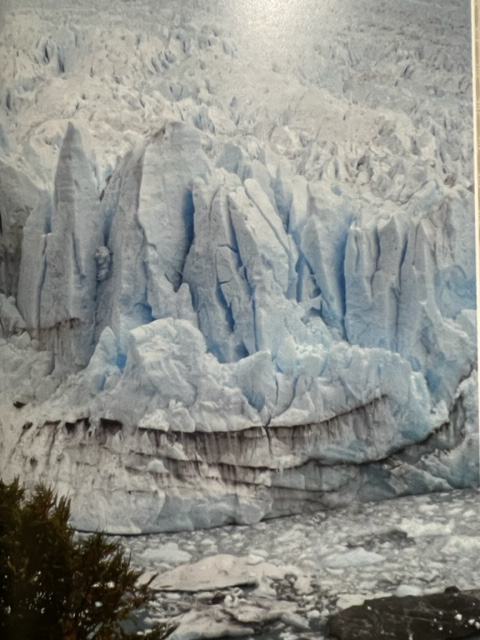
The magnificent noise and sight of a glacier calving into the water in Puerto Merino, hundreds of macaws congregated on a clay lick across from the small boat where we’ve spent an hour waiting for them to arrive, the impromptu street musicians sitting by the Laxman Bridge (where, incidentally, I was bitten by a monkey on one of our trips – ouch), the friendly guide who suggested we come home with him to meet his young family in their home in the slums of Mumbai.
The memories of the things that went “wrong’ are often the best memories of all.
My daughter and I alighting from a park employee transport in NE Thailand. The people on the transport knew no English but we understood from them that we just needed to follow the narrow asphalt trail to arrive at our bamboo hut in the cloud forest. Many kilometers later, with all our possessions on our backs, the asphalt path had become a dirt path and there was still no sign of civilization, much less our bamboo hut. At some point, after hours or walking, we had to put our backpacks down because we were giggling so hard that we couldn’t see for the tears of hilarity at our situation. No worries. We came upon the bamboo hut after about 10 kilometers and had an amazing time deep in the forest.
Driving a recommended shortcut through the mountains to reach an isolated farm, we suddenly found ourselves socked in by dense fog. I, the designated driver in countries where driving is on the left, literally photographed what I could see in front of me in my mind and closed my eyes in prayer driving each 50 feet, with a steep chasm on my right and a road not wide enough for two cars to pass each other. When we arrived, safely, at the farm, and described our hair-raising drive through the mountain pass he’d recommended, the wrinkled, crotchety old farmer wasn’t impressed. “Yep, it sometimes gets like that.”
I think many people don’t like to travel exactly because of all the surprises, challenges, lack of home familiarity and comfort, language issues, and that beast – the unknown. But in my opinion, all those parts make up the wonder and beauty of travel.
It’s a surprising and delicious world out there.
Close your eyes, take a deep breath, and jump into it all with both feet, and someone you love to share it with. Take a chance on being clueless, making the “wrong” decision, taking a turn by way of eeny meeny mayni mo and exploring whatever you find there.
One answer to Mary Oliver’s question of what you might do with your one precious life.
Here and Now in the Land of Polymyalgia Rheumatica
Here are some things we all know:
Nothing lasts forever.

Attitude makes all the difference.

Sleep makes moving in the world possible.
Family, friends, and neighbors – love – make us stronger.

And, yet, sometimes when bad shit happens, we just want to curl up under a comfy duvet with a good book, ignore the phone, ignore all the things we know will make us feel better, and WALLOW. Does it make anything better? Nope. Does it at all change the bad shit? Unh unh. Not a bit. Do we know it’s counter-productive even at the very minute we’re doing it? Yep. But there it is. We’ve all been there.
So I’ve had an image of myself for a very long time. Maybe since I was seven years old. Dysfunctional family. I’m the youngest. Given/took on lots of responsibility from the age of seven. I’m not complaining. It was quite empowering. It was a process that has served me well all my life. And as I aged that image stuck with me. Healthier and more flexible than my cohorts. Quicker, more energetic, more adventurous. Sure, my body was creaky and achy in the morning, but it didn’t prevent me from doing all the stuff I wanted to do.
And then…Polymyalgia Rheumatica. Otherwise known as WAKE UP CALL.
One day teaching six yoga classes a week and driving all over tarnation to visit grandkids. The next day taking 20 minutes to get dressed using strategies that would make a contortionist proud. Legs didn’t lift on their own. Shoulders didn’t rotate on their own; or otherwise.And the pain? We won’t even go there.
Two weeks of that. Googling MS, ALS, and every other dire possibility. To be honest, I didn’t really wallow all that much. Scared myself silly but not a lot of wallowing. A few minutes every morning when I contemplated maneuvering myself out of bed. Sometimes in the middle of the night when the pain of turning over in bed woke me up.
But, here’s the thing. Not just writing a post to rehash the last one.
All those things above that we all know? They’re all true! And they add up to another thing we all know about – resilience. The capacity to recover from difficulties; the ability to spring back; elasticity.
After two weeks, I received a diagnosis and could take MS and ALS off the table (whew!). Uncertainty is such a basic and inevitable part of life, but sometimes it’s more challenging than others. Weird as it sounds, I made my peace with dire diagnoses and death during those two weeks. Glad I can pack them away for now but also glad to have done the work.
All my life I’ve been super careful about medications and medical interventions in general. Recreational drugs are one thing. Drugs that ruin your liver, lead to dialysis, or send you out into the streets looking for opioids are another. Aches and pains? One ibuprofen, maybe a couple of times a week. Torn meniscus? No surgery for me; I’ll treat it with yoga, thank you very much.
So here’s reality staring me in the face in the form of steroids. Steroids! Yikes – the boogeyman of medications. They eat away at your bones. Lead to mood swings. Water retention. Moon face. Can cause skyrocketing sugar levels.
On one side, all those side effects and a lifetime of avoiding medical intervention. On the other side decreased pain and increased mobility.
Not even close.
It won’t last forever. I’m relishing in every minute of walking, slowly, carefully, avoiding stairs, in the glorious autumn weather. Sure, the steroids make sleep elusive but on the 3rd night when I’m so exhausted that I actually sleep for 4 or 5 hours straight, wow!, living takes on a new meaning. I hired a cheerful, energetic cook, to free up my good hours for other things and happily peruse the refrigerator feeling like I live in a restaurant.
I can laugh at the list of 11 medical appointments coming up over the next 5 weeks. Hell, I can laugh at anything.
In Buddhist philosophy, there are lots and lots of lists. One of them is a list of five obstacles. The fifth is considered the most difficult. The fifth is doubt.
I spent a bunch of time during that first two weeks, and occasionally during the past week as well, standing, huffing and puffing, in front of that fifth obstacle. Taking deep breaths. Gauging its height. I gathered 20 years of dharma talks and yoga poses and psychology books, the love and support of family, friends, students, and neighbors, the lessons of my own strength and possibilities learned early in my dysfunctional home, the belief in the meaning of life and God’s plan, took a running leap and now find myself on the other side of doubt.

It’s a tricky disease, this Polymyalgia Rheumatic. Some people are on steroids for a year and wean off them and are fine – maybe an occasional flareup. Some people are on a low dose of steroids for years, or until they die (of something else).
I have good days and not-so-great days. I take advantage of all those things we know. I thank goddess for resilience. And I invite doubt for a nice Indian tea from time to time.
If you thought you knew…
I thought I knew about aging. After all, I turned 60 a full decade ago. In kindness to my knees, I stopped teaching hip hop and aerobics. Took up yoga instead. Out of kindness to my brain, I became more selective about the books I read and the movies I see. Out of kindness to my heart, I stopped following the news. Out of awareness of the generation gap and changing society, I became more curious about how my grown children were making child-rearing and professional decisions and less opinionated about all that.
I thought my practice of acceptance of the aging process in so many areas was pretty admirable.
Aching knees, varying levels of lower back pain, a 15-year acquaintance with sleep problems, sight issues.
Check, check, check, and check – all accepted graciously.

I think of myself as an optimist but not disconnected from reality. I realize that sickness and death are inevitable. Looking around me at friends with cancer, MS, joint replacements, and a general decrease in energy, I sometimes wondered what awaited me…specifically.
But no more than the occasional and very brief thought.
And then over a period of a week my quadriceps decided to work at 25% capacity and provide unwelcome pain, my shoulders and collarbone joined the party, and my knees refused to be left out.
I went from 90% mobility to 20% mobility over that week. One morning it took me twenty minutes to get dressed. Pain moved in as a permanent body mate.
I felt and walked like a 90-year-old woman…and not a healthy one.
In the past ten days, I’ve seen my family doctor 3 times. I began a series of tests for everything imaginable. Being fortunate enough to live in a country with excellent national health insurance and health care, the bureaucracy is daunting but the availability and affordability are there.
I’ve gone through the process of learning to let go of activities I love like a ninja on steroids. I haven’t driven to visit with grandchildren or taught a yoga class in over a week. I haven’t met friends for coffee, shopping, or a museum visit, either. My walks have gone from 4 or 5 kilometers a day to 1 kilometer on a flat surface…on a good day. Cooking, which I love, has become the simplest preparation with the least standing time. And sometimes I leave the whole thing to my very supportive, caring husband.

I love to read, but when that’s pretty much the only thing I can do it gets old. I love to watch tv series, but I’ve discovered the limits of that, too. I’m super appreciative of my friends who drop by to chat, pick up a few things at the grocery store for me, or just check in to see how I’m doing.
I’m pretty careful about the meds I’m willing to use and how much. I’ve always been very stringent with things like ibuprofen and even simpler pain medications. My pain threshold is pretty high. I went from an ibuprofen or two a week, to one a day, to two a day, and then on to something stronger. Waking up to debilitating pain in so many joints and muscles every day has turned me into a junkie for the 3-7 hours of significantly decreased pain that a Naxyn 500 pill can give me.
My kids are great. They call. They listen. They’re supportive.
The hard truth of this thing, though, is that all of the wonderful people in my life give me a big morale boost and are very logistically helpful, and necessary, but ultimately pain is an individual experience.

Twenty years of meditation and learning Eastern philosophy have been helpful to me in so many areas of my life. And I’m finding that they get me through the occasional moments of deep feelings of loss – loss of mobility, loss of the activities I love, loss of comfort in my body – and allow my natural optimism to revive from occasional panic.
Exercising my deep, mindful breathing muscles and doing a lot of acceptance, living in the moment, and letting go. My ego gets in the way from time to time and the monkey chatter gets really loud, but so far I mostly can reach that sweet spot of equanimity.
Hopefully, we’ll get to the bottom of this. Find a diagnosis and management plan that works. Hopefully, I’ll be able to go back to some or all of the activities I love. Hopefully, we’ll still make that 4-month trip to India in late February.
Meanwhile, it’s been one of life’s toughest lessons yet and I’m grateful for all the many blessings in my life that are coming to my aid.