Brought up in one of "those" families - a challenge.
Lucky enough to marry someone who inspired me to create a much-healthier family and have a life which helped me begin to love myself.
From Texas to California to Wisconsin to Israel.
From reliable, responsible child to rebellious teen to fearless young adult to grateful grandmother.
Five beautiful, fascinating grown children. Fourteen amazing, enchanting grandchildren.
From university teacher to researcher to couple counselor to political spokesperson to yoga instructor.
Still married after all these years.
I thought I knew about aging. After all, I turned 60 a full decade ago. In kindness to my knees, I stopped teaching hip hop and aerobics. Took up yoga instead. Out of kindness to my brain, I became more selective about the books I read and the movies I see. Out of kindness to my heart, I stopped following the news. Out of awareness of the generation gap and changing society, I became more curious about how my grown children were making child-rearing and professional decisions and less opinionated about all that.
I thought my practice of acceptance of the aging process in so many areas was pretty admirable.
Aching knees, varying levels of lower back pain, a 15-year acquaintance with sleep problems, sight issues.
Check, check, check, and check – all accepted graciously.
I think of myself as an optimist but not disconnected from reality. I realize that sickness and death are inevitable. Looking around me at friends with cancer, MS, joint replacements, and a general decrease in energy, I sometimes wondered what awaited me…specifically.
But no more than the occasional and very brief thought.
And then over a period of a week my quadriceps decided to work at 25% capacity and provide unwelcome pain, my shoulders and collarbone joined the party, and my knees refused to be left out.
I went from 90% mobility to 20% mobility over that week. One morning it took me twenty minutes to get dressed. Pain moved in as a permanent body mate.
I felt and walked like a 90-year-old woman…and not a healthy one.
In the past ten days, I’ve seen my family doctor 3 times. I began a series of tests for everything imaginable. Being fortunate enough to live in a country with excellent national health insurance and health care, the bureaucracy is daunting but the availability and affordability are there.
I’ve gone through the process of learning to let go of activities I love like a ninja on steroids. I haven’t driven to visit with grandchildren or taught a yoga class in over a week. I haven’t met friends for coffee, shopping, or a museum visit, either. My walks have gone from 4 or 5 kilometers a day to 1 kilometer on a flat surface…on a good day. Cooking, which I love, has become the simplest preparation with the least standing time. And sometimes I leave the whole thing to my very supportive, caring husband.
I love to read, but when that’s pretty much the only thing I can do it gets old. I love to watch tv series, but I’ve discovered the limits of that, too. I’m super appreciative of my friends who drop by to chat, pick up a few things at the grocery store for me, or just check in to see how I’m doing.
I’m pretty careful about the meds I’m willing to use and how much. I’ve always been very stringent with things like ibuprofen and even simpler pain medications. My pain threshold is pretty high. I went from an ibuprofen or two a week, to one a day, to two a day, and then on to something stronger. Waking up to debilitating pain in so many joints and muscles every day has turned me into a junkie for the 3-7 hours of significantly decreased pain that a Naxyn 500 pill can give me.
My kids are great. They call. They listen. They’re supportive.
The hard truth of this thing, though, is that all of the wonderful people in my life give me a big morale boost and are very logistically helpful, and necessary, but ultimately pain is an individual experience.
Twenty years of meditation and learning Eastern philosophy have been helpful to me in so many areas of my life. And I’m finding that they get me through the occasional moments of deep feelings of loss – loss of mobility, loss of the activities I love, loss of comfort in my body – and allow my natural optimism to revive from occasional panic.
Exercising my deep, mindful breathing muscles and doing a lot of acceptance, living in the moment, and letting go. My ego gets in the way from time to time and the monkey chatter gets really loud, but so far I mostly can reach that sweet spot of equanimity.
Hopefully, we’ll get to the bottom of this. Find a diagnosis and management plan that works. Hopefully, I’ll be able to go back to some or all of the activities I love. Hopefully, we’ll still make that 4-month trip to India in late February.
Meanwhile, it’s been one of life’s toughest lessons yet and I’m grateful for all the many blessings in my life that are coming to my aid.
I’ve never looked like one of those thin, flexible women with ropy muscles and a BMI that barely hits 20. I’ve always looked more like the Russian and/or Polish peasant stock of my ancestors. You know, the ones who give birth in the field and go back to digging potatoes out of the earth.
Nowadays when I have no choice but to admit that I’m a yoga and meditation teacher I imagine that the (young) person asking the question is internally rolling her eyes, sometimes right after the (imaginary) once over.
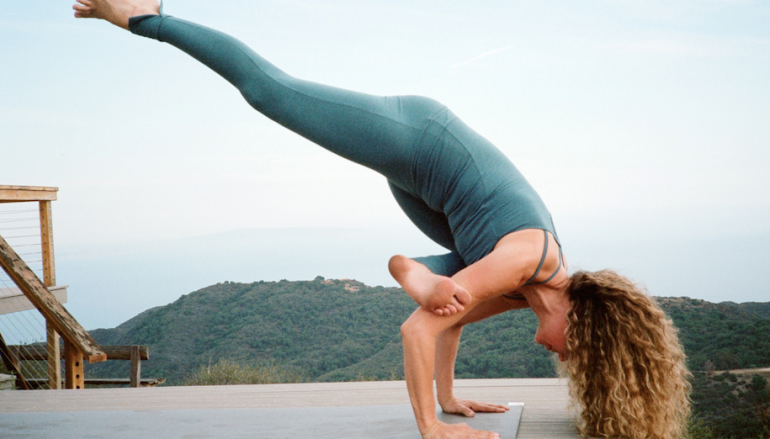
That’s all okay. Only mirroring what I know. I don’t come within many miles of looking like…
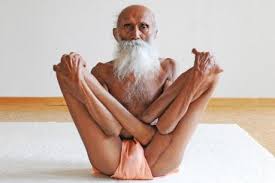
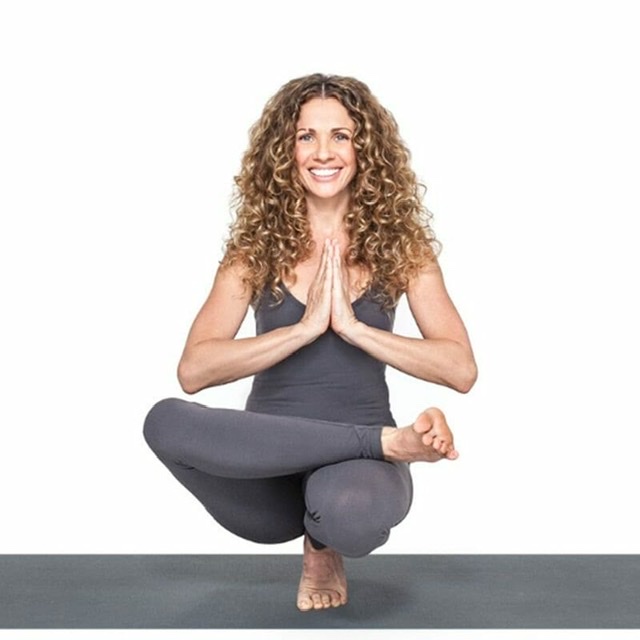
(and, no, I could never ever do that pose, whatever shape I might be in.)
But yoga and meditation teacher I am and have been for over ten years. My studio is thriving. New students joining all the time. As my body suggests I teach less, my heart doesn’t allow me to turn away students. I’ve begun teaching two young women my particular flavor of yoga and meditation, Raja Yoga, to lessen my load.
One of them is particularly serious; puts in the time and thought. She’s a personal trainer. I expected her to be an easy study when it came to the yoga poses so I chose to begin by looking at the philosophy of yoga; the spiritual side of things. We meandered through some of the more basic and beautiful parts of Pantanjali and then on to the eight limbs of yoga. She committed to sitting in meditation every day, and after a rocky beginning, stuck to it.
It didn’t take long for me to tumble to the fact that there’s a shitload of stuff to learn.
I began to seriously consider how I got to where I am today in my practice.
I began to recognize what stands behind the kind words I hear from my students and the word-of-mouth referrals. I teach kindness, compassion, and gratitude, and I suppose I related more to their having absorbed those lessons than any kind of real assessment of what they receive in class. All of a sudden I realized that they were receiving the gifts that I’ve received over the past 15 years. From the many hundreds of hours I’ve listened to and absorbed dharma talks, the many dozens of books and articles I’ve read, from the retreats I’ve gone to, and from the thousands of hours of my personal practice. My students are the continuous long chain of those gracious enough to share their knowledge and experience with me. A chain I joined not because of a conscious desire to change my life but because of my passion for and enjoyment of them.
For someone who teaches awareness, you might be surprised to read how shocked I was to realize that I’d absorbed so much and integrated it into my life with little recognition of the process.
There’s an annoying concept that says that when you chase after something in life it eludes you. When you stop chasing, you attain it.
WHAT?!?
So how does that work? What are we supposed to do with that? How can we attain something if we don’t try? What kind of New Age bs is that?
I’m here to say that I’ve been witness to this phenomenon more times than I can remember. At my age I might not remember them even if there were only a handful, but, trust me, there were many. And here I came face to face with another.
Those who bemoan being old, here’s a positive thought. You can’t be a wise crone unless you’re old. You have to absorb lots and lots of life to earn that badge. No one ever heard of a wise young crone. (p.s. you also have to be female, but maybe we shouldn’t go there)
So back to my serious young woman who’s learning to be a yoga teacher.
I abandoned the study of yoga philosophy temporarily and we began to get more deeply into asanas, yoga poses. She is, in fact, a joy to teach. She picks up everything immediately. She files it away and, contrary to many of us, remembers where she filed it in her brain and body so that it’s easily accessible.
Then I asked her to build a sequence to teach during the first part of one of my classes. Okay, there were a couple of issues that were easily definable and corrected with practice. Speaking more loudly, taking more time with each pose, checking the room to see if some adjustments needed to be made to help people to more advantageously enter into and sustain poses, and organizing the sequence in a more logical manner. Maybe that sounds a little complicated, but it really isn’t. It just takes practice.
The hard part is that which only comes with a decade of passion.
I remember reading a book about ten years ago written by an experienced yoga teacher who wrote that the best yoga classes are the ones that aren’t planned. He explained that he walks into a class and feels the vibe in the room, senses the flow as he teaches, choosing the poses according to those variables. It seemed quite unprofessional and haphazard to me at the time. Sort of like attaining things by ceasing to strive for them.
But that’s how I’ve been teaching now for at least the past five years, and probably much more.
I realized after my young student taught that sequence that I had missed a crucial element. The one I missed earlier about the philosophical and spiritual nature of my classes. I hadn’t realized to what extent my classes are a by-product of hundreds of students and thousands of hours of yoga practice.
A good yoga teacher doesn’t have to look like the stereotypic Western yoga teacher. She can be of Russian/Polish stock. She doesn’t have to be able to twist her body into a pretzel. It’s not about the technique, (though beautiful yoga technique is a thing of beauty). Less about muscles and more about heart. (which is also a muscle, but you know what I mean)
The yoga teacher so many of us seek out has the ability to sense what’s going on in her body and in the bodies and hearts of the other people in the room at the moment. And she has to have a huge repertoire of poses so that she can flow into them spontaneously in response to what she feels is going on here and now.
I can’t provide instant access to that sixth sense, even though I recognize it now in myself, because I also realize that, like the spiritual and ethical gifts that changed my life over decades, I received similar gifts over decades from my students and from an internal tapas, or fire.
Can’t run after it; have to believe in it.
I can (and did) tell her that she should commit to learning ten poses extremely well each and every week. Go over and over them. Imprint them into her body. Befriend them – each and every one – so that they’ll be there for her when her instincts kick in.
Yoga, in all its eight limbs, sneaked up on me. I dived into its depths because I loved it. I listened to dharma talks because they nurtured and calmed my soul as well as giving me continuous food for thought. After a lifetime of believing in God, I felt the actual presence of God in my life and found it felt like home.
Hopefully, when I leave for an extended stay in India in February, my young student will be ready to teach my classes. Hopefully, I can finally teach less when I return. All that remains to be seen.
But what I’ve gotten out of teaching her has been far greater than finding someone with whom to share studio responsibilities. I’ve learned what I try to convey to my students every day. I’ve learned what Patanjali wrote 2500 years ago.
The beauty, joy, and life enrichment offered through a life of yoga are attainable by everyone when practiced properly, persistently, and for the long haul.
It’s led me to internalize the gratitude I feel toward my many teachers and students for the life I love.
I just completed a 67-hour mediation course. The moderator/lecturer, Golan, was a charismatic guy in his early 50’s with vast experience and captivating stories about mediations he facilitated over the years. I wondered at the outset if I would be able to sit for five hours straight each Monday night without fidgeting and wishing I were elsewhere. Golan made the time fly. I didn’t have to do yogic breathing even once during the 10-week course.
One of the crucial concepts in mediation is the ability to differentiate the needs of the people in conflict as opposed to their positions, or presenting issues.
Eleven neighbors have entered into the mediation process regarding the parking lot between their houses where there are seven legitimate parking spaces. There are often clashes between people parked in legitimate spaces and people who park along the side of the lot making it difficult for those parked in legitimate spaces to extricate their cars. The eleven families have, between them, fifteen cars. As it turns out, two families do not have a car, one family has a driveway in which they park one of their two cars, one family has a driveway in which they park both their cars, one family does not park their two cars in the lot, and three families park only one of their two cars in the lot. One family parks two cars in the lot. Three families park one car each in the parking lot.
Have you seen this problem on a math test?
In case math wasn’t your thing, the eleven neighbors want to park nine vehicles in seven legitimate spaces.
Looks like a pretty cut-and-dry issue. Until it becomes clear that less than 50 yards away there’s a large parking lot that is virtually unused. So what are the actual needs of the people involved that must be addressed before the group can come to an amenable resolution for all involved? After all, they’re neighbors in a small community who have a common interest – living in harmony with one another.
Here’s a tip – it has more to do with the process of solving the parking problem than who parks where.
But what does this have to do with meditating with old age? And how can one meditate with old age anyway? It is what it is…isn’t it?
About seven weeks into my ten week course I found a small hole-in-the-wall Indian restaurant with a few tables outside on the cobblestone pathway. My partner and I, both Indophiles and aficionados of Indian food, were happy to find this place. The table was a bit unsteady on the cobblestones but we made do and had a great meal with lots of nostalgia. Getting up after the meal I rested my hand on the table for stability – stability from an unstable table? You can guess the results.
The cook stayed by my side until the ambulance arrived. The paramedics were extremely gentle and pleasant, in spite of the fact that they looked young enough to be in high school. My neighbor was one of the nurses in the orthopedic emergency room. The doctor was thorough and helpful. All in all, other than two weeks of being almost totally incapacitated with back pain, it was a smooth, fortuitous experience. It could’ve been so much worse.
Well-meaning friends encouraged me to sue the restaurant – never a possibility in my mind. Being in the middle of a mediation course, however, I did think about asking the restaurant owners if they would be interested into entering into the mediation process with me.
First I wanted to take myself through the mediation process of figuring out the difference between my presenting issues and my needs.
Issue #1: I was out approximately $700 for physical therapy, my deductible for the ambulance, and having missed teaching three classes. Not a huge sum but money.
Issue 2: I wanted to be reassured that the restaurant would correct for the instability of their tables on the cobblestones.
Need #1: I wanted to be seen as a person – not a fragile elderly person who lost her footing as a result of being old and unstable on my feet
Need #2: I wanted, as part of #1, for the restaurant to take partial responsibility for the objective elements of neglect which led to the injury.
Are you starting to get the point?
From the caring cook to the empathetic paramedics to the informative orthopedist in the hospital I thought I recognized that they didn’t really see me. They didn’t see a woman who teaches yoga eight times a week or drives six hours a week to visit with grandchildren, or who goes bowling, plays miniature golf, and spends months at a time in off-the-beaten-track places. For the first time in my life, I felt the invisibility that many elderly women describe. I felt small and irrelevant and “other”.
When I wrote to Golan that I’d only be coming to the simulation part of class because I’d had an accident, he had one kind of reaction. When I came to the simulation and mentioned that I was injured in a fall, his reaction was different. He thought it had been a car accident – happens to the best of us. A fall? Ah, elderly issues.
Clearly this may have all been in my head.
And that’s exactly the point. In life, as we all know, shit happens. The first arrow. Inevitable It’s our reaction to it that causes suffering…or not. The second arrow. Within our control.
In my recent revelations I realized that, yep, we can be in constant mediation with the aging process. Searching for our needs when hit in the face (or the back) with the issues. It’s an ongoing occurrence.
Not as easy as a one-time epiphany. Ah, yes, I can have a happy, peaceful old age through acceptance.
Oh yeah? What about when there’s a new challenge a few times a month? Or how about a few times a week? What about when it’s limited mobility? And how about the exasperation of the person who assumes you’re not getting his explanation of the electrical system in your home because you’re old?
The good news is that if you’re into the mediating process you’re well on your way toward living your life instead of killing time.
Or as Mary Oliver said, “What is it you plan to do with your one, wild and precious life?”
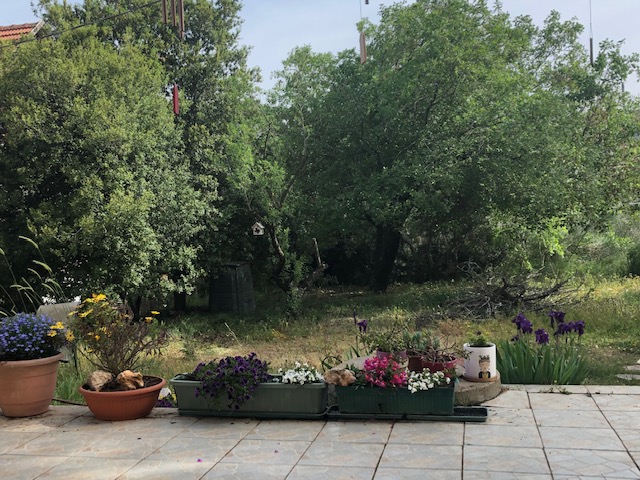
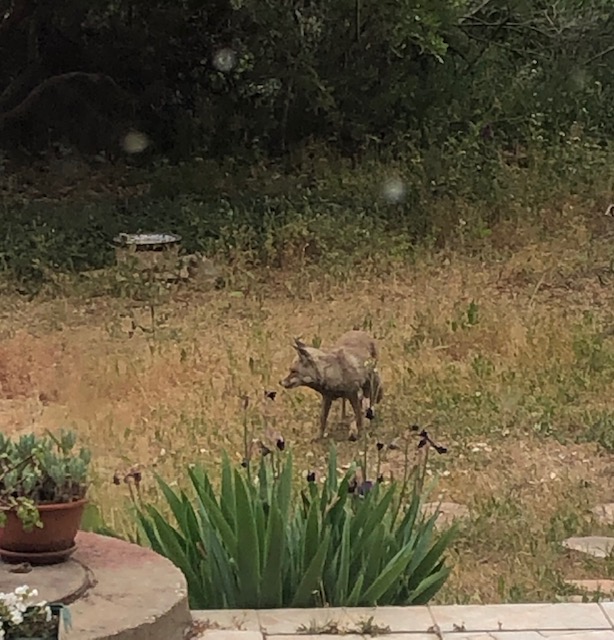
I live in a pastoral, peaceful community of 1000 families. Forty years ago, I’m told, there were no birds because there were no trees. Today my partner and I sit outside on our back porch, eat our breakfast of fresh fruit and freshly brewed coffee and tea, and watch dozens of birds eat theirs – the pieces of bread I scatter for them in our backyard every morning – before they drink from their bird bath or take leisurely baths. Sometimes a fox makes a brief visit, too. Idyllic.
The Corona pandemic is over in Israel. Stores and schools have been open for a while now. We haven’t been required to wear masks outside for weeks. In another week we won’t be required to wear them inside, either. During the various times when it was advised that people over 60 remain at home, teenagers in our community brought us the food we ordered from the community grocery store, and were happy to be able to help.
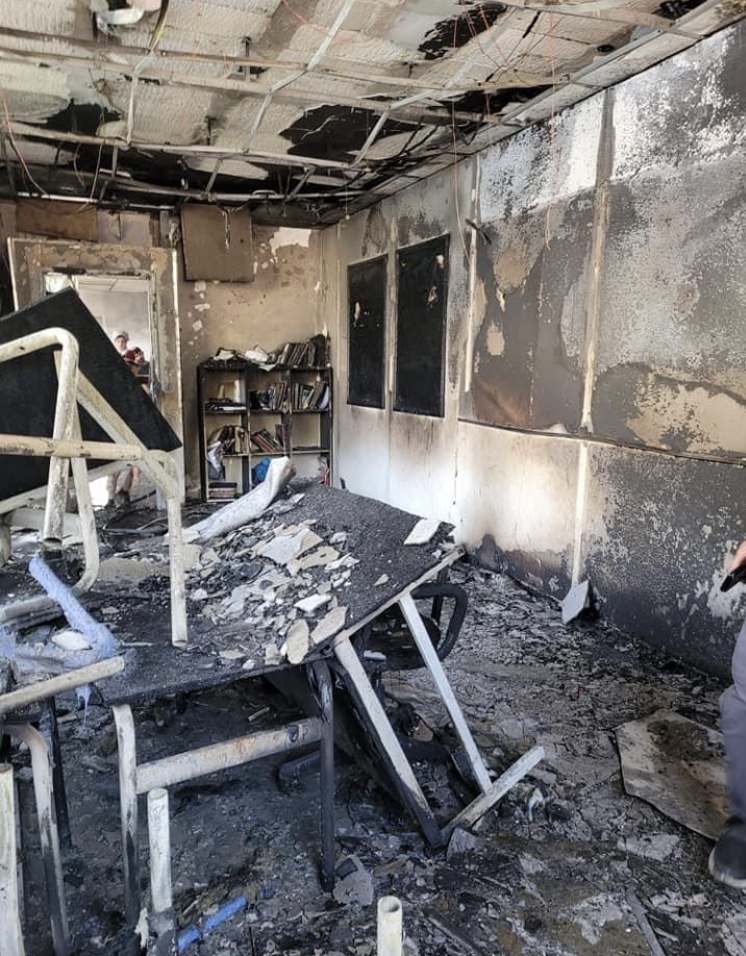
Recently Hamas, with differing excuses, renewed their shelling of our cities. Thousands of rockets were shot off indiscriminately toward residential areas, sending children and their parents rushing for bomb shelters. In some places, they had 15 seconds to get there before the rockets fell. Luckily, or by the hand of God as some people believe, we’ve developed a device to prevent 90% of the rockets from falling to the earth.
Here in our community, we have been an oasis of serenity, even as rockets fell and Arabs burned Jewish cars and synagogues in Lod, Acre, and Yafo. Communities where Jews and Arabs have been trying for over a decade to share neighborhoods in experiments of true co-existence, the veil of illusion was brutally torn away.
As anyone who watches television series or isn’t totally cut off from the news knows, the US is consuming itself like a snake devouring itself from its tail. Black protests, complete with vandalism, theft, and, in some cases, violence; Asians coming out of the closet concerning the decades-old prejudice against them, triggered by the murder of Asian spa workers. Whites feeling marginalized; any action on their part is wrong. Anti-semitism on the rise. Jews feeling it’s unsafe to walk on the streets of America wearing a kippah (Jewish head covering), and being assaulted in places as far-flung as New Mexico.
Books are being censored. History is being rewritten, People are being canceled.
“Politically correct” reigns and woe be unto the person who uses the wrong pronoun.
George Floyd, killed by police officers while resisting arrest, was found to have fentanyl in is system to the point of intoxication. His autopsy also revealed recent methamphetamine use at the time he was arrested for allegedly trying to pass a counterfeit $20 bill. He had advanced heart disease including an enlarged heart, one artery 90% blocked and two others 75% narrowed.Excessive force was used in restraining him, which, along with the other factors, resulted in his death.
George Floyd was made a martyr for the cause of Black Lives Matter. Of course they matter. No more or less than the lives of all other people. George Floyd may represent the hundreds of Blacks stopped unnecessarily by police officers, treated with suspicion and hostility, who are fearful for their lives during such stops. But does anyone really want to raise their children to think of a repeat criminal, convicted of eight crimes between 1997 and 2005 as a hero? A man who served four years in prison for aggravated robbery during a home invasion?
In what universe is every Black person in prison a victim while Jews running for shelter from falling rockets are aggressors? In what universe is a pandemic a worldwide government conspiracy and the vaccine to prevent further spreading of the virus an extension of that conspiracy? In what universe are children who come home from school with a barely passing grade met with “Good Job!” by the parents? In what universe is the murderer of an elderly woman beaten and thrown out of her window acquitted because he was under the influence of marijuana at the time?In what universe are people arrested for violent crimes released on their own cognizance immediately because it would be discrimination against the poor to require them to post bond? In what universe are crimes against Blacks hate crimes while crimes against Jews are not?
It’s a universe which is addled, afflicted, and astray. Where reality is what the media reflects instead of what we actually experience; where a person’s word is no longer the truth as she knows it but as she wants you to believe it to be.Where anything goes if you can sell it, and you have no responsibility for the consequences.Where nothing is expected to last – not jobs, appliances or relationships. Instant food, instant gratification, instant success, or move on.
Lots of people are saying what a tough year it’s been. I’m reminded of the two arrows – the first one is the inevitable pain in life such as a pandemic. The second arrow is self-inflicted suffering like societies consuming themselves like a snake eating itself from its tail.
How bad will things get before we wake up to the absurdities? I hope I live to see it. I also hope the damage done in the meantime won’t be too horrendous.
There are a bunch of things that no one tells you about aging. Or maybe they tell you but it goes in one ear and out the other. Not relevant. Things that register in the way the laws of physics register – ya da ya da ya da.
As I turned 60 and even more after 65, I became aware of the physical aches and pains that go along with aging and, in my case, are the price for having jumped and danced around and, taking advice from The Eagles, taken my body to the limits for decades. I remember an orthopedist once telling me to keep teaching hip hop, hiking, and doing whatever I loved because ultimately even sedentary people have joint aches and pains…but they have a lot less fun getting there. I totally agree. Even on the mornings that my knees wake me up with a call for help.
It’s some of the other things about aging that I never gave much thought to (or any).
finding conversations of people under 40 uninteresting
having read every permutation of book and movie plots ad nauseam
being cold (or hot) when no one else is
losing friends to illness, lack of mobility, or death
aging differently from significant people in my life
YIKES!!
It turns out that an inevitable part of aging is loss and grieving for those losses. Big losses and small losses. And some losses are harder than others; not necessarily the “big” ones.
We all do it differently.And it all looks different on other people.
I remember having no regrets at 50. Ha!
I remember letting go of hip hop and aerobics in the blink of an eye. Didn’t seem like fun anymore. Traded my spandex for yoga pants happily.
I remember not even entertaining the notion of a sedentary life requiring programmed exercise. Counting steps? Furthest thing from my mind.
I remember a time when illness and death weren’t even a tiny part of my thoughts.
I’d read about (other, much older) people complaining that many of their friends had fallen by the wayside one way or the other. I’d heard them extolling the virtues of cultivating younger friends to combat loneliness.Scroll up – in one ear and out the other.
My partner “lost” his mother 10 days ago.My mother-in-law died. She wasn’t a nice person. Not a good mother. A narcissist. She was lively and charismatic and loved to be the center of attraction, but her children and friends paid a heavy price. She had dementia for the last five of her 93 years and didn’t recognize my partner or his sister who, in spite of a complicated and challenging relationship, made sure her last years were comfortable. If emotions were rational, no one would mourn her death. But if emotions were rational they wouldn’t be called emotions.
emotion – derived from the Latin term emovere;
to agitate or stir up. The affective aspect of consciousness
My parents are both long gone. My father died thirty years ago and my mother about twenty. Fortunately for me, I made my peace with both of them while they were alive. They weren’t partners in the process, but the possibility of relating to them with equanimity in life was a blessing.
My partner wasn’t so fortunate.
Watching his mourning process has been thought-provoking and, yes, emotional. A loss of innocence. A loss of possibility. A loss of the luxury of avoidance. A recognition of the loss of reconciliation. A loss of the comforting delusion of immortality.
My mother had bi-polar disorder. The shadow of her disease lurked everywhere. Sometimes it blotted out all joy and normalcy; sometimes it was a vague and disquieting sadness in our house. It was always a sense of waiting for the other shoe to fall. I was entrusted with her care from a very young age. I gained confidence and self-esteem that’s served me well throughout my life. I also harbored resentment and fear of chaos in the world.
I used to imagine myself a very small figure, wrapping my arms around my knees, head bowed, before a huge Mr. Clean-type genie, rising out of a magic Aladdin’s lamp, arms folded, scowling down on me. I didn’t understand the image or why it recurred so consistently and persistently throughout my life.
Imagine him with a turban, beard, and ferocious expression
The image vanished, never to return again, once I worked through my relationship with my mother. It was a loss I recognized with gratitude. I forgave my mother, without her permission, and realized one day that I felt a loving, empathetic sadness for her; a brilliant woman whose life was taken from her by a crippling disease no one understood at the time.A tragic loss.No second chances.
Not so with my mother-in-law.
The frightening image my partner has of her is his to tell, not mine, but he has one no less frightening than mine.
It’s difficult to accept that a person can be unkind, cruel, and totally lacking in compassion. How much more so when it’s your parent; the person entrusted with your care, emotional and physical? It’s tempting – no, imperative – to search for an underlying reason to shed a more sympathetic light on such a parent.
He searched. We searched. The round of reasons we tried to fit into the square peg bulged and defied imagination.
Ultimately, the physical loss of his mother grew into the loss of innocence. The first kind of loss is met with a simple grief. She was, after all, turning 93 two weeks later and hadn’t been herself for years. The second kind of loss is far deeper and creates a grief that is painful at any age, but magnified at 70, after so many years of pretending, ignoring, excusing, and hoping.
Two of our sons were at their grandmother’s funeral to support my partner and express their respect for family ties. When I talked to our older son before he left to meet us at the airport, he asked how his father was doing. I explained that he had many unresolved issues with his mother and now they’d never be resolved. I added how important it is to confront unfinished business with a parent in life. Hint, hint. (He moved on.)
There’s a lot of loss involved in aging. Loss of a parent. Loss of freedom from pain. Loss of mobility. Loss of long term friends. Loss of mental acuity. Loss of hearing.(Shall I go on?)
A Buddhist parable addresses the problem of suffering. It describes the two arrows in every difficult situation in life. The first is the arrow of pain, in this case loss, and the second is the arrow of suffering. The first is inevitable but the second is optional. It’s the arrow we shoot into our own hearts with our reaction to the inevitable losses that come with aging.
So many circumstances are beyond our control. My mother’s disease; my mother-in-law’s nature.
We can only prepare ourselves by nurturing our souls. By taking a deep dive into ourselves and becoming familiar with the particles of a higher power which exist inside each of us. By honing our ear to hear the pure voice of equanimity which resides there.
Many years ago I weighed the option of starting a hospice center. I had a conversation with the man who created a small hospice center in Jerusalem. At the time he was in his early 80’s. He exuded empathy and kindness. We spoke after I took a tour of the center with a staff member. I was surprised to see that each of the rooms had two residents. I asked the founder of the center if it was disturbing for the residents to witness the death of their roommate. His answer equally surprised me. He said that with the work done with the residents, every death since the center’s inception had been peaceful, and inspired serenity in those who witnessed it.
Choosing equanimity isn’t a one shot deal, and it’s not easy. It takes diligence and practice and work. Committing ourselves to the effort doesn’t ensure total success, or success every time. But to quote a poet by whom many of our lives have been enriched, Mary Oliver,
“Tell me, what is it you plan to do with your one wild and precious life?”
For those of you who read my last post – yes, we made it home – by hook or by crook and by the hair on our chiny chin chins.
For those of you who remember the days when people used to kiss the tarmac when they arrived in Israel – for security reasons it’s no longer possible, but the feeling was certainly there for us on March 19, in these times of Corona.
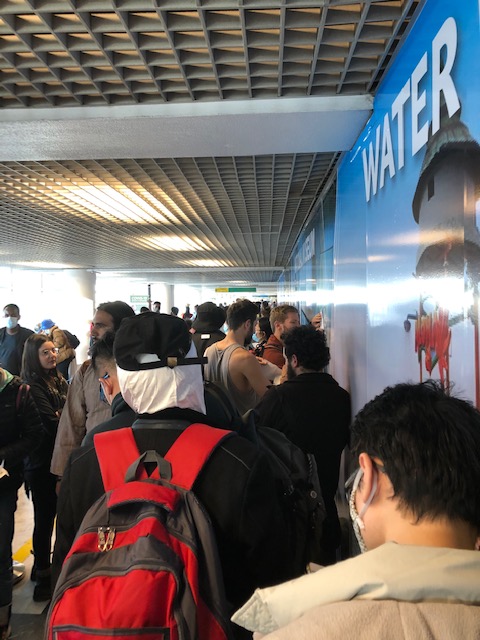
We spent 27 hours getting home from India on Ethiopian Airlines and didn’t even grumble about it. Seventeen hours in Addis Ababa? No complaints. A long line in the airport (several times) to have our temperature taken? That’s fine, thank you. Rowdy passengers (my partner calls them ‘enthusiastic’) unrestrained by the crew? Peachy.
The main thing was to get out of India and back home.
Things changed literally from every morning to every evening and then again the next morning. Prime Minister Mod’i, like many of the world’s leaders, proclaimed increasing restrictions from announcement to announcement, the difference being that he is responsible for 1.5 billion people – 17% of the population of the world! A critical mistake on his part could very well mean millions of Corona deaths; maybe tens of millions.
Within days all pending visas were canceled, and India closed its borders to foreigners. Within twelve days the skies were closed – no flights in or out.
One by one, the 29 states in India began closing their borders to foreigners. After that, one by one, they began requiring all foreigners present within each state to leave.
Cab drivers began to refuse foreigners. Guest houses did as well. The railway system shut down. Over a period of 10 days, intercity buses were canceled. Foreigners asked to leave their lodgings had limited options for travel elsewhere. Some began sleeping in the streets.
Within ten days Mod’i enforced a one day lockdown from 7 a.m. to 9 p.m. Four days later he proclaimed a nationwide lockdown…period. Anyone who’s experience the open market in Delhi or the crowded streets in Mumbai can imagine how eerie a sight that was.
By March 25th all domestic flights were canceled.
The Israeli embassy started organizing private buses to transport stranded Israeli citizens to Delhi and Mumbai to be close to an international airport for extraction.
In Israel, the restrictions of movement are barely enforced. In India, the police canvassed the streets beating non-complaint people with sticks.
We reserved flights with 5 airlines. They began canceling the day before take-off until we were left with Aeroflot and Ethiopian Air. We chose Ethiopian because Europe seemed unreliable with Russia announcing the closing of its borders for the day of our flight. After trying to get confirmation that our flight would still fly, calling Aeroflot offices in Israel, India, and Russia – including a conference call with a friend in Israel, me in India, my friend’s sister-in-law in Russia, and an Aeroflot agent in Moscow – the confirmation was still shaky.
We arrived in Israel at 3 a.m. Two friends had left one of our cars in the airport parking lot (one drove his own car to return both of them back home). No one spoke to us at the airport. No one asked us any questions or took our temperature. No one asked how we planned on getting home even though we were officially in quarantine once we touched down on Israeli land.
Go figure.
Home Again
Our friends in Israel stocked our fridge and freezer. They decorated our home with welcome home posters. We even had daily visits with several of them on our back porch – six meters from us and on their own chairs. Friends are the best! We found out later than one of them called one of our children to enlist her aid in convincing us to leave India.
My Corona symptoms disappeared once I’d spent a few hours in my own home.
Friends we made in India were in touch with us – some more than once. They were all in lockdown but doing fine. Of course, none of our Indian friends are homeless or live in slums with collective toilets and corrugated roofs. They expressed happiness that we made it home, and, interestingly, appreciation for our sensitivity to India’s needs by leaving them to cope with Corona on their own.
We can’t go out for another eight days, not even to a pharmacy or grocery store, or to get exercise within 100 meters of our house, like others can do. But we’re fortunate in so many ways – first and foremost that we are healthy, and our children and grandchildren are healthy – and then:
We spent five months together in India and became even closer so that being together in our home with very limited contact with the outside world is not at all a hardship
We have a spacious house and even a yoga studio
We have a comfortable back porch with a large, lovely backyard
We live in a community where the youth are happy to help and have organized to do shopping and bring it to people’s homes
We have neighbors who pick up our garbage from the end of our front walk to throw it away.
We have enough income to survive these crazy times if we budget ourselves properly
Of course, we worry along with the rest of the world, listening to the horrific statistics of deaths and illness. Personally, I keep busy with yoga, meditation, reading and binging on tv series. All day I have a Pollyanna-ish feeling that all will be well soon, only to be brought down to earth when I listen to the evening news.
We check in with our children and grandchildren, with our friends and our siblings when the level of worry rises too high.
And we pray, along with other inhabitants of our beautiful earth, that we’ll emerge on the other side of this crisis more grateful for our lives and our many blessings, and with renewed commitment to ease the friction, poverty, and distress in the world.
If nothing else has taught us how interconnected we are, surely the map of COVID-19’s progress throughout the world is proof.
Disclaimer: My thoughts are just that…MY thoughts. Based on my limited experience in India over the past week. India is a huge country and things may be very different in places other than those we’ve been. I’ve heard lots of stories from others, especially in two of my FaceBook groups specifically for people traveling in India, and they’re included in this post. Still – these thoughts only reflect my reality.
There are many wonderful things about India. That’s why so many people get bitten by the India bug and keep coming back.
Before the first trip there’s a feeling of trepidation. More so than a trip to South America or Canada. The names – of people and places – are ridiculously long and unpronounceable. They fly out of your head immediately, making it hard to figure out where to go and who to speak with. The food is spicy, fragrant (smelly), and unrecognizable, with names that don’t tell you anything. Driving is beyond conceivable. Rumored (and real) poverty and garbage everywhere doesn’t entice.
But a week into your first trip, you either want to beg to go home or you know you’ve found a place which will always occupy a part of your heart.
The country is full of color. The houses and the people’s clothing. It’s filled with people who radiate kindness in their smiles and in their eyes. They’re curious about you, open up their homes, their lives and their hearts to you. The natural wonders show the hand of God in a way that never ceases to be awe-inspiring. People are helpful beyond words. They love to help you navigate their food, their customs, and their railway system.
About a week ago, the background of positive curiosity and kindness began to change.
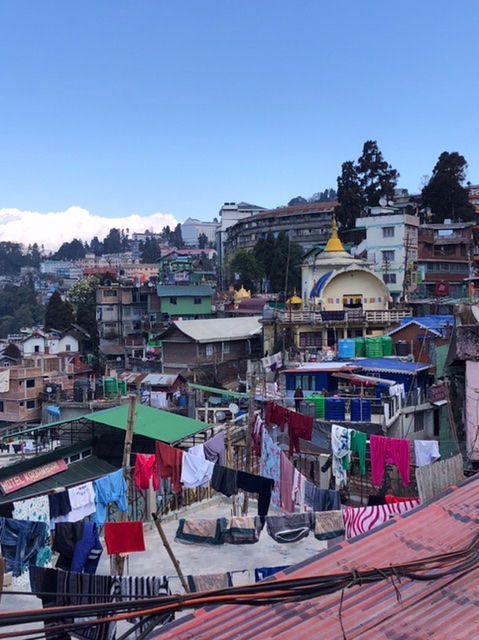
We were in a lovely hill station called Darjeeling. Neither of us knew why we wanted so much to go there – it’s way off the beaten track – but we felt a magnet drawing us there. The people there look very different from Indians in any of the other places we visited. Sort of Mongolian mixed with Chinese. The shops sell the types of mountain village items we’d seen in Mussoorie – another town in the foothills of the Himalayas but much, much further west.
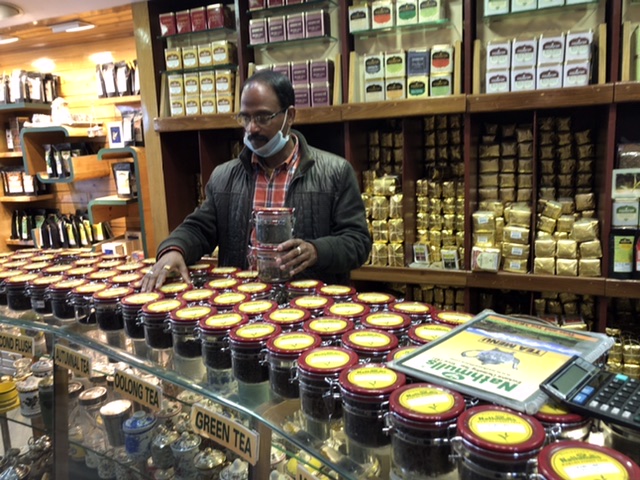
The staff at the hotel were as kind and welcoming as every other place we stayed – which is to say super kind and welcoming. We wandered up and down the steep streets daily, drank tea (Darjeeling, as its name suggests, is a center for excellent tea), took the World Heritage Toy Train, ate wonderful food, and took in the awesome mountain views daily.
And then things began to change.
We’d been following the Corona situation along with the rest of the world. Things didn’t look good but they didn’t look frightening…until they did.
One afternoon our very attentive guesthouse manager showed us something he posted in his group of hoteliers which mentioned the increasing incidence of guest houses refusing to accept foreigners and cabs refusing to allow foreigners into their cars and his own comment that this was not good behavior and he, for one, planned to welcome foreigners as Indians have always opened their hearts to them before.
Wait. What?!
Very quickly we began to see online discussions about whether or not to grab the first plane home. Some people were panicky; while others were still posting lovely photos of where they were and recommending guides in various towns. The pressure mounted until we spent at least a couple of hours every day deliberating our plans.
We were reluctant to cancel our time in Shimla, a place we both really wanted to go, and our return to Rishikesh, a place we spent three weeks and loved it so much we were planning another ten days there.
Finally, the morning we were to fly to Shimla we decided we were in denial.
We were spending so much time worrying about our decision, and asking each other if we were fiddling while Rome burned, that what were the chances we’d enjoy Shimla?
With a flurry of activity, we canceled two flights (and were refunded 1/3 of each), canceled our Airbnb in Shimla (Airbnb, btw, was wonderful and refunded the entire amount of our stay), and reserved a hotel in Delhi near the airport to be ready to hop on any plane we could find.
We had already shortened our trip to the end of March (originally we were due to fly home at the end of April), optimistically thinking it would be okay to still go to Shimla, but decided that we could smell the fires of Rome creeping closer.
Decided to stay in a super pampering hotel (Radisson Blu Plaza) as compensation for our sadness in leaving India. Forget the fact that we’d already learned that the price of the food in these hotels is more than a 3-night stay in the level of places we mostly stayed.
The posts in my FaceBook group started changing dramatically. The panic was far more widespread. Entire regions of India closed off to foreigners. People being asked to leave their lodgings. More and more flights canceled. More and more countries closing their borders.
We’d reserved a flight on Ukraine Air only to hear the very next day that they closed their borders…and subsequently canceled our flight with no refund.
With the help of others in our FB group we found other options and eventually reserved tickets on Aeroflot (who closed their borders the next day) and Ethiopian Air (with a 17 hour layover in Addis Ababa – yikes!).
There’s no end to the getting home story yet, but we have boarding passes for Ethiopian Air for 02:40 which is 10 hours from now, so it’s looking hopeful. Aeroflot hasn’t canceled the connecting flight (Moscow to Tel Aviv), but we’ve heard rumors that some agents have said it won’t be happening. We’re not taking that chance. They’d advertised that because of Corona they’d give full refunds but now say that they won’t give any refund at all…and aren’t answering their telephones in India or Israel.
I don’t even want to start calculating the cost of all this. Money comes and money goes (as they say); and mostly goes. We want to get home, even though it means 2 weeks in quarantine in our home. Maybe that’ll be a good de-pressurizing time to gradually get back into our lives…in their new shape with this ongoing crisis.
One of the major points here, though, is the change in the social climate in India. There seems to be a natural desire to circle the wagons in face of fearful times, as can surely be seen in our crazed attempts to get home to a country which is in almost total lockdown. Many Indians have begun to fear foreigners as the source of Corona, in spite of the statistics which show that there are about 7 foreigners in India with Corona; all the others are Indians who came in contact with Indians returning from abroad. They want to distance themselves from the “other” and surround themselves with the familiar.
In our hotel there are mostly foreigners who are waiting to get a flight home. I keep imagining that this is how it must feel to be a foreign national fortressed in luxurious surroundings after a revolution, waiting to be evacuated home. The feeling is one of unpleasant desperation. The lower members of the staff are still helpful and kind; the upper levels not so much.
It’s impossible not to think of families in lockdown in small apartments, or people who are on forced leave from work (or fired) and have no income, or the elderly who are now isolated from everyone because of the danger to their health.
It’s important to keep our own experience in perspective. We’ve learned an important lesson about community, but we’re healthy and safe…and together.
When we all leave our bunkers once the danger passes, the world we find will be changed one. Entire sectors of the economy will have disappeared or altered drastically (air travel, hotels, tourism in general); debts will have incurred which may take years to tackle; styles of personal interaction will have to be rebuilt.
But as my oldest daughter said – maybe the changed world we find will be a better world.
My partner and I spent 10 days in Rishikesh in 2016 and 3 weeks there so far on our current trip. We’ve decided to go back for another 10 days in April. We ran into many people there who told us they’ve been coming to Rishikesh every winter for the past 6 years, or 10 years or an incredible 20 years. One young person we spoke with last night (in Delhi) said he was there a month ago and finds that something about it is pulling him back.
So what is it about Rishikesh?
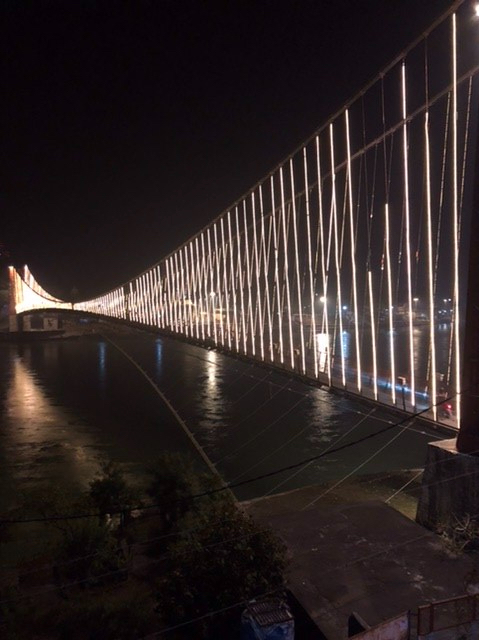
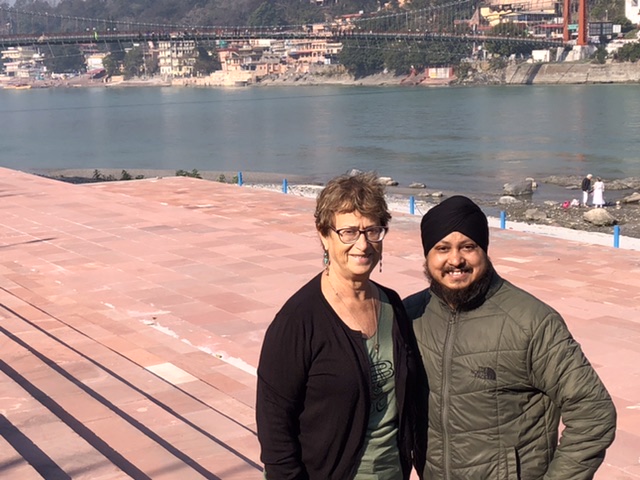
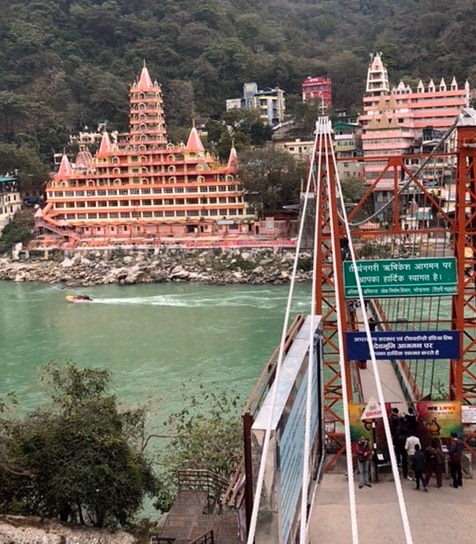
Rishikesh is a small city of a little over 100,000 people. It sits on both banks of The Ganges with two lovely suspension bridges spanning the river.
On one bridge, Ram Jhula, a few cows and monkeys maneuver between the foot traffic, motorcycles, carts, and bicycles. Things get busy on Ram by 9:30 am and don’t let up until twelve hours later, when the cacophony of horns and bicycle bells finally stops.
On the other, Laxman Jhula, they’ve recently installed barriers so there are no motorcycles or bicycles, but the monkeys there are far more numerous and aggressive (I was bitten by a monkey there in 2016).
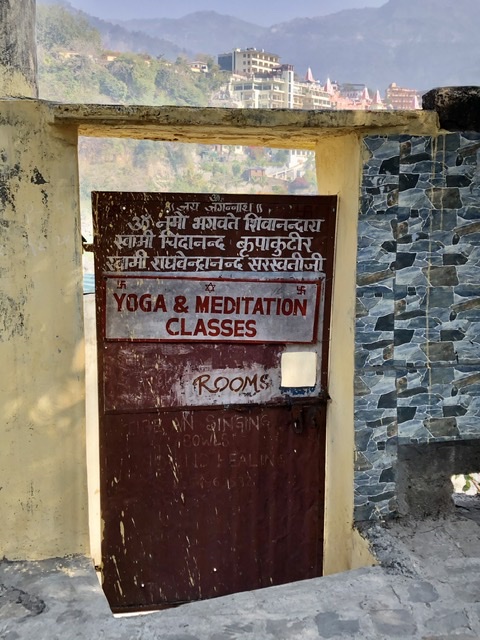
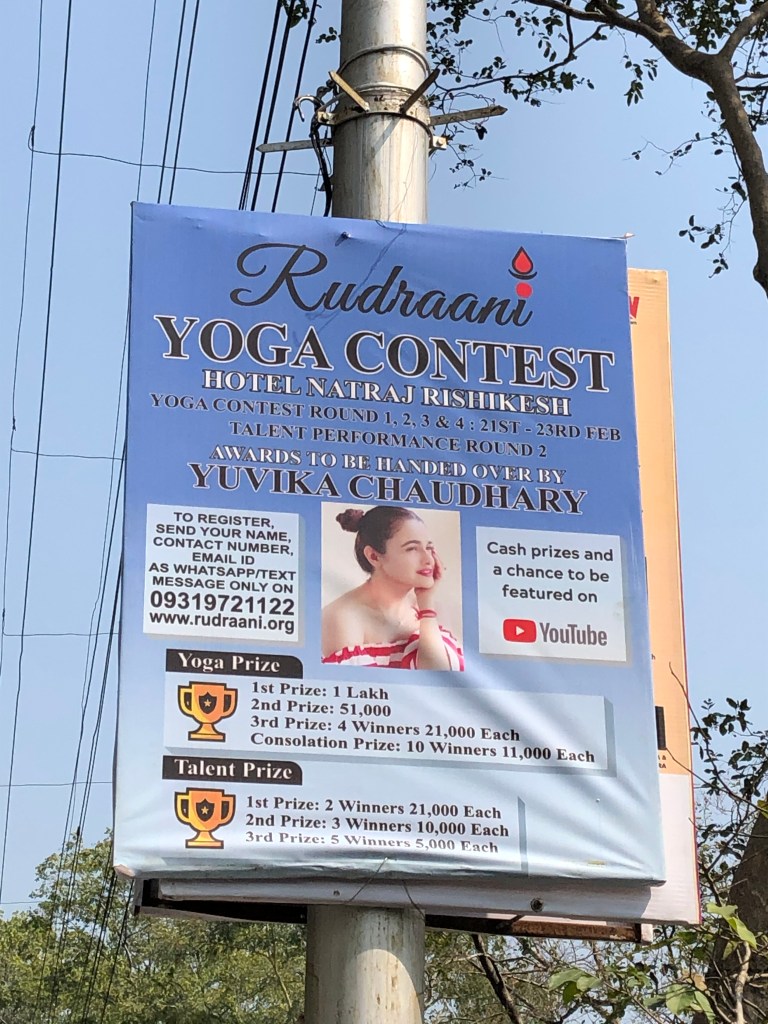
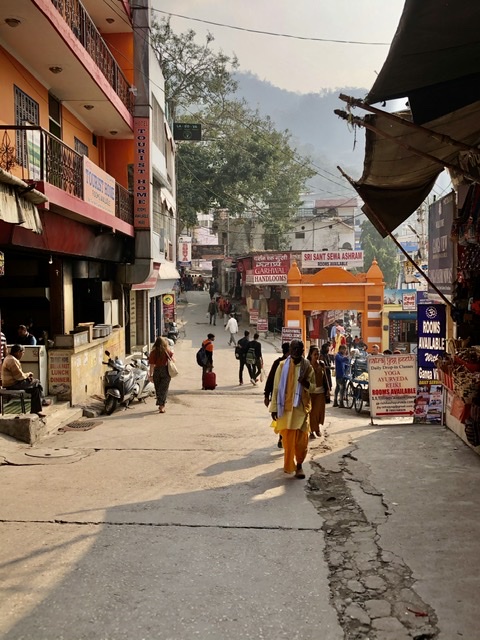
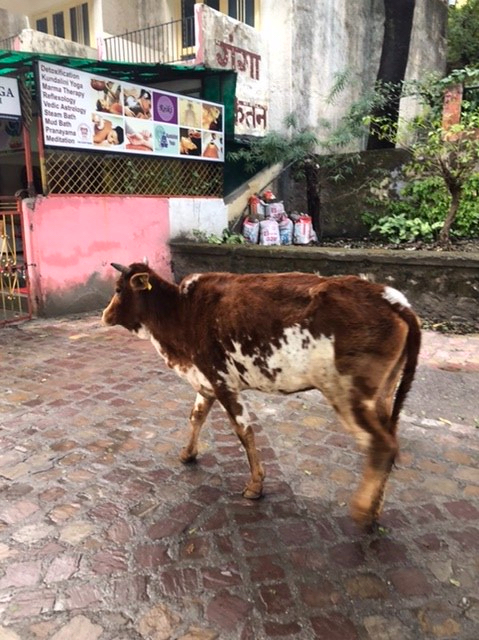
The small streets and alleyways are full of signs enticing people to take classes of all kinds – 200, 300, and 500 hour yoga certification courses, meditation classes, Hindi classes, music lessons of all kinds (harmonium, chanting, tabla, sitar to name a few), Ayurvedic massage and therapy classes – all for very low prices.
Some signs are in Hebrew, and many local people can speak a little Hebrew – a sign of how many Israelis visit and how much we make our presence felt wherever we are (for good and for bad – but mostly for good). In general, the average Indian is a big supporter of Israel, and especially of Bibi Netanyahu, expressing admiration for our strength in the face of great adversity. They enjoy the Israeli bonhomie and exuberance, responding to Israeli travelers’ warmth with readily extended friendship.
Friends Along the Way
We’ve met with kindness, extraordinary customer service, warmth, and beauty all over India. We’ve been awed by the colors, the noise, the crowds of the huge cities and the striking isolation of much of the beaches, jungles, and countryside. And, still, Rishikesh inspires an attachment that’s different.
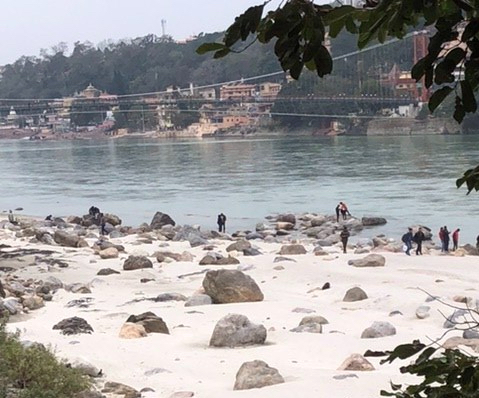
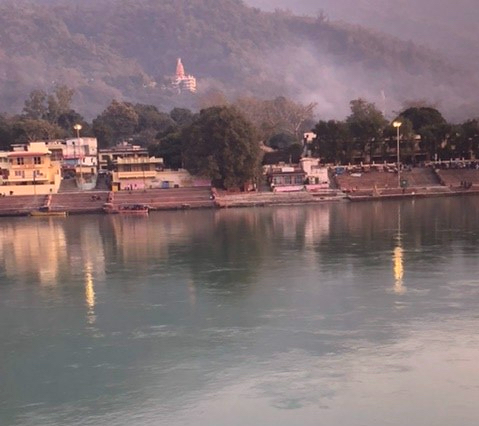
Maybe it’s The Ganges. Considered holy, originating from the matted hair of the Hindu god, Shiva, The Ganges starts in the western Himalayas, emptying finally into the Bay of Bengal. It becomes continually more polluted as it flows south and east. In Rishikesh it’s relatively clean. It also manages to be majestic and serene at the same time.
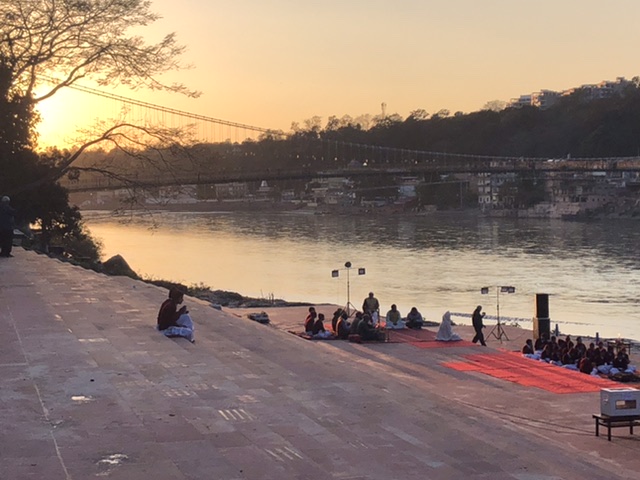
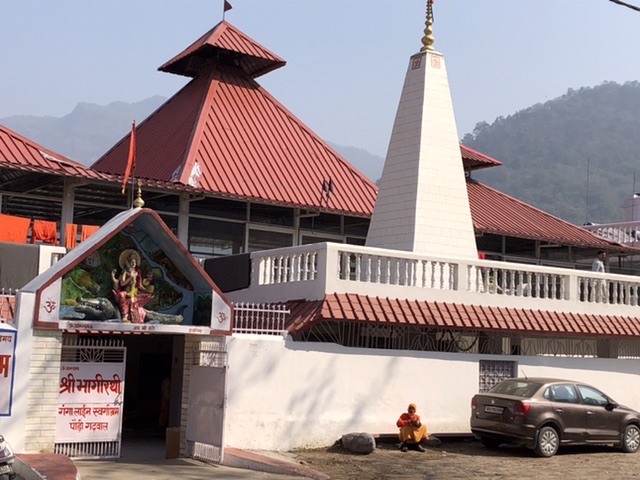
Half an hour before sunset, students and teachers from ashrams and schools congregate in their respective uniforms to sit by the river to prepare for the Puja ceremony. They chant to the music of the harmonium and the dholak drum. The ceremony culminates in fires being lit in small baskets of flowers, which are then put in the water to float downstream. As a Hindu ritual of reverence to the mother river, it is very removed from my own religion and culture. Yet the sound of the music and the sight of the small fires floating on the water are beautiful and moving. The respect for and love of the divine and nature found in India is close to my heart regardless of the different directions and beliefs that take us there.
Rishikesh is probably known best as the yoga center of India. Yoga practitioners from all over the world come to practice with Rishikesh yogis. Many of them come to take certification courses of varying lengths. From late February to mid-May it’s common to see people of all ages, speaking many different languages, walking through the streets of Rishikesh with a yoga mat slung over a shoulder.
The city is equally well-known as a spiritual center, hosting gurus such as Moojii for annual month-long retreats. Preparations begin several weeks in advance and in addition to meditation and satsang sessions for registered retreatants, a daily public talk with a Q&A session is open to all.
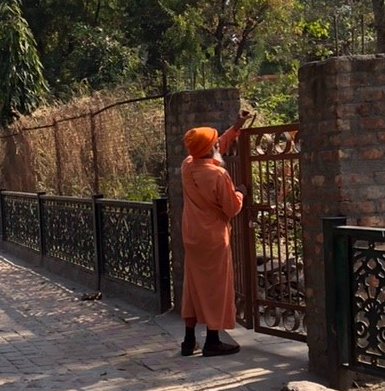
Orange is the color of Rishikesh. It is a sacred color in Hinduism, representing fire and the burning away of impurities. It’s the color worn by holy men…and many tourists. It brightens the atmosphere and, though thought garish in Western countries, is the norm in Rishikesh, just as the sound of bells – on anklets, cow collars and bags – is commonplace and cheery.
The Ganges, the chanting and music in the air, yoga, meditation, classes, cheery colors and sounds, cows and monkeys and dogs living in harmony with Sadus, spiritual seekers, tourists, shopkeepers and teachers. It’s all part of the magic of Rishikesh. But ultimately I really don’t know what it is about Rishikesh that imbues so many of us with peacefulness and calm smiles and burrows deep into our hearts.
The trick is safeguarding whatever that is and bringing it home with us.
Rishikesh is one of seven holy cities, Sapta Puri, in India. Aside from being alcohol-free and vegetarian, the city is a spiritual center, pilgrimage location, yoga and meditation center, and home to many Sadhus.
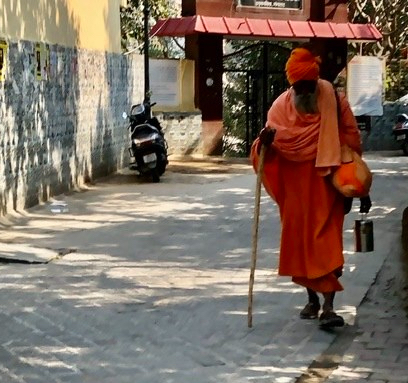
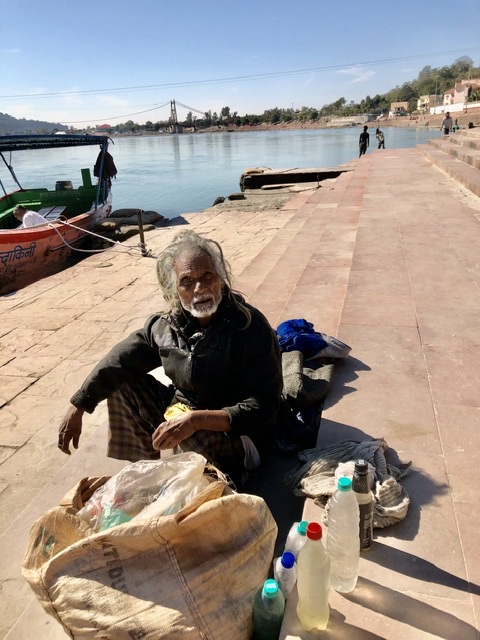
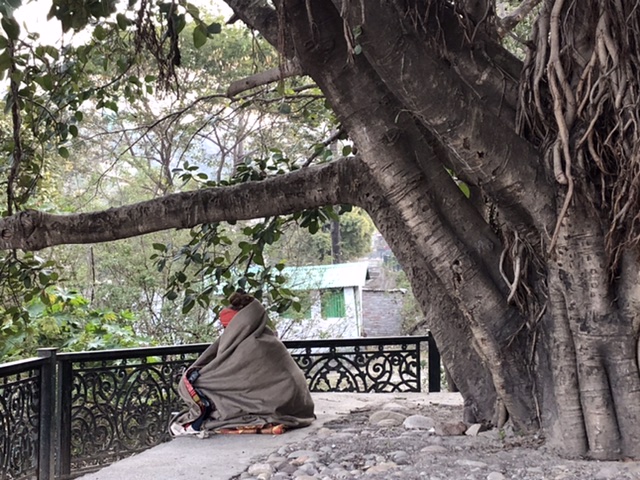
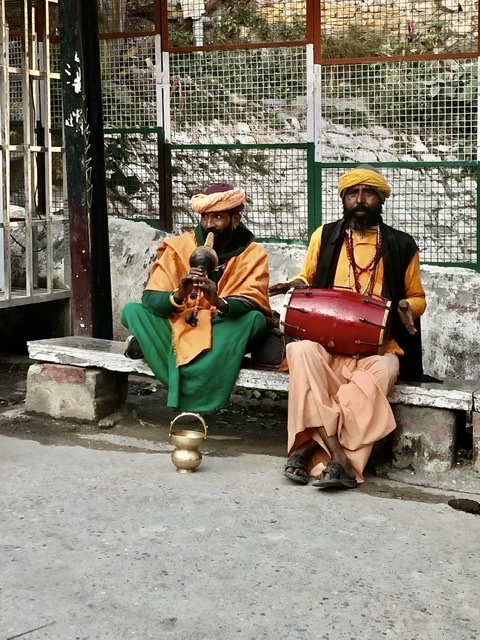
A Sadhu is a religious ascetic who has renounced the worldly life. He often lives on the street, with only the essential belongings for survival – his clothing, turban, towel, sandals, and beggar’s bowl. He is dependent upon the good will of others to provide him with enough money to buy sustenance-level nourishment each day.
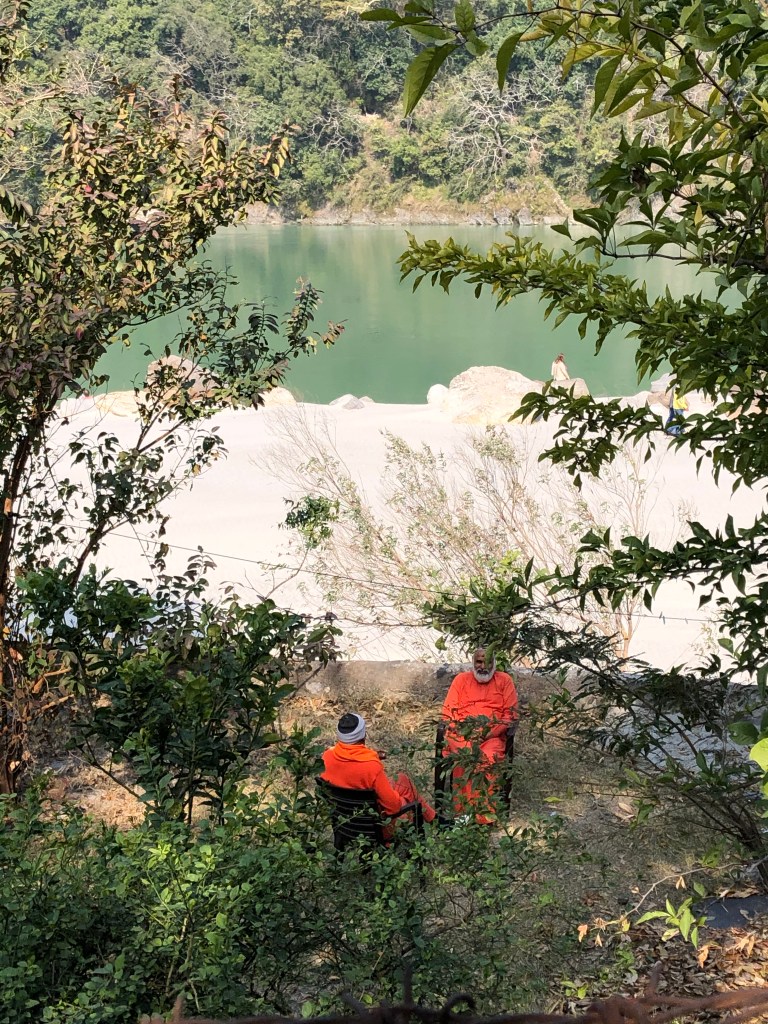
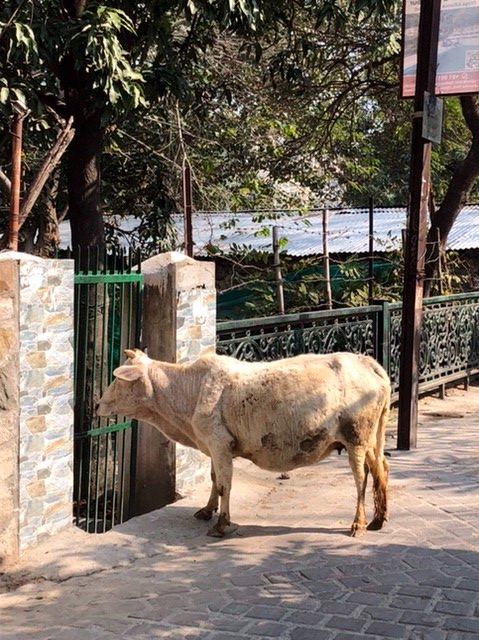
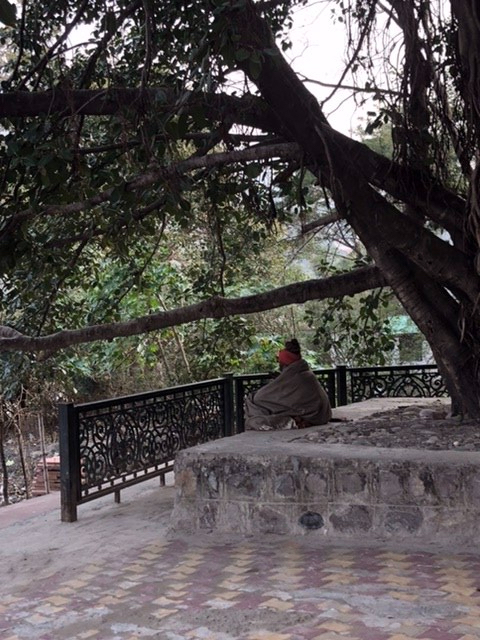
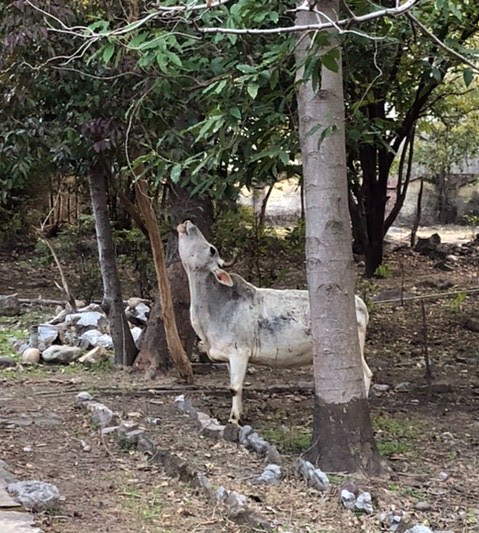
On my way to yoga in the morning, after crossing the Ram suspension bridge, which is blessedly motorcycle-free at that time of day, I meet only cows, dogs, and Sadhus, all waking up after a night spent outside.
Sadus may be said to be at one side of the spirituality-materialism spectrum. As I wait for my sweet yoga teacher, Gagan, to arrive on his motorcycle, sharing the pergola which overlooks the Ganges with the same Sadu each time, I can often hear a passing Sadu chanting quietly or not at all quietly.
“Ram. Ram. Ram. Ram. Ram. Ram. Ram.”
Though they’ve renounced family, home and worldly endeavors and accoutrements, I’ve noticed that they tend to hang out in twos, threes, and fours – a social group of sorts – and they gather their few belongings safely around them or cover them with a tarp on a nearby bench. Some take advantage of government incentives and work at ashrams where they receive food and shelter in return.
As my yogi says, human nature is one of collecting: things, acclaim, friends, knowledge, money. Another distinction between other animals and the human animal.
We ate dinner with a group of 20 strangers in Delhi not too long ago. Nice people. Friendly. As travelers are wont to do, people spoke freely about their lives, philosophies, travels, and families. The two men who sat closest to us got into a long conversation (with my partner) about their various, and, it turns out, multitude of real estate investments all over the world. The ones they sometimes live in, the travails of having renters, the value and tax issues of different locations.
Neither was Bill Gates but neither was a Sadu either.
We’ve been in India for over three months now. It’s a long time to be out of mainstream living. With each day that our work commitments, family and friend socializing, and community presence gets further away, our bonding to each other and our investigation of personal values and beliefs becomes more intriguing. There’s more time spent observing, thinking, integrating and softening.
It could be that the inherent nature of India is friendlier and more conducive to this transformative process. It could be that an extended period of free time would create the possibility of this process anywhere.
In India specifically, as we travel, meeting other travelers, shopkeepers, restaurant and guesthouse staff, yoga practitioners, musicians, and language teachers, we can’t help but observe their everyday life and that of passersby. Some of them become a regular part of our day for the week, two or three that we are in their vicinity. We seem to be seeing the spirituality-materialism spectrum in real time.
Spirituality is in the air.
From JP, the owner of our guesthouse near Munnar, who gets up at 4 am each morning for 20 minutes of yoga, to the shopkeeper in Rishikesh who closes his shop at 10 pm, bends down 3 times to kiss the step in front of his shop door, touches the doorframe and then his forehead before getting on his motorcycle to head home, to the clearly well-to-do middle-aged Indian couple who travel to The Ganges to dip themselves in holy water annually, to my lovely harmonium teacher who has a smile for the pesky monkey who pushes open her door when she shakes her head in that ubiquitous, multi-meaning Indian wag and says “He, too, is one of the gods’ creations.”
The human nature of collecting is evident, too.
The same people mentioned above charge money for their goods and services. In general, they unabashedly charge foreigners more – sometimes shocking attempts to charge 10 times more. A Sadu might complain about a donation of 10 rupee (“But a chapati costs 20!”). One South Indian man we befriended had a candid conversation with us about his constant efforts to accumulate more wealth. The yogi with whom I practiced four years ago didn’t charge money (he reluctantly accepted my ‘donation’ of $75 for 10 classes) and this time made his charges clear before we began (less than $6/class).
So where does each of us choose to be on this spirituality-materialism spectrum?
Does being a Sadu, at one side of the spectrum, preclude a bit of materialism? Does being Jeff Bezos preclude a smidgen of spirituality? (btw, did you know that there is not one woman on the list of the top ten richest people in the world?)
Gagan believes that it’s easier for those who have wealth to take on spirituality. Perhaps this originates from his vantage point as a Sikh yogi whose path of relative poverty and practice was inherited, clear from the age of 10. Perhaps he envisions those who have large bank accounts as having the luxury and ease to choose to invest time in introspection and seeking spirituality.
It seems to me, from my vantage point of never having had to concern myself with the possible absence of my next meal or a roof over my head, that it’s easier for those who have not been educated to chase ever-improving material circumstances to take on spirituality.
Clearly Gagan and I bring different life experiences to our sense of things.
Seane Corn is one of the most famous (and wealthiest) yoga teachers in the world. Her net assets are reported to be over 20 million dollars. Not anywhere near Bill Gates’ estimated 100 billion dollars, but still not too shabby. While her exhibition-type, extreme style of yoga is not my cup of tea (maybe I just wish I could have her flexibility), I’ve admired her for years for her tireless work for altruistic causes. Her organization, Off the Mat into the World, offers yoga practitioners the opportunity to volunteer to build community centers in Africa, train young people to teach yoga and meditation in their villages and towns, and offer online courses for leadership initiative. A vegan, Seane teaches 250 days out of the year, and, when not teaching, calls a tiny yurt in Southern California home.
Miriam (not her real name) is a talented artist, living in a rural area of Israel. Her husband of 25 years is most often in the US where he teaches religious studies in a small community where there would be no religious learning if he didn’t offer it. They have little in the way of material wealth, other than the modest, heavily-mortgaged home Miriam lives in, and, sadly, have no children. Their daily lives are committed primarily to the deepening of their spiritual lives and sharing what they believe are their God-given talents – painting and teaching. Miriam offers half-day and full day retreats for women, providing spiritual, artistic and nutritional nourishment, charging on a sliding scale according to means. Her walls are covered with her beautiful original works, into which one can gaze, imbued with Kabbalist and/or personal spirituality.
(not Miriam’s work)
Most of us are neither Seane Corn nor Miriam. We’re neither millionaires nor Sadhus. Some of us may not give a second’s thought to spirituality or ethical behavior or the meaning of life; others may think about it fleetingly or in depth once a week, or at random times. All that stuff has been in my thoughts for as long as I can remember. Sometimes it led me to political activism, sometimes to volunteer work, sometimes to prayer, sometimes to regrets, sometimes to books, sometimes to an open heart. I’ve been blessed with 3 months of unrestricted time, a partner who’s happy to listen to and share philosophical thoughts, and surroundings that welcome it all.
We live in an age of moral subjectivism, relative realities, political correctness – some may be tempted to call it an age of wishy-washiness. We hear that there’s no objective right or wrong, better or worse, too much or not enough. It’s all what you choose for yourself. The glorification of the individual, regardless of…well, pretty much anything.
But, hand on heart, don’t we all actually know what having enough looks like? I’m guessing it doesn’t resemble Jay Leno’s collection of cars or Imelda Marcos’s shoe closet. It most probably isn’t even reflected in most American’s refrigerators or leisure time. I’m a member of a FaceBook group of people traveling in India. Recently there was a post about whether or not to tip in India, and how much. Some of the responses were eye-openers. From ‘Indians don’t tip.’ to ‘It’s good enough to round up.’ to ‘They earn so little that 10 rupee significantly increases their income.’ (10 rupee is the equivalent of 15 cents) Seriously, guys!? Then there’s the feeling that we’re too busy to walk the breast cancer marathon or visit the aunt who’s broken her hip or volunteer at the literacy group downtown.
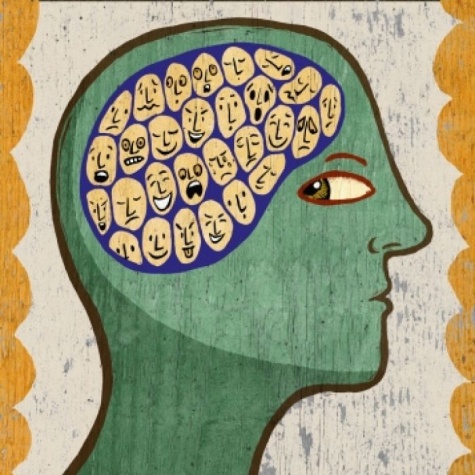
We each choose our own path, even though sometimes it doesn’t feel like it. We have internal voices that may sound a lot like one of our parents, our seventh grade teacher, our partner, our eighteen-year-old self, our rabbi, our neighbor, or all of those people and others besides. Voices that narrow our choices to, well, theirs. Or what they wish they’d chosen.
Confusing…and noisy. Hard to hear our own internal voice with all that racket going on.
Gagan shared his own belief about all this choosing, whether it’s about spirituality, materialism, or how much time to look at a screen of some sort. If you never regret your choice, your choice is good. (I wish you could see his expression and hear his voice as he says that.)
When I pushed him…what about an addict who ends up dying from his addiction?
The answer – If the addict dies with no regrets, then the choice is good.
Say whaaaat!?
That’s going too far for me, but I get it when he elaborates and adds that trying to guide someone else’s path is like trying to steer a passing car. Unless the driver pulls over, stops, and asks for directions, your shouts will just make you hoarse.
I’ve spent many hours perfecting work and making deadline only to find that the client didn’t bother to provide necessary material – and didn’t care. I’ve spent money and time fulfilling a promise that the person on the receiving end, it turned out, didn’t value much, or may have even forgotten. I’ve worried about people’s “wrong” decisions that turned out not to be so disastrous in the long run, or even had their positive aspects.
So if I believe people are happier with spirituality in their lives, authenticity, or altruism, or other people, I choose to resign as one of those internal voices that points it out.
I’ve chosen to integrate those attributes into my life and to respect your right to choose to integrate some, all or none of them into yours.
Suspend the usual platitudes and accepted opinions of the social groups to which you’ve assigned yourselves. Mission accomplished? Now read on.
We’ve seen many beautiful animals over the past 10 weeks in India.
India really knows how to create and maintain national parks the way they should be. The kind where tourists are only allowed in a tiny percentage of the park lands and animals live in the rest according to their natural instincts and behaviors, without threat or fear of their main predator – us.
As it turns out, India also really knows how to create and maintain zoos the way they should be. The kind where the animals have enough space to live their lives as comfortably as possible, while being protected from their precarious reality out of captivity.
Of course the Saraus Crane, that very tallest of birds, might prefer to fly free, and that Bengal Tiger might prefer to roam the tropical and subtropical rainforests chasing prey, but their natural habitats are, sadly, disappearing or have become too dangerous for them.
We humans have been responsible for many of the causes of extinction and the threat of extinction for many members of the animal kingdom (though certainly not all). We have become one of the major causes of their comeback, too.
Wolves and buffalo, verging on extinction in the ‘60s, have made a valiant recovery as a result of protection laws passed in the ‘80s. Severals kinds of frogs, antelope, birds, turtles, and leopards have been saved from extinction by zoos. Yep, zoos.
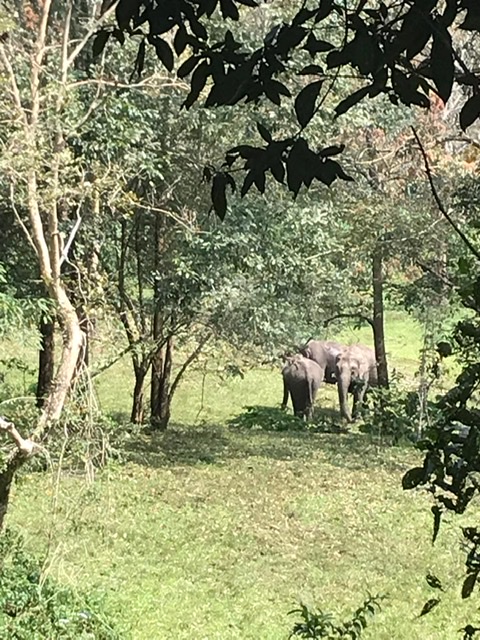
Seeing wild elephants from a safe distance in Periyar Park creates a very different visual than seeing elephants in the Mysore zoo. That difference makes it tempting to condemn the zoo concept.
But that condemnation could paradoxically lead to the extinction of a large number of animal species.
I admit to some of my very best memories being the Macaws at the clay lick in the Amazon, the playful Otter family in their natural waters near Sandoval, the Blue Boobies on the cliffs in the Galapagos, the warm weather Penguins in the Patagonia plains…you get the picture.
But I’m happy that the Golden Lion Tamarin, once almost extinct, is thriving in captivity so that my grandchildren can get acquainted. Same for the California Condor and other majestic beasts.
Sometimes generally accepted ideas need to be re-thought.