Unknown's avatar

About gettingoutalive

Brought up in one of "those" families - a challenge. Lucky enough to marry someone who inspired me to create a much-healthier family and have a life which helped me begin to love myself. From Texas to California to Wisconsin to Israel. From reliable, responsible child to rebellious teen to fearless young adult to grateful grandmother. Five beautiful, fascinating grown children. Fourteen amazing, enchanting grandchildren. From university teacher to researcher to couple counselor to political spokesperson to yoga instructor. Still married after all these years.

Travel Buddies: Ephemeral Windows into Other Realities

Every single person on the planet has a story. We never even walk by the vast majority of them. Then there are those we walk by without seeing; the ones with whom we have brief encounters without really listening; those who share our lives in some way but whose hearts we rarely see into; and, if we’re very fortunate, a few with whom we exchange intimate confidences.
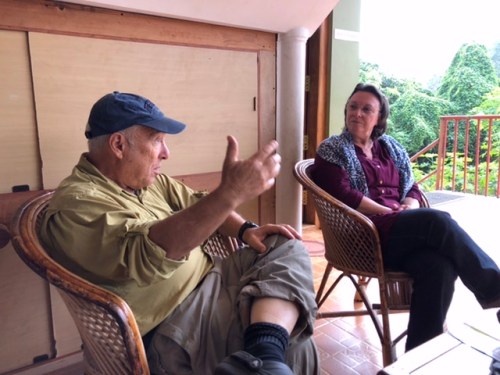
There’s an interesting phenomenon, a side effect of traveling, that involves the instant and inexplicably deep personal connection between people who meet, share a few hours or days, and never meet again.
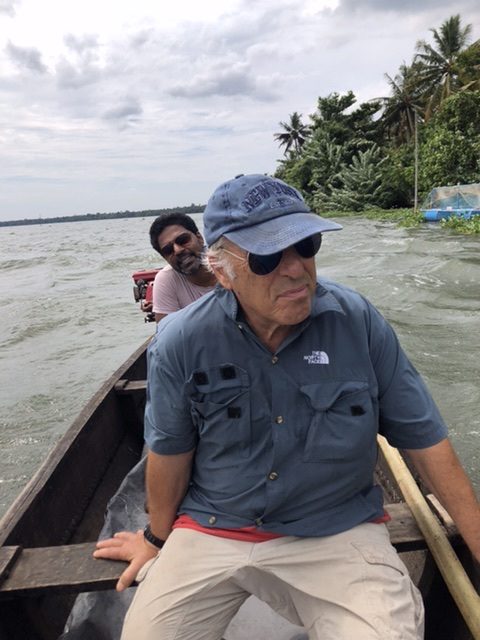
A special bond is perhaps forged as a result of similar cluelessness about surroundings & cultural behaviors, or lack of routine and familiar faces. Or maybe the freedom of absolutely zero preconceived notions or previous acquaintance. Tabula rasa.

There was the family from Latvia who shared a lodge with us in the Peruvian Amazon. She confided that they’d been having marital problems & were moving to Boston where her husband had been offered a professorial position. Maybe a change of place would improve their relationship. They were traveling with their children for a year before the new academic year. He was determined to go to a shaman in the jungle to experiment with a special hallucinegen and unpleasant about her reluctance to join him. In the end, they left their young children and their passports with us – people they’d known for two days – and headed into the jungle.

In the morning they still hadn’t returned. Thankfully, they straggled back a little before noon. Hungover but healthy in body if not in mind.

And so it goes. We tell each other things we haven’t told close friends. We trust each other with confidences, money, and apparently sometimes our children. We enthusiastically join in adventures we might have had trepidations about. We listen to, tell, and enjoy vastly different opinions, occupational stories and familial foibles unselfish-consciously. We laugh a lot.
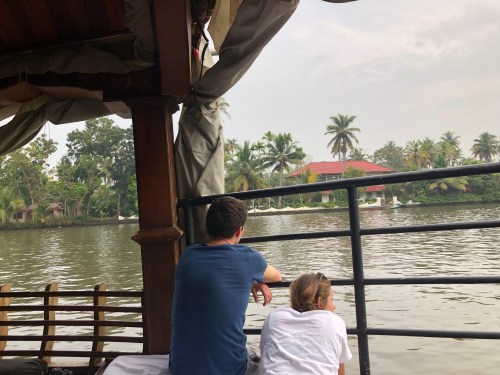
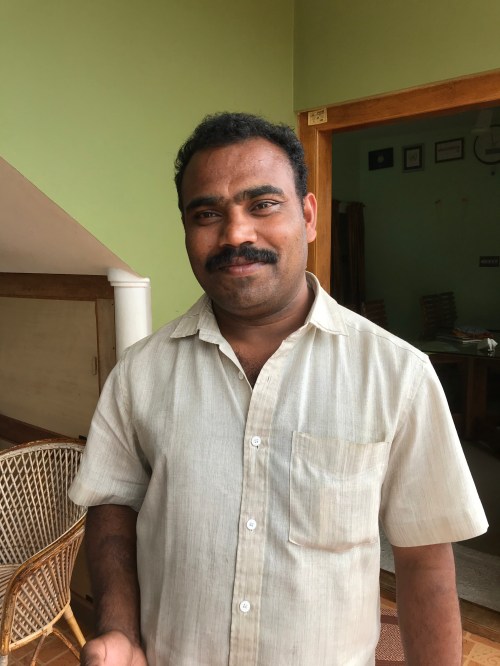
Antony (no ‘h’ in the many Antonys in Kerala, even St. Antony, and if you see an ‘h’, it’s not pronounced. There is no ‘th’ diphthong there.) was born in a very small fishing village in Kerala. Son of a fisherman, Antony loves nothing more than being out on the water in a small boat, meeting with childhood friends, hearing the waves lap the shore or crash on the rock barrier near his home. He chose a different life, though. Antony went to the military academy and spent 24 years in the military, retiring from his last position as Colonel, in charge of the anti-terrorist unit in northern India. He’s a hero in his hometown, and elsewhere. He went on to establish three businesses in the area surrounding his fishing village, employing over 90 people. It keeps him busy and away from his fishing village and the sound of The Arabian Sea. He’s not particularly interested in money for himself. His wife, Teresa, manages their bank accounts, saving what’s needed for their two children’s university educations, and gives Antony a small monthly sum to fill his motorcycle with gas and buy coffee during the day. He established businesses because he recognizes that along with employment comes dignity for his friends and neighbors. He’s also one of fifteen men who meet monthly to play games, share stories, and put money into the kitty for anyone who might be in need. His home is open to people at every level of society and they are happy to join him there for a drink or just a visit. Antony decided long ago that at sixty he’ll retire, he’s 49 now, and give himself the gift of The Arabian Sea’s whisper in his ear every day. An eclectic man, he never ceased to catch our interest or raise thought-provoking questions for discussion – philosophical as well as ‘what if’s’. We felt honored to be invited to his nearby home for dinner with his wife and son (his daughter was away at preparatory exams). It’s clear how much his son admires him and what a loving father he is (he told us that his wife keeps the kids in line because he can’t tell them ‘no’). I’m sure he was a tough officer in the military – he’d have to be – but in civilian life he has mischief and the sparkle of laughter in his eyes and a huge heart filled with kindness.

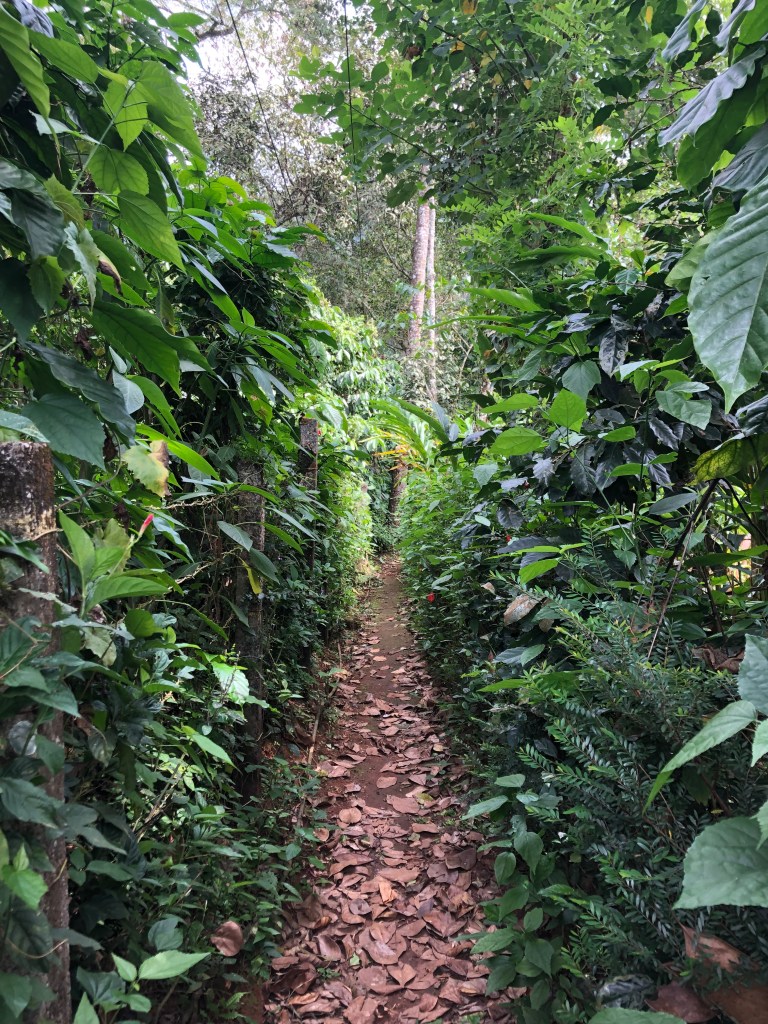
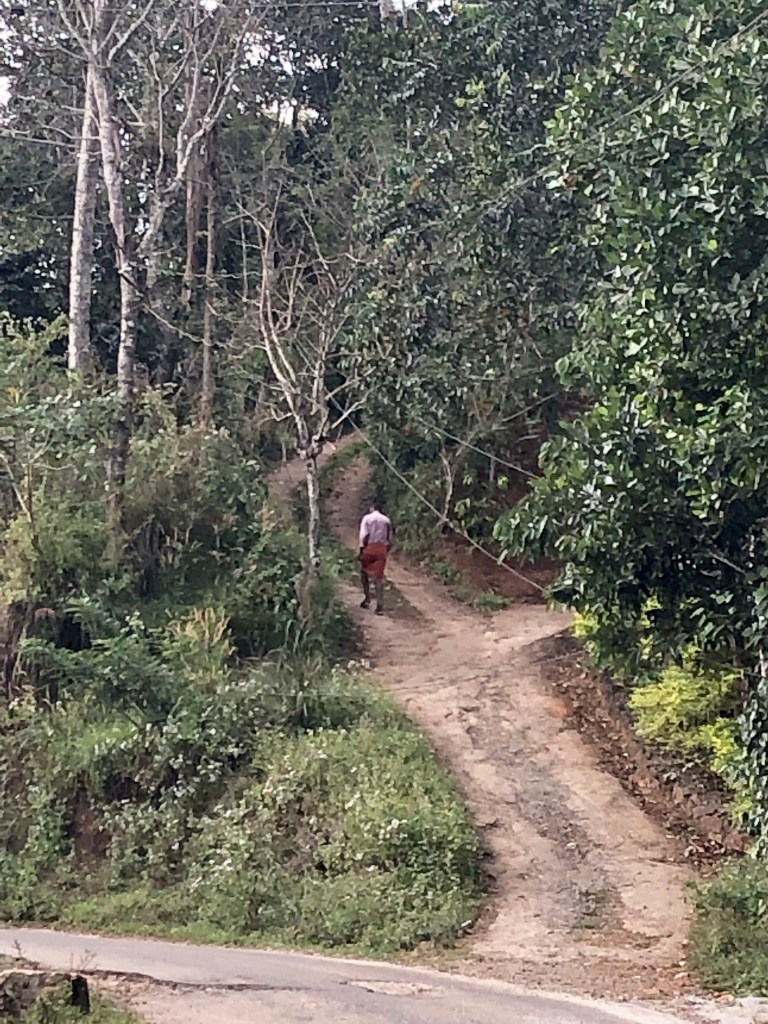
Katie’s only daughter lives in Pondicherry. Katie wasn’t much of a Mom. She was a flight attendant for Air France for her entire professional life, flying here and there and rarely at home. Her ex-husband raised their daughter. Retired now, she spends several months a year in Pondicherry, resigned to never being able to make up for lost time with her daughter, but determined to be a part of her life. A passionate woman, Katie’s views about French politics control a large part of her life. In the streets every weekend in her yellow vest, her harsh political rhetoric intrudes in almost every conversation. Macron, and Sarkozy before him, are the devil incarnate. And, yes, she does use those words. Enemies of the people, proponents of a new world order that disenfranchises everyone but the wealthy, robbers of the private benefits and income of the middle classes and the poor. Her political anger seeps into her extreme watchfulness in order to protect her from being taken advantage of, even by our sweet, accommodating host in Thekkady. We invited her to join us for a quiet day of walking in nature, surrounded by cardamom, coffee, and tea plants. Calmed by the sheer serenity of all that green, her political persuasions faded into the background, only occasionally peeking out to make a brief appearance.

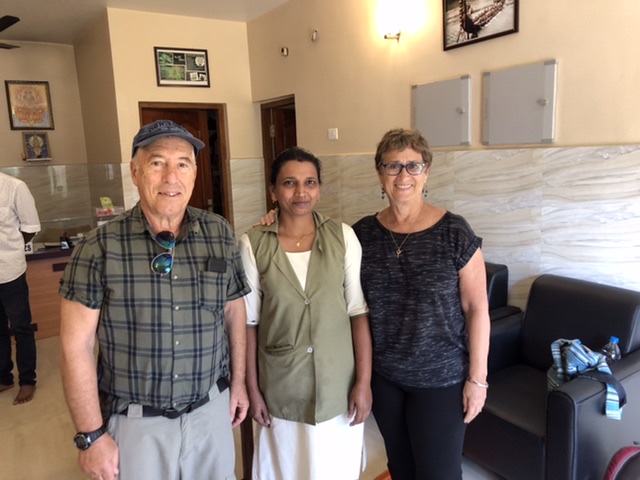
Nancee was born and raised in a house in the forest, 40 kilometers southeast of the Kerala city of Munnar. She lives there still, in her house surrounded by fruit trees and passion fruit vines, and walks the kilometer to work as cook and cleaner in a three-story guesthouse/hotel owned and run by J.P. A quiet, shy woman, her smile can light up a room. When we commented on how much we loved the passion fruit that showed up on our breakfast table after we requested fresh fruit, she brought us a bag of the most delicious passion fruit I’ve ever eaten. I come from a country known for its plentiful, extraordinary fruit – picked in the morning and in the market in the afternoon. Passion fruit is one of my favorite fruits, but I’d never seen passion fruit so big, firm and tasty. She’d picked them from the vines surrounding her home, along with large cocoa pods (interesting, but not so tasty). She acquiesced graciously to my request to watch her cook our breakfast so that I would be able to replicate it at home, only a little embarrassed at first to have me looking over her shoulder. When we left, after two weeks at Arusakthi Riverdale, she approached me hesitantly, hugged me fiercely, then joined her palms at her heart and gave me a small bow. We didn’t understand each other’s verbal language but the language of our hearts was loud and clear.

Rav Yonaton wears a mixture of Indian and Hasidic clothing, along with his long payot (side curls) and large kippah (skullcap). Born and raised in London, the son of a totally secular family, he moved to Israel where he became religious, married, fathered a son, divorced, re-married, lived joyously in poverty, and shared in learning Torah with his new South African wife. Waking up to the necessity of providing for their upcoming baby, he lucked into a job as a mashkiach (kashrut supervisor) for a Baltimore company and relocated to Jewtown, India, near Fort Kochi (Kochin). His wife joined him there with their month old daughter two weeks later. Ever enthusiastic, ever sensitive to the cultural and social realities around him, Rav Yonaton has endeared himself to the largely Catholic community. A nice mural of him walking with his daughter can be seen on the wall of one of the newer, more comfortable hotels. The Hindu family across from a memorial headstone for a Kabbalist from the 17th century, located in an alleyway, helps to make sure the memorial’s burning light never goes out and joins the Rav there sometimes when he comes to daven (pray) there. We looked forward to having a bit of chicken after over a month as vegetarians, but there were only small bits of fish in the rice for Shabbat. Rav Yonaton explained to us later that he prefers to respect the poverty of his neighbors and not stand out as having the more expensive chicken on his Shabbat table. His contract will expire in the fall and he has no idea if he will be returning to unemployment, but his infectious smile precludes worry about his family’s future. As he walks us back to our hotel after havdala (the prayer to end Shabbat) at his house, he greets and is greeted by most of the passersby, each in his own language (and there are many). Loving and loved, he has no worries.

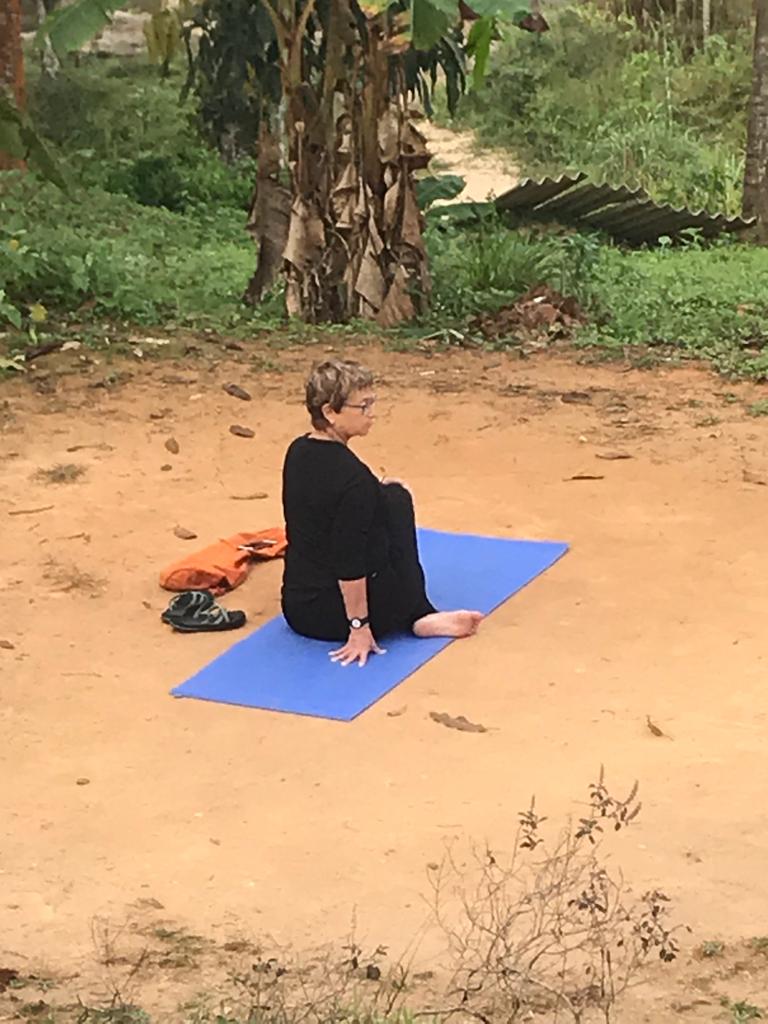
Vita and Ben are getting married in June after sharing their lives for over seven years. They’ve moved to Stamhope Hill in London, where she is a researcher for an NGO whose task is to evaluate the work of other NGOs and he is a youth worker in an adventure camp. They clearly both love their work and each other. She never wanted to marry and, in fact, when he proposed for the umpteenth time while on a romantic vacation in Japan (and was confident that she’d say ‘yes’), she told him to ‘Fxxk off!’ After a 20-minute conversation about why he wanted to marry, she was convinced, demanded he re-enact his proposal and afterwards said ‘yes’. He’s into the whole large wedding in a spectacular venue thing and she’s going along with only minor irritation in her voice as she reacts to his telling us the plan. Why marry at this point? Children are definitely on the horizon. They share a beer or two with my partner as laughter gets more and more raucous. Vita and I bond more over morning yoga on the balcony overlooking a tropical jungle. Our own temporary piece of paradise. We all swap hiking stories from beautiful Periyar National Park. They’re younger than our youngest child but age differences disappear easily among travel buddies.

Viktor is a solo traveler from Yerevan, the capital of Armenia. Somewhere in his late 40’s or early 50’s, he shares in the lives of his nephews but doesn’t see children in his future. A businessman, he’s not exactly rich but wealthy enough to help his extended family wage a decade-long (losing) battle for his ancestral home against the municipality, and pick up and come to a meditation seminar after an online Sadh Guru meditation course. Because of jet lag, he overslept and arrived two hours late to the seminar where he was turned away – ‘The Guru gave explicit instructions that no late arrivals were to be admitted.’ Offered an alternative – a 3-day retreat at the Sadhu Guru’s ashram in Coimbotore – he decided to attend and extend his time in India. That’s how we got the opportunity to make his acquaintance in Morjim Beach, Goa. We learned a lot about Armenia – he’s a super patriot. His only regret about living in Yerevan is that no one there is into spiritual meditation, or at least he hasn’t found anyone. He and my partner talked together for hours about Armenian history and politics. We visited the local fish market together and chose a big fish to have our cook fix for us one night. The cook didn’t like the look of the one we picked out so carefully, jumped on his motorcycle with it, returned it to the fish market, where he purchased a better fish for us. It was totally scrumptious and we shared a wonderful evening together with the sound of the waves and a lot of shared stories. Having fallen in love with Goa (What’s not to love? Beautiful, empty, clean sand beaches and gorgeous sunsets.), he extended his time there and we bid him adieu before heading for Kerala.

Ruth and Dieter, an Austrian couple, joined us for several days in Thekkady. We have a love of pure veg South Indian food in common that made walking down the potholed road outside our guesthouse together to The Hotel Aryas a given. They are as adventurous as we are when it comes to experimenting with new dishes and more so when it comes to eating with their hands. They went on a 20 km hike in Periyar National Park the day my partner went on a 15 km hike and I read for a couple of hours before meandering the streets and shops of Thekkady happily NOT hiking for hours and hours. They were to leave for a tree house hotel close to Ayursakthi Riverdale the next day but when they heard our praise for our amazing guide, Raj, on our 5 km nature hike earlier in the week, Dieter, a botanist finishing up his PhD, couldn’t leave without joining us on a return engagement with Raj. It meant they had to spend an extra 2500 rupee (about $40) to hire a taxi to get to their next town because they’d miss their bus, but they were game. We were happy to share the experience with them. Raj didn’t disappoint and it was so much fun watching how excited Dieter was to learn all about the flora in Periyar. Raj knows the common name and scientific name for every flower, tree and bush. Ruth, an occupational therapist, has amassed tons of botany from her many years with Dieter, as I have gained knowledge of bugs and crustaceans from my years with my partner. It was a pleasure spending time with such a like-minded couple, in spite of their being Austrian, barely thirty years old, and being in India for the first time.

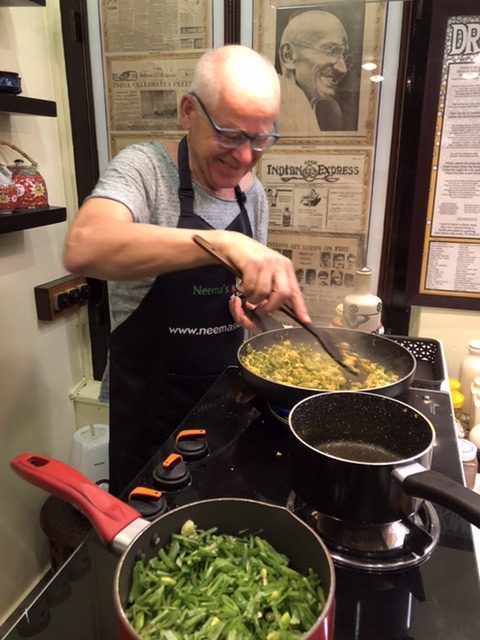
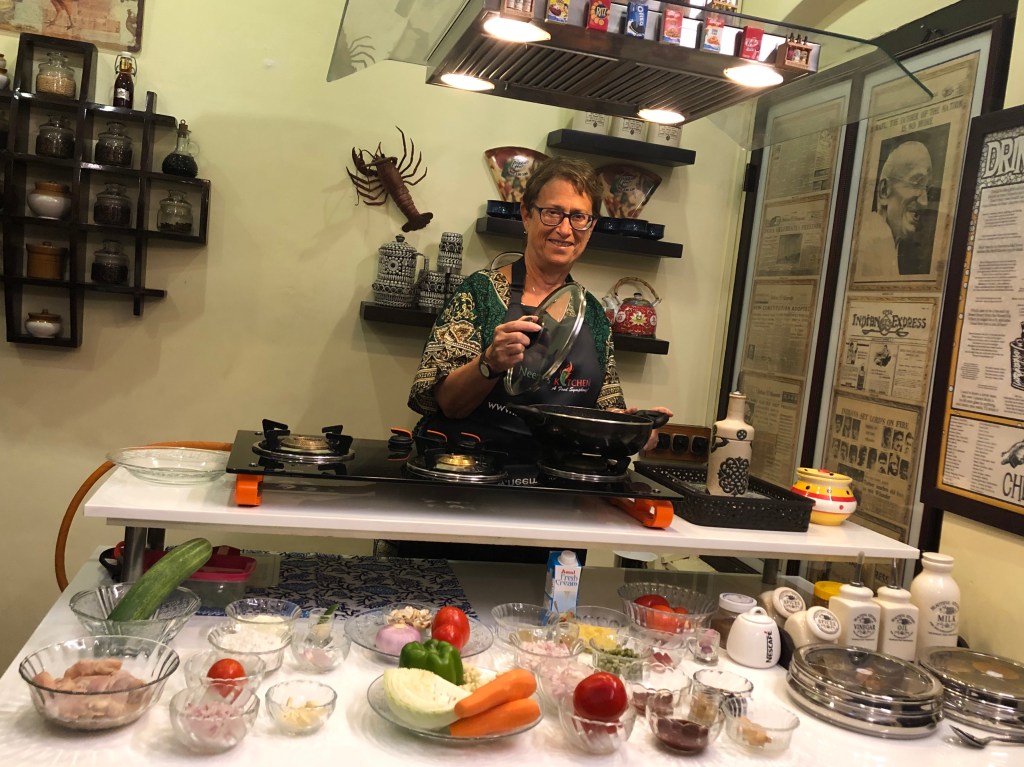
Neema taught me to cook South Indian dishes, including the masala dosa my partner loves so much. More importantly, she and her husband, Prasad, spoke to us for many pleasant hours about their India, their family, and their experience working with many tourists. A soft-spoken, gentle soul, Prasad actually worked for many years as the captain of a commercial line of ships. Neema spent her first five years of marriage (an arranged marriage, of course) traveling along with him, visiting ports all over the world, even after their daughter, Olivia, was born. It was a special privilege only the captain’s wife enjoyed. Once Olivia was a bit older, they settled down in Neema’s parents’ historical landmark home in Wypeen Island, just a short ferry ride away from Fort Kochi (Kochin). Neema’s parents live in the house as well, though we never caught sight of them. Prasad is well-read, andknowledgeable in many areas including history, Indian and world politics, world geography, ichthyology, a bit of botany, and many languages. As Neema taught me to cook, Prasad and my partner kept each other entertained. Prasad was the one to open up the, formerly unknown to us, history of Jews further north in Kerala. After cooking class, Neema put her feet up and we chatted about being mothers of independent, strong-minded young women, building a business which relies heavily on customer service, the trials & tribulations of developing and maintaining a social media presence, remembering to give back to the community, and, of course, where to shop for clothes and gifts close by for good prices and quality.

Raj Kumar is a member of the indigenous mountain tribe called the Munnan. To this day they live in small villages in the mountains with a king and village elders. When outsiders approach one of the villages, an elder meets them outside the borders of the village to decide whether or not to allow them to enter. The Munnan have control over Periyar National Park, though it’s technically a government park. The Munnan have always had control, considering it their tribal land. Of the the 357 square mile park only 118 square miles are accessible to tourists, in order to properly conserve the fauna and flora. As a result, elephant herds live in their natural age-old way, goddesses of their territory, are infrequently sighted, and make it clear with threatening noises and agitated behavior that they should never be approached from less than 100-150 meters. The park rangers are all Munnan. They guide small groups on nature hikes from 5-18 kilometers and carry out night patrols to be sure that poachers cannot harm the animals or protected flora, including sandalwood and mahogany trees. Raj Kumar was randomly selected to guide us on a 5 km hike. As we waited for a British couple, Peter and Sara, to join us, their hotel agent having asked if we agreed to add them to our private hike, Raj began to describe the park to us. We were immediately impressed by his knowledge, English, and ability to field queries. As we watched him pull the raft to shore for us to cross the small lake, he suddenly dropped the rope, patted me on the shoulder and said, excitedly, ‘Come! Come!’ He took off up a small hill and we took off after him. Once we hit the peak, our eyes followed his pointing hand across the water where a mama elephant and her baby were grazing. A beautiful sight that his sharp ears, hearing the older elephant cooing to the younger, made possible. We were to learn to trust his ears, eyes and instincts, which directed us to the huge Malabar Squirrel, two glorious Hornbill birds (who took off in flight and flew overhead, exhibiting their full colors and shapes), beautiful butterflies of many different colors, caterpillars of all sizes and monkeys high up in the branches (before they began throwing things at us). There was not a common name or scientific name of any flower, bush, or tree that he didn’t know and recite easily. He was happy to allow us to sit silently, without moving, for five minutes, at my partner’s request, in order to hear the increased sounds of forest birdsong and the noises of animals in the trees once their wariness disappears – a moving experience to try if you never have – but hold out for 20 minutes! My partner, a water biologist and ecologist with a PhD, and Raj, an autodidactic naturalist, found kindred souls in each other, swapping facts and vignettes from nature. Raj proudly told us, neither modestly nor arrogantly, that, though it was commonly believed that the jackal lived in Periyar, it had never been proven until he took a photo, at his own peril, after stalking a jackal for many hours. We arranged a second hike with him two days later and, had we stayed, would have been happy to go out with him a third and fourth time. There just seems to be no limit to the changes in the forest from day to day or to his understanding of nature’s glory.

Only a third of the way into our 6 month trip in India, I could add many more travel buddies to this already-too-lengthy post:

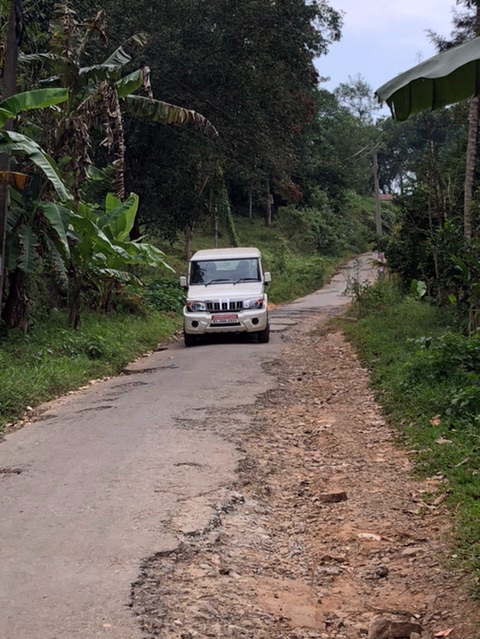
Abdul, our host, our twins’ age, who graciously took us on the worst road we’ve been on in India so we could have the day we wanted walking through quiet fields, unharrassed by tour guides or crowds, and was nonplussed when something important fell down from under his car after one particularly deep hole in the road. He found a piece of cardboard in the trunk and a tshirt and tied the cardboard under the car before happily climbing back into the driver’s seat and taking off. He explained one morning, with a chagrined smile, that his guesthouse, motorcycle, and junky car all belong to the bank – loans he hopes to pay off someday. A familiar cross-cultural story.

J.P., another host, perplexed that most days we just hung around the river behind the guesthouse or took the 8 km walk across the bridge, circling back through the small village. He never stopped asking eagerly if we wanted a tuk-tuk to go into Munnar each morning (we went 3 times during our two weeks there). He loved that he and I share a daily yoga practice and smiled with a small bow each time I came back in, though his own daily practice was long over (he does a half hour at 5 a.m.). When we left he gave us a brightly colored red and gold something or other (??) and said we would always be family. He’s since sent Whatsapp messages asking how our trip’s going and then wishing us a happy 2020.

Kavarappa maintains an art gallery on the third floor of his home on a sleepy residential road in Mysore. We found the Bharani Art Gallery online, hired a tuk-tuk to take us there, found the gate locked and no one around. Our driver called the number we found online and Kavarappa opened the gate and then the gallery for us. Some of the art was fascinating. My partner is contemplating buying a piece of Vedic art by a Finnish painter. Kavarappa then invited us into his home for coffee. The conversation was great and quite informative. He is Coorgi (Coorg is about 130 km from Mysore) and still has a coffee and pepper plantation there which, sadly, his two children will not take over from him. The way of things in India today.

The list goes on, but this post doesn’t.

One common denominator of travel buddy relationships is the desire of human beings to be really seen by other human beings. And it may be that reason that relationships are telescoped while traveling – because of their necessarily ephemeral nature.

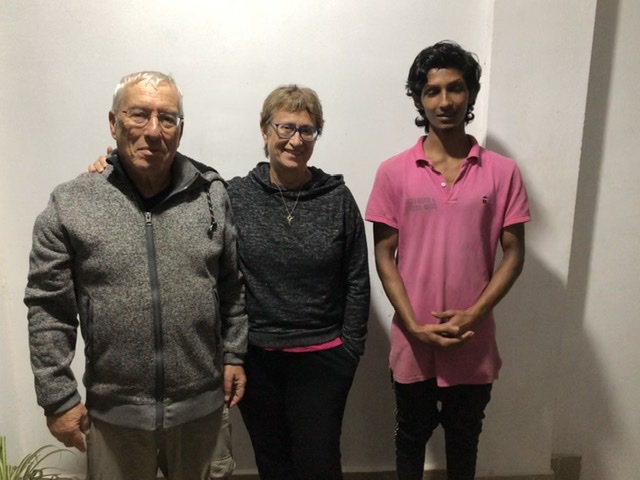
The very sweet young waiter, who served us dinner for 13 nights, spoke almost no English but summed it up far better than I can explain it when he said shyly, as we departed the rooftop restaurant for the last time,

“Please remember me.”

Munnar and Surroundings

Before coming to India, every time the topic of Kerala came up we heard about Munnar. I would have thought the town of 48,000 would be overflowing with foreign tourists. Not so. In fact, if we’ve seen more than twenty foreigners during our five weeks in Kerala, including Fort Kochi, Alleppey and the Munnar area, that’s saying a lot, and most were in Kochi.

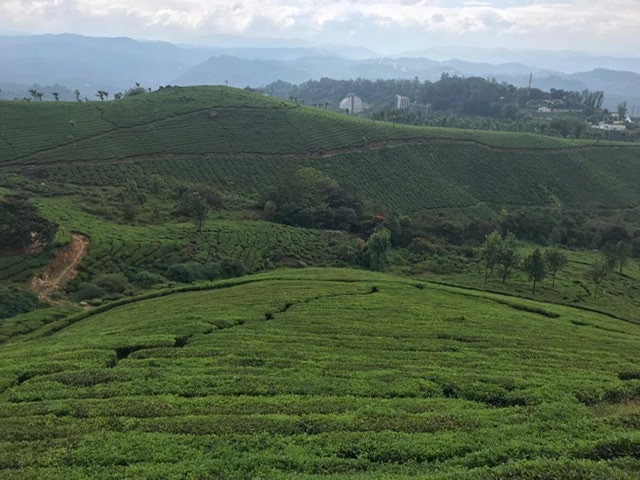
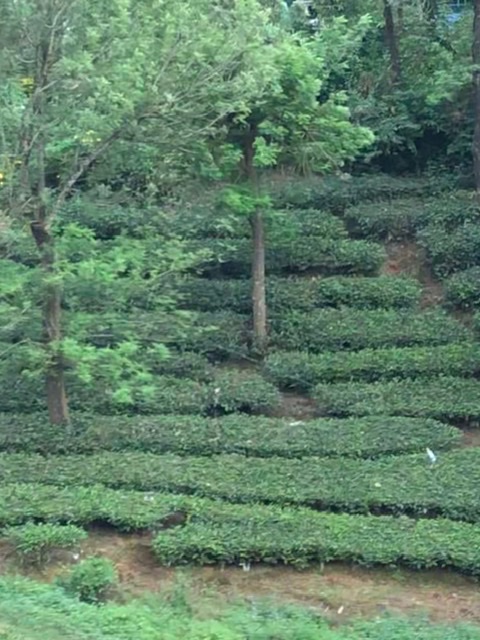
What we did see was lots and lots of tea plants. I fell in love with the quilted look of the hillsides with the orderly rows of bushy tea plants. I never tired of seeing how they cover the hills, in the shadow of the mountains with their wispy cloud cover. It never ceased to amaze me to think that every single one of those hundreds of thousands of tea plants is harvested, by either a small hand-held machine or, in the case of green and white teas, by hand. Incredible.  

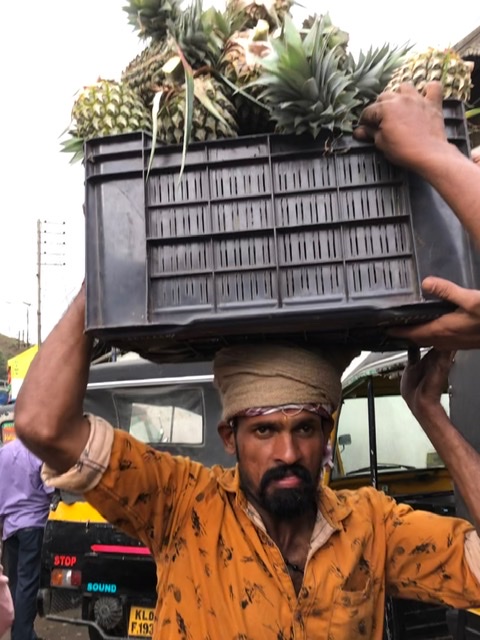
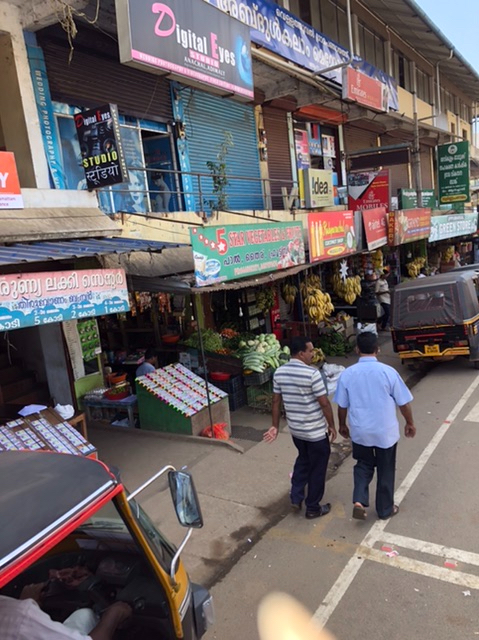
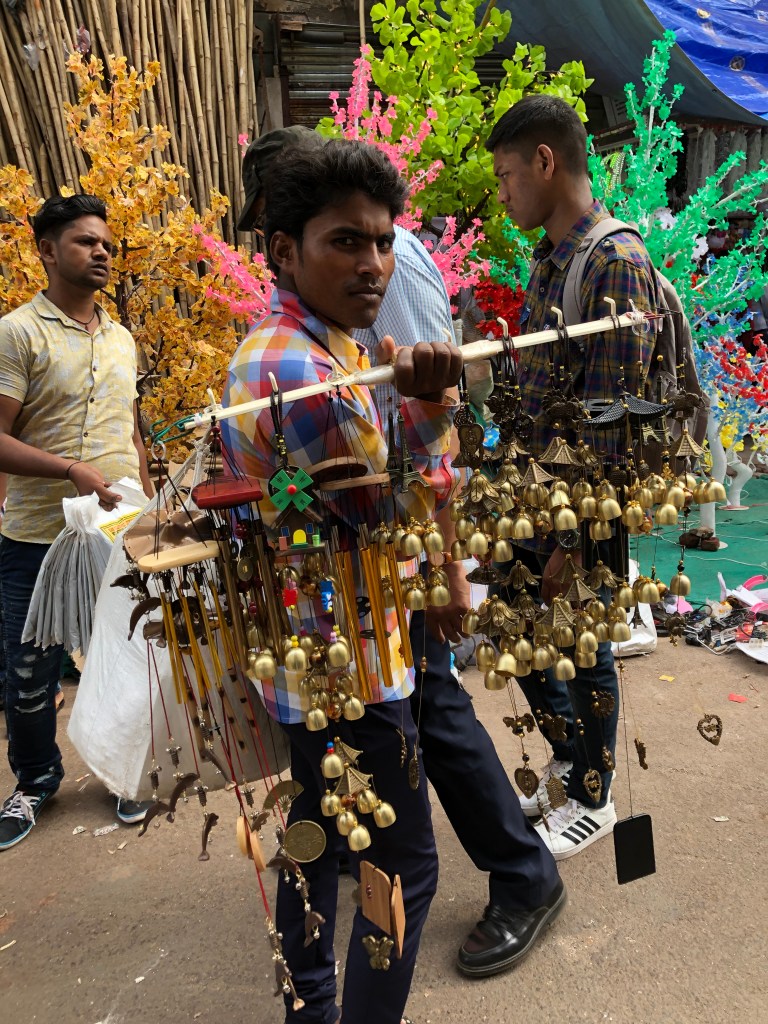
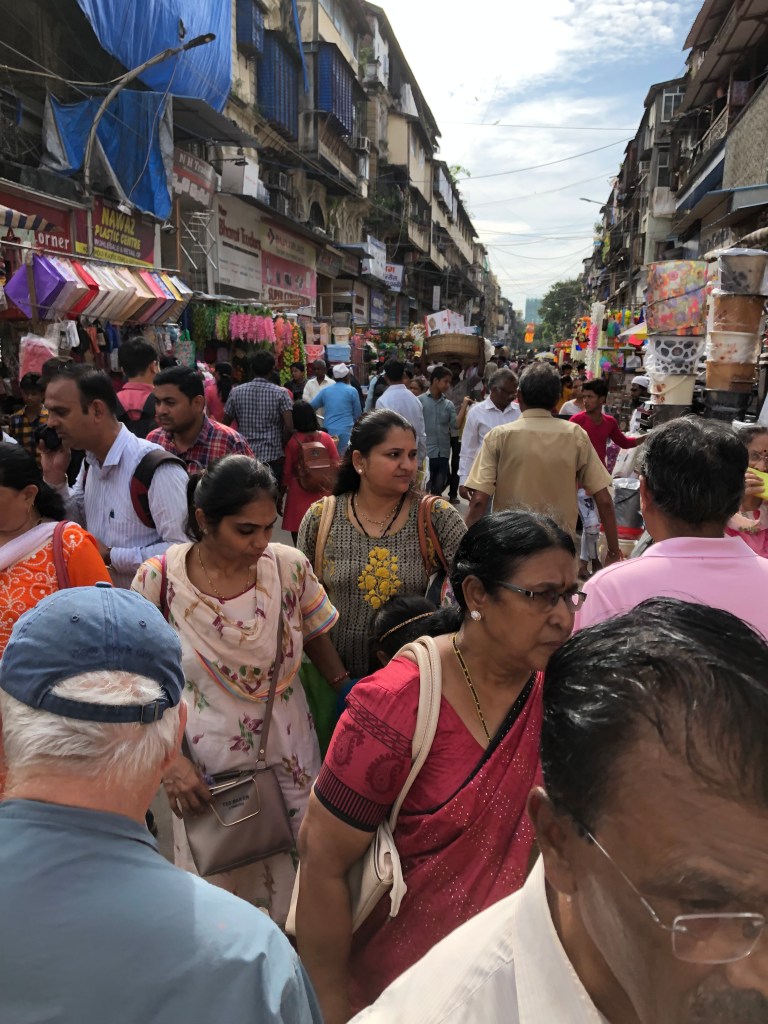
The town of Munnar itself is a bustling place with the usual tuk-tuks, motorcycles, trucks, buses, and cars. Many, if not most, pedestrians (and there are lots of them) dress in  traditional Kerala clothes: kurtas and sarees for the women, long and short wrapped skirts for the men. Some of the sarees look almost like wedding clothes with their silver or gold sparkles. Some of the men wear turbans made from orange terrycloth. Many of the women have painted foreheads; not with only a bindi spot but with lines that certainly signify something. I remain ignorant as to what significance each design represents.  

Mayalayam can be heard, as well as Hindi. As we’ve found in most of India, English is very rudimentary and often non-existent.

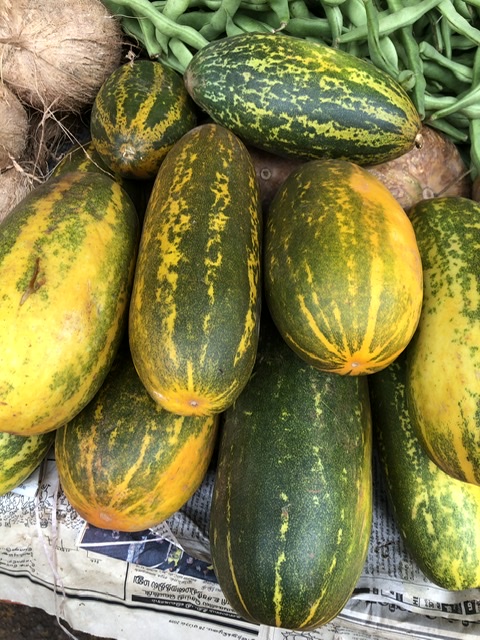
The shuk is divided into two distinct sections; fruits and  vegetables in one section and almost everything else in the other. Both are colorful, busy, and interesting places. Vendors are happy to explain their wares and solve some mysteries for us as far as the vegetables we find in our sambar and other South Indian dishes. 

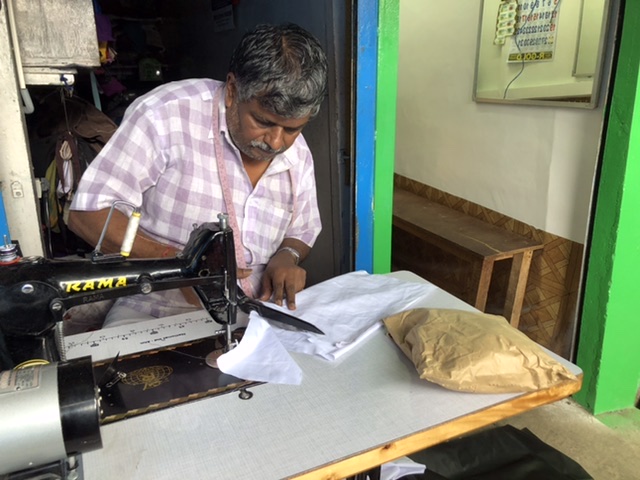
When we wanted to send two packages to the U.S. for my sisters’ birthdays, the post office clerk, after trying to explain the packaging we would need, caught up with us as we were on our way to purchase the box we thought he’d described. He walked us through narrow pathways in the back part of the produce shuk to a row of tailors. There he found one specific tailor who understood the process and sewed a cloth mail bag for the each of the gifts. I wrote the addresses directly on the sewn-closed, white bags, as instructed by the postal clerk. He then disappeared back through the secret byways of the shuk and we found our own way back to the post office.

On another visit to Munnar we went back to that tailor, who we miraculously found, and had him make another mail bag for a present for our daughter-in-law’s birthday, as well as sew the tears in the cheap cloth bag I’d been using ever since buying it in Mumbai two months earlier. By then his wife, who sits by him in her fancy saree, was our friend. She insisted we jump the long line (he’s a very popular tailor) and took a photo with me. She speaks only Tamil so we communicated with many smiles and a translator app from my phone, which was only sometimes decipherable for her. 

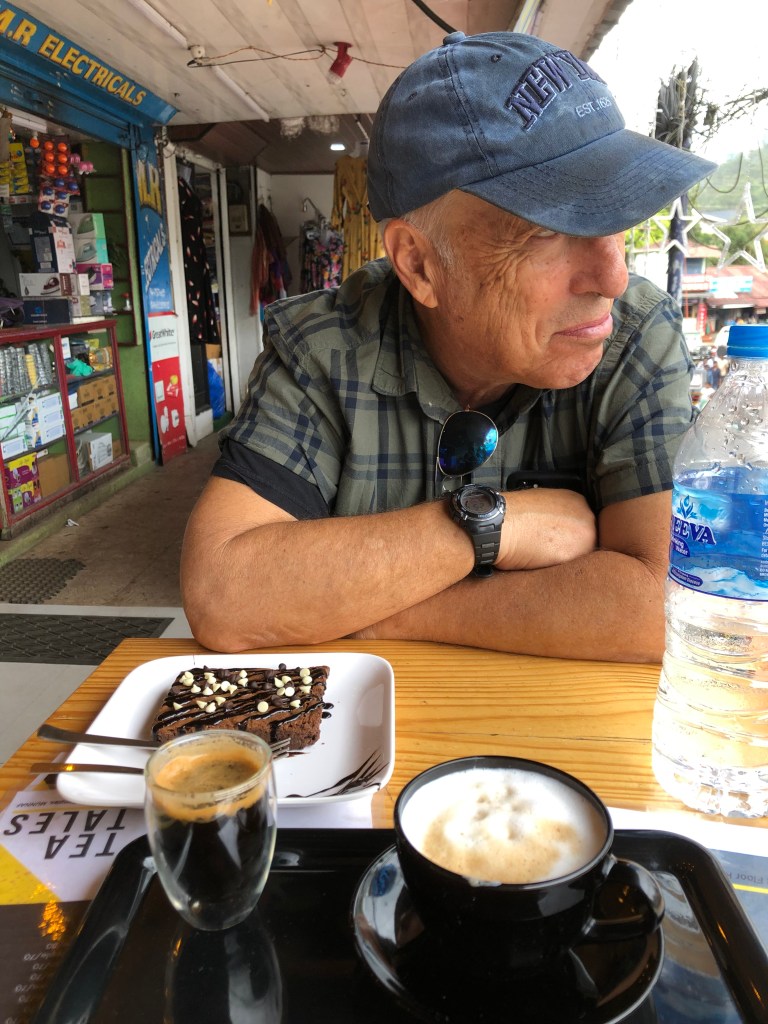
It’s hard to explain why we both liked Munnar so much. It may have been the shuk and our tailor friends. It may have been the amazingly wonderful pure veg restaurant we ate at each of the three times we visited the town (Saravana Bhavan – try it!). It may have been the first good cup of coffee we had in two months at the Tea Tales upstairs coffee and tea shop. It may have been the glorious drive thereף from our quiet river stay forty minutes away, curving around mountains, past glorious tea plantations. It may have been a combination of all those things. 

Munnar town is locked into our hearts’ memories as one of our favorites.

We also visited the Lockheart Tea Factory, where we thoroughly enjoyed the Tea Trail Tour. Go on Monday when they pick the green and white teas by hand. Arrive before 13:00 so you can actually see the tea pluckers at work. Take a tuk-tuk there on your own. No need to go with an organized group or guide. 

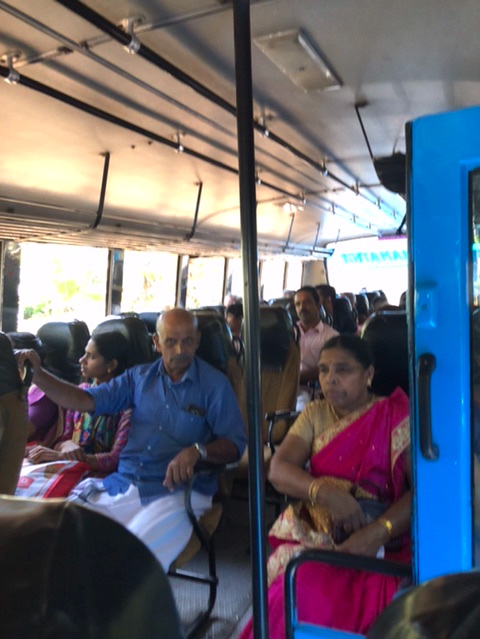
We took a local bus, a kilometer and a half walk from our Homestay, to Adimali – a commercial, industrial city and not particularly interesting – and to Anachal – a pleasant town with an amusement park. The adventure of taking a local bus was fun. If you want the experience of a local bus, better to do it in  a pleasant, rural setting where the buses are less crowded. Personally, I wouldn’t subject myself to it in any of the cities we’ve visited, where people hang off the roof and the door handles.  

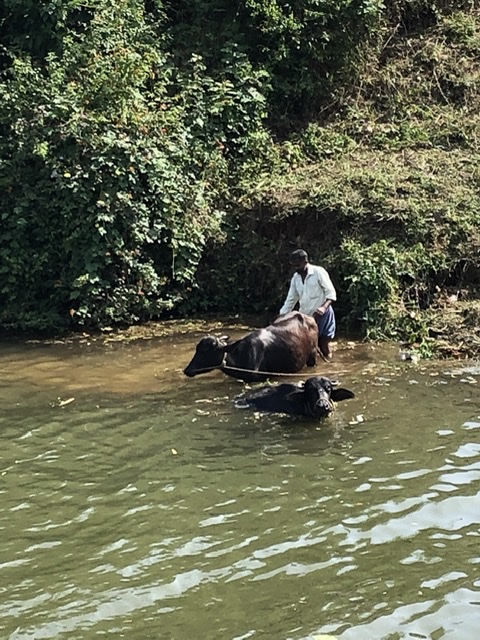
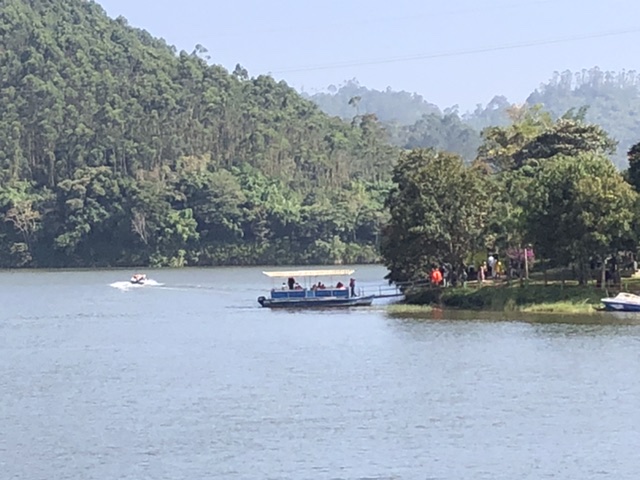
We stopped off at Sengulam Dam. A lovely lake with speed boating and quieter river boating available. A nice, unplanned attraction there was watching a farmer bathe his water buffalo in the lake. 

A word about our Homestay. 

Most tourists in the area are Indian tourists on their way somewhere else. They stay a night or two at most. We planned almost two weeks in the area as a peaceful place to wander around in nature, write, read, do yoga and meditate. That’s how we arrived at our choice of Ayursakthi Riverdale Resort. 

Just as a ‘hotel’ is often a restaurant in Kerala towns, ‘resort’ in this case is actually ‘homestay’, an all-encompassing term for anything from a 2-star hotel to a b&b. I doubt they’ve EVER had someone stay for two weeks. Just as it took us a couple of days to acclimate to the sleepy peacefulness of absolutely nothing to do, it took them a few days to realize that we didn’t expect entertainment. 

The room smelled a bit of camphor, but we got used to it. The bed was comfy, the fan was sufficient, the shower had plenty of hot water if we turned it on for five minutes before getting under the stream, the breakfast was tasty, and, as in every Indian lodging we’ve ever been in, the staff was extremely nice. 

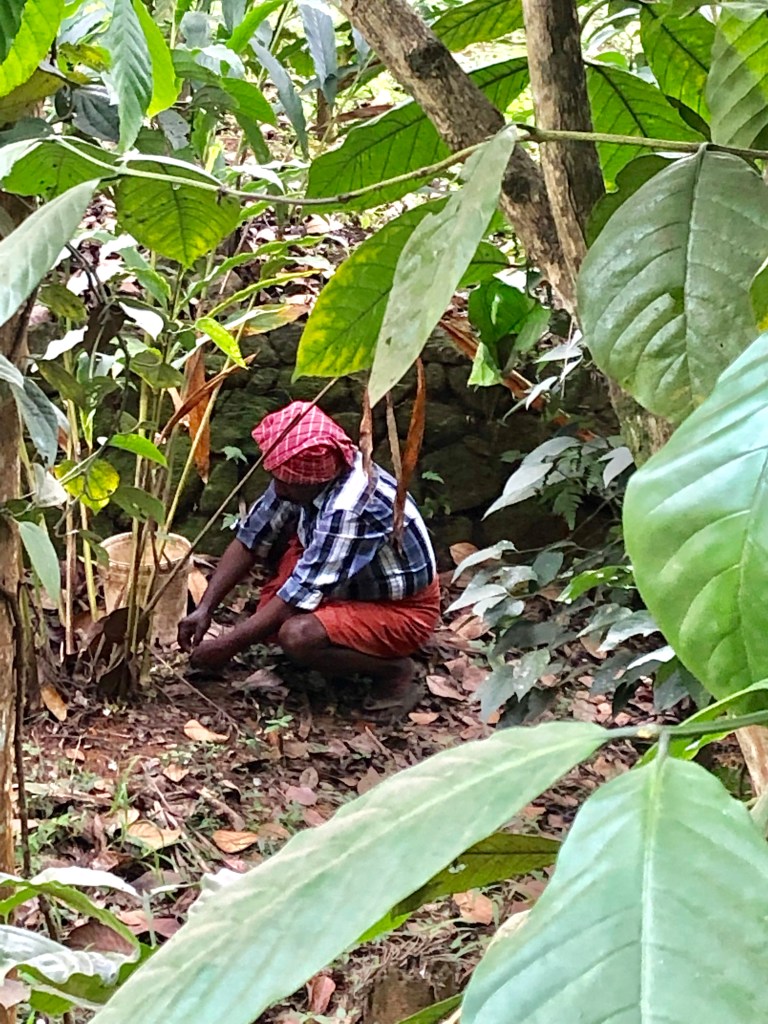
The smiling, shy woman who cooked breakfast and cleaned the rooms, brought us fresh passion fruit from the trees in her home garden, and let me watch her make sambar one morning, complete with photos, so I could replicate her particular recipe  at home.

One young man on staff invited us to rousing games of badminton in the back yard with his very respectful, nice friends.

They were all a bit perplexed by us but caring and amenable to any and every eccentricity.

The restaurant next door was a convenient place for dinner with a fairly varied menu. We don’t eat meat but were able to find different things to eat most nights. Feel free to eat their fish dishes and fresh salads. All is safe for foreign tourists and very tasty.  The paneer paratha was especially good.
Serenity of nature with the friendly town of Munnar just a short beautiful tuk-tuk ride away. A bit sad, but ready, to move on,

Let Them Drink Tea

Yesterday was a travel day. Yep, we ventured out of our little piece of heaven. Traveled forty minutes on the sometimes barely existent road in a tuk-tuk to Munnar – the big city in these parts – town of 38,000 inhabitants.

Our plan for the day was to check out Munnar and then go on a TripAdvisor tour called The Tea Trail which included a visit to the Lockheart Tea Museum and Tea Factory as well as a visit with the tea pluckers as they’re called, and the chance to pluck some tea and follow it through until it turned into a cup of tea. We should’ve been suspicious right away since, the tea process being what it is, there’s no way our freshly picked tea leaves could turn into a cup of tea within an hour.

But all in good time.

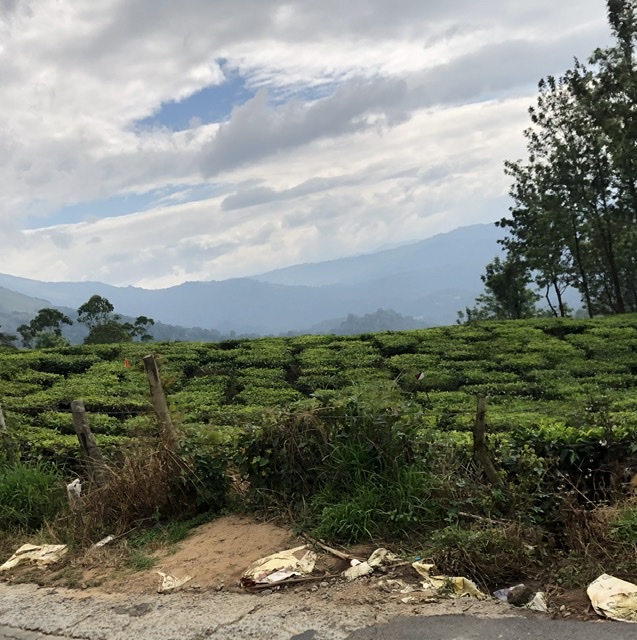
The twisty, uphill road into Munnar, aside from being narrow and deeply rutted at least half the time, was breathtaking not only because of the near-collisions but also the fantastic views of the tea, which grows all over the place in extremely well-ordered glory, under a dramatic sky with clouds wisping around and in front of mountain peaks.

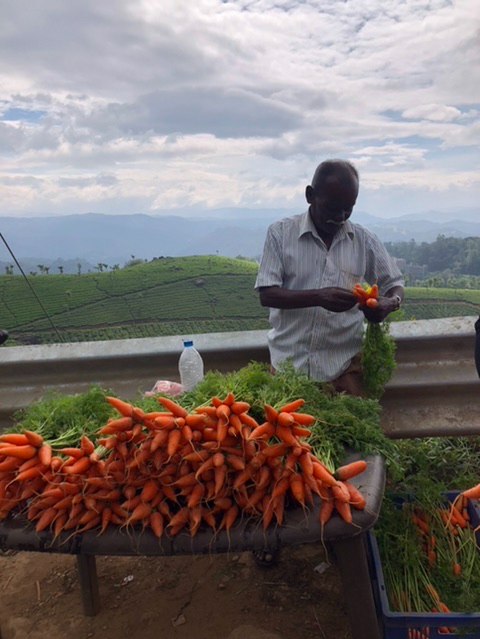
And then, suddenly, and for no apparent reason, there was this.


Why carrots? Who knows. But they were incredibly fresh and their color was the brightest I’ve ever seen. Tempting to buy but we had nothing imaginable to do with them so we sadly gave them a pass.

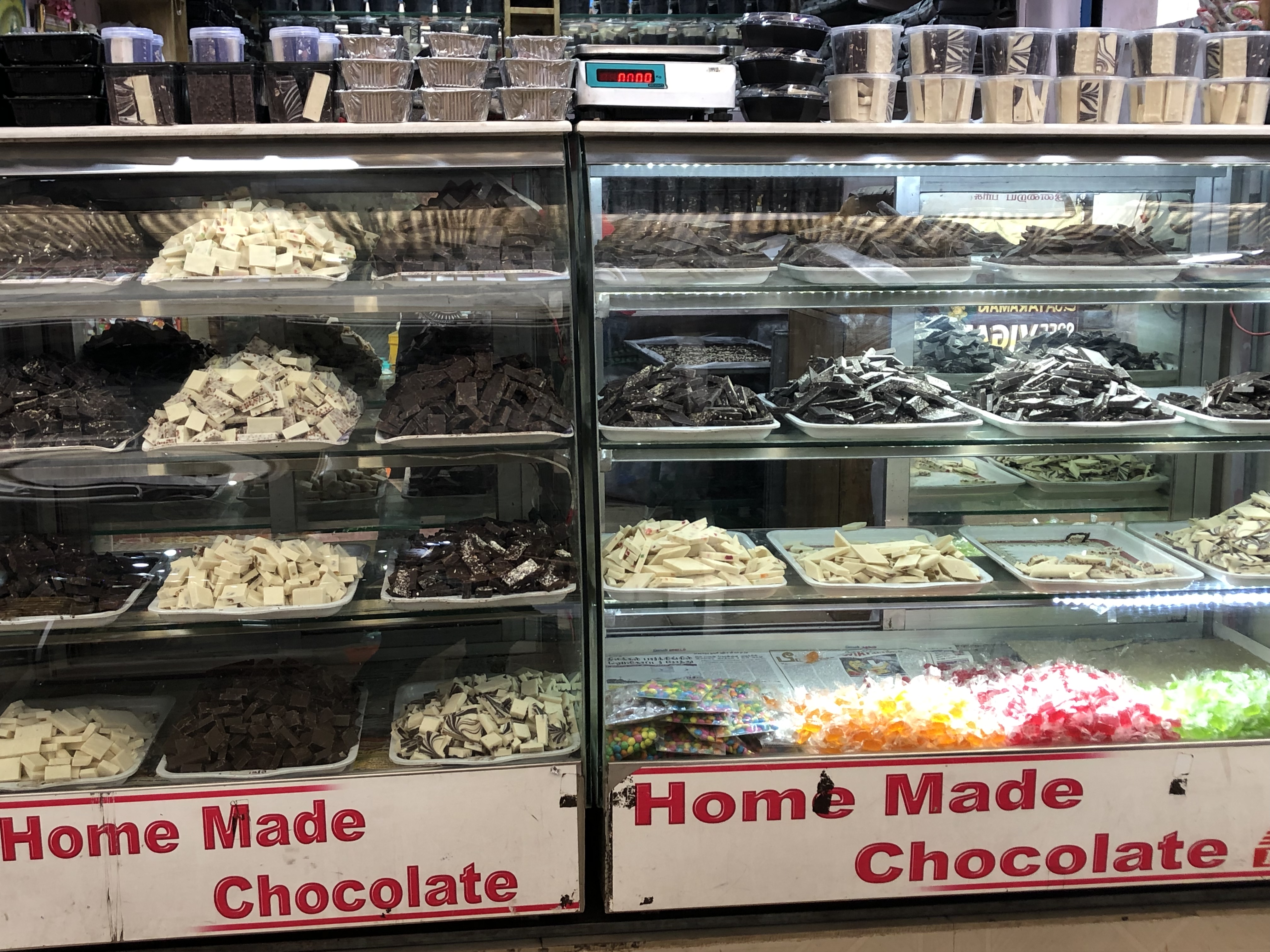
After a discussion about our finances just days ago, we’d decided to be more cautious with our spending (read“my” for “our” and “I” for “we”). But within minutes I’d bought handmade chocolates for one sister’s upcoming birthday and a mini-kurta and smaller box of chocolates for the other. This necessitated our third post office experience – the oddest and funniest yet. But that will appear in a much later post with tips for the traveler to India.

There’s a saying that everyone you meet is your teacher. Way back in Mumbai we had a young man guide us through the Mumbai markets. He was sweet  but not much of a guide. We didn’t learn anything about Mumbai markets but we did learn little tips for getting along in India. One of the most useful of his instructions concerned bargaining – always start with an offer of 1/3 the asking price. Sounds insulting but it’s right on the mark. You get a feeling when the seller is finished and really won’t go lower. The final price will be 1/2 to 2/3 of the original price and everyone will be happy.

Our tuk-tuk driver from Munnar to the pick-up point for the tour started at 300 rupee ($4) and ended up taking us for 200. It was a 25-minute drive similar to the one from Ayursakthi Riverdale to Munnar – bumpy, with hairpin turns. He dropped us off at 14:10 for our 14:30 tour. It was a beautiful location overlooking the tea fields. We’d brought warmer clothes so the chilly mountain air didn’t lessen our enjoyment of the luscious green surrounding us.

At 14:40 there was still no sign of our guide/car and TripAdvisor wasn’t answering emails so we began walking the 500 meters downhill to the Lockheart Tea Museum through the enchanting (enchanted?) Eucalyptus tree forest.

My partner’s knee had started giving him grief in the morning. Downhill aggravated his discomfort more than uphill. He’s very fit – a gym fanatic – and definitely not a complainer, but at some point I waved down a tuk-tuk to take us the rest of the way, fuming at TripAdvisor and planning my scathing review of the tour we’d paid for.

At the museum and factory there was still no sign of TripAdvisor other than their stickers all over the place. The cashier spoke no English but the word TripAdvisor gained us free entry. We bumbled along on our own in the amusing museum with its silly relics – like ‘an English bathtub’ and a rusty old iron – and fascinating photos. Once again we found ourselves wondering about British rule. Every photo showed a work crew or social group with at least 15 Indians to every Brit. How in the world did they control India for 300 years?

As we sat at a picnic bunch overlooking the plantation, pondering the lovely view, TripAdvisor and other questions, a woman came running over and asked if we were with the French group. We said ‘no’ and once again tried to explain that we were a TripAdvisor ‘group’. She turned a puzzled face to ours.

No  French. No TripAdvisor. No worries. She herded us to the factory entrance where a pleasant man with excellent English said he’d been told we’d arrive at 10 (Eureka!), which was later corrected to 13:00, but happily agreed to guide us through the factory if we would just put on little blue crime-scene booties.

The tour was very interesting. Who knew?

Turns out that all tea – black, green, and white – (white?!) – Orange Pekoe, Earl Gray and Chai – is made from the same tea plants. Black tea is made from the lower leaves, green tea from the top two leaves only, and white from the lone bud between the top two leaves.

Black tea is more processed, going through three drying stages, one of which lasts either 30, 60 or 90 minutes, a heating process, and one of three grinding options. Green tea is processed far less and white tea is barely processed at all.

Black tea is ground fine, finer or even finer, while green and white tea are not ground at all.

Finally, the death blow to my teabag drinking days, we saw that black tea, in its final stages, is separated out by color-sensitive  cameras into leaves, stems and fiber. Some tea is packaged with only tea leaves while other are packaged with a mixture of leaves, stems and fibers. It’s the second kind that goes into teabags.

Ugh!

The stems have no flavor but add color. The fiber adds bulk. The first is labeled ‘Orthodox’ tea and the second is ‘CTC’ tea. I never noticed that on boxes of tea but I’ll be looking for it.

When we had a tea tasting experience at the end of our tour we could definitely discern the difference. The CTC tea had a very  bitter aftertaste and the taste in general was less pleasing. Sadly, the white tea, which is coveted, has the most health benefits, and is very expensive, was flavorless. 

On to the fields where we were too late to meet the all-female tea pluckers. Yes, that’s what they’re called, though it may be a translation from some other language.

Turns out you have to arrive by 13:00 to actually meet those plucky women who are paid the equivalent of $5.65/day to pick 27 kilo of black tea with machines or 400 grams of green or white tea by hand. Pick less than 27 kilo and the per kilo rate drops. Oddly enough, a lower per kilo rate is paid for every kilo over 27, also. Go figure.

Pluckers who are permanent employees are given free lodging but we couldn’t figure out why some workers are eligible while others are not.

22.4 million tons of tea are bought annually in the world. That’s one heckuva lot of tea. China is first in the world of tea production with India a solid second and many other countries, like Sri Lanka, trailing behind.

The Lockheart Tea Factory sells tea to Twinings, Tetley and other tea brands. We might be able to see their export name, Harrison, on some boxes. I’ll be looking for that, too.

The lovely woman who accompanied us in the tea fields lives seven kilometers from the factory. She takes a short cut through the forest, which reminded us of the children we saw in Peru walking home from school up into the mountains. She laughed when we exclaimed at her daily journey saying that she’s still fat. While I found her pleasingly rounded, I wouldn’t have called her fat. Indians don’t find that a derogatory term, though, and use it freely about themselves and others. 

She kindly arranged a tuk-tuk to come get us, realizing that my partner’s knee was bothering him. She negotiated a price and we were off. The young driver was truly a maniac on the road, even more than usual, but we negotiated with his sweet brother (picked up along the way) a good price to wait for us while we ate dinner and then drive us back to Ayursakthi Riverdale.

Weighed our options ⚖️ – possible death on the road, good price, possibility that none of the other many many tuk-tuk drivers would be willing to risk life and limb on that road at night – and confirmed the deal.

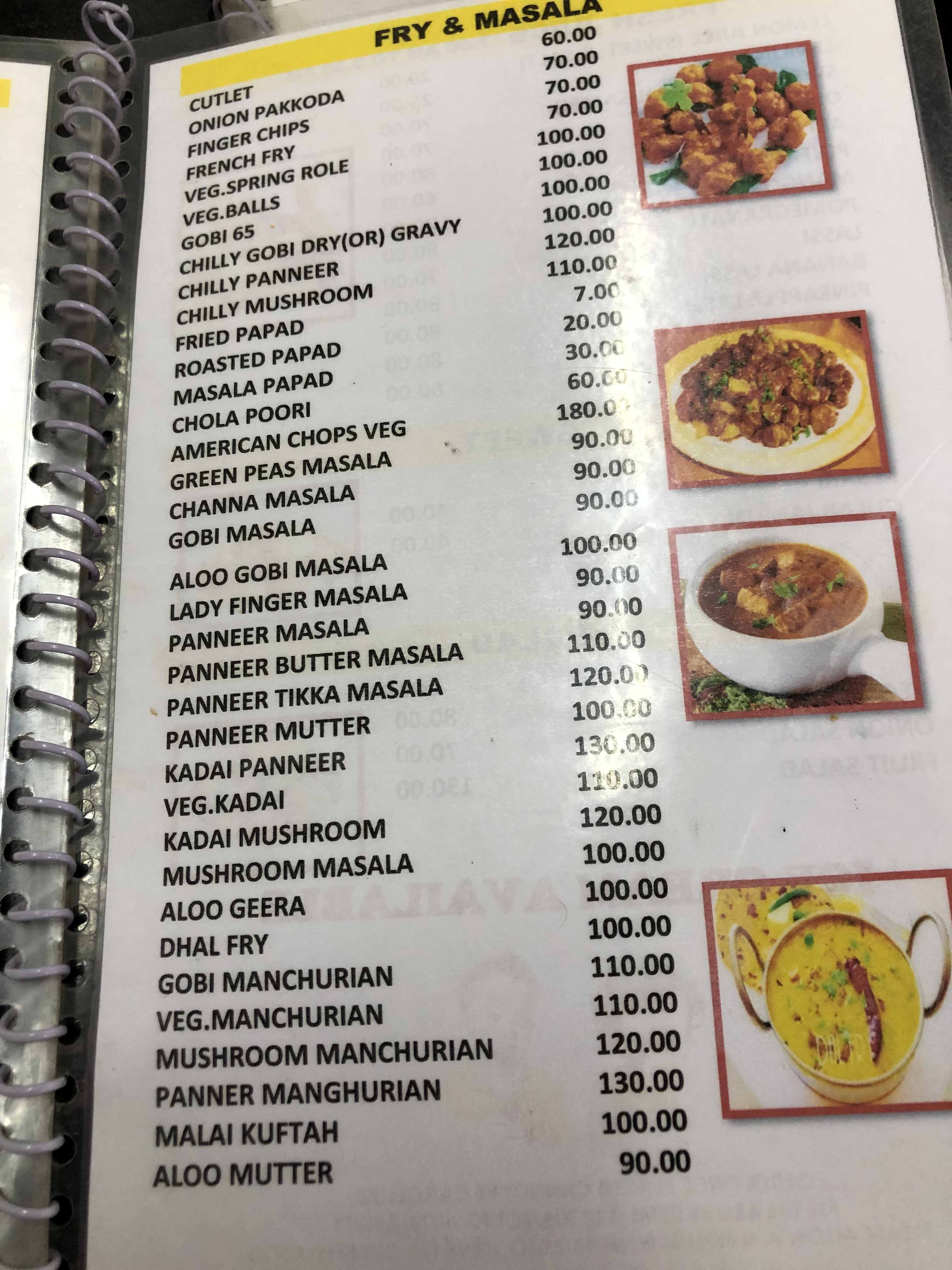
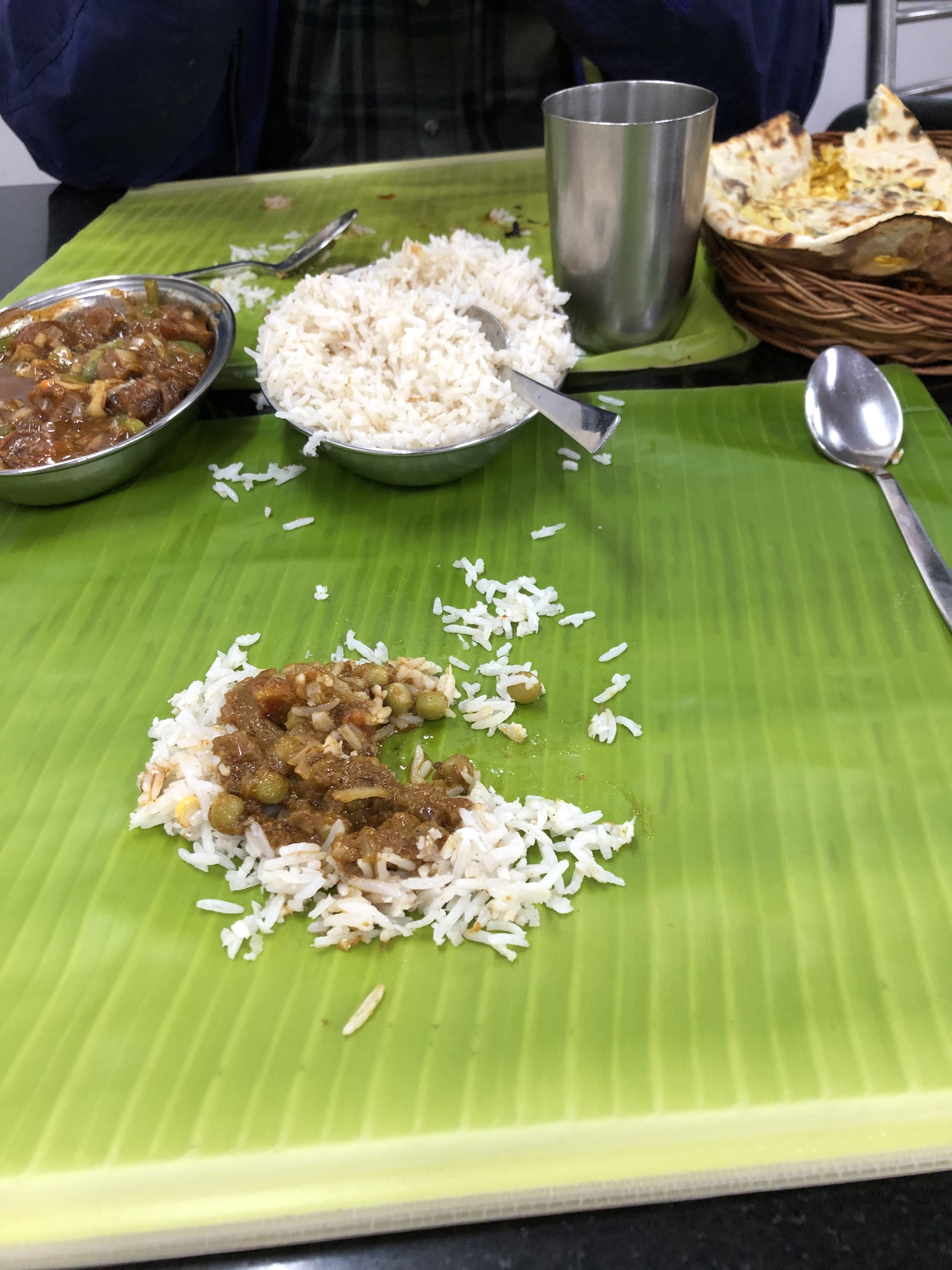
He took us to a pure veg restaurant where we had what was very possibly our best meal yet. Manchurian Mushroom, Green Pea Masala, Coconut Rice, Garlic Naan, Coffee and the best Masala Chai I’ve had so far – all for a total of about $6.50. Our dinner was served on big banana leaves.

No forks in sight.

Indians eat with their hands – actually one hand;their right – which is why only foreign tourists get forks in many restaurants and why there’s a sink or two in the restaurant. Washing one’s right hand is essential after the meal. Before the meal is optional.

Some foreign tourists emulate the eating with the hands thing. I have to admit, I don’t get it. Adopting customs that are pretty, like wearing a kurta, or practical, like the Indian version of the bidet, is nice. Using a banana leaf instead of a plate is genius. Roll it up & throw it out after dinner. No dishes to wash! But foregoing forks? Really? A bit silly, imo.

Lessons learned from our Munnar Tea Outing:

1. It only takes 3 minutes to steep tea leaves and is well worth the wait.

2. The Lockheart tea trail tour is great! Do it! But it’s done just fine without the commission  to TripAdvisor and the added hassle of trying to hook up with them. Go on Monday – the only day the manual plucking of green and white tea is done. Get there before 13;00.

3. Pure veg restaurants probably prepare better veg meals than restaurants that provide veg and non-veg options.

4. Locals know the better restaurant choices. Ask them.

But what about the family?

This trip started out as one of those ‘round the world’ tickets where you have to keep traveling in one direction – east or west – and can’t cross any specific ocean more than once. I must’ve played with that planning tool on the Star Alliance site for twenty hours or more over the course of several months.

Tel Aviv – St. Petersburg – Mumbai – all over India – China – Bora Bora – Alaska – Oregon Coast – California – Salt Lake City – Mount Rushmore – The Badlands – New Mexico – San Antonio – Fort Lauderdale – New York City – Toronto – The Bay of Fundy/Nova Scotia – Iceland – Tel Aviv

Juggling weather, direction, time.

How much is too ambitious? Australia, yes or no?

Should we rent an RV to travel around the US? A car with motel stays? Flights for the long bits?

But then the time came to make real decisions like renting out the house for the year and what to do with my yoga studio and my husband started hemming and hawing. There were hesitant chords of concern about leaving our lives for so long. I tried to ignore them. Gloss over them. Treat them like background noise.

A year. Twelve months.

I had to admit to myself that it was sounding like a really REALLY long time to me, too.

The house wasn’t the problem. Neither was the studio. Though I love both.

It was the kids, the grandkids, and the friends who have become no less our family in the 30+ years that we’ve shared a life.

So twelve months became ten months became six months and here we are with the second month of our six-month trip drawing to a close.

In this technological era, it’s pretty easy to keep in touch with people. We share our amazing surroundings and the interesting people who inhabit them with a WhatsApp group for our English-speaking friends daily. We post on FaceBook for our Hebrew-speaking friends or send separate WhatsApps or emails. We send messages to our family WhatsApp group, too, and keep in touch with them with video WhatsApp weekly when we can find a strong enough WiFi connection, or with audio WhatsApp when we can’t.

We spoke with our youngest son and his wife yesterday from an isolated snack food kiosk in the jungle as they drove home from an office party in Silicon Valley, California.

We remember the days, not too long ago, when we sat in Internet Cafes, paying for the internet per minute and waiting endlessly for the atrociously weak and slow connection. Then there was Ko Mak, an island in Thailand, where we had to hike an hour to the other side of the island daily for the only internet connection because I had left Israel in the middle of interviewing candidates for a position and had to go over resumes.

Earlier there just was no internet – impossible for our grandchildren to envision – so we made the occasional phone call when we could.

It seems that most of the important people in our lives are healthy and major crisis-free so far during this trip.

Before we left we knew that one friend was scheduled to have a small, probably cancerous, tumor removed from her kidney, and after we left we received the good news that all had gone well with her surgery.

One granddaughter had an ugly eye infection that seemed to linger endlessly. Endlessly finally came to an end after way too long a time for my taste. Her swollen-closed eye then returned to normal.

The worst of it so far has been a shocking but benign head tumor with sudden, unexpected, surgery that’s meant weeks of rehab for a neighbor who’s like a younger sister to me. That was a tough one because I knew that my presence could’ve been important for her morale, but, thankfully, her recovery seems to be going well.

Life is full of surprises – big and small; pleasant, unpleasant and neutral – and they don’t cease when we’re far away from our usual haunts.

So here’s the deal.

Relationships with people are one of the most important ingredients in the tasty soup of life. There’s our relationship with ourselves; our inner world. The one we take with us wherever we go, whether it’s to the living room or to India. Then there are all the others.

The ones we choose; the ones we’re born into; the ones we birth; the ones we marry into; the ones we grow into because of circumstances; the ones who are part of the landscape of our lives.

There are even relationships we’re semi-unaware of until they’re brought to our attention.

There are close relationships and casual relationships. There are close relationships that become casual sometimes and casual relationships that become close at others.

There are relationships that take us by surprise and relationships like old slippers – comfy and constant.

But there’s one reality of important relationships that my husband has pointed out to me many times – they have a past, a present and a future. If one of those elements is missing, the relationship is a like the one with that second grade teacher you had in elementary school. She may have been one of the most significant people in your life when your were seven but she’s only a fond memory today.

Anyone who knows me knows that I’m a relentless technological freak. I love the newest, the most creative, the most surprising new concept, gadget or app. I’m that person that buys the out-of-the-box FaceBook solution for neck tension and was one of the first to contract out administrative projects to freelancers online fifteen years ago. I never give up communicating with people in the Mayalayam spoken and written on my translation app in spite of dozens of puzzled expressions. I trust Uber and Waze and UpWork.

I prefer email and WhatsApp to phone calls or personal business meetings. If you WhatsApp me, chances are you’ll get an immediate reply sixteen or seventeen hours out of twenty-four, even from the tropical jungle of Kerala.

And yet.

I’ve learned to embrace another reality about relationships.

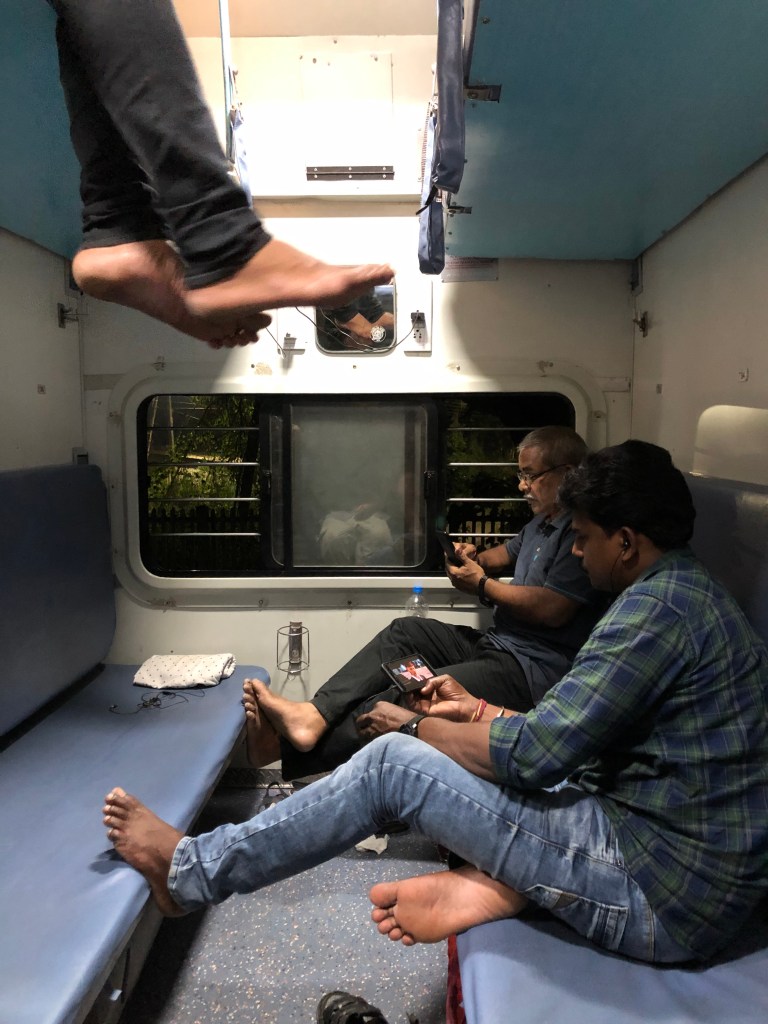
The important ones cannot, ultimately, be sustained with technology. They can be maintained temporarily in a loving electronic space when watered sufficiently – pardon the mixed metaphor – but they will eventually rise from the lower berth to the 3rd tier berth of relationships and become your second grade teacher.

It’s true of best friends, of sisters, of kids, and probably most of all of grandkids, who have the disadvantage of being too young to have solidified any relationship enough to withstand the loss of perpetual physical proximity.

I love to travel. Someday I may not be able, physically, to climb into a train berth or even get on a plane to travel to another exotic location, but I’m guessing I’ll become an armchair traveler. Meanwhile, I look forward to the next four months in India, a week in Greece with my daughter and granddaughter in July, and am already planning to rent a little place for three months in Guatemala next winter.

But I won’t be fiddling with that ‘round the world’ Star Alliance again in anticipation of a year of travel. I have a feeling that I won’t even be looking at six months again. I’m so happy that we grabbed the opportunity to take this incredible journey. I’m seriously enjoying every single day.

While I tend to feel ageless, I am aging. But that’s not the thing. It’s not fun to do many things I used to have fun doing but I’ve barely noticed that I’ve stopped doing them. I’ve moved on to things I may have once thought slow or unexciting and get a huge kick out them now.

The thing is that all the people I love are aging. Yep, even Alex, our youngest grandchild. And certainly our family-like-friends who have almost seventy years on her.

I want to be IN those important relationships. I don’t want a single one of them to become my second grade teacher and I don’t want to be theirs.

I’m so grateful that I’ve birthed, married into, grown into, chosen, and been brought by circumstances into relationships with multi-faceted, quirky, wonderful people whom I love and, wonder of wonders, love me back.

One of the best things about my life is that I’m fortunate enough to live in time that I can nourish both my love of travel and my love of relationship, if I can only remember to balance them and adjust to the times. After all, I could’ve been born under a bridge in Mumbai.

Happy Monday to all from 20 kilometers from the middle of nowhere.

Of Beaches, Lakes and Rivers

The word ‘traveling’ has nine letters and just as many aspects to the activity the word describes. There’s the actual mode of transportation involved which can fill hours, days, or even weeks,

seeing the sights, experimenting with new food, learning about new cultures, seeking spirituality, discovering history, embracing nature, deepening your understanding of yourself, your travel partner, and your relationships with both, opening your heart, your mind…YOUR EYES.

As the husband of my cooking teacher, who spent years on the sea as the captain of a commercial vessel, told me, “Life is like a book. Those who don’t travel are always reading the same page.”
At the risk of offending all too many of you, I have to admit to agreeing with that statement to some extent, but will rein in my judgey side a bit and add that there’s plenty to learn from our everyday lives in our very own homes, too. We just have to do it. Harder than it sounds.

But that’s another story.

I could write an entire blog – or three – on each aspect of traveling, and might do just that, but this one is about an epiphany I’ve had as I’ve moved from my western, Israeli, specifically ideology-driven, life, to crowded Diwali Mumbai, the vast sandy beaches of Goa, the serene backwaters near Alleppey and now to the hill station, tropical green mountain area near Munnar.

I get into the vibrancy of the city-even Diwali Mumbai with all the millions- the constant movement, lights, traffic, endless options and continual visceral stimulation. There seems to be no limit to the number of shops I enjoy entering. I’m happy walking for hours down busy streets, wandering through museums – both conventional and quirky – waiting in winding snake lines of multitudes of people to see the most touristy of sights or hop on the boat, tuk-tuk, or train at the end of the crowd. I have no problem with getting lost for a while or not understanding or being able to make myself understood. It all works out in the end.

I’m attracted to drama, and there’s plenty of that to be observed in the city. Participation voluntary. For the most part.

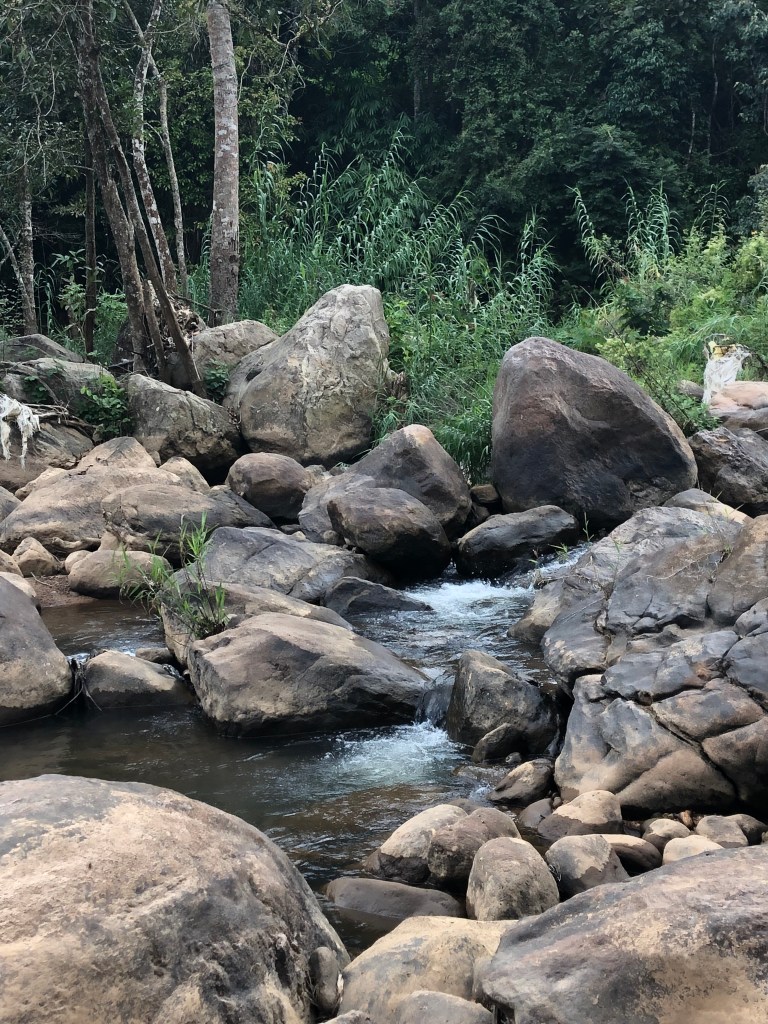
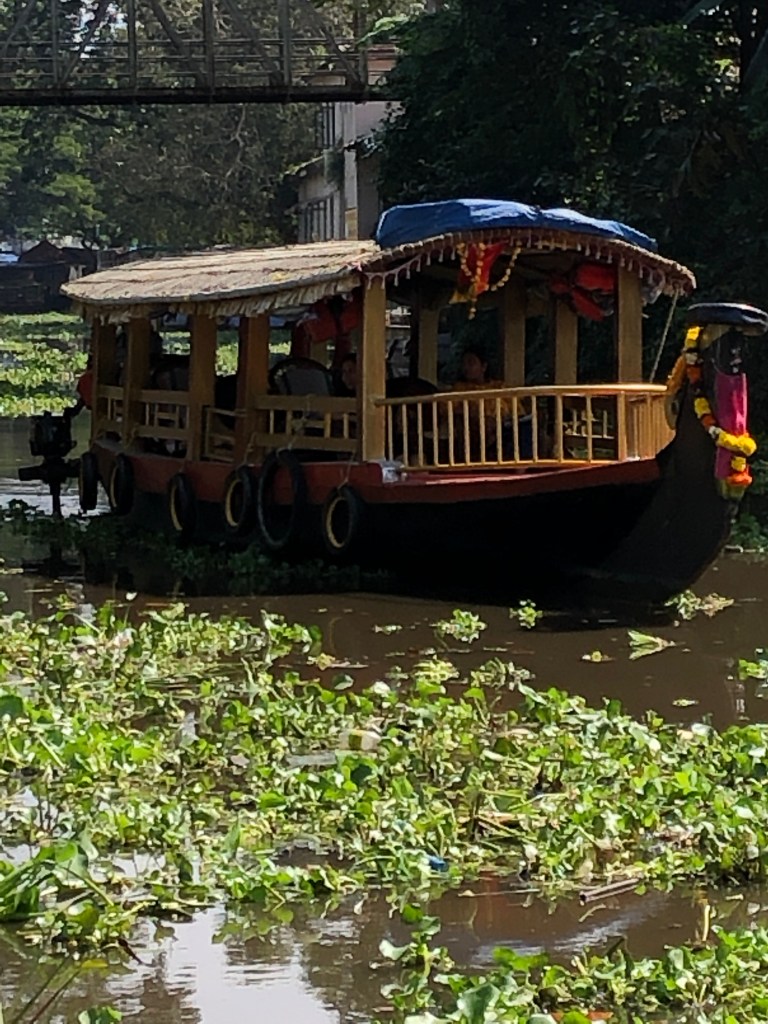
Over the past eight weeks we’ve gradually made the transition inland. From waves crashing onto the rock barrier thirty meters from our balcony and dolphins playing twenty meters beyond that, to the gurgling stream just outside our backyard tropical mountain surroundings. We were somewhat prepared by the serenity of Kerala’s backwaters, running alongside the noisy towns of Alleppey, Ernakulum and Fort Kochi, as well as the steadily deteriorating road between Kochi and Pallivasal near Munnar but nothing can really prepare you for the quiet here.

Being isolated in nature is something that has to be experienced.

We made a conscious decision to settle into our new environment and let it settle into us. No martial arts performance yet. No trip into the town of Munnar. No tea plantation or spice garden tour. Just nature and quiet and us.

It took 24-hours for the monkey chatter to subside.

My yoga practice has been evolving…getting better and better.

I experienced a meditation so deep two days ago that it scared me a bit. The pang of fear brought me to the surface so fast I thought I’d get whiplash. Fear of what? Who knows.

Yesterday’s yoga, just before dusk, was the best yet. Fluid. Soothing and refreshing simultaneously.

At one point I felt I wanted to continue forever.

And then it was just the right moment to finish.

There’s such an awareness of productivity – accomplishing things – in the city.

There’s more an awareness of being out here.

Is there a productiveness in being? Can there be?

Since getting more involved in Eastern Philosophy, yoga and meditation, I find that there’s far less drama in my relationship with the people I love. I’ve integrated the concept of non-grasping without really making an effort to do so. It’s just happened with all the reading, thinking and practice of the past two decades. I worried that it was too much. That I’d become too detached from the lives and challenges of the people I love.

He asked me to close my eyes and try to take myself back to the time when there was more drama and intensity in my relationships. It took a minute of my precious 15 minutes with him but I was able to do it.

Then he asked me to return to a more recent time, with less drama in my relationships and, after a minute or two, asked what I felt in those moments as opposed to the previous ones.

I didn’t have to answer out loud. I opened my eyes to the answering smile on his face.

I love the city. I love the satisfaction of completing many, many tasks during the day. Love noise and crowds and shops and movement.

My body and soul are nourished by nature, by being, by deep silence.

Shabbat Shalom – Peace to us all.

The Quality of Sleep

Some people get into bed at night, fall asleep immediately, and wake up in the morning refreshed.

My husband is one of those lucky people.

We have good friends who go to sleep relatively early and sleep until 10 a.m. if their schedules permit.

I’m not one of those people.

I’ve always been a night person. I’m happy and productive until well after midnight. Two a.m. is the witching hour for me – that hour that marks the border between being able to function well the next day and resigning myself to a zombie day. I’ve trained myself to get into bed by midnight in order to rise at 7 and join my partner for the breakfast he pampers me with, once I smell the wafting scent of coffee.

I no longer fight my inability to fall asleep quickly. Over the years I’ve accepted that resting with my eyes closed during those minutes or hours that I wake up in darkness, dawn far away, can replenish my body, instead of bringing the frustration and monkey mind of trying to bully my way into sleep.

Every now and then – sometimes even once a week – I have nights with virtually no sleep. Those nights are still difficult. I have a bag of tricks that includes breathing techniques and imagery, yoga nidra and other relaxation strategies, but there are nights that nothing brings sleep or rest. I might end up taking half a sleeping pill – that always works – or deciding that the next day will be a lost day. Either is okay; neither is good.

India is a busy, hectic place. Even in villages, the noise level is beyond…well, beyond anything experienced in the western world. There always seems to be something happening: a festival, a rally, a parade, a celebration, a call to worship. In Mumbai, Delhi and other big-beyond-imagination cities, the traffic never ceases. I mean, never.

In the beach towns in which we’ve chosen to begin our six-month adventure, there’s a different rhythm.

For two weeks in Morjim Beach, in Northern Goa, we joined the few people there half an hour before sunset to wait for the big event of the day. Gradually, Russian tourists and Indian residents made their way from their places of refuge from the heat to the kilometers-long, clean, sandy beach for nature’s daily phenomenon. The burst of orange that invariably accompanied the sinking of the sun into The Arabian Sea never failed to mesmerize. The wispy cloud formations lit by the hues of light thrown off with the sun’s seemingly-reluctant relinquishment of energy differed each day, but never failed to enchant.

We could both feel our inner pace slowing daily; our minds becoming less cluttered.

Each beach has its own ambience. Its  own sound. Its own flora and fauna. Each place we stay has its own staff, each with his or her own unique personality, and its own daily sights.

It takes a couple of days, and an open mind and heart, to adapt to new surroundings. To see that the curt, expressionless hotel manager makes it his personal mission to insure your enjoyment and welfare. To realize that anything lacking in your room can easily be obtained by graciously asking for it, and anything that can’t be obtained in this manner isn’t a necessity. To learn the possibilities nearby, how to navigate your way to and from them, and how to balance doing with being.

Thumboly Beach is not Morjim Beach.

Below our second-floor balcony is a sandy yard with a hammock, some tree stump seats, and a raised cement platform where I do my daily yoga and meditation. Beyond the wood-slat fence, with its greenery, is a walkway of sand and spotty grass where solitary villagers or small groups of school children can be observed passing by from time to time.

The apparel is of unending wonder and fascination.

Many men wear baggy shorts made of a large cloth tied in a mysterious way which provides modesty in spite of the tie in front that they open frequently to readjust, and a looseness essential in the humid heat of Kerala by the sea. Others wear a long skirt wrapped around their lower bodies.

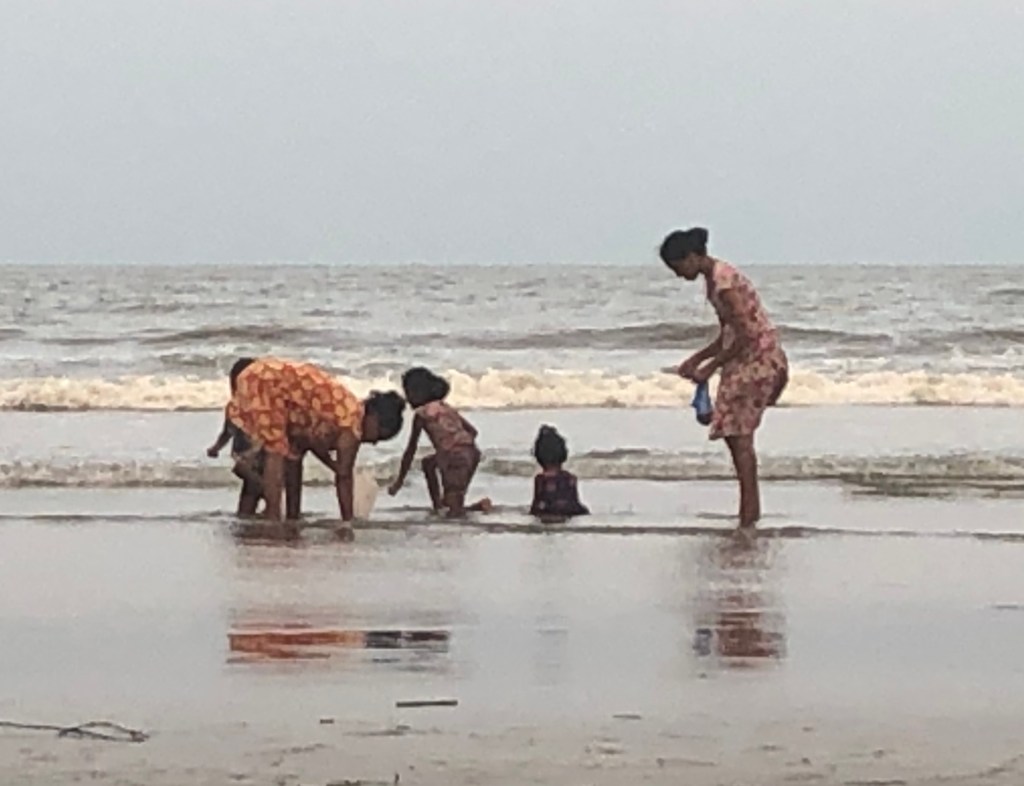
Women wear colorful saris or leggings with a tunic on top. They even go into the water dressed this way – but only to their knees. Their modesty is a constant, although their midriff is bare in their saris and partially exposed. Shorts and bathing suits are nowhere to be seen. If on the beach in Tel Aviv women show the maximum amount of skin possible, here women show the least.

Beyond the path is a wall of rocks and boulders set up as a barrier between the village structures and the sea. The waves constantly break onto the rock barrier; sometimes in a gentle lullaby; sometimes with louder music; sometimes crashing with an impressive exhibition of spray. My afternoon yoga is usually accompanied by that drama.

Beyond the waves, the calm, flat Arabian Sea is dotted with fishing boats. Some are barely big enough for one person and his fishing nets; some for three; in darkness, some are big enough for fifteen. Early in the morning we can stand on the beach and watch the fishermen pluck the fish caught in their nets. The catch is never large – 20 kilo on a good day – and the fish are never big. It’s incomprehensible how they make a living from this work. We don’t have a grasp of their reality, though, so it may make perfect sense in their world.

Breakfast arrives on our balcony table at 7-ish every morning and dinner at 8-ish every evening. The creator and carrier of our vegetarian meals is a young man, Veejay, whose wife and five-year-old daughter live a 3-day train ride from here, near the border of Bhutan. The language he shares with the owner of the hotel (for lack of a better word) is Hindi, though his native language is Nepalese and the owner’s is Mayalayam.

Veejay is a vegetarian but accustomed to very simple food. He makes a huge effort to provide a variety of vegetarian meals for us and succeeds admirably. Even when the food is not exactly what we might choose, his intention is so pure that we’re happy to eat with gusto.

His work is endless. He lives onsite and is available 24/7 to provide refreshments, call a tuk-tuk or try to rouse the WiFi. If we were ever lackadaisical about Shabbat, watching people here work every day, all day, has reminded us to be grateful for the wise decision made thousands of year ago in Judaism to set aside 25 hours for rest and spiritual nourishment. The concept, the necessity for such a time and the benefit it brings, was unheard of back then and is still unheard of in India, other than among the Christians.

Our host, Anthony, is a very special person. Born and raised in this small fishing village, his father was a fisherman and, growing up, Anthony loved nothing more than going out on the boat with him. A bright and curious mind has made him an eclectic adult with a well-respected past as a career officer in the anti-terrorist section of the Indian army. He retired as a colonel after 24 years, most of which was spent in Kashmir, the region of continual conflict and terrorism.

Our long conversations include history, not exclusively Indian history, philosophy, science, religion (he’s a Christian with some Hindu undertones), sociology, politics, and ethics. He’s well-versed in current events and spent time in Israel on pilgrimage. He had words of praise for Israeli organization, cleanliness and ingenuity, and said that when he crossed the border into the chaos of Egypt he felt at home.

He has three businesses and has to travel much more than he’d like as a result, but is never happier than when he’s close enough to the sea to hear the waves lapping the shore. He keeps working in spite of yearning for the sea, to maintain employment for his 90 employees. He believes that a person has no self-respect without employment, and finds personal fulfillment providing opportunity for his neighbors. His plan is to work until his 60th birthday – he’s 49 today – and then sell off his businesses to remain within earshot of the waves until the end of his life.

When my husband expressed his fascination with the fishing boats, Anthony called a fisherman friend and hopped – happy as a child – into a small, 3-person fishing boat with his friend and my partner for an hour at sea. I watched as they returned to shore, Anthony paddling, his bare upper body glistening, a big smile on his face. Did I mention that he’s quite beautiful?

But about the sleeping thing.

There’s virtually no internet here. Just enough to entice you into attempts to be online.

I had several logistic necessities to be accomplished online and couldn’t complete any of them, even in the wee hours when the WiFi is at its strongest. I spent one night in a futile attempt, giving up only at 3 a.m. to toss and turn, sleep elusive, my mind dashing from train tickets unreserved and cell phone data packages unrenewed. Breathing didn’t help. Nothing helped. I gave up into the reality of a sleepless night and may (or may not) have dozed off for a short while here and there.

The next day we were able to renew the cell phone data and take care of a few other errands in town. With that off my mind, falling asleep came easily but waking up several times a night came just as easily. Each time, I heard the gentle music of the waves 30 meters from our bed, and drifted back into a peaceful sleep.

Each night since has been the same.

In the morning, I open my eyes only after my ears have opened to the sound of the waves. I feel rocked awake in nature’s arms just as I’m rocked to sleep in the dark of night to the same music.

This morning I awoke to that primordial sound of comfort and a minute later found myself contemplating, with reluctance, our departure from Thumboly Beach four days from now. I gave myself a mental shake to return to the present moment – wherein I’m still in Thumboly Beach and still accompanied by The Arabian Sea.

Our next stop is The Pimenta Cooking School. A cooking course I’ve been looking forward to for months.

My guess is that the sound of The Arabian Sea will be part of me until the end of my conscious life.

In the midst of my cooking course, surrounded by Indian cooking utensils, spices, vegetables and the incredible array of non-wheat flours, I’ll probably have a moment here and there of regret that I’ll be moving on from that kitchen experience at some point down the road.

The bittersweet flavor of traveling. And of life.

Change is a wonderful thing. As I’ve mentioned before, I’m a change junky.

I love my life at home. I love my family, friends and students, my house, studio, and community, and, yet, I get itchy after a while. It might take 6 months or a year, and planning my next trip may keep the itch at bay for months at a time, but the world and its infinite wonders call me louder and louder until I have to go.

Feeling full of gratitude for each moment in this amazing world of ours.


Anyone can Detox on Morjim Beach

I think that after those last few days of stomach butterflies at home leading up to our departure from life as we know it, we chose well with Mumbai as our first stop. The drastic difference of Morjim Beach from those days of checking off the last items on our “to do” list would’ve have been too great a shock to our systems. Mumbai, with its crowds and our 17,000 steps-a-day touring, was a perfect jumping in point.
The five days of incredible Mumbai, with its teeming population of 22 million and the additional Diwali festival crowds, may sound even more hectic than organizing our life to exist without us, but the contrast between colorful India, spicy Indian food, traditionally clothed people passing us on the street and our own reality in Israel made it perfect.

Five days was enough.

We chose Morjim Beach in Northern Goa for two reasons: for the promise of turtles coming ashore to lay their eggs (which hasn’t happened yet) and the claim of serenity and lack of crowds.

Expectations are problematic for travelers. We choose because we can’t stand at the intersection without choosing right, left or straight, but if we expect our lodging to be exactly as pictured/described or expect the town/beach/tourist site to be exactly what we were looking for, without leaving our mind and heart open to accepting a different reality, we’re often setting ourselves up for a bad time.

The relatively few tourists on beautiful, sandy Morjim Beach are Russian (true to what’s reported by google), and Indians. We’ve yet to meet a tourist from an English-speaking country or an Israeli. The beach is almost deserted most of the day. People frolic in The Arabian Sea from early morning until around 10, before the extreme heat arrives, and wander back down to the beach about an hour before sunset to watch the big event.

There are pubs here and there for nightlife but pulsing music is very localized and can’t be heard from our hotel.

Our first week in Morjim Beach was spent at Baywalk Goa where two exceedingly nice, polite, helpful men eased us into beach life. Breakfast was delicious. Service was immediate. Our room was spacious and had a front and back balcony. The older of the two men even showed me his yoga routine, which included an interesting pose that was new to me. The only drawback was that it was not directly on the beach (about 100 meters away) and about a kilometer down the beach from the restaurants.

We spent the weekend in Anjuna, about 30 kilometers away, where the Chabad House correspondence had prepared us for the possibility of it being non-existent that Shabbat. Not that they said that, but they just sounded flakey. As a result, we chose a more luxurious hotel ($40/nite instead of $30) with a quiet Shabbat around the pool as a possibility. In fact, Chabad House was closed and we loved our Shabbat in the pampered surroundings. There was even a surprise bonus of a wonderful Rajasthani Dance and Music performance on Saturday night. The beautiful dancer invited me to dance with her, which I did, and I had a great time.

On Friday we walked to a coffee shop/restaurant that I’d been following online and getting some India travel tips from for several months. The owners are an Israeli man, Moshe, and his German wife, Anastasia. There’s a big lending library with books in a multitude of languages in the restaurant, a wide variety of “Mediterranean” food options – all vegetarian or vegan – a space for yoga, and a bulletin board filled with notices about yoga classes, meditation groups, tai chi classes and upcoming concerts. A very comfortable, safe hang-out for travelers and people like Moshe and Anastasia who have made Anjuna their home.

I IMd Moshe after we left asking if he’d like to be interviewed for the book I’m writing about people who have stood at that proverbial intersection and chosen a path very different from their background and peers. I mentioned that we would be at our hotel all the next day because we keep Shabbat and suggested we get together on Sunday. Then Shabbat started and I wasn’t online to receive his answer.

Saturday in the early afternoon we were sitting around the pool and Moshe appeared. He had come to be interviewed. We sat and talked (mostly I asked a question here and there and he talked) for over two hours. I don’t know if his story will end up in my book – maybe – but it was interesting and I liked him. He’s been in Anjuna for almost 25 years. He’s approaching 50 years old. He sees himself as a citizen of the world and when asked to visualize his two daughters’ future (they’re now 10 and 12), he imagines they will live somewhere out there in the world – not India – and he’ll relish their happiness. Having had three children spend years each in the U.S., I could tell him that it’s much easier to relish one’s children’s happiness from closer up, but why burst his bubble. And, who knows, maybe he won’t feel that way.

Back to Morjim Beach on Sunday but to a place directly on the beach this time and close to restaurants – Ciiroc. Gershon found the manager taciturn and took an instant dislike to him. We’d checked the place out when we were at Baywalk and it seemed very nice. Little cabins surrounding a pristine pool, with comfy beds, a fridge, and pleasant porch.

Expectations.

Reality came in the form of a small(ish) cockroach prancing across the bed as we watched Blue Bloods on my iPad, an internet connection that was so slow that it was truly useless, and no cups to go along with the hot water kettle. As it turns out, though, one has only to ask and everything appears. The “taciturn” manager provides whatever we ask, including better internet by turning off and on the router whenever we ask.

The cockroach had no friends.

We’d eaten at the restaurant the previous week and already knew that they didn’t have about 3/4 of the items listed on the very extensive menu. When we tried (again) to order fish and were told they didn’t have any, the manager came over with an explanation. The fish in the market hadn’t been good that day so they were only serving it to non-guests. He hoped to have better luck the next day at the market and would make fish available to us then. A little scary for those non-guests, eh?

One important thing to note is that every single dish we ordered (that they actually had) was delicious and more than made up for the 3/4 of things on the menu that were unavailable.

We were the only customers most evenings for dinner and could only wonder at the four or five people in the kitchen. I was invited in to take a look at the kitchen and, while primitive, it was clean and a great space to prepare food.

Today we walked the other way on the divine beach and spent an hour or more investigating a rock jetty with tidal pools and many, many living things. There are four kinds of crabs here – bubbler crabs with their amazing artwork, hermit crabs who teach us an important life lesson – to be satisfied with what we have and not chase what looks a bit better – ghost crabs, and a kind of crab we saw on the rocks that Gershon has not as yet identified. The beach and shallows are populated by thousands of tiny clams that women bring their children to gather to add flavor to their soups. There are fish in the tidal pools and the inevitable birds who feast on crabs and fish.

I participated twice in a yoga and meditation class on the beach giving by a 68 year old yogi who seems to be the real deal. I could probably learn  a lot from him but each class is a basic class because he caters to the Russian tourists who come and go. Too much talking and not enough meditating or yoga for my taste. But a very cool experience.

I have to go now. It’s almost time to see the sunset.


Glorious India

The plan to spend an extended amount of time in India was conceived so long ago that trying to remember when, how and who initiated the thought leads mostly to fractured fairy tales.

I think it was my husband’s idea to change his life radically to serve the same function as cleaning your palate between courses. He was looking forward to total retirement and fantasized about a period of time to wipe the slate clean and begin to formulate a next stage in his life.

Life has a way of whisking away parts of our ideas and morphing them into other versions of themselves. Total retirement, when contemplated in the reality of the altering of lifestyle that financial change would necessitate, has been postponed for another few years and transformed into six months working and six months…not working. (Still no definition as to what that might entail.)

But that might be exactly what led us to sitting around the pool at The Fern Spazio Resort and Spa – which sounds far fancier than it is; though it’s very nice – in Arjuna, North Goa, India. It might be kismet, karma, or just one of life’s serendipitous events. It’s feeling a lot like one of those proverbial gift horses in whose mouths we’ve been forewarned not to look too carefully

Five days in bustling Mumba; a city with a population of an unbelievable 22 million people. Mumbai is a city of contrast. Extreme wealth in its commercial center and extreme poverty with literally millions living in the slums with which we became familiar in Slum Dog Millionaire (which, by the way, is quoted extensively by guides in Mumbai.)

We arrived during the Diwali Festival – five days of vacation celebrating the removal of darkness and ignorance; The Festival of Lights (not to be confused with Chanukah, though there are similarities). The fireworks were on Sunday so we missed them but we didn’t miss the crowds of Indians on holiday in Mumbai.

As we approached The Gateway of India, lovely architecture reminding us of the not-so-lovely period of British Rule when in 1911 the stone gateway was built for the king and queen’s visit, we saw a mass of humanity second only to the million people we joined at Woodstock. Dripping sweat in the hot Mumbai humidity, I could only smile at the outlandish possibility of inserting myself into that press of people. It seemed so ludicrous.

My children pointed out to me long ago that the only possibility of not having to stand in a long line for activities for kids is choosing really boring activities. I take my grandchildren into lines and crowds I never would’ve taken my children. The funny thing is that when I mentioned that recently to one of my kids she said she was happy that I take her kids to those crowded fun places because she’s not willing to.

A sweet young man was kind enough to show us the right line to be in to get onto the ferry to Elephant Island to see the caves, and seemed to be saying that the tickets would sort themselves out. The long but orderly snake line looked daunting but he assured us it would only take half an hour. Google advised getting on the 2 o’clock ferry so we were standing in the hottest sun Mumbai could serve up and it was plenty hot. At some point a man came and sold us tickets and, lo and behold, in 40 minutes we were on a ferry. The promised 45 minute ride stretched out to an hour and a half, but the breeze was welcome.

Elephant Island has no elephants and neither do the elephant caves. It seems that once upon a time there were two big statues of elephants at the entrance to the island. The British, as is their wont, stole them and took them wherever they fancied, but the name stuck.

We took a local guide, Harish, one of the 1200 inhabitants of the island, and made our way up 125 narrow stone steps, four and five abreast, with people packed in front of and behind us. Along both sides of the stairs was a market of trinkets, including wonderful Tibetan singing bowls for a tenth the price we pay for them in Israel. Carried along by the crowd, we ignored the vendors’ pleas.

The Portuguese (who also ruled here for a little more than 500 years) tried to destroy the elephant caves but the beautiful carvings of the nine images of Shiva as well as the caves themselves are made of basalt and remained mostly impervious to the attempts. The carvings are beautiful and their stories well told.

We went on a private car tour of Mumbai and a walking tour of the markets. The sights were interesting but the guides were more so. We saw the in/famous Mumbai laundry, got a peek at the slums surrounding it, and were fascinated by the Gandhi Museum.

Our driver/guide told us a tragic story that may or may not have been partially or totally true. He said his father died when he was 12 and his mother ran off. He slept on the streets or in temples and learned English from an old man who read the newspaper with him to teach him. He married and rents a tiny place in the slums for himself, his wife and their two children. We said hello to his two, very sweet, children on his phone.

There’s really no need for a guide in the Mumbai markets but our pleasant 25 year old guide gave us many tips for bargaining that have come in very handy as well as sharing his insights into Indian culture. He yearns to move out of his parents’ home and live independently, mostly to indulge his desire to have unbridled fun. He and his parents disagree about what he should be doing to prepare for his future as well as what his future should look like. (Sounds like young people here, or at least this one, have a lot in common with their age group in the States).

We both took to pure vegetarian food immediately again, as if we hadn’t been carnivores for the past 3 years since leaving India. We found our special place to eat dinner and ate there most evenings. At home I make an effort to get to 6000 steps a day; here I get to 11,000 and even 18,000 without trying. At home I’ve developed tricks to remain hydrated; here I swig liters of water constantly.

Feeling healthy and happy and relaxed after a week in Northern Goa. Met up with a wonderful yogi/teacher on the beach.

But that will wait for my next post.

Namaste

The Bungy Jumping of Authors

Lots of people say that beginnings are always hard. Changes of all kinds, even for the better, are always listed high up on the list of things that cause people stress.

pulling out hair

Me? I’m a change junky. Always have been. It’s been toned down over the years between raising children and owning a viable business for a decade or two but the buzz has been increasing over the past few years.

Every single day I start my day giving thanks for hundreds of blessings  – Snoopy dancingpotable water in the pipes in my house, my house itself with its beautiful backyard and shady back porch where I eat breakfast every morning, my husband of 45 years who makes that breakfast, the amazing fruit he cuts up for us, the coffee he brews, and the money to buy it all, our healthy children and grandchildren, my supportive, fun friends and my (more or less) healthy body.

Lots of people say how much they love their lives and I hope they mean it as much as I do.

And then there’s that buzz, that itchiness to get moving – the voice of the change junky in me.

In less than three months my husband and I will be headed off for big changes. Six months in India. Different scenery, different languages, different food. Building new routines and then moving on to create yet other routines in other places when the spirit moves us.

But three months when I’m ready right now is a while.

What to do? What to do?    anxiety

One of the answers I’ve found is finally hiring someone to help me market my first two books. I loved writing them and relished actually holding the paperback in my hands and seeing each of them on my shelf. Marketing? I found I didn’t really have much of a passion for getting other people to read them.

I’ve been finishing up things in my present life to get ready for my new life in India. I’ve been de-cluttering my house and putting together a schedule for my studio for while I’m gone. I find that part of this temporary closure is a rising desire to have strangers buy my books. I wasn’t even aware of it being a circle that needed completion.     Old person forgetting

An organized, pleasant man from Germany is partnering with me to call my first two books to the attention of their potential readers. Working with someone in this field and getting acquainted with the logistics and technology of marketing is just the tweak my brain needs at the moment. It’s a world unto itself made up of puzzle pieces that fit together nicely when arranged properly.

He has many ideas that are tested and proven. I have ideas that are a bit out of the box for him as an expert in his field and a true example of the beauty of beginner’s mind.

There’s a rule out there that says that artists are intrinsically unskilled at selling their art; that the two talents are mutually exclusive. picasso


I’m guessing there are thousands upon thousands of excellent, fascinating books out there that go unread and unknown because their authors throw their hands up before even trying to sell them.

I don’t know if this marketing experience will lead to thousands of people reading my books, but I know that they won’t read them if they don’t know they exist. It seems that in this day and age they won’t know they exist if the books aren’t search engine optimized and connected to a similarly optimized author’s page. They need the boost that reviews give and being sold to libraries all over North America.

Alas, none of that happens by itself.

For some people, the blank page is the monster lurking under the bed. For other people, it’s brand awareness. I’m here to tell all you writers out there –

It isn’t as scary as it sounds.

namaste


Awakening Again

I made a new friend on my walk today. We’ve met with mutual suspicion six times a week for a few weeks now. He lowers his head, looks at me surreptitiously, and keeps his distance. I keep my eye on him as I pass on the other side of the path. But today was different.

I walk for about an hour every day except Thursday, usually alone. It’s a peaceful time. I listen to a talk for part of the time, and to music the rest of the time, except for Saturday morning. Saturday is Shabbat and my time off from electronics. My Saturday walk is a little less quiet – all that noise in my head. That’s okay, too, though. My curiosity gets a kick out of all those thoughts. “What? THAT one again?”

I started this walking thing – or I should say I got back to it after a very long break – about 2 months ago. It seemed an easily accessible habit, useful for changing the sedentary lifestyle that crept up on me when I began having hip pain from my Nordic machine.

Research shows that it takes 28 days to create a habit. That seems true for my walking regime. It’s become a habit. I check the weather & my schedule to decide the best time to get out there. The time arrives and I lace up my sneakers. I connect my earbuds, choose the talk I want, slip the phone into a back pocket, and I’m out the door.

Today’s walk started out the same. Aside from a sore throat and a little cough, nothing warned of a difference in today’s walk. After almost a full day of rain yesterday – with just enough delay to allow for a walk under threatening skies – the sun warmed the crisp mid-winter air just enough to allow me to shed my down jacket after fifteen minutes.

The talk I chose was good. They always are. The winding road up the hill was pleasant – not too easy and not too challenging. It always is.

The difference came from inside, I guess. One of those awakenings that come upon us all of a sudden. Or it seems to be all of a sudden, but I’m betting it’s the culmination of lots of stuff. For some reason, today, after about forty similar walks, I felt how strong my legs have become and how easy my breath comes on the incline now. I was aware of my sure-footedness coming downhill on loose gravel. I realized that I was enjoying the walk for its own sake. I had a glimmer of why hikers love to hike. Today it wasn’t about being healthier or exercising my knee or my hip. Today was pure pleasure.

When I got near the top of the penultimate hill I saw the same dog I’d seen in the very same place on every walk, but this time I didn’t pass him warily. This time I approached him with my hand extended. He didn’t move. He, too, had created a habit. But he let me rest my hand on his head and, after a few seconds, his tail started wagging as I massaged his neck. It was only a moment in time. Then he went his way and I went mine.

Later, on a secluded, wooded path, I danced to “Fallin’ All in You” before resuming a sedate demeanor more suitable to a 66-year-old woman on a bright noon somewhere in January.

(please click on the photo)

Hours later I can’t stop the feelings of gratitude. Thankful for my body’s vitality (with all its aches and pains of aging, coughs and sniffles of winter) – the muscles in my legs, my lungs, my heart. Thankful for the undeveloped countryside right near my home. Thankful for the resources and the freedom to wander. Thankful for my many teachers – official & unofficial – who imbue me with the ability to see the half-full glass (and the occasional moments when I realize that it’s full).

Maybe I’ll meet my friend again tomorrow.