Do We Really Get It?

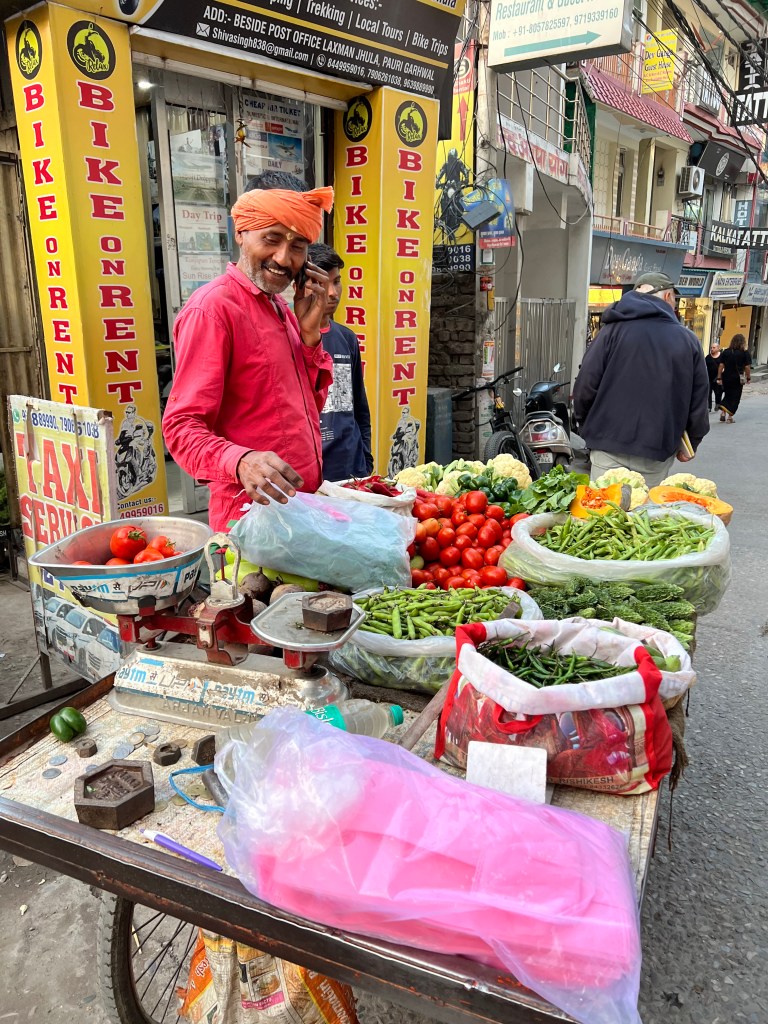
All told, we’ve been in India almost a year. We’ve spent over two months in Kerala, four months in Rishikesh, and a week to ten days in Hampi, Meysore, Delhi, Goa, Mumbai, Varanasi, Darjeeling, Khajuraho yogashram, Kaziranga, Puri, Shimla, Dharamshala, Dalhousie, Chennai, Pondicherry, Auroville, Bandhavgargh, Rambagh, Jim Corbett, and the Andaman Islands.

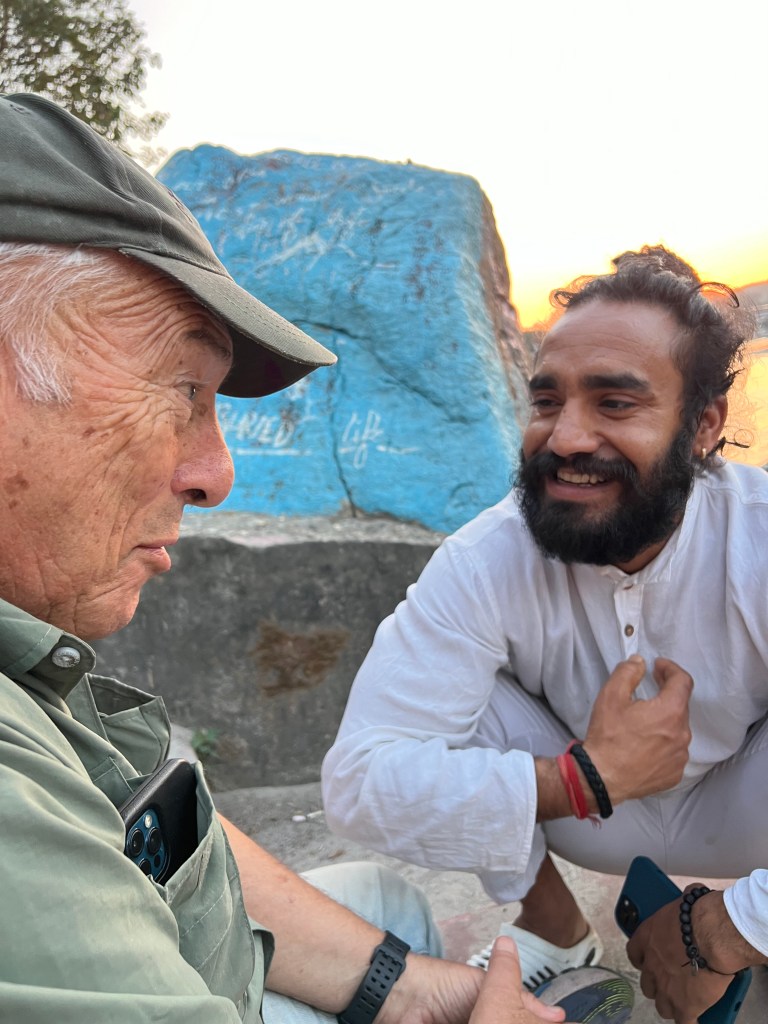
My partner has been learning Hindi off and on for 7 years. Between his Hindi and Google audio translate we’ve had many conversations with people about their lives and their opinions about many issues – geopolitical, philosophical, sociological, religious, and how they view the future.

We’ve observed familial interactions, public and less public behaviors, hygiene and eating habits, changing clothing preferences, and acceptable and less acceptable commercial activities.

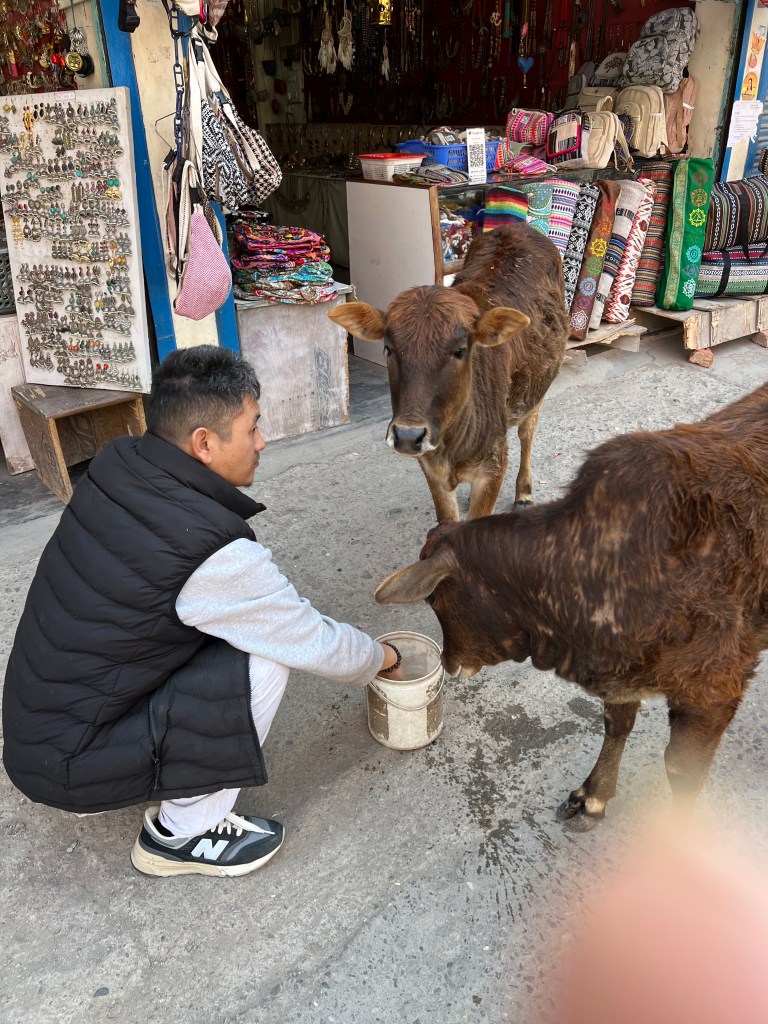
We’ve experienced the kindness, patience, and acceptance of Indians in many different situations from driving to waiting in line to communication difficulties to cultural misunderstandings.

When asked how many children an Indian has they will invariably give a number that reflects only male children. Mothers as well as fathers respond in this way. Sexist? I don’t think so. It seems that in traditional Indian families (and in spite of rapid and visible change it’s estimated that over 90% of Indian marriages are still arranged marriages) sons remain in the nuclear family home after they marry. Their wives become subservient to the matriarch who travels with them on vacations and sets the tone for parenting. Daughters move on to their spouse’s family. They are only temporarily part of their parents’ lives. I’ve come to believe that is why they’re not included in the natural spontaneous reply about the number of children in the nuclear family.

Is this belief accurate? Maybe. Maybe not. One thing I’ve learned is there’s no point in asking for clarification. Such requests are met with puzzled expressions followed by acceptance of my theory regardless of its accuracy or inaccuracy.

Here’s a much more prosaic, but much more day to day question I’ve been asking in vague euphemistic terminology since our very first visit in 2016. Why don’t Indians, especially women, use toilet paper? It’s excellent for the ecology of every country and certainly one with a billion and a half people, and yet… What’s the deal? It’s all well and good that our tushes and other intimate places are actually cleaner after that spritz from the bidet but what is it about walking around wet that doesn’t annoy them? And is it even hygienic?

They’ve learned that foreigners need toilet paper. Hotels provide small rolls of it and are happy to replenish it as frequently as their patrons allow themselves to make the request (we tend to buy our own to avoid the issue altogether). But when asked why they don’t require it themselves I’ve been met with puzzled expressions and literally no answers, They don’t understand why I do require it but accept it and I don’t understand why they don’t require it but still ask from time to time.

The nearest things I’ve received to an answer have been (1) the concept of the comfort of dry being preferable over damp is a Western concept (really?!?) and (2) you can carry a small towel to dry off, keep it in a small plastic bag all day and wash it in the evening (a nice solutionbut I doubt Indian women actually do that).

That may be similar to something an Indian friend of ours said recently. He owns an amazing guesthouse literally 50 meters from a pristine Arabian Sea beach. He’s made lots of improvements over the past few years. Indian tourists are accustomed to ordering their meals and eating in their rooms. They seem to prefer it. It might be a question of the chicken and the egg. Maybe at one time hotels didn’t have restaurants. So our friend didn’t have a restaurant but realized that the (mostly foreign) guests preferred not to eat in their rooms so he added a really nice place to eat.

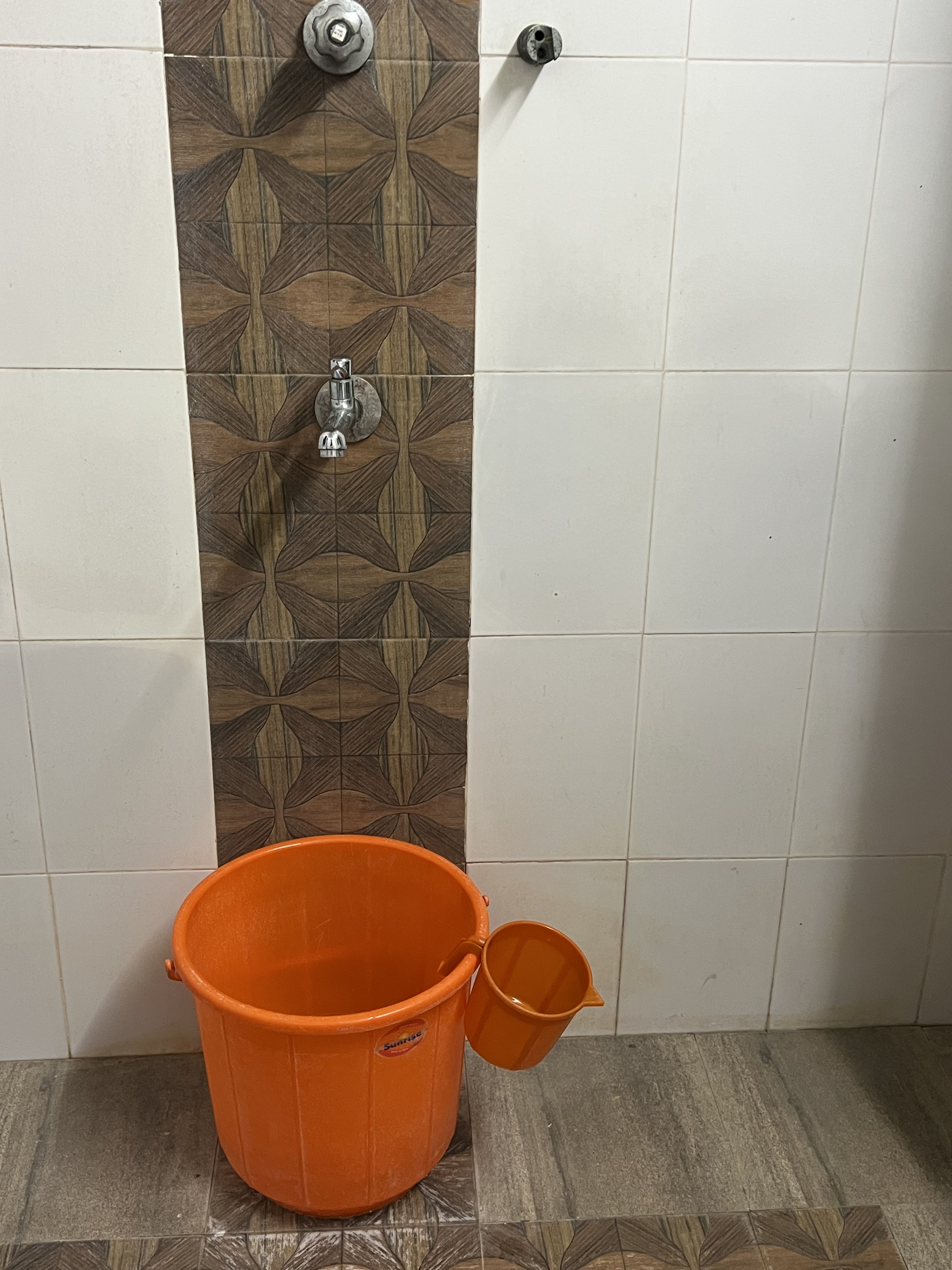
His showers had no hot water. Granted it’s quite hot in Thumboly Beach and the locals see no need for hot water but others do. As a result, he decided to arrange hot water and told us he had done so. In most Indian showers there’s a shower head and also a faucet beneath it about a foot annd an half off the floor with a bucket and plastic cup below it. Turns out he set up water in the lower faucet and not in the shower head.

When we laughed about it with him he said something quite true and profound. He said that one of the differences between Israelis and Indians is that Israelis look at something and immediately start figuring out ways to improve upon it while Indians look at the same thing, accept it as is, and immediately figure out a way to live with it. There are pluses and minuses in both approaches.

And what about respect for personal space, acceptable noise levels in public places or in hotels late at night, what it means to be a couple, the relative merit of avoidance or honesty in confronting legitimate disagreement or misunderstanding; the cultural differences go in and on.

Even when we think we get it we have to keep asking ourselves if we really get it.

There’s no escaping the fact that part of the joy in being in India is the adventure of the Western shrug of shoulders or the Indian wag of the head. The humor in “I don’t know.” The puzzled expression followed by a smile.

You aren’t in Kansas anymore, Dorothy. And ain’t that grand?

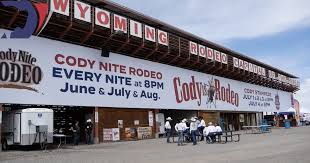
Cody Nite Rodeo

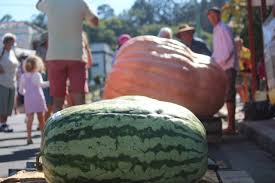
I grew up and went to school with kids who were members of the 4H club. Each one of them had a project every year so that they could enter a competition at the annual State Fair. Back then, one year it might be raising a pig from birth to market weight (300 pounds/136 kilograms or more). Another it might be growing the largest cucumber or melon.

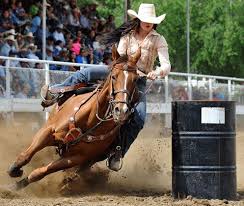
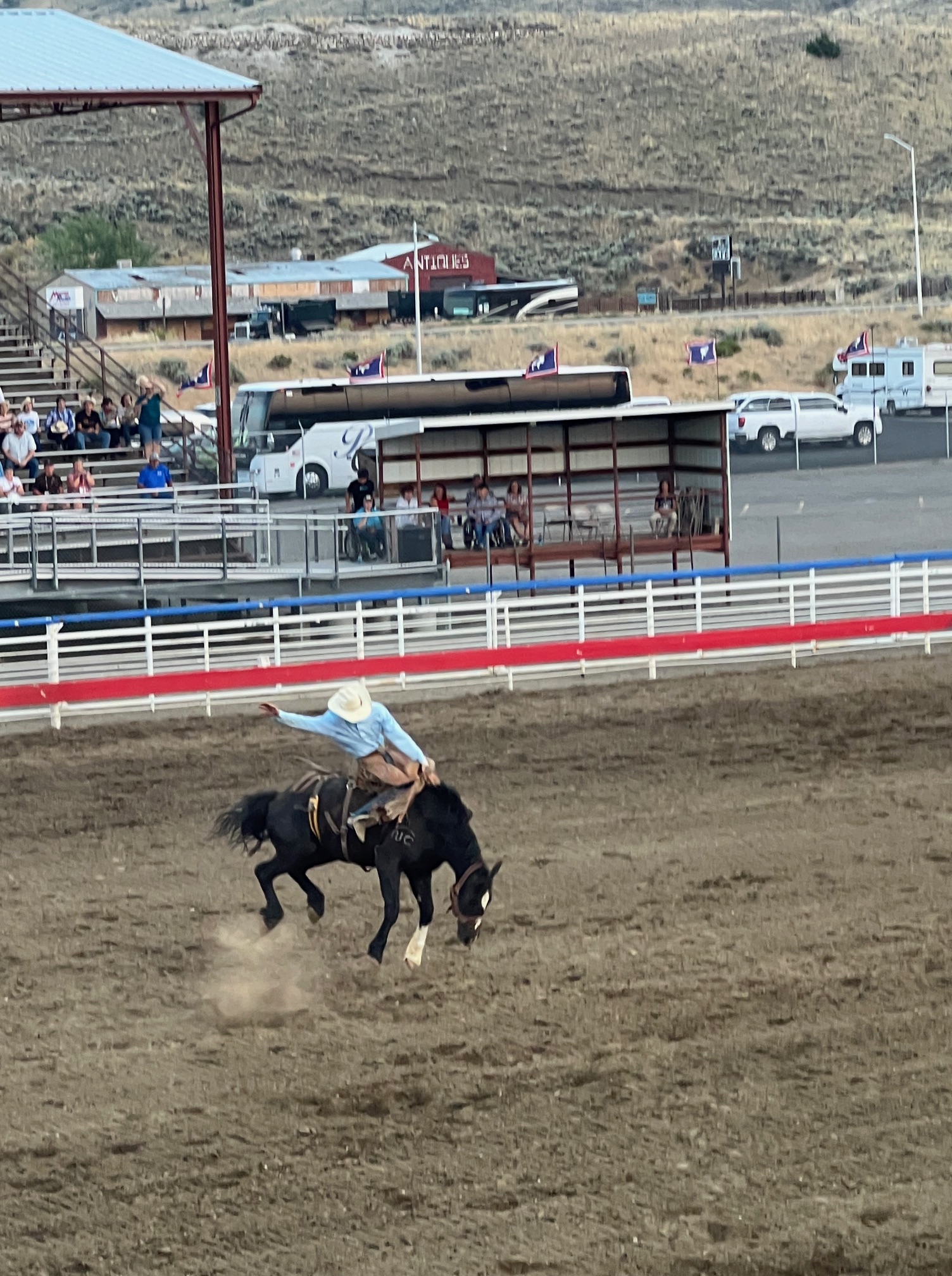
There were pie contests at the State Fair and games and rides. But the main attraction for me was always the rodeo. I never tired of the suspense of that 8 seconds of bone-rattling ride on the back of a bucking bronco or bull ride. (the bull ride was reduced to 6 seconds this year) I always sat on the edge of my bench until the girls rounded the last barrel in the barrel race event without knocking over a barrel and cheered them on that last super fast race back to the finish. When I worked at a horse stable for a summer in my teens I imagined myself one day entering the barrel race myself.

So it’s no wonder that while making plans for our American road trip, getting tickets to the Cody Night Rodeo was high on my list of priorities. It was written right there on the site that there are always enough tickets and every ticket is good for any date during the summer. But I read it over several times to be absolutely sure. This was one event I wasn’t going to miss. More importantly, my partner wasn’t going to miss it. A New York City boy, he stutters when asked if he’s been to a rodeo. I think his not being sure is a sure sign that he’s never been. Once at a rodeo, there’s no forgetting.

The Cody Night Rodeo is held every night during the tourist season. There are thousands of people every night. People come from all over the United States and from some foreign countries. The competitors are amateurs but many are well-seasoned amateurs. There are some father-son teams for the calf roping or tie-down roping event and some siblings who compete against each other in other events. There are entries from states as far away as Texas, over 1000 miles southeast, and home-grown entries.

The American flag was flying high in numerous places around the stadium. Horses paraded around the stadium with a flag-holding rider as the stadium filled. People stood as the flag went by them. A large screen showed scenes across America as accompaniment to the poem Why We Stand by Maury Tate read with a heavy cowboy accent. Google it. It doesn’t get much more patriotic than that.

The MC called out the names of states one by one asking if there was anyone from each. People cheered when they heard the name of their state. After Californians cheered for their home state the MC said ‘ “Welcome to America, Californians!” It got a big, good-natured laugh. This was a crowd well aware of the political divide.

We chatted with the couple sitting behind us on the bleachers as we waited for the first event and in between events. They were a Minnesota farming couple; farming the land their parents and grandparents had farmed before them. Two of their 7 kids (all grown and married) work the farm with them today, and the others live close by. Turned out that the man had recently begun a process of semi-retirement so he and my partner had a lot to discuss. The women, Kim, and I shared stories of our children and grandchildren. She was used to people being surprised to hear she has 13 grandchildren and two on the way. She was just as surprised to see that I wasn’t and that we have 16 grandchildren of our own.

She talked about the degeneration of the American school system and the introduction of gender education in elementary school. All of her school-age grandchildren are home-schooled as a result of both of those issues. She expressed dismay at the schism between the woke population (which confuses her) and what she believes to be the majority of Americans who value family and remain staunch patriots.

They both expressed empathy and sorrow about the atrocities of October 7th and the war with Gaza. We’d heard that a lot so far on our trip and it sounded very genuine.

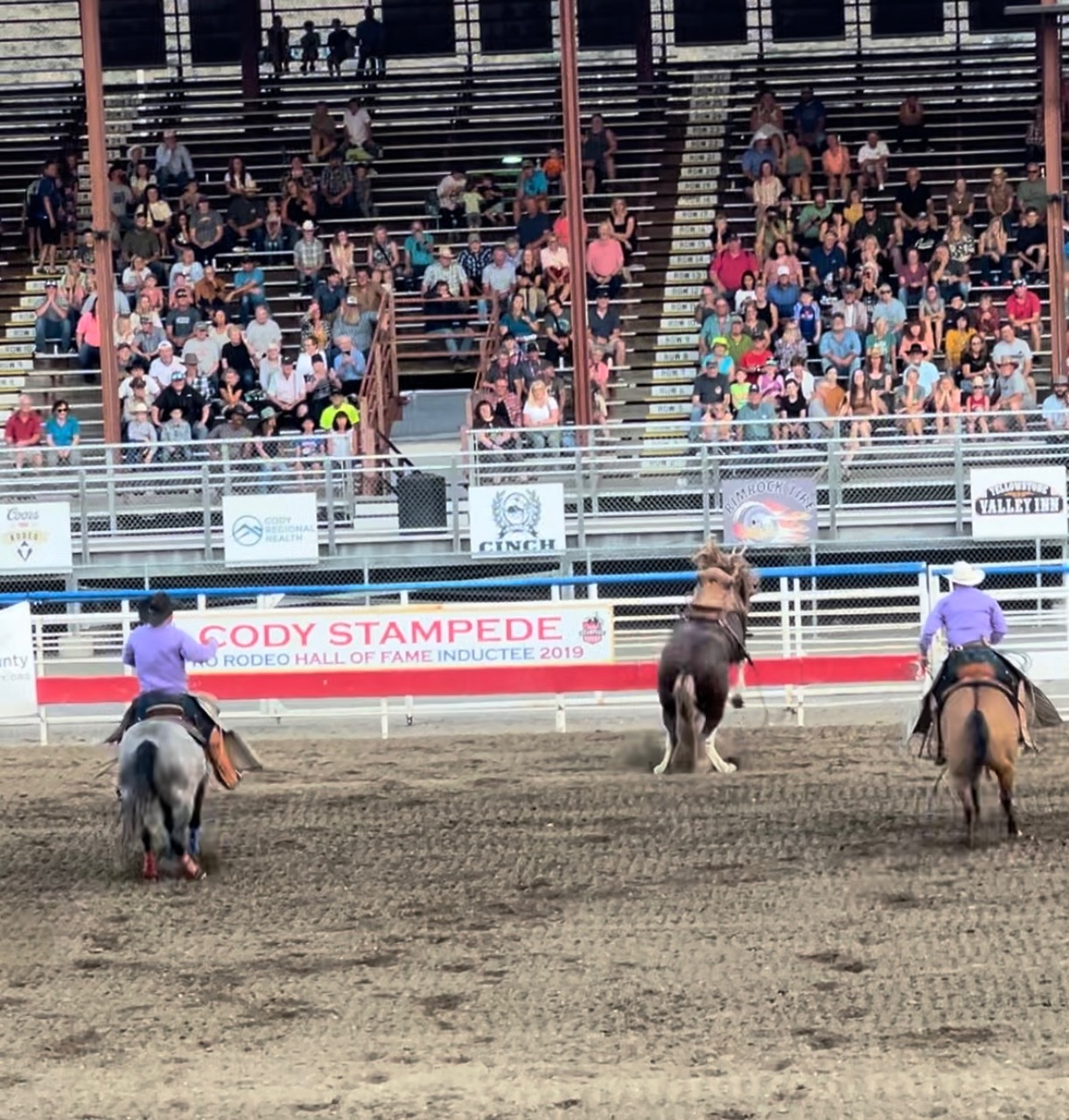
The best, most exciting bucking bronco rides are, of course, on the backs of the wildest, craziest broncos. If you’re wondering why those horses buck like maniacs, a flank strap or bucking strap is used to encourage the horses to kick out straighter and higher when bucking. The strap is about 4 inches wide, covered in sheepskin or neoprene, and fastens behind the widest part of the horse’s abdomen. But that doesn’t entirely explain why some bucking broncos are truly uncontrollable to the point where the two wranglers whose job it is to get them back in their stalls after their run struggle to accomplish the task. Some horses are just maniacs, I guess.

The barrel racing, a woman’s event added to rodeos in 1931 in Stamford, Texas, was tense. Trying not to knock over barrels and to be the fastest at it at the same time is an exact contradiction. Some of the girls were high school students. They’d probably been barrel racing since elementary school. Those girls and women could fly!

Only one competitor managed to stay on his bucking bronco for the entire 8-second ride. A clear winner. None of the competitors stayed on the bulls for the full 6 seconds. The horns on those animals are daunting. You’d think the riders would stay on just to avoid them, but it ain’t easy.

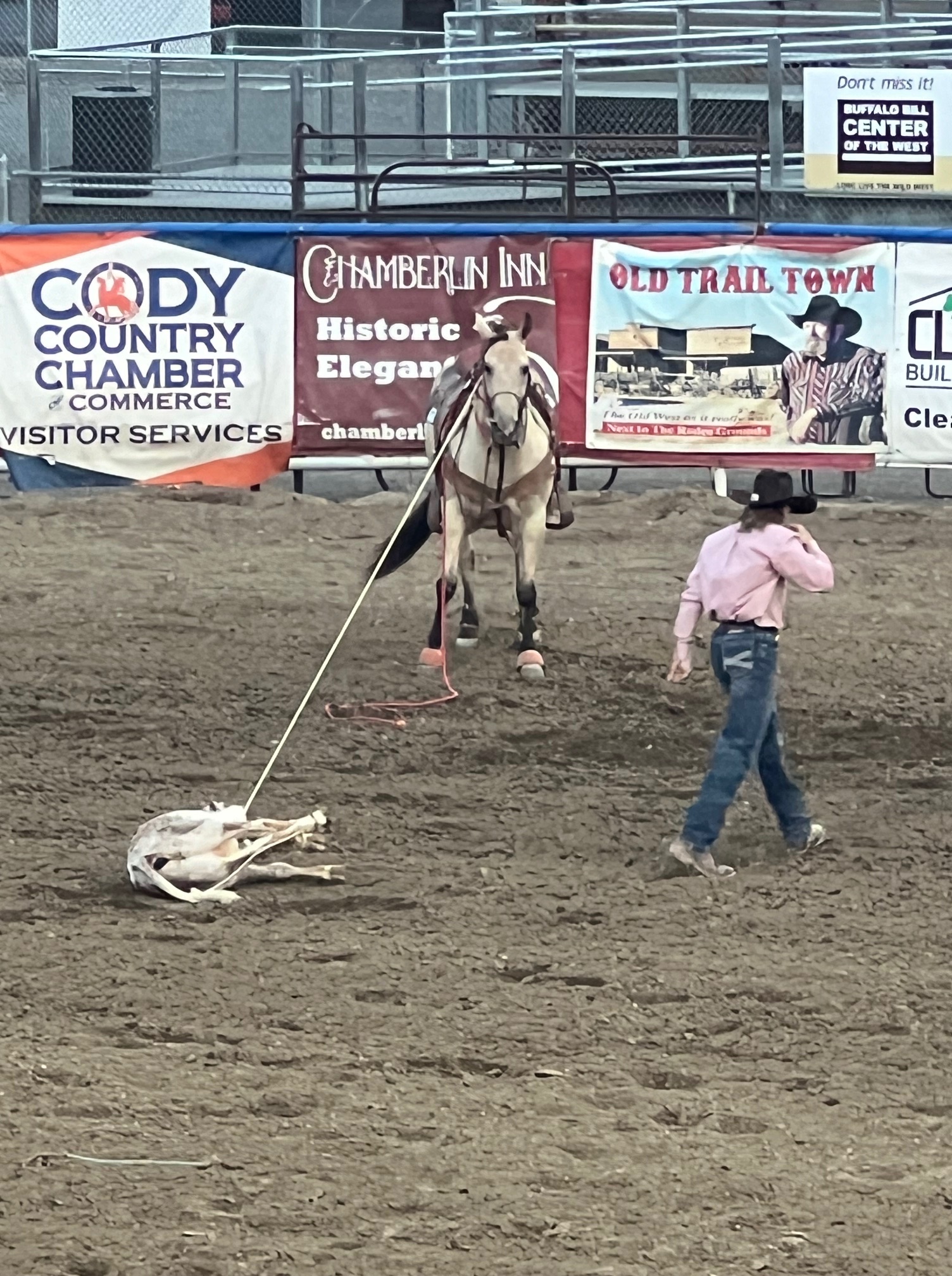
One of my least favorite events is also the one many people would like to see eliminated because it seems to be especially cruel to animals. Riding on the back of a horse or bull might be annoying to the animals or it might be a thrill for them to get back at human beings. I remember in Norway the dogs were rearing to pull the sleds – they were mostly annoyed that it took us so long to get started. Really – who are we to presume that we know the druthers of animals. But calf-roping doesn’t look like much fun for the calves. The lassoing part takes skill. I can vouch for that. The main skill of the girls’ marching group in my high school was lassoing. I never ever got the hang of it. Tying the calves’ legs as fast as you can just seems cruel.

Everyone had a great time. Lots of beer. Lots of smiles and laughter. Lots of strangers talking to each other and cheering side by side. An evening of good, clean fun. Small kids, teenagers, adults, and old folks (like us). At one point kids were invited into the ring for a quasi-treasure hunt. Dozens of them joined the game, running to and fro. The winners, a boy, and girl who looked to be about 10, couldn’t smile big enough holding up their small trophies.

A fun respite from phone screens and politics.

If you can find a rodeo to go to, do it! You might be surprised how much you enjoy it.

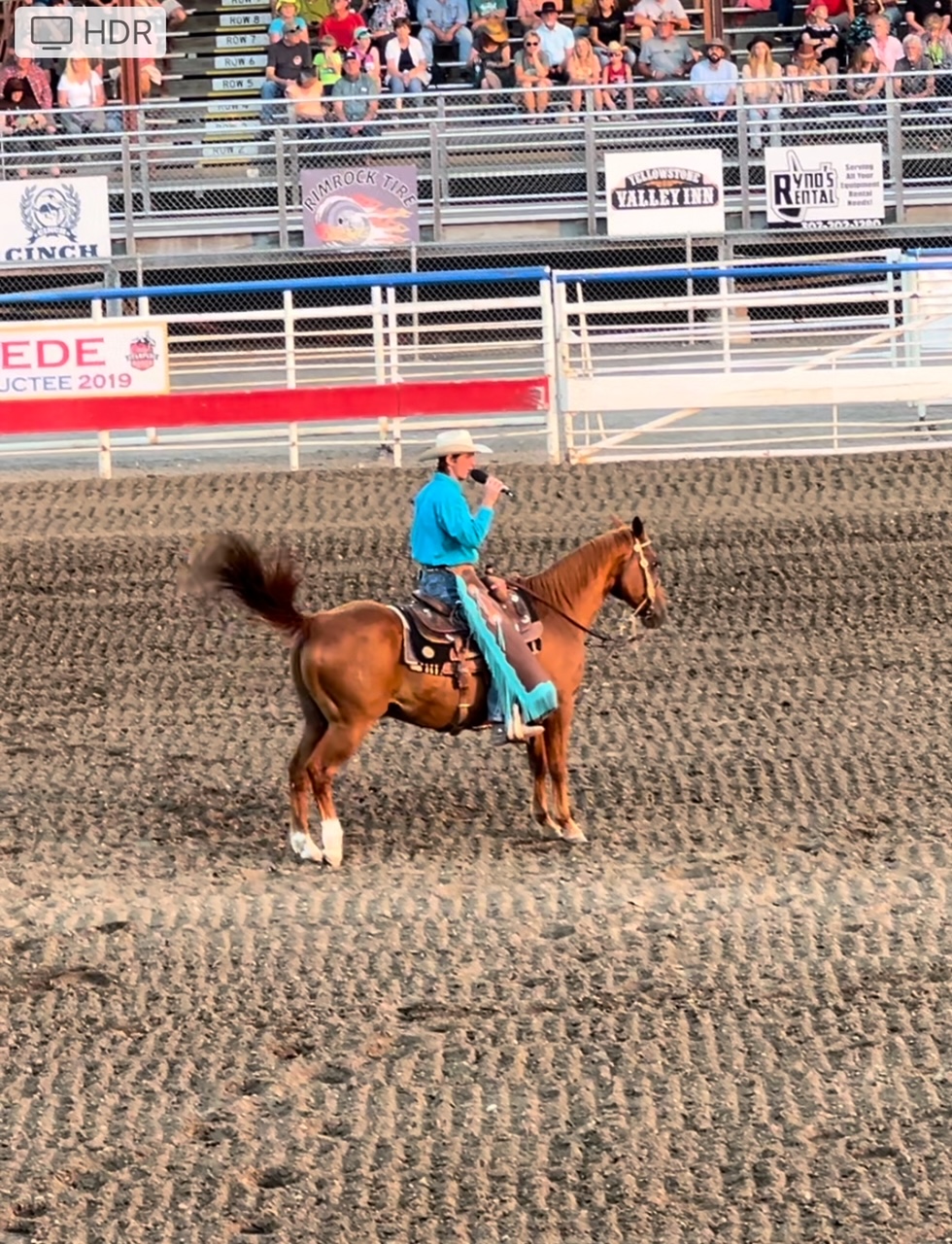
The big winner of the evening by far was this guy…

The Winner

Life in The Great Plains

The Great Plains of the United States is a vast area with few people and beautiful vistas. You can drive on the open roads in Montana, North and South Dakota, Wyoming, Nebraska, and Kansas for hours and see only a handful of cars. The houses are few and far between and without exception have an American flag flying in front. Each town’s population sign boasts between 29 and 1500 residents.

On our way from the Battlefield of Little Bighorn to Cody, Wyoming, where we’d be spending the night before heading into Yellowstone Park, we stopped in for some lunch at a small diner in the town of Lovell, Wyoming, population 2320.

During our travels, we’ve come to expect quirky, odd people and sights, but so far in this part of America what’s stood out the most is the utter normalcy of the people and towns. The diner was quite ordinary. Plain tables and chairs. Around one table were four middle-aged women having a girls’ lunch. Otherwise, we were alone. The menu was also nothing special. Hamburgers, french fries, pizza, tuna salad sandwiches.

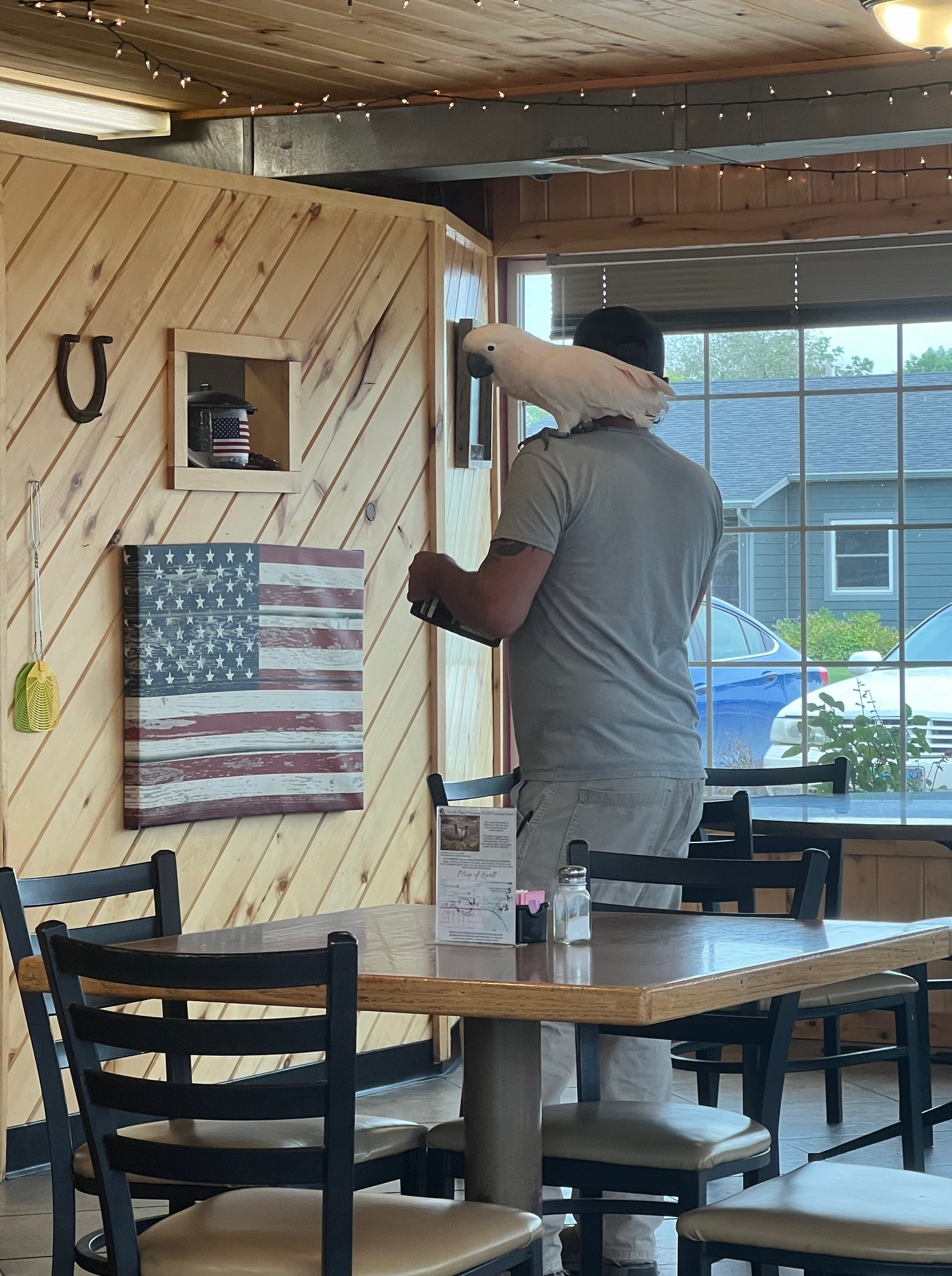
And then there was this sight –

No one seemed to think it strange. I guess man and bird are regulars.

Our teenage server was a fresh-faced, blonde girl. No tattoos. No piercings. No make-up. Just a few freckles and a friendly smile. I found myself wondering about her life. Being a teenager in a town of 2000 people in the Great Plains. The nearest city, Cody, boasting 10,000 residents, is an hour away.

After we’d eaten our sandwich and were waiting for coffee, I approached the girl and asked if she’d be open to talking about her life. She nodded with a respectful ‘yes’ and a shy smile. I started with an easy question.

“What do kids your age do for fun around here?”

She didn’t hesitate. She told me the obvious – there’s nothing to do in Lovell – but went on to say that, as a result, kids make their own fun. They sometimes build a campfire and sit around talking and telling stories. They go fishing. Most teenagers work in the summer and often after school during the school year.

I mentioned that I’d noticed the lack of tattoos, piercings, and make-up and asked if that was the norm. She replied that most families in Lovell are Mormon (she’s not), and have been brought up not to find those kinds of things attractive. There’s a strict dress code at her school, which is fine with her, but she wishes they were allowed to wear leggings. (that was her only objection)

I asked if she saw herself settling down in Lovell after school or moving to a bigger city. With a mischievous smile, she said that her dream was to go to New York City and become a cosmetologist but added that she’d likely get married and settle down in Lovell, or maybe as far away as Cody.

Interestingly enough, her parents divorced when she was 10 and after a year living with her mother in Denver, Colorado, she chose to move to Lovell to live with her father. Of course, the explanation may lie simply in a troubled relationship with her mother, but I wondered later if it was the siren call of a simpler life surrounded by stark natural beauty.

There are undoubtedly inconveniences living in a tiny town with limited options. But in the towns of the Great Plains states, there’s also the inspiration and peacefulness of being surrounded by natural beauty. The rush and tension that people love to hate in the big population centers are absent. There’s virtually unlimited space. Zero crowding on the roads, in the restaurants; no long lines in the grocery store or the post office (which each town has!). From our limited experience, no one is in a hurry. They have time for conversations with the neighbor ringing up their purchases and the customers in the diner.

At our server’s age, I was also a server in a restaurant. I worked in an Indian restaurant, wearing an elegant sari, where the choices on the menu were exotic and expensive. The restaurant was on the river that ran through the tourist area of San Antonio and was constantly packed with people. Without a reservation, people were out of luck. I saved my tip money to get the hell out of Dodge. San Antonio, a city of over a million people, was too familiar. I wanted nothing more than to strike out, on my own, for more interesting pastures.

It took me 50 years to reach the point that our server reached by 16. The point where I appreciate the empty open road, the farms where the closest neighbor is at least a kilometer away. When I can often think of nothing better than sitting in a wooden chair looking out at a calm lake for an hour or two with an unopened book on my lap.

Lubec, Maine

I used to think that living in the city provided more opportunity for connection to other people. I imagined living in rural areas to be isolating. Living in a small community of 5000 people created doubt in my mind and observing people and talking to people in The Great Plains sealed my recognition of my faulty reasoning. I now think that, while it clearly depends on the individual, living among fewer people may very well encourage kinder, more intimate connection than living in a city.

As the miles rolled by, we were finding the sheer size of the open, empty plains comforting. Neither my partner nor I being particularly stressed out or hyper people, we were, nevertheless, experiencing an inner loosening in our very souls.

I often thought of travel from Wisconsin, where I was at university for more years than I care to think about, to San Antonio, as boring. Lots of wheat fields. Lots of cornfields. they go on and one and…on.

The boredom of the 70s through the 90s is today’s meditation.

Like Father; Like Daughter

I was looking for something in an old file the other day and came across a letter my father sent me 33 years ago. It was the day he found out that his cancer had returned and the prognosis was not good. In fact, within six months he would be dead.

When I showed it to my partner, he said that it looked exactly like something I might have written. The sentiment is mine, Even the language is mine. And it’s very 2024, even though it was written in 1991.

My Dad. What a special person. A complicated man. A man never quite at home with his emotions. Quick to smile; slow to hug. A very active inner life. A very active public life. But most often not emotionally present for those of us he shared a house with.

I like to think things would be different today.

So here’s that very special letter, with those very special thoughts, lessons for us all, from that very special man who was my father.

  It was an idyllic morning in sunny Sarasota.

  I stepped outside the hospital, blinking in the sunlight. The everyday sights and sounds were different; they were as never before. The deep blue sky, the gently moving leaves, the traffic flow, the people — all seen in a new light.
  I reflected on how casual I had been, before my traumatic experience, to such common phenomena and to so much else in life — indeed, to life itself. And so I resolved to spend wisely whatever of life was yet to be mine; not to squander it. For life, I saw with stark clarity, is an incalculable gift. It should be held close, made the most of, constantly enriched, and cherished.

  That is one half of the lesson I learned there, standing in the sun. There was another.

  The wondrous sunlight enveloping me, could I retain it? Could I keep that sun from setting? Had I tried to halt its slipping away, and inevitably failed, how frustrated and saddened I could have been. But if that were my reaction I’d have transformed the glorious moment into one of regret and sorrow.

  But it is not only the sunlight which must slip away. Our youth and our years, our senses and our lives, these must go also. And we must accept their inevitable departure; be ever ready to let go.

  That is the other half of the lesson.

  This, then, is the paradoxical conclusion. Hold fast, hold close the precious gift of life, but with arms so loose as to be ever ready to release it; with arms virtually open.

  Is this an impossible challenge? Physically, yes; mentally, emotionally, of course not. We do it repeatedly throughout our lives. We give away our hearts in love, and we have more heart to give. We wear out our minds in deep thought, and we have a better, sharper mind. We are smitten by pity for the deprived, and we are the stronger for it.

  The key word in the conclusion about life is ‘inevitability’.

  Aware that life must and will inevitably end, each of life’s moments becomes all the more cherishable. The sole unknowns are the when and the how; when and how these moments will end. The choice is between succumbing to fruitless agonizing — fear and dread of the when and how — or living those moments richly, fully, gratifyingly; savoring them and saying, in effect, “I’ll relish this as long as I may, and whenever it ends I’ll be grateful for having had it — and hope there are some others who will be grateful that I had it also.”

  I imagine nodding heads. It does seem logical. But is it unduly difficult to transfer from the thought process to one’s inner being? To transplant the idea into actual, living reality? To live by it?

  It is not difficult. We do it again and again in our daily lives.

  Look. We are enthralled by a spectacular sunset. We are immersed in passionate expression of our love. We are transported by a rapturous violin concerto. Do we destroy such moments by dwelling upon their transitory nature? Our minds tell us these moments will pass. We know it. But do we permit that knowledge to suck out our enjoyment? How infinitely sad that would be. And in truth, we don’t, do we?

  So it is, or so it should be, with life.

  Life, that wonder-filled possession, is ours to keep for a while. Think of it as the wise sage Bruriah, wife of the Tanna Rabbi Meir, did, as a divine loan. How wholesome, how sensible, to make the most of the temporary gift while accepting that one day, any day, it will be taken back; that one day, as in Joshua Leibman’s lovely Day in the Park fable, the Great Nurse will beckon, “It’s time to go home now.”

  And, so, hold life close, with open arms.

  Of course, I have had frequent occasions in my life to recognize life’s precious worth — in peak moments of joy, or when escaping serious dangers. And, of course, I have long known that being mortal, my life must end at some time. But my acceptance of both of these truths was tucked away inside me somewhere. They were concepts I did not question. They were “givens”. I was never challenged to affirm them. I was never tested. How, then, could I be certain? When the Angel of Death confronted me, how would I really react?

  I have been tested now.

  And I thank God that I found, find, myself in total accord with the balance; with the synthesis of holding life close and readiness to let it go — of holding life with open arms. And in cognizance that I really believe this, that it has penetrated my inner being, I am warmed, strengthened, grateful, at peace.

  For you who may read or hear this, I pray that you find the wisdom to enjoy life, to cherish it, to make the very most of it for yourself and for those with whom your life is entwined; to hold it close — all the while accepting its inevitable departure without fear, frustration, or dread; prepared to let it go.

  And if you do that, if you really make that belief your innermost conviction, you will be among the most fortunate of mortals. For you will not only rob death of its anticipatory fright, replacing that with inner peace, but your life will be enriched beyond measure.

Amran Prero, March 1991

Addendum: I was with my father for the last few days of his life. We watched television together, chatted about my kids and about Israel, and he told me about a series of dreams he had on the nights leading up to his death. He was calm, at peace, happy, and in good spirits. He laughed at Tom Selleck’s Magnum P.I. as usual, giving him a constant barrage of advice.

He truly held life close with open arms.

Here and Now in the Land of Polymyalgia Rheumatica

Here are some things we all know:

Nothing lasts forever.

Attitude makes all the difference.

Sleep makes moving in the world possible.

Family, friends, and neighbors – love – make us stronger.

And, yet, sometimes when bad shit happens, we just want to curl up under a comfy duvet with a good book, ignore the phone, ignore all the things we know will make us feel better, and WALLOW. Does it make anything better? Nope. Does it at all change the bad shit? Unh unh. Not a bit. Do we know it’s counter-productive even at the very minute we’re doing it? Yep. But there it is. We’ve all been there.

So I’ve had an image of myself for a very long time. Maybe since I was seven years old. Dysfunctional family. I’m the youngest. Given/took on lots of responsibility from the age of seven. I’m not complaining. It was quite empowering. It was a process that has served me well all my life. And as I aged that image stuck with me. Healthier and more flexible than my cohorts. Quicker, more energetic, more adventurous. Sure, my body was creaky and achy in the morning, but it didn’t prevent me from doing all the stuff I wanted to do.

And then…Polymyalgia Rheumatica. Otherwise known as WAKE UP CALL.

One day teaching six yoga classes a week and driving all over tarnation to visit grandkids. The next day taking 20 minutes to get dressed using strategies that would make a contortionist proud. Legs didn’t lift on their own. Shoulders didn’t rotate on their own; or otherwise.And the pain? We won’t even go there.

Two weeks of that. Googling MS, ALS, and every other dire possibility. To be honest, I didn’t really wallow all that much. Scared myself silly but not a lot of wallowing. A few minutes every morning when I contemplated maneuvering myself out of bed. Sometimes in the middle of the night when the pain of turning over in bed woke me up.

But, here’s the thing. Not just writing a post to rehash the last one.

All those things above that we all know? They’re all true! And they add up to another thing we all know about – resilience. The capacity to recover from difficulties; the ability to spring back; elasticity.

After two weeks, I received a diagnosis and could take MS and ALS off the table (whew!). Uncertainty is such a basic and inevitable part of life, but sometimes it’s more challenging than others. Weird as it sounds, I made my peace with dire diagnoses and death during those two weeks. Glad I can pack them away for now but also glad to have done the work.

All my life I’ve been super careful about medications and medical interventions in general. Recreational drugs are one thing. Drugs that ruin your liver, lead to dialysis, or send you out into the streets looking for opioids are another. Aches and pains? One ibuprofen, maybe a couple of times a week. Torn meniscus? No surgery for me; I’ll treat it with yoga, thank you very much.

So here’s reality staring me in the face in the form of steroids. Steroids! Yikes – the boogeyman of medications. They eat away at your bones. Lead to mood swings. Water retention. Moon face. Can cause skyrocketing sugar levels.

On one side, all those side effects and a lifetime of avoiding medical intervention. On the other side decreased pain and increased mobility.

Not even close.

It won’t last forever. I’m relishing in every minute of walking, slowly, carefully, avoiding stairs, in the glorious autumn weather. Sure, the steroids make sleep elusive but on the 3rd night when I’m so exhausted that I actually sleep for 4 or 5 hours straight, wow!, living takes on a new meaning. I hired a cheerful, energetic cook, to free up my good hours for other things and happily peruse the refrigerator feeling like I live in a restaurant.

I can laugh at the list of 11 medical appointments coming up over the next 5 weeks. Hell, I can laugh at anything.

In Buddhist philosophy, there are lots and lots of lists. One of them is a list of five obstacles. The fifth is considered the most difficult. The fifth is doubt.

I spent a bunch of time during that first two weeks, and occasionally during the past week as well, standing, huffing and puffing, in front of that fifth obstacle. Taking deep breaths. Gauging its height. I gathered 20 years of dharma talks and yoga poses and psychology books, the love and support of family, friends, students, and neighbors, the lessons of my own strength and possibilities learned early in my dysfunctional home, the belief in the meaning of life and God’s plan, took a running leap and now find myself on the other side of doubt.

It’s a tricky disease, this Polymyalgia Rheumatic. Some people are on steroids for a year and wean off them and are fine – maybe an occasional flareup. Some people are on a low dose of steroids for years, or until they die (of something else).

I have good days and not-so-great days. I take advantage of all those things we know. I thank goddess for resilience. And I invite doubt for a nice Indian tea from time to time.

If you thought you knew…

I thought I knew about aging. After all, I turned 60 a full decade ago. In kindness to my knees, I stopped teaching hip hop and aerobics. Took up yoga instead. Out of kindness to my brain, I became more selective about the books I read and the movies I see. Out of kindness to my heart, I stopped following the news. Out of awareness of the generation gap and changing society, I became more curious about how my grown children were making child-rearing and professional decisions and less opinionated about all that.

I thought my practice of acceptance of the aging process in so many areas was pretty admirable.

Aching knees, varying levels of lower back pain, a 15-year acquaintance with sleep problems, sight issues.

Check, check, check, and check – all accepted graciously.

I think of myself as an optimist but not disconnected from reality. I realize that sickness and death are inevitable. Looking around me at friends with cancer, MS, joint replacements, and a general decrease in energy, I sometimes wondered what awaited me…specifically.

But no more than the occasional and very brief thought.

And then over a period of a week my quadriceps decided to work at 25% capacity and provide unwelcome pain, my shoulders and collarbone joined the party, and my knees refused to be left out.

I went from 90% mobility to 20% mobility over that week. One morning it took me twenty minutes to get dressed. Pain moved in as a permanent body mate.

I felt and walked like a 90-year-old woman…and not a healthy one.

In the past ten days, I’ve seen my family doctor 3 times. I began a series of tests for everything imaginable. Being fortunate enough to live in a country with excellent national health insurance and health care, the bureaucracy is daunting but the availability and affordability are there.

I’ve gone through the process of learning to let go of activities I love like a ninja on steroids. I haven’t driven to visit with grandchildren or taught a yoga class in over a week. I haven’t met friends for coffee, shopping, or a museum visit, either. My walks have gone from 4 or 5 kilometers a day to 1 kilometer on a flat surface…on a good day. Cooking, which I love, has become the simplest preparation with the least standing time. And sometimes I leave the whole thing to my very supportive, caring husband.

I love to read, but when that’s pretty much the only thing I can do it gets old. I love to watch tv series, but I’ve discovered the limits of that, too. I’m super appreciative of my friends who drop by to chat, pick up a few things at the grocery store for me, or just check in to see how I’m doing.

I’m pretty careful about the meds I’m willing to use and how much. I’ve always been very stringent with things like ibuprofen and even simpler pain medications. My pain threshold is pretty high. I went from an ibuprofen or two a week, to one a day, to two a day, and then on to something stronger. Waking up to debilitating pain in so many joints and muscles every day has turned me into a junkie for the 3-7 hours of significantly decreased pain that a Naxyn 500 pill can give me.

My kids are great. They call. They listen. They’re supportive.

The hard truth of this thing, though, is that all of the wonderful people in my life give me a big morale boost and are very logistically helpful, and necessary, but ultimately pain is an individual experience.

Twenty years of meditation and learning Eastern philosophy have been helpful to me in so many areas of my life. And I’m finding that they get me through the occasional moments of deep feelings of loss – loss of mobility, loss of the activities I love, loss of comfort in my body – and allow my natural optimism to revive from occasional panic.

Exercising my deep, mindful breathing muscles and doing a lot of acceptance, living in the moment, and letting go. My ego gets in the way from time to time and the monkey chatter gets really loud, but so far I mostly can reach that sweet spot of equanimity.

Hopefully, we’ll get to the bottom of this. Find a diagnosis and management plan that works. Hopefully, I’ll be able to go back to some or all of the activities I love. Hopefully, we’ll still make that 4-month trip to India in late February.

Meanwhile, it’s been one of life’s toughest lessons yet and I’m grateful for all the many blessings in my life that are coming to my aid.

Loss and The Two Arrows

There are a bunch of things that no one tells you about aging. Or maybe they tell you but it goes in one ear and out the other. Not relevant. Things that register in the way the laws of physics register – ya da ya da ya da.

As I turned 60 and even more after 65, I became aware of the physical aches and pains that go along with aging and, in my case, are the price for having jumped and danced around and, taking advice from The Eagles, taken my body to the limits for decades. I remember an orthopedist once telling me to keep teaching hip hop, hiking, and doing whatever I loved because ultimately even sedentary people have joint aches and pains…but they have a lot less fun getting there. I totally agree. Even on the mornings that my knees wake me up with a call for help.

It’s some of the other things about aging that I never gave much thought to (or any).

  • finding conversations of people under 40 uninteresting
  • having read every permutation of book and movie plots ad nauseam
  • being cold (or hot) when no one else is
  • losing friends to illness, lack of mobility, or death
  • aging differently from significant people in my life

YIKES!!

It turns out that an inevitable part of aging is loss and grieving for those losses. Big losses and small losses. And some losses are harder than others; not necessarily the “big” ones.

We all do it differently. And it all looks different on other people.

I remember having no regrets at 50. Ha!

I remember letting go of hip hop and aerobics in the blink of an eye. Didn’t seem like fun anymore. Traded my spandex for yoga pants happily.

I remember not even entertaining the notion of a sedentary life requiring programmed exercise. Counting steps? Furthest thing from my mind.

I remember a time when illness and death weren’t even a tiny part of my thoughts.

I’d read about (other, much older) people complaining that many of their friends had fallen by the wayside one way or the other. I’d heard them extolling the virtues of cultivating younger friends to combat loneliness. Scroll up – in one ear and out the other.

My partner “lost” his mother 10 days ago. My mother-in-law died. She wasn’t a nice person. Not a good mother. A narcissist. She was lively and charismatic and loved to be the center of attraction, but her children and friends paid a heavy price. She had dementia for the last five of her 93 years and didn’t recognize my partner or his sister who, in spite of a complicated and challenging relationship, made sure her last years were comfortable. If emotions were rational, no one would mourn her death. But if emotions were rational they wouldn’t be called emotions.

emotion – derived from the Latin term emovere;

to agitate or stir up. The affective aspect of consciousness

My parents are both long gone. My father died thirty years ago and my mother about twenty. Fortunately for me, I made my peace with both of them while they were alive. They weren’t partners in the process, but the possibility of relating to them with equanimity in life was a blessing.

My partner wasn’t so fortunate.

Watching his mourning process has been thought-provoking and, yes, emotional. A loss of innocence. A loss of possibility. A loss of the luxury of avoidance. A recognition of the loss of reconciliation. A loss of the comforting delusion of immortality.

My mother had bi-polar disorder. The shadow of her disease lurked everywhere. Sometimes it blotted out all joy and normalcy; sometimes it was a vague and disquieting sadness in our house. It was always a sense of waiting for the other shoe to fall. I was entrusted with her care from a very young age. I gained confidence and self-esteem that’s served me well throughout my life. I also harbored resentment and fear of chaos in the world.

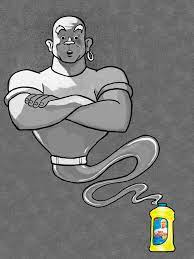
I used to imagine myself a very small figure, wrapping my arms around my knees, head bowed, before a huge Mr. Clean-type genie, rising out of a magic Aladdin’s lamp, arms folded, scowling down on me. I didn’t understand the image or why it recurred so consistently and persistently throughout my life.

Imagine him with a turban, beard, and ferocious expression

The image vanished, never to return again, once I worked through my relationship with my mother. It was a loss I recognized with gratitude. I forgave my mother, without her permission, and realized one day that I felt a loving, empathetic sadness for her; a brilliant woman whose life was taken from her by a crippling disease no one understood at the time. A tragic loss. No second chances.

Not so with my mother-in-law.

The frightening image my partner has of her is his to tell, not mine, but he has one no less frightening than mine.

It’s difficult to accept that a person can be unkind, cruel, and totally lacking in compassion. How much more so when it’s your parent; the person entrusted with your care, emotional and physical? It’s tempting – no, imperative – to search for an underlying reason to shed a more sympathetic light on such a parent.

He searched. We searched. The round of reasons we tried to fit into the square peg bulged and defied imagination.

Ultimately, the physical loss of his mother grew into the loss of innocence. The first kind of loss is met with a simple grief. She was, after all, turning 93 two weeks later and hadn’t been herself for years. The second kind of loss is far deeper and creates a grief that is painful at any age, but magnified at 70, after so many years of pretending, ignoring, excusing, and hoping.

Two of our sons were at their grandmother’s funeral to support my partner and express their respect for family ties. When I talked to our older son before he left to meet us at the airport, he asked how his father was doing. I explained that he had many unresolved issues with his mother and now they’d never be resolved. I added how important it is to confront unfinished business with a parent in life. Hint, hint. (He moved on.)

There’s a lot of loss involved in aging. Loss of a parent. Loss of freedom from pain. Loss of mobility. Loss of long term friends. Loss of mental acuity. Loss of hearing. (Shall I go on?)

A Buddhist parable addresses the problem of suffering. It describes the two arrows in every difficult situation in life. The first is the arrow of pain, in this case loss, and the second is the arrow of suffering. The first is inevitable but the second is optional. It’s the arrow we shoot into our own hearts with our reaction to the inevitable losses that come with aging.

So many circumstances are beyond our control. My mother’s disease; my mother-in-law’s nature.

We can only prepare ourselves by nurturing our souls. By taking a deep dive into ourselves and becoming familiar with the particles of a higher power which exist inside each of us. By honing our ear to hear the pure voice of equanimity which resides there.

Many years ago I weighed the option of starting a hospice center. I had a conversation with the man who created a small hospice center in Jerusalem. At the time he was in his early 80’s. He exuded empathy and kindness. We spoke after I took a tour of the center with a staff member. I was surprised to see that each of the rooms had two residents. I asked the founder of the center if it was disturbing for the residents to witness the death of their roommate. His answer equally surprised me. He said that with the work done with the residents, every death since the center’s inception had been peaceful, and inspired serenity in those who witnessed it.

Choosing equanimity isn’t a one shot deal, and it’s not easy. It takes diligence and practice and work. Committing ourselves to the effort doesn’t ensure total success, or success every time. But to quote a poet by whom many of our lives have been enriched, Mary Oliver,

“Tell me, what is it you plan to do with your one wild and precious life?”

But what about the family?

This trip started out as one of those ‘round the world’ tickets where you have to keep traveling in one direction – east or west – and can’t cross any specific ocean more than once. I must’ve played with that planning tool on the Star Alliance site for twenty hours or more over the course of several months.

Tel Aviv – St. Petersburg – Mumbai – all over India – China – Bora Bora – Alaska – Oregon Coast – California – Salt Lake City – Mount Rushmore – The Badlands – New Mexico – San Antonio – Fort Lauderdale – New York City – Toronto – The Bay of Fundy/Nova Scotia – Iceland – Tel Aviv

Juggling weather, direction, time.

How much is too ambitious? Australia, yes or no?

Should we rent an RV to travel around the US? A car with motel stays? Flights for the long bits?

But then the time came to make real decisions like renting out the house for the year and what to do with my yoga studio and my husband started hemming and hawing. There were hesitant chords of concern about leaving our lives for so long. I tried to ignore them. Gloss over them. Treat them like background noise.

A year. Twelve months.

I had to admit to myself that it was sounding like a really REALLY long time to me, too.

The house wasn’t the problem. Neither was the studio. Though I love both.

It was the kids, the grandkids, and the friends who have become no less our family in the 30+ years that we’ve shared a life.

So twelve months became ten months became six months and here we are with the second month of our six-month trip drawing to a close.

In this technological era, it’s pretty easy to keep in touch with people. We share our amazing surroundings and the interesting people who inhabit them with a WhatsApp group for our English-speaking friends daily. We post on FaceBook for our Hebrew-speaking friends or send separate WhatsApps or emails. We send messages to our family WhatsApp group, too, and keep in touch with them with video WhatsApp weekly when we can find a strong enough WiFi connection, or with audio WhatsApp when we can’t.

We spoke with our youngest son and his wife yesterday from an isolated snack food kiosk in the jungle as they drove home from an office party in Silicon Valley, California.

We remember the days, not too long ago, when we sat in Internet Cafes, paying for the internet per minute and waiting endlessly for the atrociously weak and slow connection. Then there was Ko Mak, an island in Thailand, where we had to hike an hour to the other side of the island daily for the only internet connection because I had left Israel in the middle of interviewing candidates for a position and had to go over resumes.

Earlier there just was no internet – impossible for our grandchildren to envision – so we made the occasional phone call when we could.

It seems that most of the important people in our lives are healthy and major crisis-free so far during this trip.

Before we left we knew that one friend was scheduled to have a small, probably cancerous, tumor removed from her kidney, and after we left we received the good news that all had gone well with her surgery.

One granddaughter had an ugly eye infection that seemed to linger endlessly. Endlessly finally came to an end after way too long a time for my taste. Her swollen-closed eye then returned to normal.

The worst of it so far has been a shocking but benign head tumor with sudden, unexpected, surgery that’s meant weeks of rehab for a neighbor who’s like a younger sister to me. That was a tough one because I knew that my presence could’ve been important for her morale, but, thankfully, her recovery seems to be going well.

Life is full of surprises – big and small; pleasant, unpleasant and neutral – and they don’t cease when we’re far away from our usual haunts.

So here’s the deal.

Relationships with people are one of the most important ingredients in the tasty soup of life. There’s our relationship with ourselves; our inner world. The one we take with us wherever we go, whether it’s to the living room or to India. Then there are all the others.

The ones we choose; the ones we’re born into; the ones we birth; the ones we marry into; the ones we grow into because of circumstances; the ones who are part of the landscape of our lives.

There are even relationships we’re semi-unaware of until they’re brought to our attention.

There are close relationships and casual relationships. There are close relationships that become casual sometimes and casual relationships that become close at others.

There are relationships that take us by surprise and relationships like old slippers – comfy and constant.

But there’s one reality of important relationships that my husband has pointed out to me many times – they have a past, a present and a future. If one of those elements is missing, the relationship is a like the one with that second grade teacher you had in elementary school. She may have been one of the most significant people in your life when your were seven but she’s only a fond memory today.

Anyone who knows me knows that I’m a relentless technological freak. I love the newest, the most creative, the most surprising new concept, gadget or app. I’m that person that buys the out-of-the-box FaceBook solution for neck tension and was one of the first to contract out administrative projects to freelancers online fifteen years ago. I never give up communicating with people in the Mayalayam spoken and written on my translation app in spite of dozens of puzzled expressions. I trust Uber and Waze and UpWork.

I prefer email and WhatsApp to phone calls or personal business meetings. If you WhatsApp me, chances are you’ll get an immediate reply sixteen or seventeen hours out of twenty-four, even from the tropical jungle of Kerala.

And yet.

I’ve learned to embrace another reality about relationships.

The important ones cannot, ultimately, be sustained with technology. They can be maintained temporarily in a loving electronic space when watered sufficiently – pardon the mixed metaphor – but they will eventually rise from the lower berth to the 3rd tier berth of relationships and become your second grade teacher.

It’s true of best friends, of sisters, of kids, and probably most of all of grandkids, who have the disadvantage of being too young to have solidified any relationship enough to withstand the loss of perpetual physical proximity.

I love to travel. Someday I may not be able, physically, to climb into a train berth or even get on a plane to travel to another exotic location, but I’m guessing I’ll become an armchair traveler. Meanwhile, I look forward to the next four months in India, a week in Greece with my daughter and granddaughter in July, and am already planning to rent a little place for three months in Guatemala next winter.

But I won’t be fiddling with that ‘round the world’ Star Alliance again in anticipation of a year of travel. I have a feeling that I won’t even be looking at six months again. I’m so happy that we grabbed the opportunity to take this incredible journey. I’m seriously enjoying every single day.

While I tend to feel ageless, I am aging. But that’s not the thing. It’s not fun to do many things I used to have fun doing but I’ve barely noticed that I’ve stopped doing them. I’ve moved on to things I may have once thought slow or unexciting and get a huge kick out them now.

The thing is that all the people I love are aging. Yep, even Alex, our youngest grandchild. And certainly our family-like-friends who have almost seventy years on her.

I want to be IN those important relationships. I don’t want a single one of them to become my second grade teacher and I don’t want to be theirs.

I’m so grateful that I’ve birthed, married into, grown into, chosen, and been brought by circumstances into relationships with multi-faceted, quirky, wonderful people whom I love and, wonder of wonders, love me back.

One of the best things about my life is that I’m fortunate enough to live in time that I can nourish both my love of travel and my love of relationship, if I can only remember to balance them and adjust to the times. After all, I could’ve been born under a bridge in Mumbai.

Happy Monday to all from 20 kilometers from the middle of nowhere.

Awakening Again

I made a new friend on my walk today. We’ve met with mutual suspicion six times a week for a few weeks now. He lowers his head, looks at me surreptitiously, and keeps his distance. I keep my eye on him as I pass on the other side of the path. But today was different.

I walk for about an hour every day except Thursday, usually alone. It’s a peaceful time. I listen to a talk for part of the time, and to music the rest of the time, except for Saturday morning. Saturday is Shabbat and my time off from electronics. My Saturday walk is a little less quiet – all that noise in my head. That’s okay, too, though. My curiosity gets a kick out of all those thoughts. “What? THAT one again?”

I started this walking thing – or I should say I got back to it after a very long break – about 2 months ago. It seemed an easily accessible habit, useful for changing the sedentary lifestyle that crept up on me when I began having hip pain from my Nordic machine.

Research shows that it takes 28 days to create a habit. That seems true for my walking regime. It’s become a habit. I check the weather & my schedule to decide the best time to get out there. The time arrives and I lace up my sneakers. I connect my earbuds, choose the talk I want, slip the phone into a back pocket, and I’m out the door.

Today’s walk started out the same. Aside from a sore throat and a little cough, nothing warned of a difference in today’s walk. After almost a full day of rain yesterday – with just enough delay to allow for a walk under threatening skies – the sun warmed the crisp mid-winter air just enough to allow me to shed my down jacket after fifteen minutes.

The talk I chose was good. They always are. The winding road up the hill was pleasant – not too easy and not too challenging. It always is.

The difference came from inside, I guess. One of those awakenings that come upon us all of a sudden. Or it seems to be all of a sudden, but I’m betting it’s the culmination of lots of stuff. For some reason, today, after about forty similar walks, I felt how strong my legs have become and how easy my breath comes on the incline now. I was aware of my sure-footedness coming downhill on loose gravel. I realized that I was enjoying the walk for its own sake. I had a glimmer of why hikers love to hike. Today it wasn’t about being healthier or exercising my knee or my hip. Today was pure pleasure.

When I got near the top of the penultimate hill I saw the same dog I’d seen in the very same place on every walk, but this time I didn’t pass him warily. This time I approached him with my hand extended. He didn’t move. He, too, had created a habit. But he let me rest my hand on his head and, after a few seconds, his tail started wagging as I massaged his neck. It was only a moment in time. Then he went his way and I went mine.

Later, on a secluded, wooded path, I danced to “Fallin’ All in You” before resuming a sedate demeanor more suitable to a 66-year-old woman on a bright noon somewhere in January.

(please click on the photo)

Hours later I can’t stop the feelings of gratitude. Thankful for my body’s vitality (with all its aches and pains of aging, coughs and sniffles of winter) – the muscles in my legs, my lungs, my heart. Thankful for the undeveloped countryside right near my home. Thankful for the resources and the freedom to wander. Thankful for my many teachers – official & unofficial – who imbue me with the ability to see the half-full glass (and the occasional moments when I realize that it’s full).

Maybe I’ll meet my friend again tomorrow.

News Flash: Old Age is Not the Enemy

Old Super people                            Old People iin Wheelchairs

Fight                                   Or flight?

Remember when 40 sounded old? Remember when you weren’t sure if your mother was 38 or 83 (because, hey, what was the difference?) Remember when you hoped you’d live long enough not to have to do homework? Or wait for summer to have some fun?

Okay, kids, here we are. We made it!

anxiety

NOW WHAT?!?

Truth is that it kind of creeped up on me. The 40’s were great years. And then the 50’s? Even better. And then came…THE SIXTIES.

I breezed past my 60th birthday. We had a big birthday to mark the accomplishment. But, really, I just liked having all those people in the same room – the people I love and like and some I hadn’t seen in awhile. I didn’t really think of being 60 as a big deal.

The rest of that year began what I like to think of as my period of enlightenment.

Awakening to the reality of small aches and pains becoming larger and not so easy to ignore. Awakening to an EVEN SLOWER metabolism. (how was that even possible?)

And as the 60’s progressed I couldn’t deny that I  had less energy, less ambition and less cartilage in my knees.

Old white water rafting                                                                       =   Old canoe

A new stage in life began the day I closed  my company.

Stage One

business woman>>>>>>  No work

Another stage of life began when I stopped agreeing to meet with people who just “have a couple of questions”.

Stage Two

Then another stage when the answer to “So, what do you do?” began without disclaimers.

justify

Followed by a blissful couple of years when I:

  1. wrote a book and published it.  http://www.amazon.com/Yoga-Detectives-Lesson-A-E-Prero/dp/1512109371

Yoga Wed am 002                   Yoga photos 004

2. created a yoga studio

and 3. filled it with classes

4. got into a regular habit of spending quality time with my grandchildren

036  (maybe the most fun of all)    001

And now? Now I seem to have arrived at Stage Four.

Partially I’ve arrived here on my own, in a natural kind of way, and partially I’m being dragged into it and, I admit, initially with a bit of kicking and whining, by my friends. Noooo

This is a Stage of wondering a lot about how to best do this thing called “Old Age”. Give into it? Okay, THAT sounds bad. Fight it? Hmm. That sounds tiring.

Road Lesds Traveled And I haven’t found a good guide book yet. Not on Lonely Planet or Footprint or even Google.

Oh, there are plenty of books out there on the topic. I’ve read a bunch of them. Probably the one I liked the best was From Age-ing to Sage-ing http://www.amazon.com/Age-Ing-Sage-Ing-Revolutionary-Approach-Growing/dp/1455530603/ref=sr_1_1?s=books&ie=UTF8&qid=1449132020&sr=1-1&keywords=from+age-ing+to+sage-ing+a+revolutionary+approach+to+growing+older   But I don’t seem to have many people in my life who are looking for a sage. And, truth be told, it sounds a teeny big presumptuous.

Coach?  Yuck! Gives me a rash thinking of that title. Mentor? Better but headed toward ‘sage’.

And, anyway, is this Stage about what I am for others or for myself!?

pondering

When I taught aerobics and hip hop it was all about pushing to your limit and going one step beyond.

When I teach yoga it’s more about investigating your limits and taking one step back.

But in this evolving life of mine, where old age has creeped up on me? A step forward? A step back? What does that even MEAN?

Many of us loved what Dylan Thomas had to say about it:

Do not go gentle into that good night,

Old age should burn and rage at close of day,

Rage, rage against the dying of the light

But, you know what?, now it just makes me roll my eyes. And, hey, he was in his mid-40’s when he wrote that. I might have agreed more when I was in MY mid-40’s.

Raging and burning? Unh unh. No raging and burning for me. I have a feeling that road leads to frustration and grumpiness.

Old and grumpy

For the past 2-3 months I’ve been feeling like I’ve over-scheduled my life; like there’s not enough time to sit and write or sit and read or just sit. But facts must be faced…right?…and the fact is that I’m still teaching the same amount of classes and private lessons a week and I’m still traveling each week to visit the same number of homes to which I’ve lent my grandchildren.

It’s that bogeyman of all bogeymen…old age. I just have less energy for it all. So when I’ve finished teaching all the classes and private lessons and finished driving and playing with my amazing grandkids and finished shopping and cooking and cleaning, I’m POOPED.

Now there are some who make fun of us older people and our running out of energy mid-afternoon

Old Woman sleeping  but there can be some nice things about napping.  Old People Napping  And maybe, just maybe, that’s part of it all.

No, no, not napping. But pedaling down some of those things we love to more manageable bites.

Meditation for Elders  Old woman enjoying music   Old person reading

And maybe we can sage our way into some nourishing and gratifying volunteering  Old professors  Old knitter

Okay, so we tend to freak about forgetting a couple of details

Old person forgetting

But young people forget stuff, too, they just don’t worry about it.

Young person forgetting

And there are some great things about long term memory.

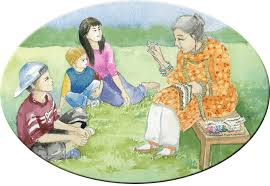
Old woman telling stories

I think I DO want to fight the tendency to decrease the size of one’s world to the boundaries of what’s familiar to me; to what’s easy and comfy. I want to fight to keep my boundaries open to new ideas and new activities, new places and new people.

But, at the same time, I want to accept gracefully my decreasing physical energy and re-direct my time to the ever-changing physical reality of old age. And, yep, I want to accept that my mind isn’t quite so quick, quite so sharp and, at times, quite so reliable.

Ultimately, I know that ‘old age’ is NOT the enemy. It’s my own fears that I need to remain mindful of and face with compassion, kindness and awareness.

Older yoga  Old women walking  Old cooking

I can hear you saying, “Yeah, right. Blah blah blah.” So here’s what I have to say to you…

mountain out of molehill

Well, maybe.

Let’s hope so!