But Nobody Died!

Our youngest son, Rafael, moved with his family to New Jersey last night. We don’t know how long they’ll be there. We don’t know why they moved.

Neither of their excellent jobs requires the move. They have a beautiful house here that they renovated just 5 years ago to their exact specification. Their garden is flourishing, as are their kids. All four kids have many friends and are happy here. They have an active social life with friends and with their siblings/cousins. The other grandparents live a 15-minute walk away, are retired, and are always happy to have the kids over, pick them up, and take them places.

The given reason is that they get itchy when they’re in one place too long. They seek adventure (in New Jersey? 😂) They seek a challenge when things are too settled and smooth. Our son fears getting stodgy (he’s 42). At 40, having made partner at the most prestigious law firm here, he quit to do something else. He didn’t want to get stuck in a rut.

I sort of get it. I was that way myself. But once we had kids, I reframed my need for change into something more compatible with having first one and then, within 7 years, five kids. I changed professions six times; just about every 2 or 3 years. I wrote a few books. Once the kids were a bit older we traveled…a lot.

And, of course, the biggie – we moved from the US to Israel.

Rafael and his family moved to the US once already. They spent 5 years in Silicone Valley. He’s a hi-tech lawyer so that made sense. It provided him with the lift he needed to become one of the younger partners in his law firm. We missed him. The 10-hour time difference and 16-hour flight were brutal. But it made sense. And once was enough.

This move makes less sense to us.

Of course, we’re ten years older.

My in-laws were devastated when we moved our own young family to Israel. My mother-in-law literally keened and wailed when we parted at the airport. But, we felt, we were moving toward something. It was an ideological move. It was living our dedication to Zionism. We still feel that way.

What kind of ideology could possibly warrant a move to New Jersey – the state Americans love to mock? Clearly (to us) they are moving away from something and not toward something.

I get that, too. Living in Israel is not for the faint of heart.

Although it has one of the strongest, most stable economies in the world, wages are relatively low, real estate is ridiculously priced out of most young families’ reach, and many families struggle to get through the month. None of this applies to Rafael, who is blessed with financial stability.

Israel has been at war from the moment the state was established in 1948. Sometimes the war is more volatile and sometimes less, but it’s a constant threat. Our neighbors make no bones about hating us and have consistently made clear their goal of destroying our state and killing us all. The past two years, since the atrocities of October 7th, have been traumatic for every single family in Israel, and continue to be so.

Hard times, however, seem to strengthen Israelis’ resolve, not weaken it.

The divisiveness in Israeli society over politics and religion seems to be more of a factor in people leaving Israel than the war. The exaggerations and fears on each side lead to a lack of tolerance that feeds on itself.

For those of us who left comfortable lives in the US (or other Western countries) to live in Israel, we take a dim view of those who leave. It would be more accurate to say that many of us look upon it as betrayal of an ideal; betrayal of the country. In addition, given the current ugly anti-Semitism in the world, we believe that Jews should be aware today more than ever that Israel is the place for Jews to live.

We worry about our children and grandchildren’s safety. We worry about our grandchildren being taken out of a place where they are like most everybody else – it’s not an issue – and put in a place where they are ‘the other’.

We believe that our son and daughter-in-law have a tremendous amount of talent and skills to give to our country, and that our country needs people exactly like them.

And, perhaps most of all, I’ll miss being able to drive an hour whenever the spirit moves me and enjoy a good cup of coffee and great conversation with my youngest son. He’s the best! I’ll miss all the many special things about each and every one of those four delicious children. And, yes, sometimes, of course, I feel that strong twinge of sadness and loss in my heart.

Tisha B’Av is the day that our first two holy temples were destroyed. The date is commemorated with a 25-hour fast and special prayers. When tragedy strikes and someone is very sad we might say she has on her Tisha B’Av face.

That’s the face I see on many of our friends lately when considering our son’s departure with his beautiful family.

And, ironically enough, I want to console them.

“But nobody died! They’re only going to New Jersey!”

As hard as it is for us to imagine, they’re off on what they see as an adventure for their family. We made our choices. Some of them were great and some not so great, but they were ours to make. And if they turned out to be not so great, we readjusted and reframed and began a new adventure. Or at least I hope you all did, because we sure did. Why be stuck when life is so fleeting?

I, personally, believe they’ll be back in a couple of years. After all…New Jersey. And in the meantime, how fortunate that in this day and age there’s Facetime and WhatsApp and convenient flights.

They’re a happy, successful, healthy couple with four amazing, funny, quirky, interesting, healthy kids. We’ve had them near us for five blessed years and, G-d willing, we’ll have them near us again one of these days.

So chin up, friends, no Tisha B’Av faces, please.

Do We Really Get It?

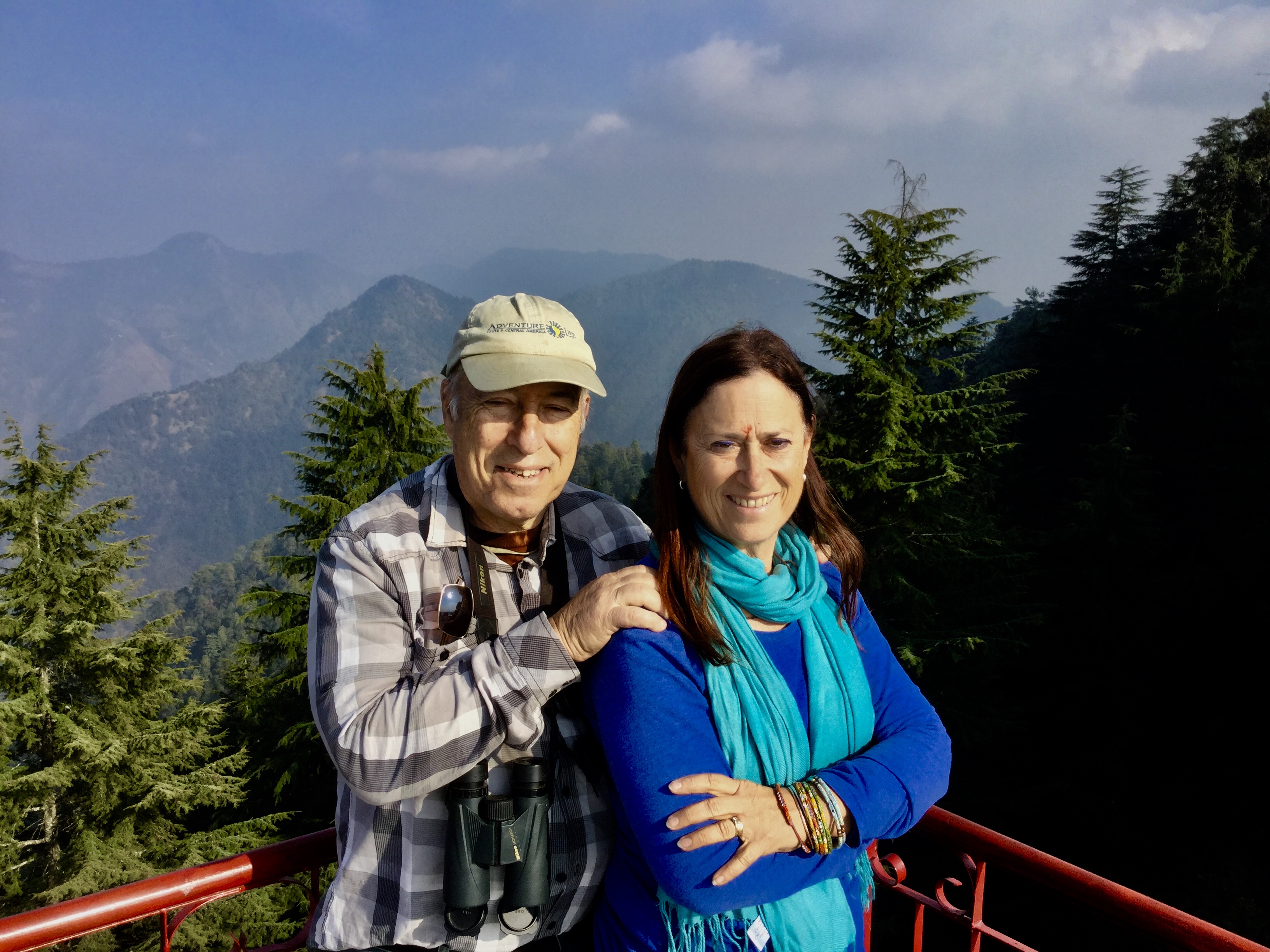
All told, we’ve been in India almost a year. We’ve spent over two months in Kerala, four months in Rishikesh, and a week to ten days in Hampi, Meysore, Delhi, Goa, Mumbai, Varanasi, Darjeeling, Khajuraho yogashram, Kaziranga, Puri, Shimla, Dharamshala, Dalhousie, Chennai, Pondicherry, Auroville, Bandhavgargh, Rambagh, Jim Corbett, and the Andaman Islands.

My partner has been learning Hindi off and on for 7 years. Between his Hindi and Google audio translate we’ve had many conversations with people about their lives and their opinions about many issues – geopolitical, philosophical, sociological, religious, and how they view the future.

We’ve observed familial interactions, public and less public behaviors, hygiene and eating habits, changing clothing preferences, and acceptable and less acceptable commercial activities.

We’ve experienced the kindness, patience, and acceptance of Indians in many different situations from driving to waiting in line to communication difficulties to cultural misunderstandings.

When asked how many children an Indian has they will invariably give a number that reflects only male children. Mothers as well as fathers respond in this way. Sexist? I don’t think so. It seems that in traditional Indian families (and in spite of rapid and visible change it’s estimated that over 90% of Indian marriages are still arranged marriages) sons remain in the nuclear family home after they marry. Their wives become subservient to the matriarch who travels with them on vacations and sets the tone for parenting. Daughters move on to their spouse’s family. They are only temporarily part of their parents’ lives. I’ve come to believe that is why they’re not included in the natural spontaneous reply about the number of children in the nuclear family.

Is this belief accurate? Maybe. Maybe not. One thing I’ve learned is there’s no point in asking for clarification. Such requests are met with puzzled expressions followed by acceptance of my theory regardless of its accuracy or inaccuracy.

Here’s a much more prosaic, but much more day to day question I’ve been asking in vague euphemistic terminology since our very first visit in 2016. Why don’t Indians, especially women, use toilet paper? It’s excellent for the ecology of every country and certainly one with a billion and a half people, and yet… What’s the deal? It’s all well and good that our tushes and other intimate places are actually cleaner after that spritz from the bidet but what is it about walking around wet that doesn’t annoy them? And is it even hygienic?

They’ve learned that foreigners need toilet paper. Hotels provide small rolls of it and are happy to replenish it as frequently as their patrons allow themselves to make the request (we tend to buy our own to avoid the issue altogether). But when asked why they don’t require it themselves I’ve been met with puzzled expressions and literally no answers, They don’t understand why I do require it but accept it and I don’t understand why they don’t require it but still ask from time to time.

The nearest things I’ve received to an answer have been (1) the concept of the comfort of dry being preferable over damp is a Western concept (really?!?) and (2) you can carry a small towel to dry off, keep it in a small plastic bag all day and wash it in the evening (a nice solutionbut I doubt Indian women actually do that).

That may be similar to something an Indian friend of ours said recently. He owns an amazing guesthouse literally 50 meters from a pristine Arabian Sea beach. He’s made lots of improvements over the past few years. Indian tourists are accustomed to ordering their meals and eating in their rooms. They seem to prefer it. It might be a question of the chicken and the egg. Maybe at one time hotels didn’t have restaurants. So our friend didn’t have a restaurant but realized that the (mostly foreign) guests preferred not to eat in their rooms so he added a really nice place to eat.

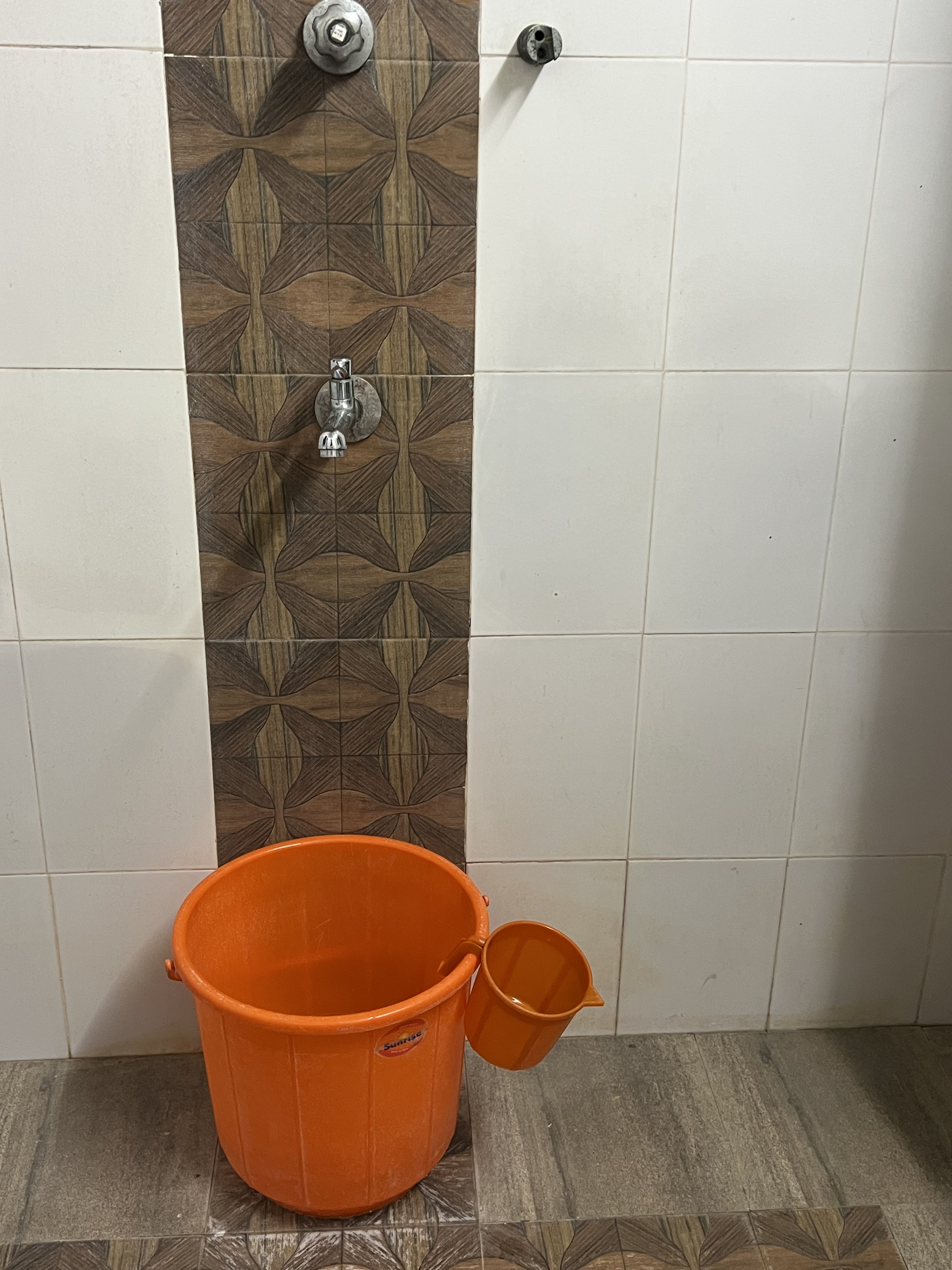
His showers had no hot water. Granted it’s quite hot in Thumboly Beach and the locals see no need for hot water but others do. As a result, he decided to arrange hot water and told us he had done so. In most Indian showers there’s a shower head and also a faucet beneath it about a foot annd an half off the floor with a bucket and plastic cup below it. Turns out he set up water in the lower faucet and not in the shower head.

When we laughed about it with him he said something quite true and profound. He said that one of the differences between Israelis and Indians is that Israelis look at something and immediately start figuring out ways to improve upon it while Indians look at the same thing, accept it as is, and immediately figure out a way to live with it. There are pluses and minuses in both approaches.

And what about respect for personal space, acceptable noise levels in public places or in hotels late at night, what it means to be a couple, the relative merit of avoidance or honesty in confronting legitimate disagreement or misunderstanding; the cultural differences go in and on.

Even when we think we get it we have to keep asking ourselves if we really get it.

There’s no escaping the fact that part of the joy in being in India is the adventure of the Western shrug of shoulders or the Indian wag of the head. The humor in “I don’t know.” The puzzled expression followed by a smile.

You aren’t in Kansas anymore, Dorothy. And ain’t that grand?

Not Agreeing to Disagree

We live in an age where so-called enlightened people (you know who you are) are reluctant to stand up for their beliefs. Where the words “right” and “wrong” are taboo, “evil” is an archaic term, “good” is a question of perspective, and regarding all disagreements people prefer to politely agree to disagree.

I know someone who has decided to not regard himself as a member of humanity because of all the terrible things people do to each other.

Is that really a possibility?

While I don’t believe so, I don’t close my eyes to the terrible things happening in the world or my part in them as a member of humanity. But I also refuse to see all actors and all actions as a question of perspective.

I don’t agree to disagree.

I acknowledge that I am not knowledgeable about every conflict around the globe. I am too lazy or busy with other things of more importance to me to educate myself about most of them. I accept that my opinion about those conflicts, should I be foolish enough to insist on an opinion, is of little value or accuracy. I don’t agree to disagree with those who have an opinion. I simply confess my ignorance.

I accept that unfortunately it is no longer possible to trust news sources as accurate and unbiased. Lacking a simple alternative, I concede that my opinion can only be superficial, uninformed, and speculative. Not to mention lacking in importance, and very likely offensive to many of those who have done the research, spent the time to form an educated opinion, or who are actually living in the conflict.

I live in an area of conflict. I live in Israel. The conflict in our very tiny country has been going on since biblical times. The names and faces of our enemies have changed over the centuries but the conflict is the same.

It’s unclear to me why so many people around the world feel the need to focus on and weigh in with an opinion about our conflict.

More than 45 armed conflicts are going on today in Africa alone. I challenge you to even recognize some of the names of the countries where these conflicts are taking place (how about Burkina Faso? I had to look that one up.) There are 21 such conflicts going on in Asia, 7 in Europe, and 6 in Latin America.

Why don’t we see demonstrations about any of those conflicts? Why aren’t there daily “news” reports about them? No outrage about them?

My friend who no longer considers himself part of humanity is right – we’re a harsh, often brutal, murderous species. Many of us would like to think of ourselves as having progressed past territorial, ethnocentric, belligerence but the facts on the ground prove otherwise.

Why, then, is Israel constantly under the world’s microscope? Why is the lens of that microscope constantly out of focus? Why is the eye looking through the microscope so willing to ignore the possibility of a resultant lack of accuracy? So sure of the hypothesis that there’s absolutely no modesty about the conclusions.

I rarely allow myself to get dragged into conversations about what’s going on in our corner of the Middle East with people who live in other corners of the world. It seems pointless to talk about reality on the ground as seen through the eyes of someone who actually lives on that ground. As the saying goes – “Don’t confuse me with the facts.”

It’s a bit disappointing to hear the same tiresome rhetoric when the rhetoric makes no logical sense and is being spouted by people who one is justified in considering intelligent.

The rhetoric of “We realize that burning babies alive, decapitating people, gang-raping women, and starving hostages is truly terrible, but surely murdering 30,000 innocent (sic) residents of Gaza is a disproportionate response.”

I can hear the echo, echo, echo from the media and Arab propaganda. Why can’t they?

I don’t intend to explain why that rhetoric is patently ridiculous and totally transparent to anyone who cares to put their preconceived notions and biases aside. I just want to put forth the question of why people are so eager to have an opinion based on nothing when it comes to Israel.

And now comes another wake-up call.

People! There is good and evil in the world. As much as we prefer to say it’s all a question of perspective, we all actually know it when we see it.

We all know in our hearts that whatever our differences may be politically and philosophically, it is evil for us to machete limbs from the bodies of those with whom we disagree (Sierra Leone), to throw gays off roofs to their death (The Islamic State – Iraq and Syria) and to sex traffic women and children (Libya and others), just to name a few of the actions of obvious evil.

We all know that it’s good to provide shelter for abused women, food for those who don’t have enough, medical care for those for whom it’s unaffordable, to listen to people in distress who need an empathetic ear, and share our resources with those who have limited access. We may not do all of it, but we recognize the good nature of those activities.

It’s not rocket science and it’s not a matter of culture or perspective.

I don’t agree to disagree about any of the above and I’m past being tired of those who are. I’m disappointed and I’m sometimes angry and, while not interested in shouting it from the rooftop, I’m no longer willing to smile when told we’ll just have to agree to disagree. I’m willing to agree to disagree about the best restaurant in Jerusalem or the most fun activity in Disneyland.

Our world is a tough neighborhood with some very evil, brutal residents. It always has been. In the past, the good guys didn’t accept evil as a given and didn’t excuse it as cultural or a reasonable response on the part of the downtrodden. There were clear rules of conduct even for the resistance of the downtrodden that didn’t include beheading and rape.

Regardless of what my young-ish friend thinks, we cannot drop out of humanity. We’re all a part of humanity whether we approve of the behavior of all our counterparts or not. So let’s get on with realizing the limitations of our knowledge, acknowledging the presence of evil actions and evil people who carry them out, and refusing to agree to disagree with uninformed opinions and evil.

Whether or not you choose to recognize this reality – Israel has restructured the Middle East to secure relative peace and quiet for a decade to come with all that entails for the rest of the world. None of it at our own instigation nor without a high price in lives lost and families without one parent home for months at a time.

We don’t expect a thank you but we could do without your slogans condemnation.

Life in The Great Plains

The Great Plains of the United States is a vast area with few people and beautiful vistas. You can drive on the open roads in Montana, North and South Dakota, Wyoming, Nebraska, and Kansas for hours and see only a handful of cars. The houses are few and far between and without exception have an American flag flying in front. Each town’s population sign boasts between 29 and 1500 residents.

On our way from the Battlefield of Little Bighorn to Cody, Wyoming, where we’d be spending the night before heading into Yellowstone Park, we stopped in for some lunch at a small diner in the town of Lovell, Wyoming, population 2320.

During our travels, we’ve come to expect quirky, odd people and sights, but so far in this part of America what’s stood out the most is the utter normalcy of the people and towns. The diner was quite ordinary. Plain tables and chairs. Around one table were four middle-aged women having a girls’ lunch. Otherwise, we were alone. The menu was also nothing special. Hamburgers, french fries, pizza, tuna salad sandwiches.

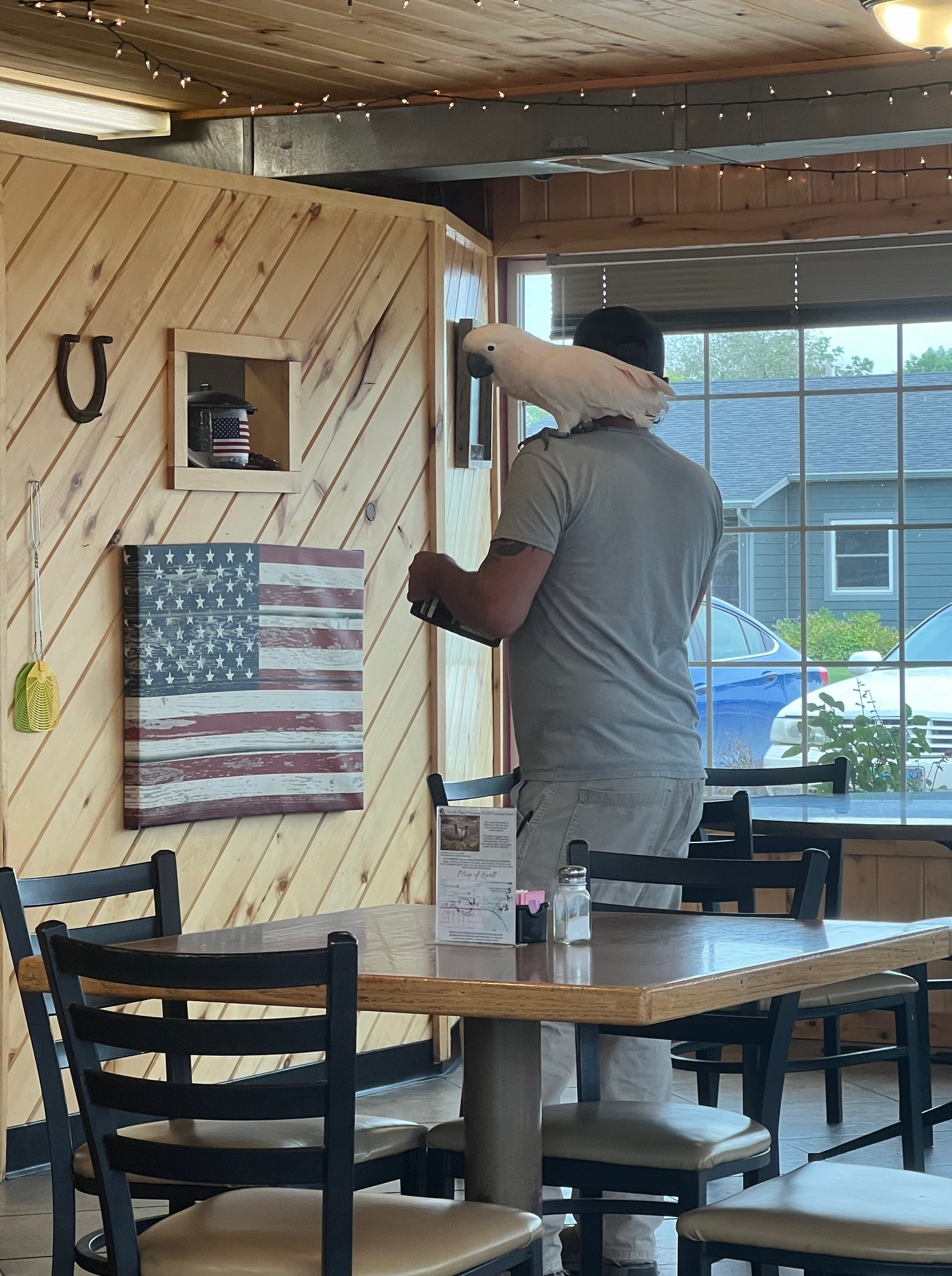
And then there was this sight –

No one seemed to think it strange. I guess man and bird are regulars.

Our teenage server was a fresh-faced, blonde girl. No tattoos. No piercings. No make-up. Just a few freckles and a friendly smile. I found myself wondering about her life. Being a teenager in a town of 2000 people in the Great Plains. The nearest city, Cody, boasting 10,000 residents, is an hour away.

After we’d eaten our sandwich and were waiting for coffee, I approached the girl and asked if she’d be open to talking about her life. She nodded with a respectful ‘yes’ and a shy smile. I started with an easy question.

“What do kids your age do for fun around here?”

She didn’t hesitate. She told me the obvious – there’s nothing to do in Lovell – but went on to say that, as a result, kids make their own fun. They sometimes build a campfire and sit around talking and telling stories. They go fishing. Most teenagers work in the summer and often after school during the school year.

I mentioned that I’d noticed the lack of tattoos, piercings, and make-up and asked if that was the norm. She replied that most families in Lovell are Mormon (she’s not), and have been brought up not to find those kinds of things attractive. There’s a strict dress code at her school, which is fine with her, but she wishes they were allowed to wear leggings. (that was her only objection)

I asked if she saw herself settling down in Lovell after school or moving to a bigger city. With a mischievous smile, she said that her dream was to go to New York City and become a cosmetologist but added that she’d likely get married and settle down in Lovell, or maybe as far away as Cody.

Interestingly enough, her parents divorced when she was 10 and after a year living with her mother in Denver, Colorado, she chose to move to Lovell to live with her father. Of course, the explanation may lie simply in a troubled relationship with her mother, but I wondered later if it was the siren call of a simpler life surrounded by stark natural beauty.

There are undoubtedly inconveniences living in a tiny town with limited options. But in the towns of the Great Plains states, there’s also the inspiration and peacefulness of being surrounded by natural beauty. The rush and tension that people love to hate in the big population centers are absent. There’s virtually unlimited space. Zero crowding on the roads, in the restaurants; no long lines in the grocery store or the post office (which each town has!). From our limited experience, no one is in a hurry. They have time for conversations with the neighbor ringing up their purchases and the customers in the diner.

At our server’s age, I was also a server in a restaurant. I worked in an Indian restaurant, wearing an elegant sari, where the choices on the menu were exotic and expensive. The restaurant was on the river that ran through the tourist area of San Antonio and was constantly packed with people. Without a reservation, people were out of luck. I saved my tip money to get the hell out of Dodge. San Antonio, a city of over a million people, was too familiar. I wanted nothing more than to strike out, on my own, for more interesting pastures.

It took me 50 years to reach the point that our server reached by 16. The point where I appreciate the empty open road, the farms where the closest neighbor is at least a kilometer away. When I can often think of nothing better than sitting in a wooden chair looking out at a calm lake for an hour or two with an unopened book on my lap.

Lubec, Maine

I used to think that living in the city provided more opportunity for connection to other people. I imagined living in rural areas to be isolating. Living in a small community of 5000 people created doubt in my mind and observing people and talking to people in The Great Plains sealed my recognition of my faulty reasoning. I now think that, while it clearly depends on the individual, living among fewer people may very well encourage kinder, more intimate connection than living in a city.

As the miles rolled by, we were finding the sheer size of the open, empty plains comforting. Neither my partner nor I being particularly stressed out or hyper people, we were, nevertheless, experiencing an inner loosening in our very souls.

I often thought of travel from Wisconsin, where I was at university for more years than I care to think about, to San Antonio, as boring. Lots of wheat fields. Lots of cornfields. they go on and one and…on.

The boredom of the 70s through the 90s is today’s meditation.

Like Father; Like Daughter

I was looking for something in an old file the other day and came across a letter my father sent me 33 years ago. It was the day he found out that his cancer had returned and the prognosis was not good. In fact, within six months he would be dead.

When I showed it to my partner, he said that it looked exactly like something I might have written. The sentiment is mine, Even the language is mine. And it’s very 2024, even though it was written in 1991.

My Dad. What a special person. A complicated man. A man never quite at home with his emotions. Quick to smile; slow to hug. A very active inner life. A very active public life. But most often not emotionally present for those of us he shared a house with.

I like to think things would be different today.

So here’s that very special letter, with those very special thoughts, lessons for us all, from that very special man who was my father.

  It was an idyllic morning in sunny Sarasota.

  I stepped outside the hospital, blinking in the sunlight. The everyday sights and sounds were different; they were as never before. The deep blue sky, the gently moving leaves, the traffic flow, the people — all seen in a new light.

  I reflected on how casual I had been, before my traumatic experience, to such common phenomena and to so much else in life — indeed, to life itself. And so I resolved to spend wisely whatever of life was yet to be mine; not to squander it. For life, I saw with stark clarity, is an incalculable gift. It should be held close, made the most of, constantly enriched, and cherished.

  That is one half of the lesson I learned there, standing in the sun. There was another.

  The wondrous sunlight enveloping me, could I retain it? Could I keep that sun from setting? Had I tried to halt its slipping away, and inevitably failed, how frustrated and saddened I could have been. But if that were my reaction I’d have transformed the glorious moment into one of regret and sorrow.

  But it is not only the sunlight which must slip away. Our youth and our years, our senses and our lives, these must go also. And we must accept their inevitable departure; be ever ready to let go.

  That is the other half of the lesson.

  This, then, is the paradoxical conclusion. Hold fast, hold close the precious gift of life, but with arms so loose as to be ever ready to release it; with arms virtually open.

  Is this an impossible challenge? Physically, yes; mentally, emotionally, of course not. We do it repeatedly throughout our lives. We give away our hearts in love, and we have more heart to give. We wear out our minds in deep thought, and we have a better, sharper mind. We are smitten by pity for the deprived, and we are the stronger for it.

  The key word in the conclusion about life is ‘inevitability’.

  Aware that life must and will inevitably end, each of life’s moments becomes all the more cherishable. The sole unknowns are the when and the how; when and how these moments will end. The choice is between succumbing to fruitless agonizing — fear and dread of the when and how — or living those moments richly, fully, gratifyingly; savoring them and saying, in effect, “I’ll relish this as long as I may, and whenever it ends I’ll be grateful for having had it — and hope there are some others who will be grateful that I had it also.”

  I imagine nodding heads. It does seem logical. But is it unduly difficult to transfer from the thought process to one’s inner being? To transplant the idea into actual, living reality? To live by it?

  It is not difficult. We do it again and again in our daily lives.

  Look. We are enthralled by a spectacular sunset. We are immersed in passionate expression of our love. We are transported by a rapturous violin concerto. Do we destroy such moments by dwelling upon their transitory nature? Our minds tell us these moments will pass. We know it. But do we permit that knowledge to suck out our enjoyment? How infinitely sad that would be. And in truth, we don’t, do we?

  So it is, or so it should be, with life.

  Life, that wonder-filled possession, is ours to keep for a while. Think of it as the wise sage Bruriah, wife of the Tanna Rabbi Meir, did, as a divine loan. How wholesome, how sensible, to make the most of the temporary gift while accepting that one day, any day, it will be taken back; that one day, as in Joshua Leibman’s lovely Day in the Park fable, the Great Nurse will beckon, “It’s time to go home now.”

  And, so, hold life close, with open arms.

  Of course, I have had frequent occasions in my life to recognize life’s precious worth — in peak moments of joy, or when escaping serious dangers. And, of course, I have long known that being mortal, my life must end at some time. But my acceptance of both of these truths was tucked away inside me somewhere. They were concepts I did not question. They were “givens”. I was never challenged to affirm them. I was never tested. How, then, could I be certain? When the Angel of Death confronted me, how would I really react?

  I have been tested now.

  And I thank God that I found, find, myself in total accord with the balance; with the synthesis of holding life close and readiness to let it go — of holding life with open arms. And in cognizance that I really believe this, that it has penetrated my inner being, I am warmed, strengthened, grateful, at peace.

  For you who may read or hear this, I pray that you find the wisdom to enjoy life, to cherish it, to make the very most of it for yourself and for those with whom your life is entwined; to hold it close — all the while accepting its inevitable departure without fear, frustration, or dread; prepared to let it go.

  And if you do that, if you really make that belief your innermost conviction, you will be among the most fortunate of mortals. For you will not only rob death of its anticipatory fright, replacing that with inner peace, but your life will be enriched beyond measure.

Amran Prero, March 1991

Addendum: I was with my father for the last few days of his life. We watched television together, chatted about my kids and about Israel, and he told me about a series of dreams he had on the nights leading up to his death. He was calm, at peace, happy, and in good spirits. He laughed at Tom Selleck’s Magnum P.I. as usual, giving him a constant barrage of advice.

He truly held life close with open arms.

Udaipur: The Village Tour

We met our daughter and her three children at the Delhi airport after they’d spent the weekend in Agra seeing the Taj Mahal. We flew together to UDAIPUR, a small, pretty city in the Rajasthan District. UDAIPUR is known as a romantic honeymoon location, home to the lovely Lake Pichola and impressive City Palace. My partner and I were there 7 years ago on our first trip to India and thought it would be a good place for children’s activities.

Rajasthan has its own rich history of colorful dress, dance, and music. We were sure the kids would love the cultural evening with the live Rajasthani music and groups of women dancing with bells on, fire pots on their heads, and especially the young woman dancing while balancing 10 colorful pots on her head. We were wrong. Luckily it was only an hour.

The next day we fared a lot better. All but one of us really got into the 3 hour art workshop where a patient, sweet, talented artist helped us each paint our very own miniature. Our daughter and granddaughter both created truly beautiful miniature paintings. My partner’s peacock and my dancing elephant weren’t bad but revealed that we needed a bit more instruction. Our youngest, a very active 7 year old, showed more focus and attention to detail in his prancing horse than I’d ever seen.

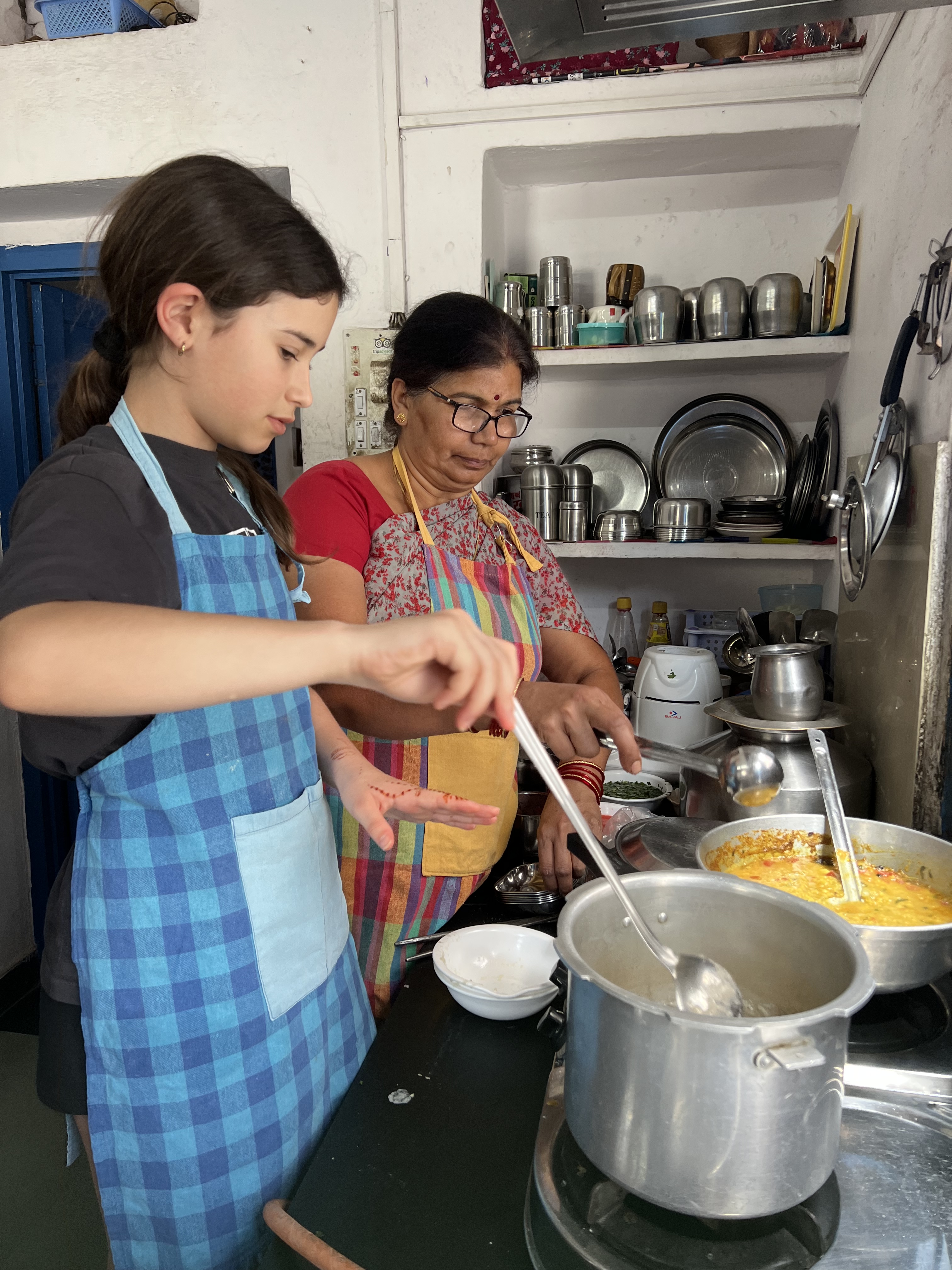
The 3 hour cooking class was a hit with all of us. It was very hands on – from the chopping to the kneading to the measuring and mixing of spices, to the frying…and, of course, the eating. The shy cook started off embarrassed that her English might not be good enough, but once she warmed up (and it’s hard not to warm up to these three kids!), she totally took over the instructions from her (very good looking) son, Gautam.

But the day none of us will ever forget is the day of the village tour.

My partner and I had taken a cab and driver out into the countryside 7 years previously. Our driver took us to several cottage industries – hand stamped textiles, pottery, a country art school for miniatures. We didn’t remember the names of the villages so after reading the glowing reviews of “Salim’s Day Village Tour” we decided to put our motley crew in Salim’s hands and follow wherever he led.

Salim, a devout soft-spoken Muslim, showed up dressed all in white in honor of the Muslim holiday of Ramadan. He brought another auto-rickshaw in addition to his own. We all piled in and off we went in the shimmering 35 degrees heat (95 degrees Fahrenheit).

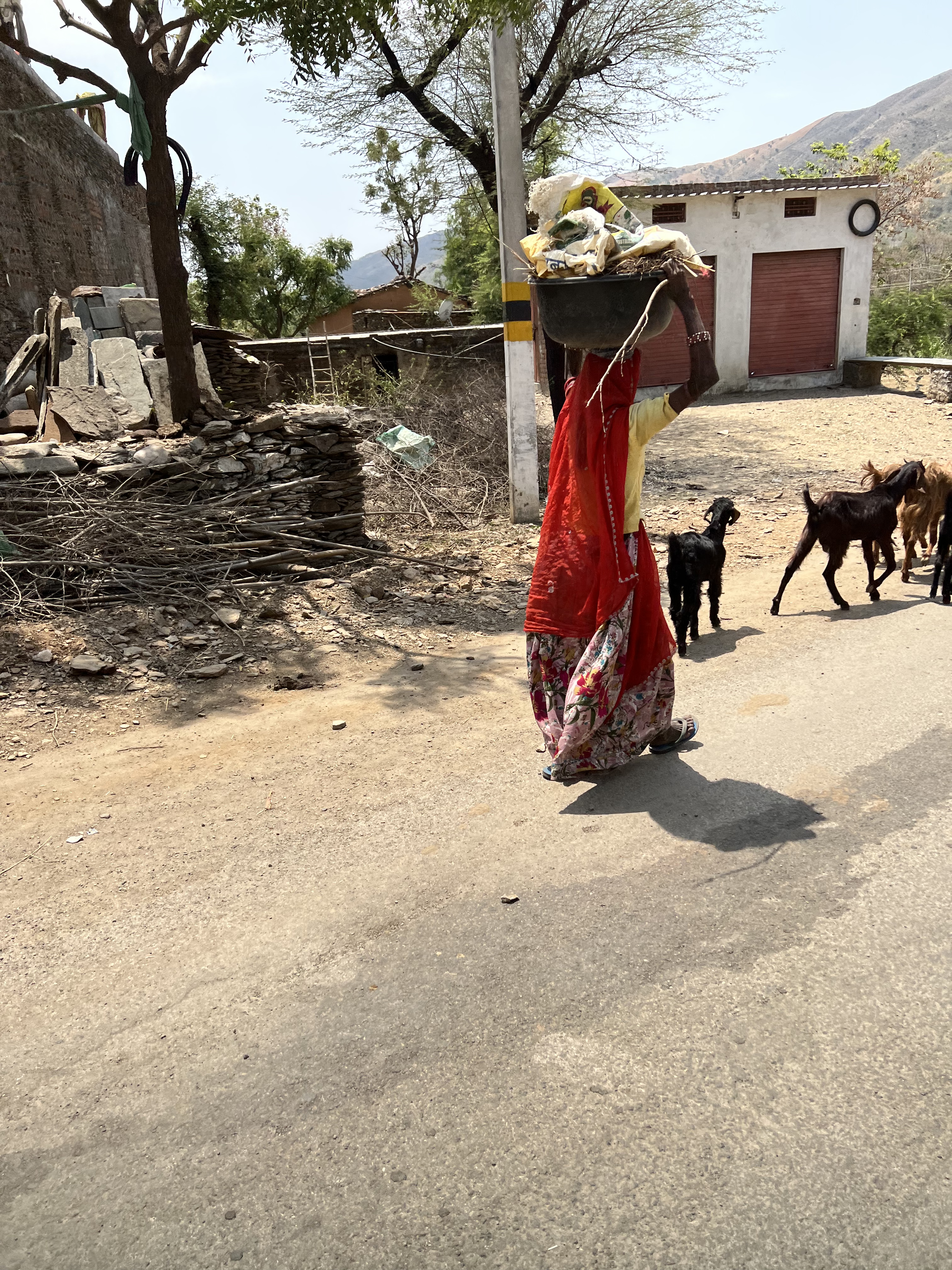
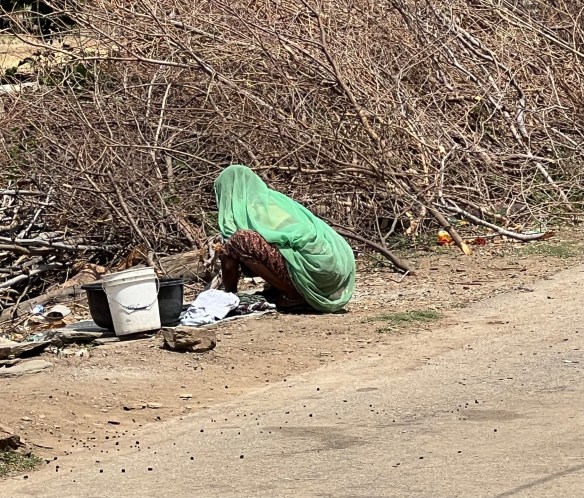
About half an hour later he pulled onto a dirt and gravel road and then turned again onto a rocky path where he parked after another 100 meters. Our first sight was of two women in the distance washing clothes in the small creek. The second was a woman, also dressed in a traditional, colorful sari, with a stack of cow patties balanced on her head.

We followed Salim into a lean-to where five men of varying ages sat on a flat stone area and several women stood by a counter leading into a small hut. It turned out that the father of the woman of the house had died and they were celebrating his life according to their Hindu custom. Somewhat similar to the Jewish shiva, but not exactly an act of mourning since they believe that while his physical manifestation is gone, his (much more important) essence remains.

Oddly enough, one of the ways they honor their guests is to give them cigarettes. Maybe to hasten their reunion with the recently departed? There were giggles from the women and guffaws from the men when my daughter took one of the cigarettes and lit up. Indian women do NOT smoke. But my very white, very light haired daughter differs from them in so many ways that a puff on a cigarette didn’t offend.

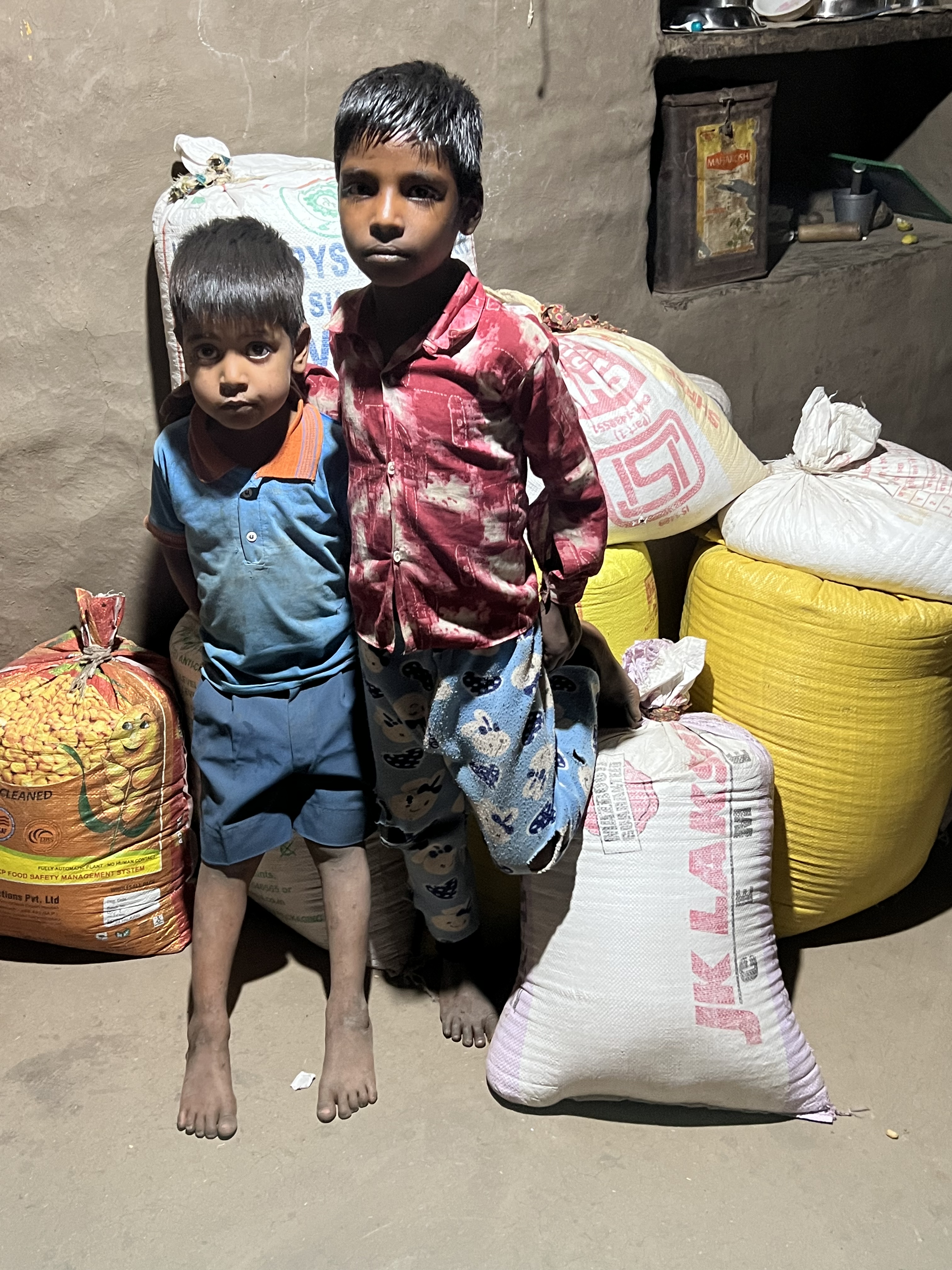
We asked to see inside their one-room home and they happily acquiesced. One of the young women whisked off the covering from a large pot to show us the gas burners (my daughter told us later that a mouse came barreling out). Inside it was quite dark. There were big sacks of flour and rice along one wall. There was one bed with pots, pans, metal plates and cups on it. Salim explained later that the couple sleep in the bed and the children, in this case three, sleep on mats on the floor. There was no bathroom; it’s presumably outside.

We asked if there was electricity and a man pointed the one bare, unlit, bulb hanging in the entranceway.

After our goodbyes we moved on to a day care center not too far away. There were about 15 gorgeous three and four year olds inside.

To say the cramped space was dark, dirty, with virtually no toys doesn’t come close to giving an adequate description.

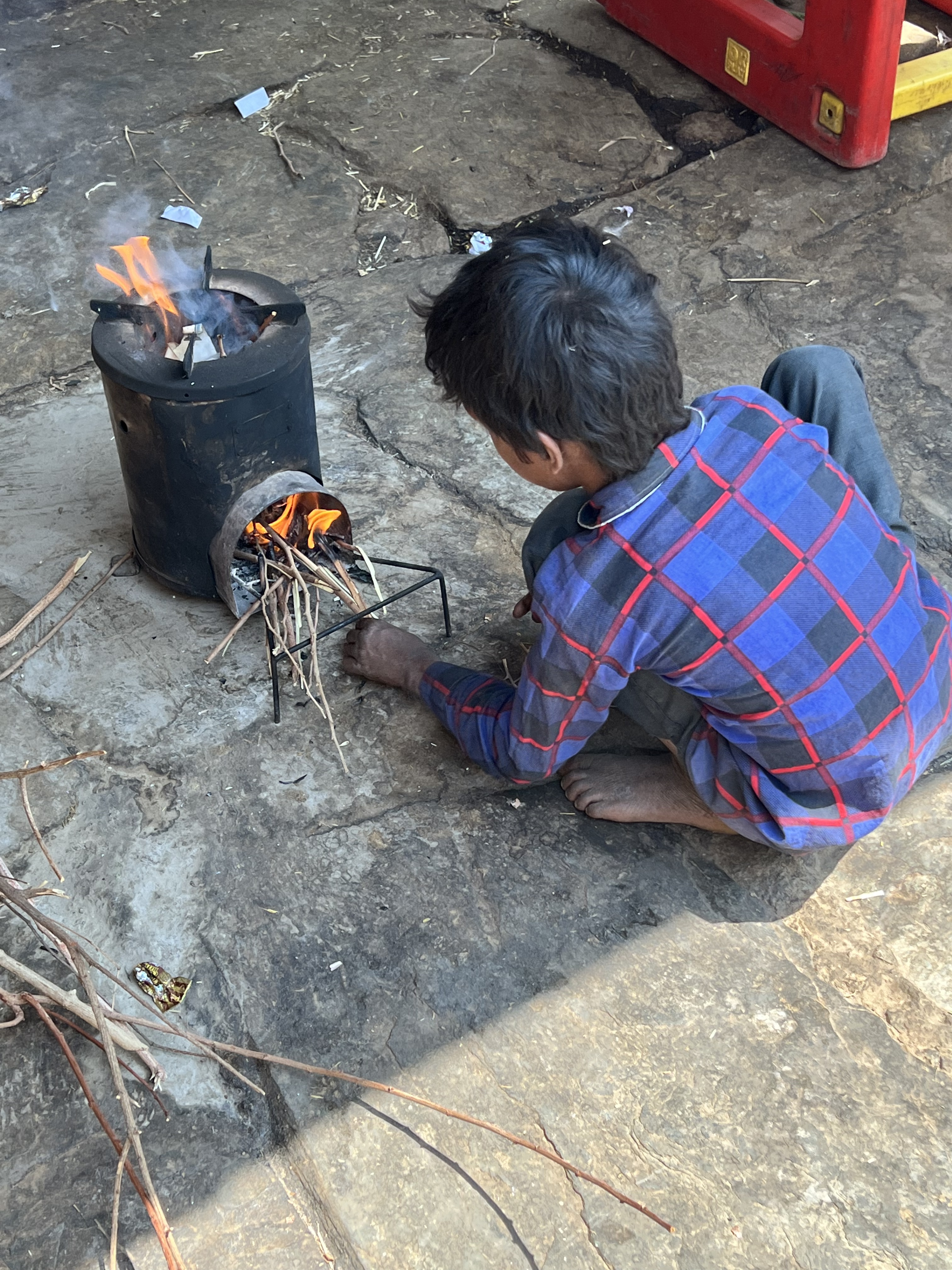
At one point a boy, who looked to be 8 or 9 years old, set fire to some kindling stuffed into a canister-looking contraption. We basically stood with our mouths open contemplating how many safety measures were being ignored while the smaller children heedlessly walked around the open flame. The lone day care worker put a pot of soup on top and began to prepare the children’s lunch.

Salim had recommended we bring candies. Our grandchildren had a great time handing out candies to the youngsters both inside the day care center and walking around the village. They were surprised that when they offered a candy to a child who, as it turned out, had already received one, she declined to take a second. What kid does that!?

By this time we were all drooping from the intense heat and more than ready to head back to our hotel. It wasn’t only because of the heat, though, that it was so quiet in the tuk-tuk on the ride back. There was a lot to think about.

We arrived at the gates to the 42 acres (over 160 dunam) surrounding our hotel. The turbaned guard called a buggy to come get us: goddess forbid we should walk the 150 meters to the entrance to the hotel. Along the way we saw peacocks roaming the grounds freely, smelled the fragrance of the beautiful flowers, and heard the splashing of many fountains.

Truth be told, we don’t usually stay in such elegant surroundings where there are so many impeccably dressed, beyond pleasant staff constantly bowing namaste in our direction over prayer hands. Our daughter is more accustomed to 5-star hotels and it’s actually much easier to enjoy a vacation with children, one of whom is a teenager, when they’re comfortable.

Inevitably at the dinner table when we talked about our impressions of our day, and after the grumbling about the schlepping around in too much heat for way too long, we all expressed our dismay at the parity between the lives of the villagers and the vacationing Indians sitting at the tables around us.

Almost 70% of the one and half billion people who live in India live outside the cities. As in most developing countries, every year people move to the city for employment or other ways of bettering the lives of their family – about 2% annually in India. The already overloaded infrastructure of the cities – Delhi with almost 33 million people, Mumbai with over 21 million, Bangalore with almost 14 million – is hard put to cope with more.
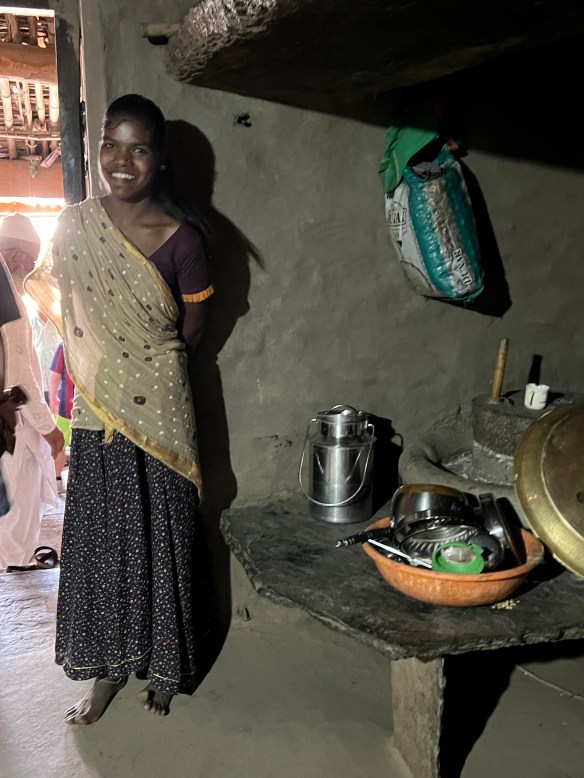
Prime Minister Modi, since his election in 2014, has instituted several programs to encourage villagers to remain in their villages. His government guarantees 100 days of employment to every villager who’s eligible. A gift of 150,000 rupee ($2000) is given to each village homeowner for home improvements, primarily to fortify roofs and walls to withstand monsoon season. 600 million toilets were purchased for the villages in the first five years of the present government .

And, still, the parity is huge.

We talked about the Indian trait of acceptance and the joy in the villagers’ children’s play. We talked about the bountiful nature of our own lives and how, even so, we so often strive for more and better. One of us reminds us of the pride in one man’s voice when he pointed out that his daughters were home visiting from college. So along with acceptance there can be a desire for change.

We conclude our conversation as so many of them end – knowing that we can only ever get a small peek into the depth and vastness of this amazing country called India.

None of us will ever forget these two weeks of ours as a family in India and this day will always stand out.

A Gentler Way of Life

We’re leaving Thumpoly Beach later today.
Yesterday I spent two hours happily painting with acrylics surrounded by paintings of local artists and classical music in a specially designated room in a local art gallery. The owner of the gallery, a retired professor of political science and engineering, provides this wonderful experience for any tourist fortunate enough to learn of the possibility and make a reservation. There’s no fee.
He explained as we shared a cup of (way too sweet) coffee that he left the university five years before the age of retirement because his wife left her teaching position and was at home. There was a hint of illness on her part but he didn’t elaborate and I didn’t ask.
I sensed that the experiential opportunity he offers is an opportunity for him to socialize with people from all over the world now that he’s restricted to this lovely but insular fishing village. We chatted for an hour as he brought out spicy roasted cashews and cookies. A little politics (a big Modii and Bibi fan). A little religion (he’s Christian and fondly recalled his pilgrimage to Israel). A little economy (India has a vastly more reasonably priced medical system and price of living).
A man happy with his lot in life.
As I walked home I thought it could be very pleasant to be in Thumpoly for an extended visit and share afternoon tea and conversation with him from time to time.
I recognized several of the women I passed in their colorful saris with an umbrella held overhead to protect them for the sizzling sun. We smiled at each other, wagged our heads and offered a soft ‘namaste’.
Most stores are closed for a few hours when the sun is at its hottest and only now, at five o’clock, people are again out and about.
My partner and I had agreed just that morning that, as wonderful as it is here, we were ready to move on. But as I gazed at The Arabian Sea and the young men strolling along the beach I realized that I’m a little sad to be leaving.
Every morning we see the fishermen heading out for another day of catching whatever they can – and it isn’t much this time of year. They throw their gill nets or small trawling nets and harvest what they can. A few shrimp. A crab or two. A kilo of very small fish if they’re lucky. Later in the day we see exuberant children walk by in their school uniforms. Inevitably they stop to say hello, ask our names (again) and inquire after our health.
In the late afternoon, when there’s more of a breeze, we see various village residents walking by on the dirt path along the shore in front of our balcony. No one is in a hurry. They seem to be enjoying the sea air and the crash of the waves as much as we do, even though they’ve undoubtedly lived here all their lives.
I suppose there’s gossip and intrigues here as there are everywhere; heartbreak, ill health, kids making life choices their parents don’t understand.
There are very big beautiful homes and tiny unkempt hovels.
But in general life here seems to have a gentle rhythm and people seem to smile much more than in the towns with which I’m more familiar.
Our friends here have two children, which is the norm. One, their daughter, was accepted into the engineering program at a prestigious university very far away. The other, their son, is finishing high school and plans to spend seven years in the army.
Our friend, Antony, raised in this village, the son of a fisherman, was a career officer, head of the anti-terrorist units fighting in Kashmir, and retired as a colonel, one of the wealthier residents of Thumpoly. His wife is a school principal who (in spite of her profession?) is almost always smiling and happy.
Antony and Teresa both give much of their time to the community. Whether from modesty or simply relaying this village’s reality, Antony has told us often that giving to the community is the norm and not the exception.
There are certainly downsides to life in this crazy patchwork of a billion and a half people, over 25 spoken languages, millions living in slums alongside the abundance of IT employment, jewelry production and export, and a caste system which refuses to die, just to name a few challenges.
At the same time, there is a gentler way of life and a serene inner beauty to those who have less, in many cases a whole lot less, but retain an appreciation for what they do have.
So, yes, I’m a little sad to be moving on, even while I look forward to better physical conditions and an evening cocktail.
Ah! The contradictions of life.

From Here to the Sun and Back Sixty Times

Human knowledge grows at a phenomenal rate. Think of the world as understood in Medieval days and as we understand it today. No need to go so far back. Think of the average Western household in Ozzie and Harriet’s time and your own household.

My partner, who could be called antagonistic toward maneuvering through life via screens, came home one day not too long ago decrying how much even he relies on screen technology in the course of his day. He checked the best route into the city with Waze to avoid as much traffic as possible. He parked his car using the Pango app. He received and acknowledged orders from clients via WhatsApp. While waiting for an appointment he got caught up with local, national, and international news online. He called me from his cell phone to mine to kill time in traffic on the way home.

And traveling? How did we manage when we started traveling to out of the way places 30 years ago? No booking.com, Airbnb, TripAdvisor; no Facebook groups of like-minded people offering tips or asking for information. No Uber or Ola to find and get us to hole-in-wall locations at a reasonable price. No google to locate pure veg restaurants.

Okay, all that technology is amazing. It makes our lives so much easier and so many things more accessible. And it also, of course, has huge downsides and creates many distressing societal issues. But this isn’t about that.

Human knowledge doesn’t begin and end with technological advances like those.

The medical world has now advanced to allow for many previously terminal cancers to become chronic cancer; cancer with which, with continuous treatment, people can live a quality life for decades. Prosthetics moveable by thought. I could go on but I don’t really know even a minuscule percentage of all the incredible innovations in the world of medicine.

And what about all the new information coming from the James Webb Space Telescope? It can see what the universe looked like around a quarter of a billion years (possibly back to 100 million years) when the first stars and galaxies started to form. Astrophysicists are scratching their heads wondering how their science could’ve gotten so much so wrong now that the telescope is providing new information.

The study of the cell – that most basic of components in the biological world – has changed so much over the past few decades that today we know that if the DNA from the cells found in one human body were stretched out in one continuous line it would reach the sun and back sixty times, Sixty. Six-oh. We didn’t even know DNA existed before the 1860s. It wasn’t known to be the carrier of genetic material until 1944 and became a reliable profiling mechanism only 40 short years ago.

Amazing, exciting, miraculous advances in human knowledge.

And yet…

Yesterday I tuned into day three of The Dalai Lama Global Vision Summit. I happened to choose Dr. Joe Loizzo’s talk about ethical leadership. I got as far as his call for every person on the entire planet to commit to becoming an ethical leader. Certainly I agree that each of us can and should develop leadership skills in our lives but, seriously!?! If the prerequisite to improving the unfortunate state of a world in conflict is for every single person on earth to become an ethical leader, it just ain’t gonna happen, bubba.

I mean look at us.

In the United States you have the cancel culture, a city proposing that each household pay $600,000 to help pay reparations to people who were never enslaved by a state which never had slavery, part of another state wanting to secede from that state to join a neighboring state, and people afraid to express their opinion for fear of being fired from their jobs. And in one 45 hour period, in one state, there were three mass shootings resulting in nineteen dead.

In England there have been three heads of state in three years. In Spain the birthrate has plummeted to 1.23%. In France the divorce rate is over 50%. The crime rate continues to rise in the Baltic countries. In France a man was found not guilty of a brutal murder of an elderly Jewish woman by reason of marijuana smoking.

In India, Muslims in the state of Kashmir continue to fight for independence. A recent reactivated Sikh movement has begun demanding their independence in the state of Punjab. The Muslim minority in the southern state of Kerala is quietly taking over local political positions.

In Israel political, social, and judicial reform has provided an opportunity for those interested in strengthening social and religious divisions. Extreme and violent language has become acceptable on both sides of any given issue. Defamation of character, personal attacks, and demagoguery are representative while, unsurprisingly, compromise is less and less of an acceptable option.

Humanity seems to be like the proverbial snake swallowing its own tail

We can create, investigate, research, change, and vastly improve our physical reality. But what good is it ultimately if we tear ourselves apart as human beings inhabiting a common earth?

Contrary to what many of us have come to believe when our phones have achieved the capability of supplying so much of our needs, no (emotionally healthy) human being is an island. We do, in fact, inhabit a common earth. And one of animals’ basic instincts is, pardon the expression, not to shit in their own home.

People! We’re unloading a lot of crap in our own homes. And it will not end well for us.

How about trying this? The next time you’re faced with a person whose opinions are not your own, take a breath, think to yourself that she, too, just like you, is a human being who wants to be happy. First and foremost, a human being. Immediately afterwards, who wants to be happy. Choose to distance yourself from her if you must, but treat her with the respect and, if it’s not stretching it too much, caring, that could provide for a gentler, less threatening world.

As far as human knowledge has taken our understanding so far, we only have one world. And if there turns out to be others we would do well to practice protecting the one we know about or we’ll just destroy any others we discover.

Stories Our Parents Tell Us

Just back from a dip in The Arabian Sea.

I’m sitting on the wooden balcony just outside our room, watching the mid-morning calm waves, really ripples, just as I’ve been contented to do most of my waking hours over the past four days.

There’s a rhythm to the sea. Several actually. And a rhythm to life here dictated by the sea.

The waves arrive from the south and break on the shore traveling northward, but oddly seem to recede back into the sea at the same time along the shore for quite a way. I’m sure there are physicists among you who can explain that phenomenon to me in language I wouldn’t understand.

In the morning the sea is so calm that the ripples have no sea froth. By mid-morning they are already small waves complete with white caps. In the afternoon the waves become quite healthy. At night they are loud and powerful and often stormy.

When they are at their calmest the fishermen in this small village of Thumboly are out in force. They employ several different techniques but none of them catches much, and the few fish they catch are tiny. We’re told there was a time when fishing was a viable industry here but that time is long over.

By mid-morning there isn’t a soul on the pristine beach other than the occasional tourist. By mid-afternoon the fisherman are out repairing their nets or playing card gambling games , sitting on the sand in groups of six to ten men.

It’s a bit of a mystery where the women are. Home, I suppose. We see the occasional woman shopkeeper and saw a little girl out playing with a little boy on their shared bicycle on one of our afternoon walks. But mostly we see men and boys. Playing soccer. Playing volleyball on the beach. Walking the village streets.
Our days are quite serene.

My partner takes a morning beach walk early every morning. He always comes home with a new adventure to tell me about. One morning it was two children out walking their crab…on a leash.

We have a breakfast of some kind of unfamiliar grain dish in various forms, a vegetable in soupy sauce to put over it, papaya or some other fruit, and tea.

Once breakfast is digested I spend an hour on my yoga mat. My practice immediately returned to its full glory with the first unfurling of my mat opposite The Arabian Sea. It had sadly stagnated for the past six months.

We read, write, and chat most of the day to the accompaniment of the sea’s music.

In the late afternoon we take a walk through the narrow byways of the residential area, where people happily greet us with a friendly “Namaste” and often ask us in to eat (which we politely decline) or into the small commercial area just past the large church.

Today, we decided, was the day we would venture into the water. We were out there at 9:45 when the waves were just starting to be more than ripples. My partner went in first to scout out the drop off and reported that it was sudden but not too steep. The water was warm and delightful.

In I went. But not far and not for long.

Sixty years ago my mother told me about her good friend, Joseph. They were childhood friends and both enrolled at Northwestern University in Chicago. He was an engineering student and she was a drama major so they didn’t share classes but they shared social circles.

In their sophomore year they went to the beach one afternoon with a group of friends. A beach on Lake Michigan they often frequented. Like Israel’s Kineret, Lake Michigan could be treacherous in the afternoon, with a strong undercurrent.

As the story went, on that fateful day Joseph decided to go back in the water long after the others deemed it unwise. As my mother and her friends watched helplessly he was rolled over and over, dragged under and drowned. No one could save him without endangering their own lives.

I love the ocean. If I have a few free hours I sometimes jump in the car and drive an hour or more to walk along the beach. On my way home from visiting grandkids I often take the slower, longer route to stop off for a half hour of breathing sea air and watching sea birds hop in the shallows.

I’m not convinced that my mother’s story about her friend, Joseph, was true or just a cautionary tale, but it accompanies me to the beach every time I go. I rarely go in the water past my ankles or, if I do, it’s only a little above my waist. I need both feet firmly planted. I have what I like to call a healthy respect for the power of the ocean, while recognizing it as anxiety that’s not always justified.

I enjoy my grandchildren’s fearless frolicking in the waves and beyond but only while keeping an eye on the lifeguard to make sure she remains alert. I’m happy that some of my children and grandchildren surf; proof that Joseph isn’t a filter through which they experience the sea.

I’d love to ask my mother if she actually had a friend named Joseph and if she actually watched him drown in Lake Michigan. But she’s been dead for twenty years and, really, does it even matter?

Beware all you parents out there. Stories our parents tell us are powerful beyond logic.

Differing Realities

I’ve been teaching meditation in one form or another for the past 20 years. During that time I’ve listened to hundreds, maybe thousands, of hours of dharma talks given by insightful teachers. I’ve been a member of meditation groups – presently a wonderful group of people from the west coast of the USA on Zoom every other week – pretty much consistently for decades. I’ve read dozens of books about mindfulness, awareness, no self, here and now, letting go, equanimity, and lots and lots of other catchwords and phrases. You know the ones.

All this is to say that from many different sources, I’ve received the magnificent gifts of self-knowledge and the possibility of inner serenity during tough and not-tough times. I’m hugely grateful to all my many teachers, those who call themselves teachers and those who don’t, who give of themselves so generously and to God for giving me the time and resources to take advantage of it all. As my husband and I often say when thinking of our bountiful lives – We couldn’ve been born under a bridge in Mumbai.

But it’s only recently that the light went on over my head concerning not only the reality of being born under a bridge in Mumbai – having few material resources and few possibilities of their attainment – but living in a reality that doesn’t allow for integrating those catchwords into one’s life.

It came about one evening after teaching a Raja yoga class (which includes a segment of meditation). I stood talking to one of my students, a particularly beautiful young woman who looks startingly like a well-known gorgeous movie star. She’d obviously lost some weight from her already-very-thin frame and had black circles under her eyes. Her entire affect was one of misery. As it turns out she was caught up in the turmoil of what she saw as a terrible injustice on the part of the employer at the job she’d just left. She felt that, while she’d left the company, others were still suffering the injustice and she was struggling with the idea of suing the company. It took me a few questions to realize that, in fact, it had nothing to do with her directly anymore. I kept thinking surely I must be missing something.

She said that she hadn’t been sleeping and had lost her appetite; that she couldn’t stop thinking about the bad behavior of her former employer. I suggested that she might focus on her supportive husband, healthy scrumptious kids, and her new (more appropriate) employment. We spoke about the possibility of letting the drama and injustice go. She said she’d think about it, but I could tell she wasn’t happy with the direction our conversation had taken.

Since she only comes to my classes sporadically, I noticed that I hadn’t seen her in a while but didn’t think much of it. I wished her well in my heart and hoped that she was able to make peace with not championing those who had remained with her former employer.

About a month later she got in touch with me. She’d been on a 10-day silent retreat. Her first.

She said that when we’d had the conversation about her former employer she’d been very angry with me. She thought my idea of letting the injustice in her former workplace go was surrendering to unethical behavior and part of the larger problems in the world. (in the world!! no less). It was only very far along into the retreat that she felt what she called a clarification which was like the lifting of a heavy fog. She realized that the entire issue of the injustice wasn’t her issue at all; that her inability to see what was clear to me lay in her having always been responsible for her siblings and even her parents in her dysfunctional home. She needed to take care of everyone around her to feel okay about herself. Once she recognized that she was able to let it go. She felt a huge physical relief as if a suit of armor had been lifted from her body.

Of course, I was happy for her and hopeful that she would continue to safely investigate her feelings. I know there’s a lot of inner disquiet and deep fragility there. But I was also chagrined at my cavalier projecting onto others with catchwords and phrases I never stopped to consider might be out of the realm of possibility for some of them.

I know better than that on so many levels, and, apparently, know less than that on others.

I began to look more carefully at other concepts I act as though are healthy, positive, and accessible to all, with a more discerning eye. Is this one really accessible to all? And that one?

It’s all fine and well to talk about relinquishing our narratives and not letting them be in control of our present lives, for instance, but is that accessible to everyone in the present moment of their lives?

Easy to talk about being grateful and satisfied with what is, but how does that resonate with someone who never experienced the unconditional parental love that encourages an ability to feel that one has enough, that one is enough?

And what about letting go, being joyful at the happiness of others, and oh so many others?

I’m embarrassed to say that I seemed to operate on the belief that saying it’s possible, telling stories and legends about people who have integrated such things into their lives, could shine a light bright enough to make it come true for my students. But while I like to think that it could and did for many of them, I will be making amends/changes to accommodate those for whom it’s not part of their reality…yet.

My reality is an ever-changing thing. Nothing in this life is permanent. So why in the world should my ever-changing reality be anyone else’s reality. For the most part, even in our uniqueness, we share quite a bit of similarity to those in our general milieu, but not enough to assume….well, anything.

You know what they say about people who assume…