Discovering America

America gets a bad rap abroad.

Speaking as a semi-ex-pat who visits the big cities in the United States frequently but has lived in Israel for over 30 years and seldom has occasion to be in the smaller towns and rural areas of America, I was in for a big surprise when I ventured out of California and into Nevada and Utah in September.

First, if you’re sitting in a big city in the United States and have little contact with anyone who doesn’t sit in a similar place, you may not even know that elsewhere in the world you’re thought to have questionable values, unruly children (if you have children), little or no knowledge about anything outside your city limits and to be clueless about any of your above traits.

Okay, now, I have good friends living in the big cities of America so I know that not all of the above is true of everyone geographically near you but I have to admit to basically accepting much of that criticism for many people in your situation.

I recently went to a family wedding in Oakland and stayed in Berkeley, one of my favorite university towns, for Labor Day weekend. One of my favorite university towns only because I don’t have to live there. I used to live there in ancient times (ps it hasn’t changed much) but left Northern California when I tired of trying to get re-acquainted with my friends every month as they totally shed one persona for another.

Late Monday night I flew to Las Vegas, my planned jumping off point to go hiking in the canyons of Utah, Bryce Canyon and Zion Canyon.

Las Vegas.  I had thought I might enjoy a little gambling – the glitz and sparkle of the man-made wonders of the world; The Venetian Hotel, The Luxor Hotel (complete with pyramids) – and had planned my trip to come back to Las Vegas for all that on the weekend. But while walking through the lobby (read: casino) to get to the hotel registration desk I began to hear a loud whisper in my ear warning of my mistake.

It went something like this:

OMG! Cigarette smoking is allowed here? And what’s with all these sleazy people who look like miserable zombies? Yikes!

Followed by:

Is this another “old person” reaction? Have I totally lost my sense of fun? Hmmm. Doesn’t look like anyone’s actually having fun. 

Up bright and early to make my getaway. More or less made a beeline for the parking lot through all those not-so-happy-time gamblers. There were many more of them at 8 a.m. than there had been at 2 a.m. but they still didn’t look very happy. I noticed when grabbing some breakfast that plenty of them had children in tow so I guess they don’t think of Las Vegas with its gambling and, ahem, other sports, as sleazy or shameful.

Personally, it all seemed like America at its worst to me…or at least not a very pretty side of glory, glory hallelujah. But this blog post really isn’t a rant about Las Vegas.

The drive to Zion Canyon put me immediately in a different frame of mind. As soon as I broke free of the construction-entangled highways of Las Vegas I found myself breathing easier and more deeply.

Crusing down a ribbon of highway, I was surrounded on all sides by open, rolling desert savannah with mountains in the distance to my right and to my left.

It went on for miles and miles getting more and more beautiful as I traveled further away from the city. I’m a big fan of the desert in all its many variations and soon was singing along with the golden oldies radio station.

By the time I pulled in at The Dream Catcher’s Inn just outside of Zion Canyon the world seemed like a kinder place. One of the owners suggested that even though the sun would be setting in another hour or so, it would be a good idea to go on the Park shuttle to get an overall idea of a plan for the next day. So off I went.

In the parking lot of the park before getting on the shuttle I ran into a young couple who asked that I take their picture together with the gorgeous mountains in the background. After I’d taken a couple of photos and they’d checked to make sure the pictures were okay (he told me that she’s sensitive about her (miniscule) thighs. Sigh) he enthusiastically told me that they’d gotten engaged 20 minutes ago and I was the first to know. We chatted about their news and my own 37 year marriage for a bit. I wished them a good life as we parted. Nice kids.

The Shuttle was one example of the U.S. national parks’ exemplary organization for handling large numbers of people in the most efficient and ecologically sound ways.  At every stop along the way there are (clean!) bathrooms and spigots to fill water bottles so that people only carry in one plastic bottle and no tissues or toilet paper.

The sunset over The Court of the Patriarchs (three peaks names Abraham, Isaac and Jacob) was peaceful and pretty. The ringtail cat sighting was exciting (they’re rare). Laying on a low-lying wall at one of the stops and gazing up at the spectacular night time sky, as suggested by the shuttle driver, was wonderful (I didn’t want to head back but was afraid I’d miss the last shuttle back to town).

But even though every time I thought I couldn’t possibly see anything more gorgeous than the last amazing, breathtaking sight,  I came around the bend to see something even more mind-bogglingly beautiful, this blog post isn’t about God’s handiwork (He so outclasses anything Humankind has come up with so far).

“So what the Sam Hill is this blog post about?” I can hear you asking. (you may have substituted another word for ‘Sam Hill’.)

It’s about America. It’s about Americans. It’s about major misconceptions about both.

I was travelling, hiking, horseback riding alone.  
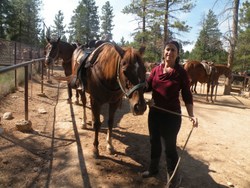
There are some really great things about doing all that with other people – especially people you love and find interesting. But there are also some really great things about going it alone.

For me, anyway, I find that I think more and I talk to strangers more when I’m alone. And, usually, first I think more and then I talk to strangers more so the conversation can be simple, “how ya’ doin’; where ya’ been; where ya’ from; where ya’ goin’ next” conversation but it can also be “I’ve been thinking about how people must’ve lived and felt back when this area was pretty much unpopulated. What do you think they were like?”

And then there’s alot more just plain eavesdropping on other people’s conversations. Something to keep in mind when you see someone sitting alone who looks like she’s reading a book.

And that’s what this blog post is about. The wholesome people who visit and live in the Western States of the US of A.

The teenagers who actually speak to older people and actually listen to them with respect.  
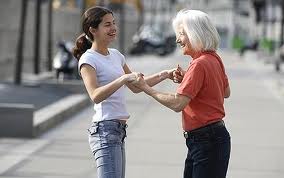
The waitress in Hurricane,Utah, who works to pay for the upkeep of her horses and the couple in Springdale who spoke to me about past vacations – all hiking, camping or skiing with their entire family – and the mountain marathon runner from Southern Utah University who chatted with me in Dixie National Park while she waited for her teammate to show up and pass her the baton. She mostly spoke about her college organization’s volunteer activities for children with special needs and her upcoming wedding.

In Bryce I spoke with an elderly couple from Minnesota as they rested on a  bench along the sunrise hike trail. They were with a group of 12 retired  couples, all with recreational vehicles, who were travelling together across the United States. As we talked, another couple in their group came along and we all shared hiking experiences in between long minutes of companionable silence.

At Hoover Dam a woman from South Carolina struck up a conversation with me about the ingenuity and work ethic that went into the Dam Project.  Later, over coffee, she told me about the two children from Guatemala she had adopted when they were 3 and 5 and how proud she was to be at her younger son’s college graduation in June. She showed me pictures of them with her hiking in the mountains near their home. I traveled in Guatemala a few years back and she pondered the wisdom of, perhaps, making a trip there with them. None of them had been back since she brought them to the plane upon adoption.

There were many others who made me proud to be an American and gave me renewed hope for the future of the land of my birth.

It’s true that many of the conversations made me sad for an America whose economy is not only bad but unimproving and sadder about the resulting disappearance of the optimism which typified my youth and university days. Several people spoke of losing their jobs and securing a new position more than a year later…at a lower salary. A few mentioned that our children’s generation is the first to have no hope for a better life than that of their parents…or even equally good.

As an Israeli I nurtured an inward smile at the disillusionment with President Obama which I heard over and over again from Democrats, Republicans, those who voted for him and those who voted against. But as an American I despaired together with them in the reasons for their disillusionment – the high rate of unemployment, family businesses closing down, a “new” health plan which leaves so many worse off than before. (I continue to be shocked how many Americans make significant life decisions based on where they can find the best health care coverage.)

If you’re old enough to remember, there was a human interest show of heartwarming and nostalgic vignettes about simple Americans on CBS news in the olden days.  It featured Charles Kuralt and lasted for a quarter of a century, airing for the last time in 1992, just five years before Kuralt died in 1997 from complications of lupus at the age of 62. The popularity of the show surprised the decision-makers at CBS and even Kuralt himself.

I met some people worthy of a couple of minutes of Mr. Kuralt’s time on my recent wanderings and it’s a great feeling knowing that so many of them are still out there almost 20 years after Kuralt closed up shop.

Might I dare to hope that they make up the majority of Americans?

Good news for your brain

The good news is that we can change the actual physical structure of our brain to make our lives easier, with less anxiety, less fear and less negativity.

The bad news is that it takes attention and effort…and the job is never done.

Recently I came across Dr. Rick Hanson, neuro-psychologist, www.rickhanson.net, and listened to the first two parts of a four part series of lectures called “Taking the Good” (www.audiodharma.org) about positive thinking research primarily out of UW/Madison’s Waisman Institute for Integrative Health (www.investigatinghealthyminds.org).

While the purists among us might want to read/listen to the research at its source, I found Dr. Richie Davidson’s rendering dry, unnecessarily long and boring, while Dr. Hanson takes the same information and makes it interesting and easy to listen to and comprehend.

The short version, without all the science about neurons, neuro-transmitters, and impressive-sounding names of brain sections, (which is fascinating and definitely worth listening to) is that we can create and fortify new neuro-pathways with mental exercises.

That while we’re wired to live by an emphasis on negativity (those laid back, it’s-all-good type animals and humans became someone’s dinner while the fearful, careful, anxiety-ridden became our grannies and granddaddies), we can carry out exercises in positive thinking 2-3 times a day for a couple of minutes each time, and thicken right up our left frontal lobe, creating a life of more personal comfort, altruism and even stave off Altheimer’s.

As some Canadian neuroscientist said “the neurons that fire together, wire together.”

Used to be we thought our brain cells died off all the time leading inexorably and inevitably to a feeble old age. Turns out that we do, indeed, lose 10,000 brain cells a day (and 10,000 for every alcoholic beverage…yikes!). But we can also add new brain cells and, actually better yet, expand the ones we have left.

Hanson describes it sort of like this – When there’s a forest fire, after awhile there are lots of little saplings. A decade later those saplings haven’t become an equal number of big trees. They’ve thinned out. The remaining trees, though, are not only way taller but have branched out with their branches reaching to each other in an”arborization” effect.

That’s what our brain cells do. But only through brain exercise.

Luckily, we all get lots of brain exercise without making a conscious effort. There are billions of synapses that send trillions of messages daily. Wiggle your big toe and you’ve sent hundreds of thousands of messages in a flash.

Our brain never rests. Not even when we’re asleep.

But there’s brain exercise and there’s brain exercise.

Wiggling your big toe is great but research has shown that meditation is greater.

What do I, with my daily meditation practice,  have in common with a Tibetan monk who lives in a monastery and a Christian contemplative nun who lives a life of service? We all have three areas in our brains which light up like a campfire when seen on an MRI slice. The area responsible for executive decisions, the area where enjoyment of reward shows up and the left front lobe with self-awareness and positive sensations.

Aside from the usual meditation practice of quieting thoughts to be present in the here and now – what Hanson calls stage one “let it be” and stage two “let it go”- research has shown that a practice of stage three “let it in” can make those brain changes to improve our lives vastly.

What do we let in? We let in positive thought to counter our great-great-grandparents fear of the tiger who doesn’t exist (we still don’t want to ignore the tiger who does exist) and antidote thought to counter holes of lacking from our early development. And we practice both daily to keep those neurons firing and wiring.

Positive Thought Practice

1. Choose a positive experience from today or yesterday and think about it

This can be something as small as a kind word from someone, completing a task you’ve set for yourself like washing the car, or as huge as getting a raise or getting pregnant.

2. Move the experience from your mind to your body

Let your thought become the feeling associated with it. Does it translate into a smile? A feeling of an expansion in your chest? A relaxation of your brow and other face muscles?

3. Let the thought and feeling sink more deeply into you and stay with it for a minute or two.

We have a tendency to have negative thoughts pop up to the surface. “Yeah, but washing the car is something I should do much more regularly.” “Yeah, well, the job won’t last because I probably won’t be able to fulfill her expectations.” Just note what comes up and bring the positive thought and feeling back into the foreground.

Antidote Thought Practice

We all have at least one narrative of “not enough” from our formative years. Not enough love. Not enough recognition. Not enough power. And it becomes a theme for how we react to our lives and the events and people in them.

A meditation practice can help us slow down, take a deep breath, and respond differently.

Neuroscience has now shown that we can also do exercises to change the physical structure of our brain to direct our reactions toward a new neuropathway.

1. Think of the hole of whatever was lacking (most of us know what it is but if you don’t, just choose “not enough love” since that’s a generic fallback that’s true for almost all of us) and then choose an experience from today or yesterday that shows the exact opposite and think about it.

If your particular hole has to do with not having been seen/recognized by your family of origin or your peers, you might think about a conversation with someone wherein they really “got it”.

Or if you felt powerless, perhaps you can call to mind a few of the decisions you made today which were totally your own.

Let the hole remain in the background while the positive opposite stand firmly in the foreground.

2. Move the positive experience from your head to your heart; from thought to feeling. Like the “positive thought practice” but take along the hole of lacking in a much smaller dose.

3. Let the thought and feeling really sink in and hold it inside for a minute or two. Note all the thoughts that arise, often thoughts of negativity, and the feelings, often of sadness, getting choked up, or of fear or anger.

The hole may gape ever larger and threaten to swallow up the positive. Pay attention but return it firmly to the background.

I’ve been talking about all this to the women in my Monday night yoga and meditation group. A few of them have taken it to heart and are trying to do their brain exercises 2-3 times a day. It will be interesting to see if a few months of it make a difference, or as Hanson says, the difference that makes a difference.

And now I have to go…it’s time for my brain exercise.

For Better or for Worse But Not for Lunch

My husband had an uncle who lost his job at some point. Apparently he couldn’t find another and couldn’t face the disgrace of not having a job. Every day he got up, got dressed like usual, took the lunch his wife packed for him and left the house as if he were going to work. Every day for years. Until he could “safely” say he was retired.

They say that men define themselves by their work and women don’t. I’m thinking maybe they had in mind an earlier age in time.

I think I basically retired.

I’ve never had a normal job – well, when I was pregnant with our oldest daughter who just turned 35, I worked for The State of Wisconsin updating licensing for nursing homes. You don’t get much more normal than that, I suppose. Punched a clock, checked paperwork all day and could’ve made more money working at MacDonalds.

But generally speaking, I’ve always had jobs where I’ve made my own decisions, kept my own hours on a per project basis and noone really knew what I was doing or where I was doing it.

When I was in college I worked for a labor union – long since defunct – whose regional offices were 300 miles away in Chicago and national offices were in New York. My job was to show a strike film to rank-and-file around the state of Wisconsin. In 6 months I might have shown that film 3 times. It’s a family joke to this day.

But I turned into a responsible person at some point and  worked harder and put in more hours in my self-devised frameworks than lots of people do in the places where the clock gets punched.  No dropping the pencil mid-sentence at exactly 4 o’clock for me.

I planned building projects and supervised them going up on virgin hills. I took SOS calls when electricity went out in the middle of the night or contractors threatened to walk off the job. I spoke to the press at the sites of terrorist attacks, political rallies and at dramatic turns of events of all kinds. I solicited philanthropic funds all over the world.

Wow! I’m even impressing myself!

And then, about two years ago, I stopped.

It didn’t happen in a day, or a week or a month.

I started screening my calls from the media, taking only those from the largest agencies that I couldn’t ignore. I started skimming the newspaper, checking only one or two news sites and only once or twice a day.

All those articles about lowering your tension levels by giving up reading the news? They’re true. Ahhhh! How nice not to know. And what do we know from reading the news anyway? As Mark Twain said, “If you don’t read the newspaper, you’re uninformed. If you do read the newspaper, you’re misinformed.” Wise man.

I had stopped taking on new clients several years previously  in theory. I turned theory into reality. Slowly but surely, my “current projects”  finished up and became past clients.

I’d begun listening to dharma podcasts and found myself, more and more, listening to them on my morning walk instead of listening to music. And the music I listened to at the end of the podcasts changed. Until one day, or over a period of several months, I came to the realization that the principles had been soaked up into the very fabric of my thinking, feeling and  behavior and the calming music had become my music default.

I found a yoga class I loved and found that yoga added to meditation added to dharma equaled a peaceful happiness that served me and all those around me well.

Sounds idyllic, right?

There was this one little cloud on the horizon. When people would ask that question “So, what are you up to these days?” I heard myself hedging. Making the 3 clients I still handle sound like a real job. Embellishing the help I give a friend who’s directing a big project in the Galilee and the Negev.  Hinting at a busyness that, in actuality, has more to do with travelling around the country to see my granddaughters than anything else.

Had I become Gershon’s Uncle Sam? Metaphorically taking the packed lunch off to “as if” work every morning? Was my definition of myself really that dependent on my work and the status of what I do as I perceive it in the eyes of others?

I practiced the other night answering that question differently. No hints of greatness or fame. Her: “So, what are you up to these days?” Me: “I’m doing alot of yoga and meditation.” Her: Those are the main things you’re doing?!?”

YIKES!!

Me: “Yep.”

Oh, so proud of myself. I did it. I stopped packing my lunch. I retired.

Now I just have to worry about how it’ll be when Gershon retires. You know the adage – “For better or for worse, but not for lunch.”

Here and Now in the Shuk

Thursday is one of my favorite days of the week.

When I open my eyes on Thursdays as 6 a.m. approaches, my body decides for me whether or not to head out on my usual hour walk through the misty valley and up the little mountain near my house. Lately I’ve been trying to remember to say the morning blessing of gratitude for waking up to another day and sometimes that 30 seconds is just enough to fight off the temptation to close my eyes and roll over again into that blissful morning slumber.

By 7:15 the house smells like fresh-ground coffee and there’s freshly sliced fruit on the table – the best in the world. My husband is the morning chef, like his father before him and our older son, who’s continuing the tradition.

After our morning schmooze, I’m out of the house by 8:30 to get to my weekly hour and a half yoga class in Jerusalem. After trying yoga about a dozen times in various studios from California to New York to Jerusalem, I’d about given up on it when I happened onto Rachel’s class. Wow! She does a holistic yoga which includes special breathing and stretches which ease my relatively inflexible body into delicious poses.

Most Thursdays I round up our younger son from the beautiful new Supreme Court Building where he’s clerking and we go to the nearby Mahane Yehuda Shuk for lunch.

Rafi lived just 3 blocks from The Shuk for his last two years of law school and acquired a love for The Shuk to rival my own. He and I wander The Shuk, buying a few things but mostly soaking up the sounds and the colors.

The one place we never miss is Oz the fish monger’s basta. Oz is the very quintessence of basterionarim. A grumpy middle-aged Sephardi guy who always has a 3-day growth of dark beard and a scowl on his face. Despite the demeanor, now that I’ve been buying fresh fish there once or twice every week for a year, he hurls endearments my way instead of insults.

Oz's Father Helps Out at Oz's Basta

“Where’ve you been, Mami,” he shouts when I’ve been out of the country for a few weeks. Or “I’ve been saving two of my most beautiful trout for you, Metuka Sheli.” (my sweet one)…and he has.

Further on is “my” spice man. The smells and colors…nothing compares. I often wonder how he supports his family selling 100 grams of mustard seeds and 200 grams of cardamon. But there he’s been for the past 30 years I’ve been coming to The Shuk. And like most of the basterionarim at The Shuk, he probaby inherited the basta from his father.

Most of the basterionarim in The Shuk have little education. Many of them did not complete high school. Alot of them are rich. Their day begins before dawn and they work hard all day. They’re as honest as the day is long (maybe a tad less honest with tourists). You can trust their word. They’re good to their clients…though they probably don’t call it customer relations.  Oz isn’t the only one who “saves” his best produce for his preferred customers. Sometimes they tell shoppers they’re out of something only to pull that same something out of the back room for their regular clients.

My husband markets fruit to wholesalers, some of whom also have bastas at The Shuk. We’ve gotten to know many of them very well and are invited to their family simchas (family events). Often there are tables and tables of just men…basterionarim. Their wives aren’t encouraged to go out alot but if they do come along they’re always amazing to look at. Dressed like celebs with the kind of high heels it’s suicidal to fall off of. Danskos are so much more comfortable but, oh!, those high heels are to die for.

One basta I frequent for vegetables is owned by an Arab man who is a 2nd generation basta owner. His son works alongside him every now and then – but rarely. We talked about it one day and he sounded a little bitter. He said that he’s not willing for his son to live the life he lives. In spite of his wealth, he said that he regrets not having an education, and is determined that his son (who loves The Shuk) will go to university and do something else with his life.

I get that. It’s a hard life. I’m happy that Rafi is clerking at The Supreme Court instead of getting up at 3 a.m. to stack fruit, dealing with thousands of people a day who want everything a little bit cheaper and falling into bed exhausted at the end of another 15 hours of physical labor.

But The Shuk is still one of the things that make Thursdays one of my favorite days of the week.

What a variety of colors , shapes, smells and sounds! What a variety of humanity passes me by as I wander! What an abundance of the blessings we find here on earth!

“Halva – al ha-sakin!” (halva slices cut fresh) “Agvania b’shekel!” (only one shekel for a kilo of tomatoes)

If I’m given my choice of the top ten places I want to be mindfully in the here and now, Mahane Yehuda is definitely on the list.

From the Depths of the Holocaust to Heights of Statehood

A week ago we stood in a moment of silence to remember the 6 million Jews who vanished in the ovens and mass graves of Hitler’s Europe. For 24 hours we once again heard the stories of atrocities, of the heroics of bravery and small kindnesses in the face of unimaginable degradation and physical hardship. We saw survivors speaking about the richness of the extended family which was extinguished so unspeakably and so completely.

One short week later we again stood in a moment of silence to remember Jewish deaths and have now spent almost 24 hours hearing stories of those killed once again for being Jews. The atrocities of bombing buses, shooting women and children, bombing Jews conducting a seder on Passover, and, of course, the horrific butchery of five members of the Fogel family just weeks ago in the community of Itamar.

Nowhere in the world can Holocaust Remembrance Day and Memorial Day for Fallen Soldiers and Victims of Terror be as poignant as in Israel. Nowhere in the world is the Jewish Family so concentrated and interconnected as in Israel.

From the depths of despair, at the mercy of the most uneducated, the simplest of peasants nurtured with hatred engendered by ignorance, starved, killed on the slightest whim, deprived of the most basic need – that of protecting our children- we rose, literally from the ashes, in only one generation to a state of our own where we can never again be helpless to protect our families.

The week beginning with Holocaust Remembrance Day and culminating in Israel Independence Day is a roller coaster of emotions for the entire nation. We – that noisy, rowdy bunch – Israelis – actually stop and collectively, as one, stand silently in awareness of our history.

I read about Anne Frank and many other books on the Holocaust when I was in my early teens. I watched Holocaust movies and heard Holocaust stories. It was a phase, like loving horses, and then it was over. I rarely picked up another Holocaust book afterwards.

I made aliya to Israel as an adventure and, partially, to try to make a difference in a new country. I was neither fervently  religious  nor much of a Zionist – though a little bit of both.

I loved living in America and had it pretty good there. Fortunate enough to be born into a family with enough money (not under a bridge in Bombay, as I tell my children when they complain). I had the luxury of rebelling against the establishment and protesting the government without getting mowed down by tanks, still managing to receive multiple university degrees.

I didn’t feel discriminated against. I rarely felt uncomfortable as a Jew.

And yet, for the past 32 years I’ve lived in a country steeped in the emotions of Holocaust survivors and their children. I’ve never passed through a Holocaust Remembrance Day emotionally unscathed.

I’ve lived in a country where Jews don military garb (sloppy but military nevertheless), sacrificing three years of their young lives when most American kids are off exploring campus life. In a country where hi-tech workers, lawyers and accountants leave their jobs for a month every year to train,  guard and sometimes fight so that the rest of us can live a somewhat normal life in this crazy, tiny country of ours.

I’ve never passed through the Memorial Day for Fallen Soldiers and Victims of Terror without that schizophrenic sadness and immeasurable pride and gratitude.

Every year I go to a ceremony about 10 minutes from my house in a beautiful valley surrounded by heights covered with olive trees and scrub brush and gorgeous rock formations where 10 reserve duty soldiers were ambushed and killed. It’s a ceremony for all those in my region who died for our country’s continued existence. At the end, the mayor of our region reads the list of those people. I knew many of them. I remember some of them as children and some as colleagues and neighbors.

This year, for some reason, I thought alot about Hana, a friend who came from Russia, with a frizzy reddish afro, an inexhaustibly happy spirit, who was learning flamenco when she was blown up on a bus in Jerusalem.

It’s a long list.

This year Udi Fogel’s mother spoke through her tears about her son and her grandchildren who were butchered in their sleep. Shlomo Riachi openly wept as he said kaddish. I remember his son, Kfir, as a smiling, happy child who grew into the 15 year old shot many years ago as he played basketball with his friends.

I cried, too. I do every year.

Yesterday I went to the brit (circumcision) of my best friend’s grandson. I’ve known the father of the baby, Ehud, since he wasn’t much more than a baby himself. He spoke about how his new baby, Nir, was born on Holocaust Remembrance Day and his brit was on the eve of Memorial Day for Fallen Soldiers and Victims of Terror.

He spoke about the vast difference – one being the very depths of Galut (the Diaspora) and the other commemorating the heights of the beginning of the Geula (Redemption).

He spoke about how the brit is a contract between Jews and God which, like any legal contract, binds both sides. He said that he often wonders why his parents’ generation was blessed with the creation of the State of Israel when so many great people came before them and were not so blessed. Somehow during the week between Nir’s birth on Holocaust Day and his entering into the brit with God on Memorial Day for Fallen Soldiers and Victims of Terror, it started to make sense to him.

The brit or contract with God challenges both parties. It is only with great effort that we earned the beginning of the Geula in the creation of the Jewish State. That great effort is what binds God to the Geula.

The ultimate “what goes around, comes around”.

In two hours Memorial Day will be over for another year. We’ll begin Israeli Independence Day. We’ll sing and watch our children perform. We’ll ooh and aah at another great fireworks show in the skies over Ofra.

And, finally, before heading home, we’ll sing the Israeli National Anthem, HaTikva (The Hope)  – maybe the only national anthem which sounds a bit like a funeral dirge in parts – and I’ll get a lump in my throat again, for the thousandth time, and feel a pride and comfort that no international community, world media, J Street (or L, M, N, O, P Street) can stamp out.

Thank you, Kfir, Hana, Udi, Gabriel. Thank you Irit, Miri, Erez, Noa. Thank you Aryeh, Asaf, Ofra, Sarah. Thank you, thank you to the 20,000 plus Jews who have died to strengthen the State of Israel for me to live in today.

Wow! I’ve become a Zionist!

No Death No Fear?

On Monday nights I join with other women to practice meditation and yoga for an hour and a half. We’re a small group – sometimes only 4 of us meet – and our backgrounds and ages are quite diversified.

Last night the first woman to join me on my back porch was my neighbor, Nechama. She was born in Ethiopia, married at 14 to Yaakov, an unassuming, gentle, quiet man who, as it turns out, worked for several years leading people across the desert under cover of darkness to escape to Israel.

Nechama is a tall, graceful woman of about 40 who told me that signing up for the yoga and meditation group was the first thing in her entire life that she had done to set aside time for herself. New to yoga, and new to feeling and acknowledging her lovely body underneath her modest clothes, Nechama quickly became a joy to look at in yoga positions, asanas, and to see her own joy at her body’s possibilities.

She didn’t come to our group last time we met and last night she explained that when her daughter told me on the phone that her mother was on her way to our group last time, she was actually on her way to a quiet place to cry.

The Ethiopian community in Israel is made up of many interrelated families. Being isolated from the main Jewish populations of the world for so many decades, they generally married within the large framework of family to remain confident of their Jewish roots. As a result, in many cases, they are related to each other many times over.

Yaakov has 15 siblings, all from the same father but from two different mothers. They relate to each other as siblings in every way and are very close to each other. Yaakov is the only brother who has chosen to live outside of the Ethiopian-Israeli community.

Their mother has been in a home for the ailing elderly for 9 years as a result of her failing health. Her 15 children take turns being with her and she is rarely alone. Recently when Nechama’s sister was about to marry, Nechama prepared her home every day for the possibility of Yaakov’s mother’s death.

However, nothing could prepare her or her home for the death which actually occurred.

Yaakov’s oldest brother was the beacon and role model for Yaakov and many of his siblings. He was Nechama’s brother-in-law and also her much beloved uncle in the complicated way of the Ethiopian community’s structure. He was a healthy man who did physical work all his 69 years and died suddenly while sitting with fellow gardeners, taking a short break at his gardening job the day before Nechama’s sister’s wedding.

As we waited for the other women to join us for yoga and meditation last night, Nechama told me that the past few weeks have been very difficult for her and Yaakov. Neither of them is finding it easy to move on after her uncle’s death.

She spends alot of time crying.

Later, before we began the second meditation sitting of the evening, she said that she’s been finding it impossible to quiet her mind.

The Vietnamese monk, Thich Nhat Hanh, is  one of the most renown and respected poets, philosophers and practitioners of Zen meditation in the world. He helped found the “engaged Buddhism” movement in the early 60’s in response to the Vietnamese War – a movement dedicated to encouraging meditators to get off their cushions and put their practice to use helping other people and improving the world situation.

In Judaism we call it “tikun” and have long held it to be one of the main purposes in our existence as human beings on the earth.

One of Thich Nhat Hanh’s many books is called No Death No Fear, in which he examines concepts of death, fear and the very nature of existence.

Immediately upon reading the introduction and first chapters of this book many years ago I felt a relaxing in my heart. And in the years since, whenever confronted with the death of someone I love or someone loved by others close to me, that feeling has returned when I’ve brought my mind and heart back to his words.

Thich Nhat Hanh’s mother died when he was already a seasoned meditator and Zen practitioner. He was very sad – they had been very close – and the sadness showed little sign of lifting even close to a year after she died. One night he had a dream in which he was sitting and having a wonderful talk with her. She looked young and beautiful in the dream and they were sharing a very pleasant time. He awoke from the dream at 2 in the morning with the feeling that he had never lost his mother. The feeling that she was with him was very strong. It was suddenly clear to him that the idea that he had lost his mother was just an idea. He realized that she is always alive in him.

He went outside of his highland hut and walked in the moonlight among the tea plants. He felt his mother alongside him. “She was the moonlight caressing (him) as she had done so often, very tender, very sweet…wonderful! Each time (his) feet touched the earth (he) knew (his) mother was there with (him). (He) knew that this body was not (his) alone but a continuation of (his) mother and (his) father and (his) grandparents and (his) great-grandparents. Of all (his) ancestors. Together (his) mother and (he) were leaving footprints in the damp soil”

Thich Nhat Hanh wrote about seeing his mother in his hands and his feet and then in all that was around him – the trees, the flowers, the sky and in all of creation. And knowing that all are manifestations of his mother and of all the people who have died loved by others. He explained that, though we all suffer when we lose people we love, if we can look deeply enough to see their manifestation in our world we can again embrace the joy of life.

In Judaism, often when we ask if there is an afterlife, if a loved one who has died can see us on earth in our daily lives, we receive the answer that whether or not there is “heaven” and an afterlife in some form similar to the one we know on earth, a person who has been loved lives in the memories of those who have loved her.

When I was young, that answer didn’t satisfy me much. As I got older it seemed to sit a bit more comfortably inside. And when I read Thich Nhat Hanh’s words, I felt my heart embracing the combination of the two concepts – like so many other Jewish concepts re-stated in Eastern Thought in that uncanny way that makes them a bit more user-friendly.

Later today I hope to find some quiet time with Nechama to remind her of ThichNhat Hanh’s writing. We shared his thoughts when a tragic fire took the life of a close friend of my daughter’s and a bus full of others. But until death is up close and personal, many of us don’t integrate such ideas into our hearts. As Nechama said about her own children – “They don’t understand why I’m so sad. They say that he was old anyway.”

Our lives are made up of the people who inhabit them. The landscape of our life changes when one of them dies. But those who have died remain part of our inner landscape as soon as we can stop and recognize our loved oen manifesting again and again in many forms.

There is an interesting parable about ideas and notions.

“A young tradesman came home and saw that his house had been robbed and burned by bandits. Right outside what was left of the house, there was a small, charred body. He thought the body belonged to his little boy. He did not  know that his child was still alive. He did not know that after having burned the house, the bandits had taken the little boy away with them. In his state of confusion, the tradesman believed the body he saw was his son. So he cried, he beat his chest and pulled out his hair in grief. Then he began the cremation ceremony.

This man loved his little boy so much. His son was his reason for living. He longed for his little boy so much that he could not abandon the little boy’s ashes for one moment. He made a velvet bag and put the ashes inside. He carried the bag with him night and day.

One night his son escaped from the robbers. He came to the new house his father had built. He knocked excitedly on the door at two o’clock in the morning. His father called out as he wept, still holding the bag of ashes, “Who is there?”

“It’s me, your son!” the boy answered through the door.

“You naughty person, you are not my boy. My child died three months ago. I have his ashes with me right here.”

The little boy continued to beat on the door and cried and cried. He begged over and over again to come in, but his father continued to refuse him entry. The man held firm to the notion that his little boy was already dead and that this other child was some heartless person who had come to torment him.

Finally, the boy left and the father lost his son forever.”

If you get caught in one idea and consider it to be “the truth”, then you miss the chance to know the truth. Even if the truth comes in person and knocks at your door, you will refuse to open your heart and your mind.

For many of us, our greatest pain is caused by our notions of coming and going – of birth and death. How comforting to nourish our understanding of no birth and no death in our daily lives. This is the wonderful gift of non-fear. And with non-fear, we still miss the manifestation of the one we love as we knew it in our daily life and may wish for her to return but we can also experience her over and over in new ways with love in our hearts.

Starting Out

How many books and articles have we read about growing up in a dysfunctional family?

Parents who abused alcohol, drugs…us.  

Narcissistic parents. Negligent parents. Absent parents.

Over-protective parents. Over-indulgent parents. Overwhelmed parents.  

Confused parents. Abused parents. Amused parents.

It so often starts out badly for us in one way or another.

Somewhere on the spectrum of unhealthy, problematic, foreshadowing of complications to follow.

If our childhood were a movie, the background music would warn the audience of dark possibilities.

But in every book, every article, every home, each of us coped in our own way. Each of us took a different path. It twisted and wound its way through our childhood, adolescence and young adulthood. For many of us, the path went on to our own young parenthood. Our formative years shaped each of us differently. And with that we met all of life’s circumstances and made decisions which led to other circumstances…

and other decisions…

and on and on.

All interconnected. One step on the path to the next. One decision at one crossroad to the next.

They say that children raised in dysfunctional families fall into three categories:

One child made of glass. Fragile.

One child made of clay. Malleable.

One child made of steel. Tough.

I think they may be right…and wrong. The teenager or young adult may be that child when she leaves home but then her meandering path takes over. Where it leads may be out of fragility, out of malleability, out of toughness into limitless possibilities and permutations.

I was raised in a dysfunctional family. I was the child made of steel. At 58 the steel has become a crystal. With all the diversity of the fragility of glass, malleability of fractured light and toughness of tempered geometry. The beautiful diversity of the human condition.

Every day is a reflection of that diversity.