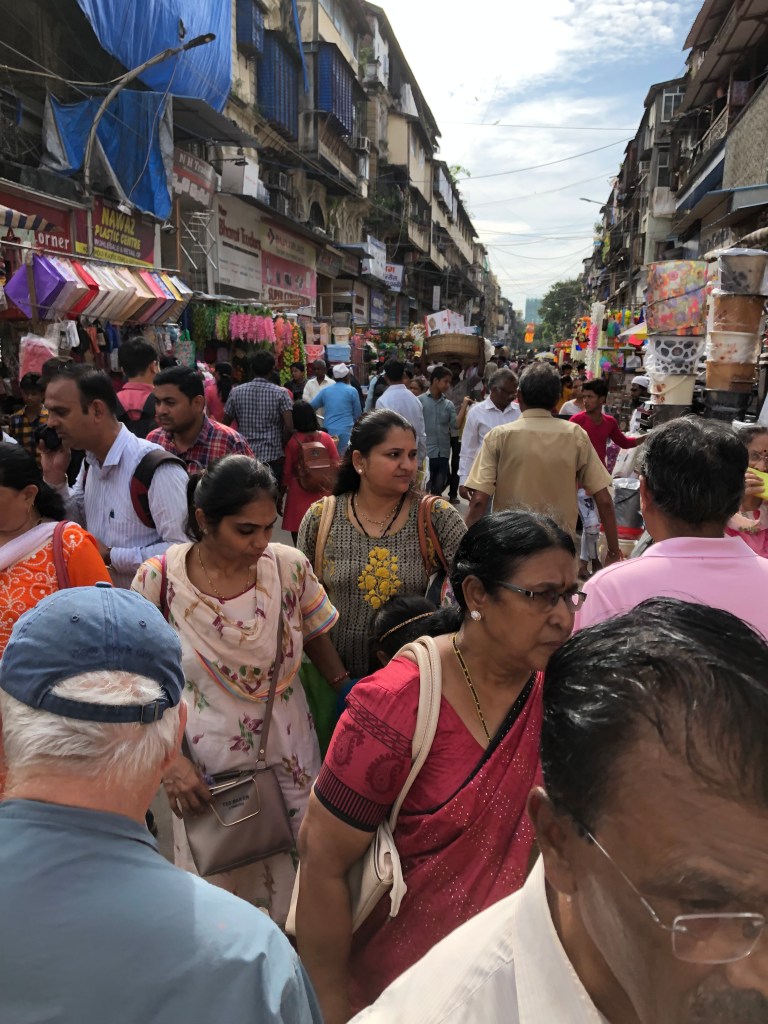
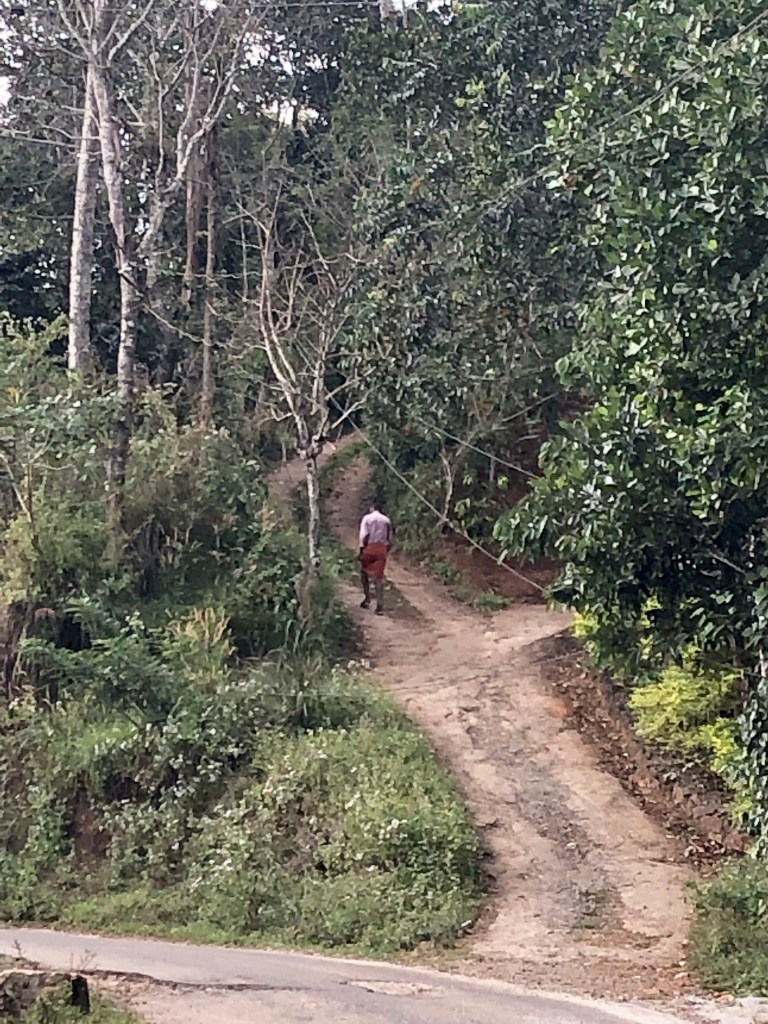
Do We Really Get It?

All told, we’ve been in India almost a year. We’ve spent over two months in Kerala, four months in Rishikesh, and a week to ten days in Hampi, Meysore, Delhi, Goa, Mumbai, Varanasi, Darjeeling, Khajuraho yogashram, Kaziranga, Puri, Shimla, Dharamshala, Dalhousie, Chennai, Pondicherry, Auroville, Bandhavgargh, Rambagh, Jim Corbett, and the Andaman Islands.

My partner has been learning Hindi off and on for 7 years. Between his Hindi and Google audio translate we’ve had many conversations with people about their lives and their opinions about many issues – geopolitical, philosophical, sociological, religious, and how they view the future.

We’ve observed familial interactions, public and less public behaviors, hygiene and eating habits, changing clothing preferences, and acceptable and less acceptable commercial activities.

We’ve experienced the kindness, patience, and acceptance of Indians in many different situations from driving to waiting in line to communication difficulties to cultural misunderstandings.

When asked how many children an Indian has they will invariably give a number that reflects only male children. Mothers as well as fathers respond in this way. Sexist? I don’t think so. It seems that in traditional Indian families (and in spite of rapid and visible change it’s estimated that over 90% of Indian marriages are still arranged marriages) sons remain in the nuclear family home after they marry. Their wives become subservient to the matriarch who travels with them on vacations and sets the tone for parenting. Daughters move on to their spouse’s family. They are only temporarily part of their parents’ lives. I’ve come to believe that is why they’re not included in the natural spontaneous reply about the number of children in the nuclear family.

Is this belief accurate? Maybe. Maybe not. One thing I’ve learned is there’s no point in asking for clarification. Such requests are met with puzzled expressions followed by acceptance of my theory regardless of its accuracy or inaccuracy.

Here’s a much more prosaic, but much more day to day question I’ve been asking in vague euphemistic terminology since our very first visit in 2016. Why don’t Indians, especially women, use toilet paper? It’s excellent for the ecology of every country and certainly one with a billion and a half people, and yet… What’s the deal? It’s all well and good that our tushes and other intimate places are actually cleaner after that spritz from the bidet but what is it about walking around wet that doesn’t annoy them? And is it even hygienic?

They’ve learned that foreigners need toilet paper. Hotels provide small rolls of it and are happy to replenish it as frequently as their patrons allow themselves to make the request (we tend to buy our own to avoid the issue altogether). But when asked why they don’t require it themselves I’ve been met with puzzled expressions and literally no answers, They don’t understand why I do require it but accept it and I don’t understand why they don’t require it but still ask from time to time.

The nearest things I’ve received to an answer have been (1) the concept of the comfort of dry being preferable over damp is a Western concept (really?!?) and (2) you can carry a small towel to dry off, keep it in a small plastic bag all day and wash it in the evening (a nice solutionbut I doubt Indian women actually do that).

That may be similar to something an Indian friend of ours said recently. He owns an amazing guesthouse literally 50 meters from a pristine Arabian Sea beach. He’s made lots of improvements over the past few years. Indian tourists are accustomed to ordering their meals and eating in their rooms. They seem to prefer it. It might be a question of the chicken and the egg. Maybe at one time hotels didn’t have restaurants. So our friend didn’t have a restaurant but realized that the (mostly foreign) guests preferred not to eat in their rooms so he added a really nice place to eat.

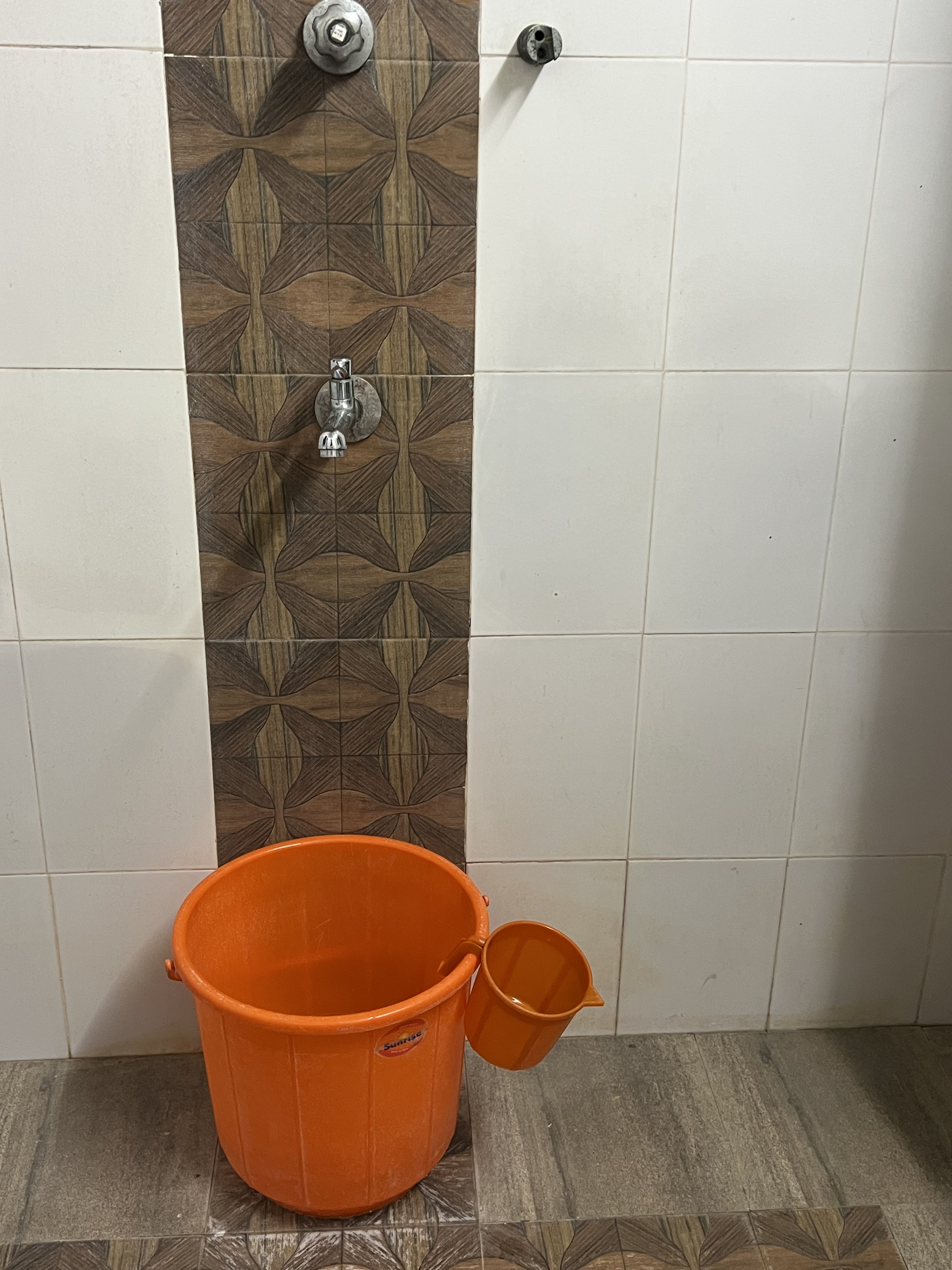
His showers had no hot water. Granted it’s quite hot in Thumboly Beach and the locals see no need for hot water but others do. As a result, he decided to arrange hot water and told us he had done so. In most Indian showers there’s a shower head and also a faucet beneath it about a foot annd an half off the floor with a bucket and plastic cup below it. Turns out he set up water in the lower faucet and not in the shower head.

When we laughed about it with him he said something quite true and profound. He said that one of the differences between Israelis and Indians is that Israelis look at something and immediately start figuring out ways to improve upon it while Indians look at the same thing, accept it as is, and immediately figure out a way to live with it. There are pluses and minuses in both approaches.
And what about respect for personal space, acceptable noise levels in public places or in hotels late at night, what it means to be a couple, the relative merit of avoidance or honesty in confronting legitimate disagreement or misunderstanding; the cultural differences go in and on.

Even when we think we get it we have to keep asking ourselves if we really get it.

There’s no escaping the fact that part of the joy in being in India is the adventure of the Western shrug of shoulders or the Indian wag of the head. The humor in “I don’t know.” The puzzled expression followed by a smile.

You aren’t in Kansas anymore, Dorothy. And ain’t that grand?

Udaipur: The Village Tour

We met our daughter and her three children at the Delhi airport after they’d spent the weekend in Agra seeing the Taj Mahal. We flew together to UDAIPUR, a small, pretty city in the Rajasthan District. UDAIPUR is known as a romantic honeymoon location, home to the lovely Lake Pichola and impressive City Palace. My partner and I were there 7 years ago on our first trip to India and thought it would be a good place for children’s activities.

Rajasthan has its own rich history of colorful dress, dance, and music. We were sure the kids would love the cultural evening with the live Rajasthani music and groups of women dancing with bells on, fire pots on their heads, and especially the young woman dancing while balancing 10 colorful pots on her head. We were wrong. Luckily it was only an hour.

The next day we fared a lot better. All but one of us really got into the 3 hour art workshop where a patient, sweet, talented artist helped us each paint our very own miniature. Our daughter and granddaughter both created truly beautiful miniature paintings. My partner’s peacock and my dancing elephant weren’t bad but revealed that we needed a bit more instruction. Our youngest, a very active 7 year old, showed more focus and attention to detail in his prancing horse than I’d ever seen.

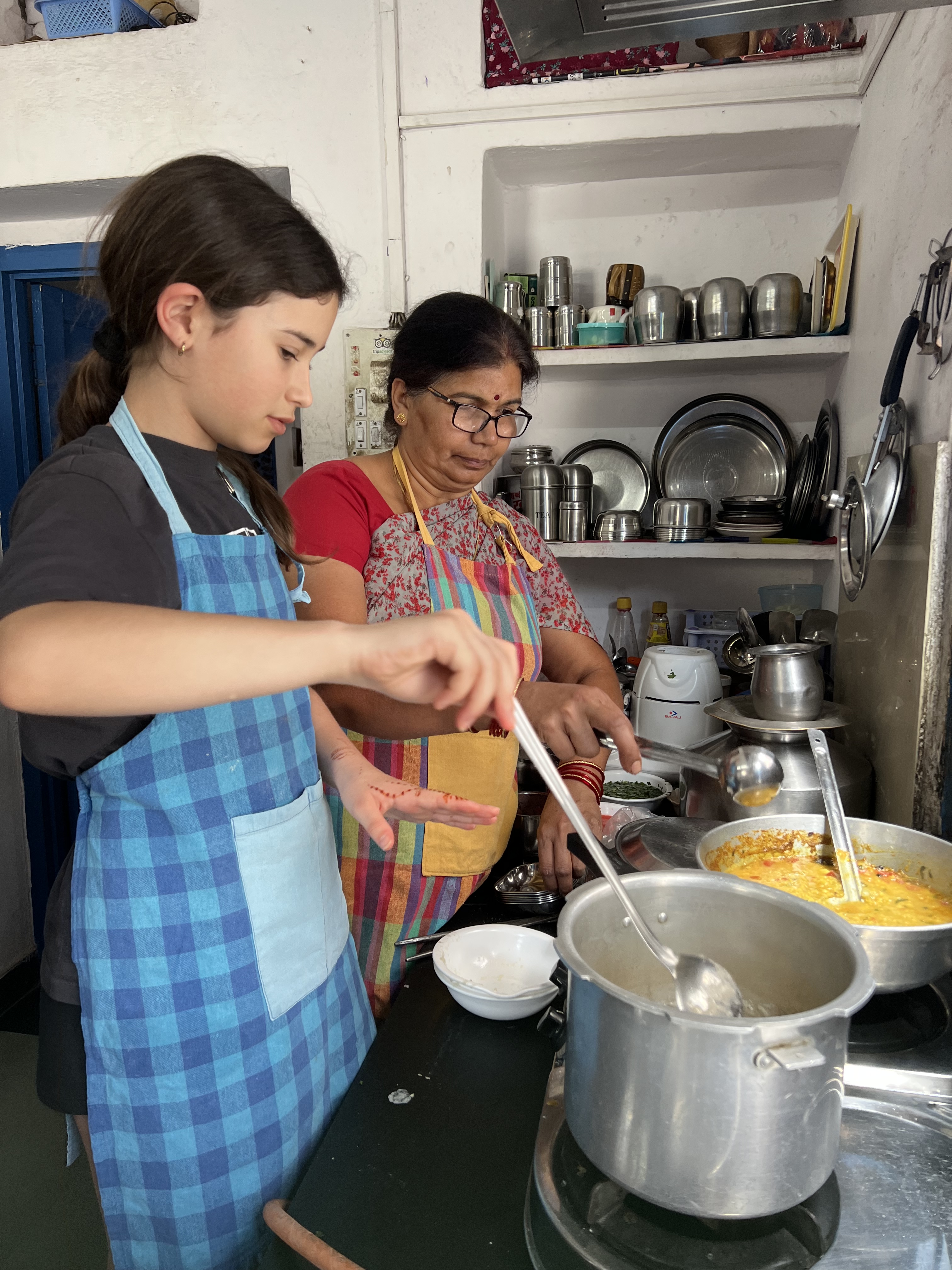
The 3 hour cooking class was a hit with all of us. It was very hands on – from the chopping to the kneading to the measuring and mixing of spices, to the frying…and, of course, the eating. The shy cook started off embarrassed that her English might not be good enough, but once she warmed up (and it’s hard not to warm up to these three kids!), she totally took over the instructions from her (very good looking) son, Gautam.

But the day none of us will ever forget is the day of the village tour.

My partner and I had taken a cab and driver out into the countryside 7 years previously. Our driver took us to several cottage industries – hand stamped textiles, pottery, a country art school for miniatures. We didn’t remember the names of the villages so after reading the glowing reviews of “Salim’s Day Village Tour” we decided to put our motley crew in Salim’s hands and follow wherever he led.

Salim, a devout soft-spoken Muslim, showed up dressed all in white in honor of the Muslim holiday of Ramadan. He brought another auto-rickshaw in addition to his own. We all piled in and off we went in the shimmering 35 degrees heat (95 degrees Fahrenheit).

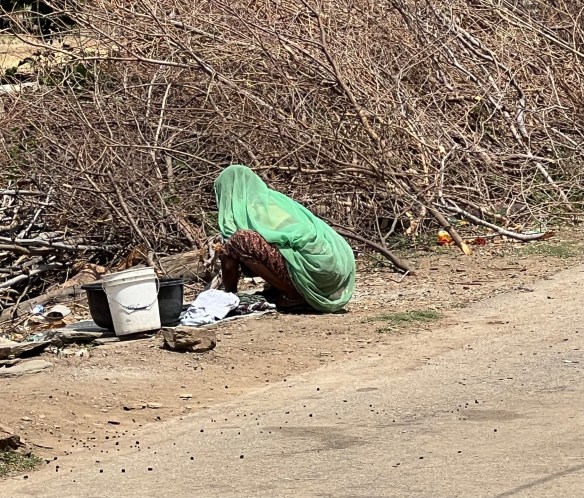
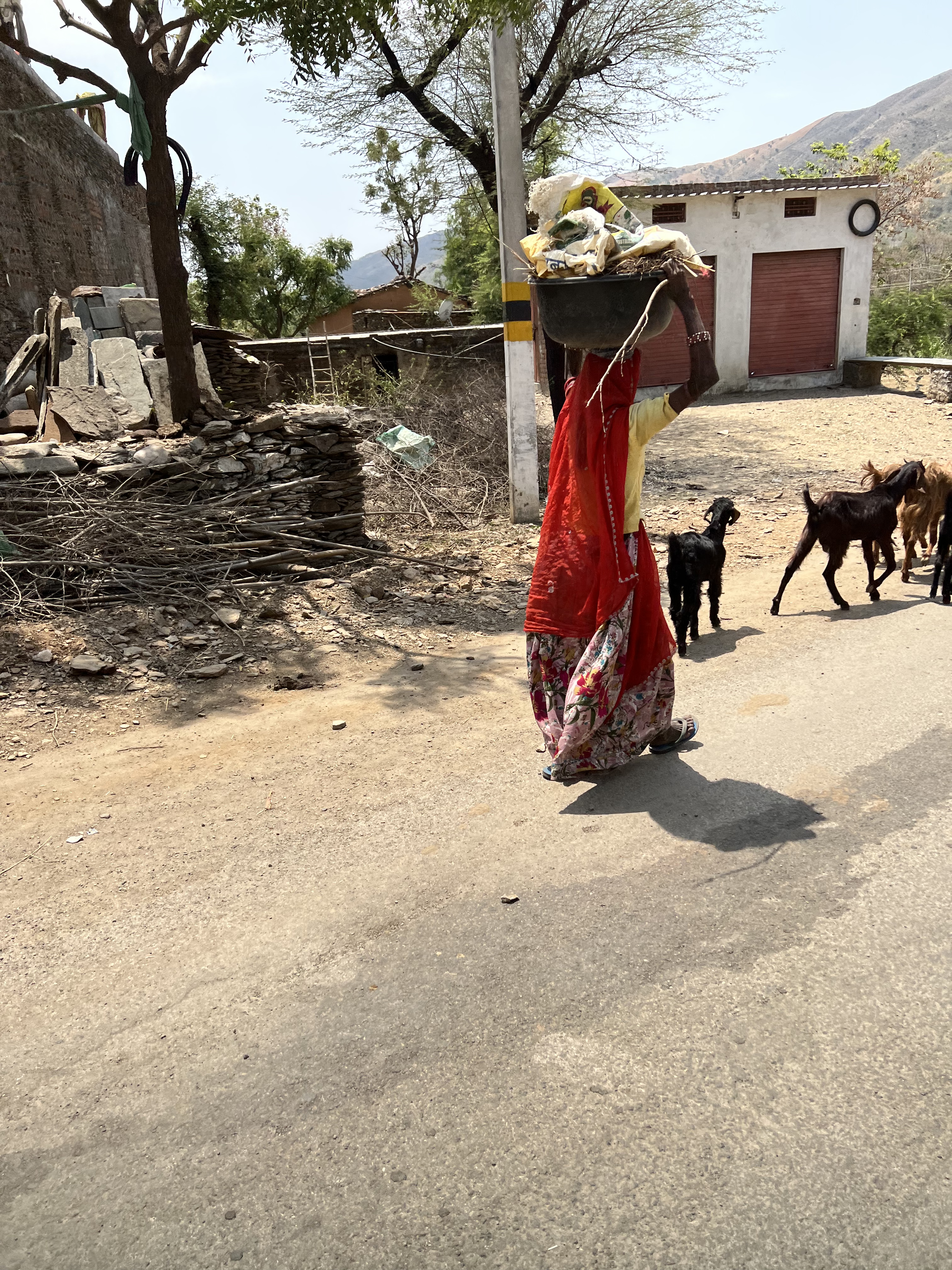
About half an hour later he pulled onto a dirt and gravel road and then turned again onto a rocky path where he parked after another 100 meters. Our first sight was of two women in the distance washing clothes in the small creek. The second was a woman, also dressed in a traditional, colorful sari, with a stack of cow patties balanced on her head.

We followed Salim into a lean-to where five men of varying ages sat on a flat stone area and several women stood by a counter leading into a small hut. It turned out that the father of the woman of the house had died and they were celebrating his life according to their Hindu custom. Somewhat similar to the Jewish shiva, but not exactly an act of mourning since they believe that while his physical manifestation is gone, his (much more important) essence remains.

Oddly enough, one of the ways they honor their guests is to give them cigarettes. Maybe to hasten their reunion with the recently departed? There were giggles from the women and guffaws from the men when my daughter took one of the cigarettes and lit up. Indian women do NOT smoke. But my very white, very light haired daughter differs from them in so many ways that a puff on a cigarette didn’t offend.

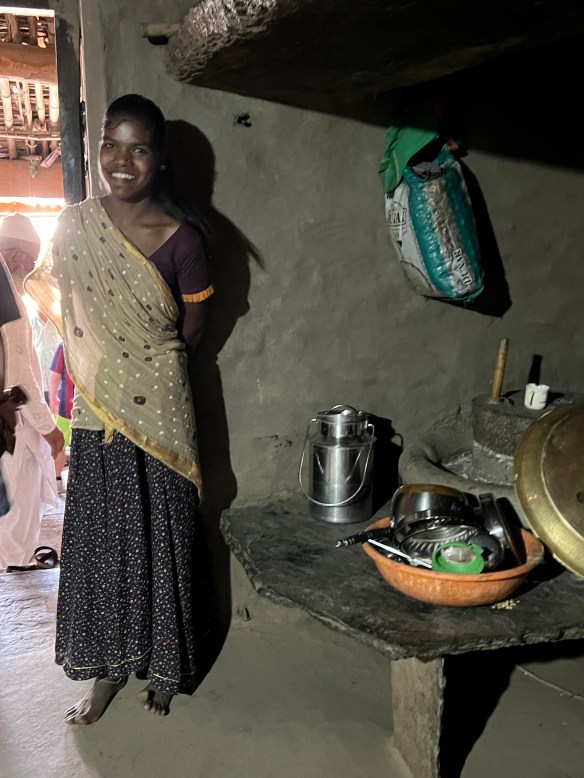
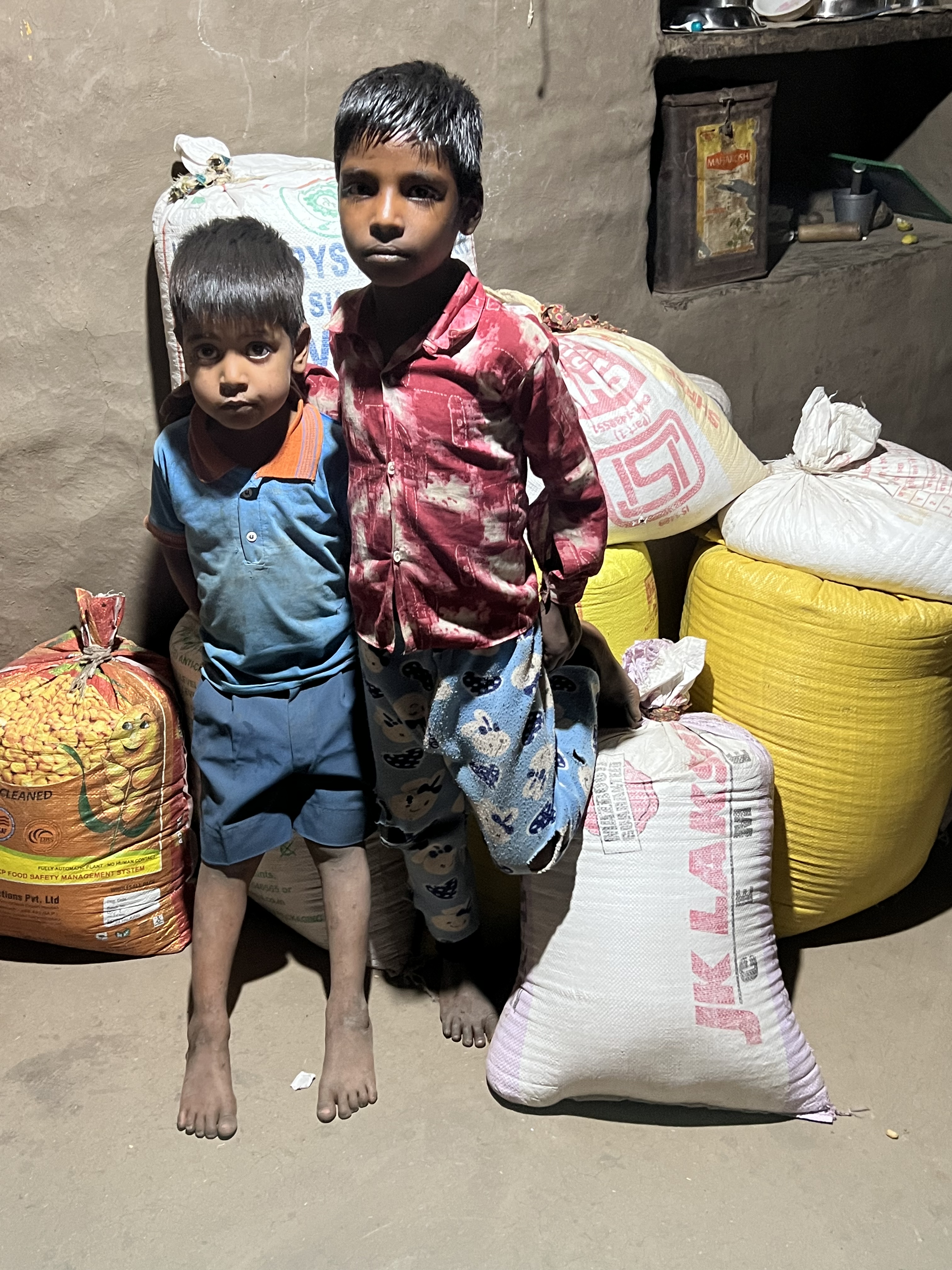
We asked to see inside their one-room home and they happily acquiesced. One of the young women whisked off the covering from a large pot to show us the gas burners (my daughter told us later that a mouse came barreling out). Inside it was quite dark. There were big sacks of flour and rice along one wall. There was one bed with pots, pans, metal plates and cups on it. Salim explained later that the couple sleep in the bed and the children, in this case three, sleep on mats on the floor. There was no bathroom; it’s presumably outside.

We asked if there was electricity and a man pointed the one bare, unlit, bulb hanging in the entranceway.

After our goodbyes we moved on to a day care center not too far away. There were about 15 gorgeous three and four year olds inside.

To say the cramped space was dark, dirty, with virtually no toys doesn’t come close to giving an adequate description.

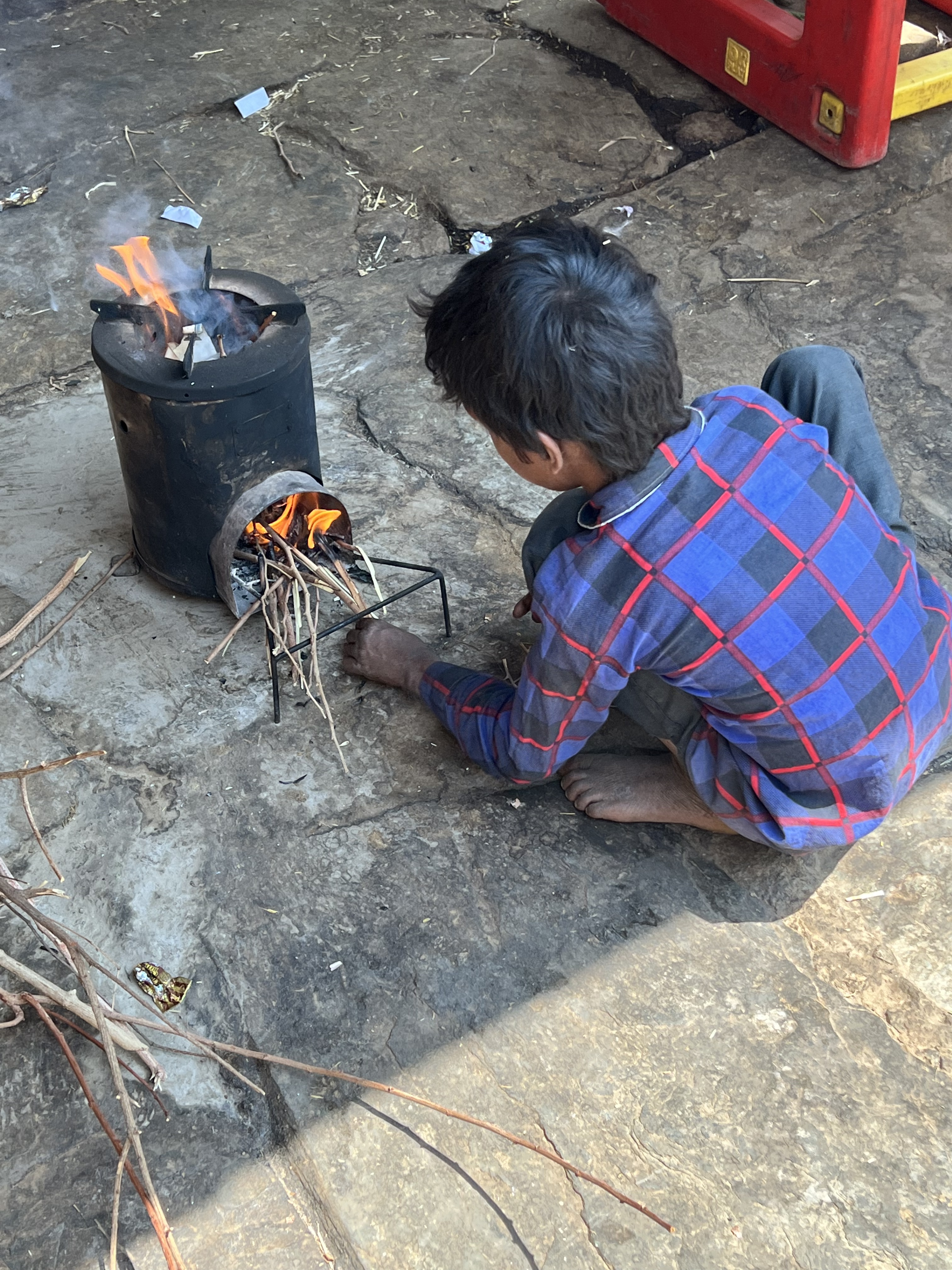
At one point a boy, who looked to be 8 or 9 years old, set fire to some kindling stuffed into a canister-looking contraption. We basically stood with our mouths open contemplating how many safety measures were being ignored while the smaller children heedlessly walked around the open flame. The lone day care worker put a pot of soup on top and began to prepare the children’s lunch.

Salim had recommended we bring candies. Our grandchildren had a great time handing out candies to the youngsters both inside the day care center and walking around the village. They were surprised that when they offered a candy to a child who, as it turned out, had already received one, she declined to take a second. What kid does that!?

By this time we were all drooping from the intense heat and more than ready to head back to our hotel. It wasn’t only because of the heat, though, that it was so quiet in the tuk-tuk on the ride back. There was a lot to think about.

We arrived at the gates to the 42 acres (over 160 dunam) surrounding our hotel. The turbaned guard called a buggy to come get us: goddess forbid we should walk the 150 meters to the entrance to the hotel. Along the way we saw peacocks roaming the grounds freely, smelled the fragrance of the beautiful flowers, and heard the splashing of many fountains.

Truth be told, we don’t usually stay in such elegant surroundings where there are so many impeccably dressed, beyond pleasant staff constantly bowing namaste in our direction over prayer hands. Our daughter is more accustomed to 5-star hotels and it’s actually much easier to enjoy a vacation with children, one of whom is a teenager, when they’re comfortable.

Inevitably at the dinner table when we talked about our impressions of our day, and after the grumbling about the schlepping around in too much heat for way too long, we all expressed our dismay at the parity between the lives of the villagers and the vacationing Indians sitting at the tables around us.

Almost 70% of the one and half billion people who live in India live outside the cities. As in most developing countries, every year people move to the city for employment or other ways of bettering the lives of their family – about 2% annually in India. The already overloaded infrastructure of the cities – Delhi with almost 33 million people, Mumbai with over 21 million, Bangalore with almost 14 million – is hard put to cope with more.

Prime Minister Modi, since his election in 2014, has instituted several programs to encourage villagers to remain in their villages. His government guarantees 100 days of employment to every villager who’s eligible. A gift of 150,000 rupee ($2000) is given to each village homeowner for home improvements, primarily to fortify roofs and walls to withstand monsoon season. 600 million toilets were purchased for the villages in the first five years of the present government .

And, still, the parity is huge.

We talked about the Indian trait of acceptance and the joy in the villagers’ children’s play. We talked about the bountiful nature of our own lives and how, even so, we so often strive for more and better. One of us reminds us of the pride in one man’s voice when he pointed out that his daughters were home visiting from college. So along with acceptance there can be a desire for change.

We conclude our conversation as so many of them end – knowing that we can only ever get a small peek into the depth and vastness of this amazing country called India.

None of us will ever forget these two weeks of ours as a family in India and this day will always stand out.

Riding the Rails

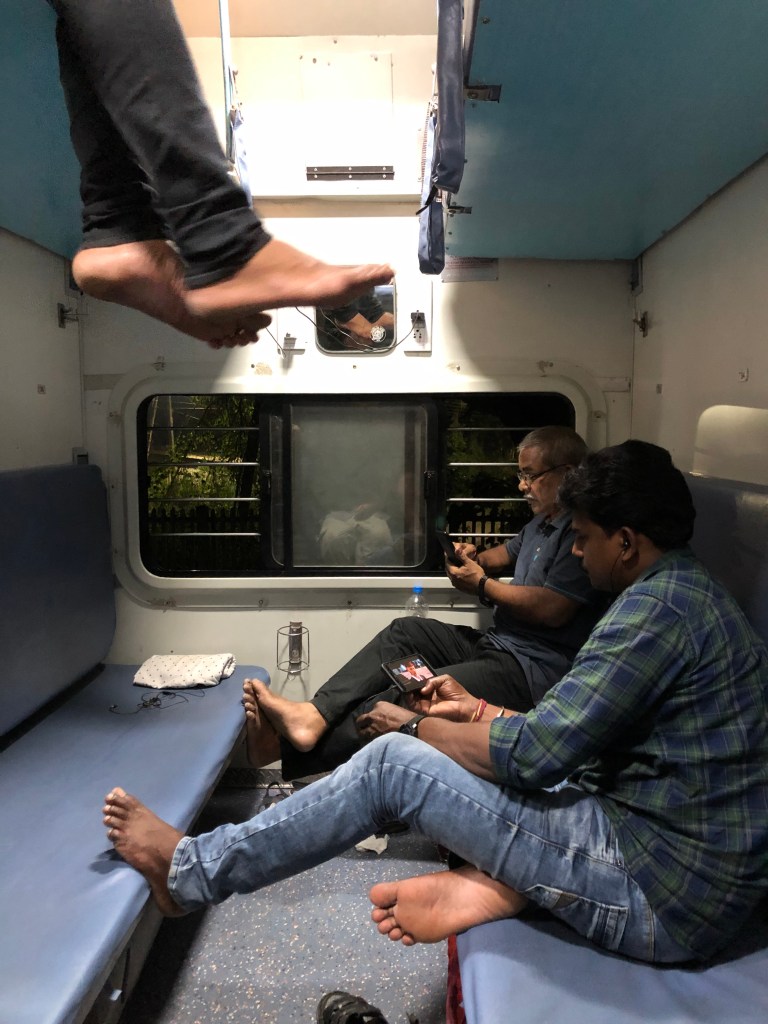
Literally billions of people ride the Indian Railways every year – 8.086 billion in 2022. Established in 1836, it remains the most utilized form of public transportation between cities in India. Cheap, reliable, and relatively comfortable, passengers can choose between at least 3 classes of travel from non-air conditioned, usually very crowded, sleeper class to air conditioned first class (not available on most trains) with only one person per berth. Clean sheets and pillow cases are provided. There’s a small table and individual reading light in each berth. The seats revert into beds. Often there is a western toilet as well as an Indian “toilet” and the bathrooms are relatively clean, although often stinky.

The reservation process is tricky.

We were fortunate our first time in India to be taken under the wing of the young man who arranged for us to see tigers in Bandhavgarth. Though not at all his job, he walked us through the complicated process of opening our own Indian Railway account. As a result, we’ve been able to purchase train tickets online on every trip since. Most foreigners use the ubiquitous travel agencies where they can purchase train tickets for an added fee.

The status of a reservation is crucial.

We didn’t understand what all the abbreviations stood for at first and learned by making funny mistakes which thankfully didn’t result in us getting kicked off trains, but only because Indians have inhuman patience with how life rolls.

There are many levels of waiting list status. The final status only becomes available 3-4 hours before the train leaves the station. That’s why so many Indian families can be seen sitting, or even sleeping, on the platform floor. Often they’ve brought stainless steel closed pots with food for the long wait.

If a seat has not become available money is automatically refunded.

If one traveler receives confirmed status, all travelers in her party can board the train but they may not have an actual seat. They can sit on the berth of the confirmed traveler…or on the floor.

And then there’s finding the correct platform and your particular train car’s position. The train may stop for only 2 minutes and each train is ridiculously long. If you read Tamil Nadu or Mayalayam you may not have trouble reading the electronic sign but, even so, the platform may change. The final platform may only be announced (thankfully also in English though so heavily accented sometimes that it’s a challenge to understand) 10 minutes before the train’s arrival. Being old and very white, people often approach us to ask if they can assist us in standing in the right place. Indian kindness and gentleness is found everywhere.

Our first time in India we had to keep asking where to get off the train. There’s no announcement of stations. The stations are often not lit up so there’s no possibility of seeing the name of the stations at night. At that time there was no live online running status as there has been for consequent trips. Again Saptarishi, our guardian angel on our first trip, stepped in to save us on one overnight journey. He called us as 4 am to tell us to get off at the next stop. Sweet guy. Who knows where we would’ve ended up?

There’s a sense of accomplishment in learning the twists and turns of using the train system. And not only fanagling our way effortlessly through the process.

Also realizing that less is more. Each trip I’ve packed less so as to be more comfortable getting on and off trains as well as having more space around me in the berth. And that’s a useful skill for every aspect of travel, imo.

Also being with Indian travelers and having some interesting conversations- glimpses into their lives. Once a large group of university students traveling to various cities to see different types of city planning. Another time two middle aged couples – friends – taking an annual vacation together. A few days ago a young man whose job it is to be sure used linens are removed and clean linens provided.

On one of our first train trips a 50-something couple, both professors, returning home from visiting their son at college explained the Hindu relationship with god/dess statues and shared their views on arranged marriages versus “love marriages” (they were shocked to learn that ours wasn’t an arranged marriage).

Another benefit is being able to move around, stretch your legs, and even do a little yoga if you’re so inclined. India is huge – Rajasthan, one state out of 28 – is the size of Germany. A journey between cities might be a couple of days or more. Hiring a car with a driver is relatively inexpensive but not only are you in a pristine bubble, removed from actual India, you’re also stuck in a car for hours and hours, day after day. Sure, you can stop whoever you want, and you can stay overnight in nice air conditioned hotels along the way, but it just takes that much longer and is, imo, claustrophobic.

Did I mention the vendors who hop on the train selling tea, coffee, snacks, and meals?

“Chai, chai, masala chai, coffee!”

So far we’ve only been on two train trips and I’m not sure how many more we’ll take this time around.

I’m already feeling a bit nostalgic..

Whatever happens, I’m satisfied

In Israel parents teach their children a saying very early on in life – Whatever happens, I’m satisfied. It rhymes in Hebrew and expresses a futile hope on the part of parents that it will nip complaining in the bud.

Pretty ironic since Israelis (and maybe Jews in general) are among the most, ahem, discerning (read critical, judgmental, complaining) people I’ve come across in my extensive travels. And I am one, so I’ve had plenty of experience.

On the positive side, perhaps that’s why we’re the start-up nation with more technological and medical innovation than any other place on earth. That squinting one-eyed gaze at everything around us and thinking…hmmm. I could do that better.

On the not-so-positive side, it’s a pain in the rear end to be so often surrounded by people who are almost never satisfied with the way things are. The food in the restaurant is never quite right even after an order reminiscent of Jack Nicolson in Five Easy Pieces (I’ll have omelette plain, with a chicken salad sandwich on wheat toast, no butter, no lettuce, no mayonnaise, hold the chicken). The room temperature is too cold or too hot. The teacher doesn’t pay enough attention to my kid or singles her out for special (not good) treatment.

I wasn’t feeling great the other day. Stuffed up, headache, scratchy throat, didn’t sleep well. Here I am in southern India. Home of Ayurvedic medicine. Decided to get an Ayurvedic massage. For the uninitiated, this involves total nudity and more oil than a Mediterranean diet calls for in a lifetime.

The very sweet young woman spoke no English – zero – and my Malayalam is pretty rusty. There was absolutely no possibility of any request whatsoever. None of the usual massage direction – harder, softer, higher, lower. Nada.

As I lay there swimming in oil I thought THIS is the opportunity of a lifetime to fulfill that Israeli saying – Whatever happens, I’m satisfied.

I found thoughts popping up about how I might prefer this, that, or the other thing she was doing but they disappeared as quickly as they arose. They were irrelevant given our mutual lack of communication skills.

Ultimately, after she wiped off a lot of oil and I pulled my shift over my head – this not being my first rodeo I knew that less is more is the rule when committing to a Ayurvedic massage – I showered and crawled back into my stuffed up, scratchy throated, headachy nest and realized my headache was gone, my throat a bit less scratchy, and that prickly low grade fever feeling had disappeared.

I woke up this morning with more energy than the past couple of days. Had a peaceful, flexible hour on my yoga mat, and sat down to ponder the potential of “Whatever happens, I’m satisfied.” She knew what she was doing and any direction from me would have just gotten in the way.

It’s a continual conundrum in my mind. This contentment with what is versus the striving for improvement.

What do you think?

PS The above photo was taken from this very balcony three years ago. The most peaceful place on earth, Thumboly Beach


Differing Realities

I’ve been teaching meditation in one form or another for the past 20 years. During that time I’ve listened to hundreds, maybe thousands, of hours of dharma talks given by insightful teachers. I’ve been a member of meditation groups – presently a wonderful group of people from the west coast of the USA on Zoom every other week – pretty much consistently for decades. I’ve read dozens of books about mindfulness, awareness, no self, here and now, letting go, equanimity, and lots and lots of other catchwords and phrases. You know the ones.

All this is to say that from many different sources, I’ve received the magnificent gifts of self-knowledge and the possibility of inner serenity during tough and not-tough times. I’m hugely grateful to all my many teachers, those who call themselves teachers and those who don’t, who give of themselves so generously and to God for giving me the time and resources to take advantage of it all. As my husband and I often say when thinking of our bountiful lives – We couldn’ve been born under a bridge in Mumbai.

But it’s only recently that the light went on over my head concerning not only the reality of being born under a bridge in Mumbai – having few material resources and few possibilities of their attainment – but living in a reality that doesn’t allow for integrating those catchwords into one’s life.

It came about one evening after teaching a Raja yoga class (which includes a segment of meditation). I stood talking to one of my students, a particularly beautiful young woman who looks startingly like a well-known gorgeous movie star. She’d obviously lost some weight from her already-very-thin frame and had black circles under her eyes. Her entire affect was one of misery. As it turns out she was caught up in the turmoil of what she saw as a terrible injustice on the part of the employer at the job she’d just left. She felt that, while she’d left the company, others were still suffering the injustice and she was struggling with the idea of suing the company. It took me a few questions to realize that, in fact, it had nothing to do with her directly anymore. I kept thinking surely I must be missing something.

She said that she hadn’t been sleeping and had lost her appetite; that she couldn’t stop thinking about the bad behavior of her former employer. I suggested that she might focus on her supportive husband, healthy scrumptious kids, and her new (more appropriate) employment. We spoke about the possibility of letting the drama and injustice go. She said she’d think about it, but I could tell she wasn’t happy with the direction our conversation had taken.

Since she only comes to my classes sporadically, I noticed that I hadn’t seen her in a while but didn’t think much of it. I wished her well in my heart and hoped that she was able to make peace with not championing those who had remained with her former employer.

About a month later she got in touch with me. She’d been on a 10-day silent retreat. Her first.

She said that when we’d had the conversation about her former employer she’d been very angry with me. She thought my idea of letting the injustice in her former workplace go was surrendering to unethical behavior and part of the larger problems in the world. (in the world!! no less). It was only very far along into the retreat that she felt what she called a clarification which was like the lifting of a heavy fog. She realized that the entire issue of the injustice wasn’t her issue at all; that her inability to see what was clear to me lay in her having always been responsible for her siblings and even her parents in her dysfunctional home. She needed to take care of everyone around her to feel okay about herself. Once she recognized that she was able to let it go. She felt a huge physical relief as if a suit of armor had been lifted from her body.

Of course, I was happy for her and hopeful that she would continue to safely investigate her feelings. I know there’s a lot of inner disquiet and deep fragility there. But I was also chagrined at my cavalier projecting onto others with catchwords and phrases I never stopped to consider might be out of the realm of possibility for some of them.

I know better than that on so many levels, and, apparently, know less than that on others.

I began to look more carefully at other concepts I act as though are healthy, positive, and accessible to all, with a more discerning eye. Is this one really accessible to all? And that one?

It’s all fine and well to talk about relinquishing our narratives and not letting them be in control of our present lives, for instance, but is that accessible to everyone in the present moment of their lives?

Easy to talk about being grateful and satisfied with what is, but how does that resonate with someone who never experienced the unconditional parental love that encourages an ability to feel that one has enough, that one is enough?

And what about letting go, being joyful at the happiness of others, and oh so many others?

I’m embarrassed to say that I seemed to operate on the belief that saying it’s possible, telling stories and legends about people who have integrated such things into their lives, could shine a light bright enough to make it come true for my students. But while I like to think that it could and did for many of them, I will be making amends/changes to accommodate those for whom it’s not part of their reality…yet.

My reality is an ever-changing thing. Nothing in this life is permanent. So why in the world should my ever-changing reality be anyone else’s reality. For the most part, even in our uniqueness, we share quite a bit of similarity to those in our general milieu, but not enough to assume….well, anything.

You know what they say about people who assume…

Is There a Spiritual-Material Spectrum?

Rishikesh is one of seven holy cities, Sapta Puri, in India. Aside from being alcohol-free and vegetarian, the city is a spiritual center, pilgrimage location, yoga and meditation center, and home to many Sadhus.

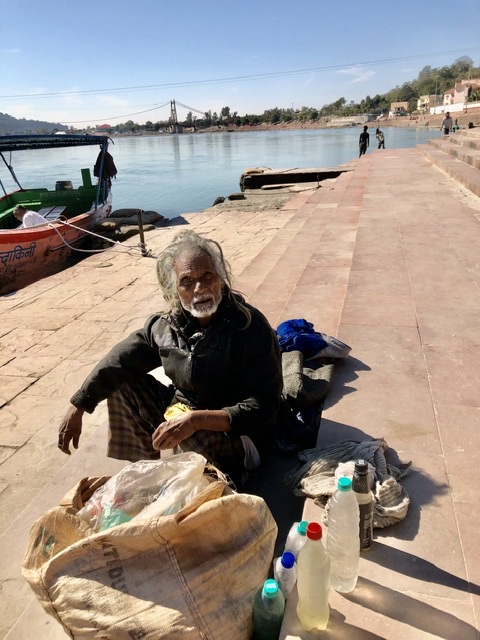
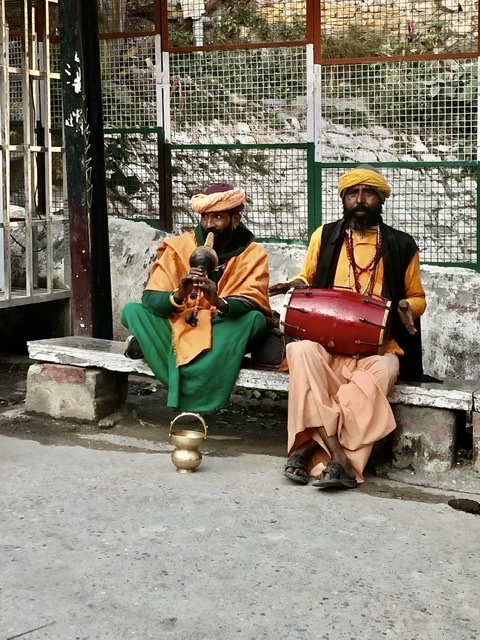
A Sadhu is a religious ascetic who has renounced the worldly life. He often lives on the street, with only the essential belongings for survival – his clothing, turban, towel, sandals, and beggar’s bowl. He is dependent upon the good will of others to provide him with enough money to buy sustenance-level nourishment each day.

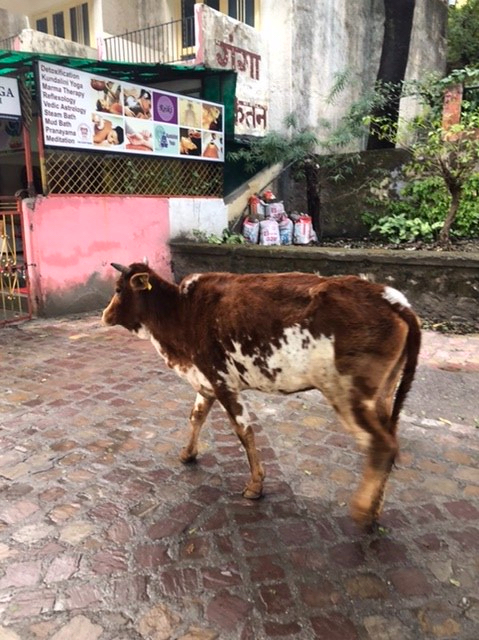
On my way to yoga in the morning, after crossing the Ram suspension bridge, which is blessedly motorcycle-free at that time of day, I meet only cows, dogs, and Sadhus, all waking up after a night spent outside.

Sadus may be said to be at one side of the spirituality-materialism spectrum. As I wait for my sweet yoga teacher, Gagan, to arrive on his motorcycle, sharing the pergola which overlooks the Ganges with the same Sadu each time, I can often hear a passing Sadu chanting quietly or not at all quietly.

“Ram. Ram. Ram. Ram. Ram. Ram. Ram.”

Though they’ve renounced family, home and worldly endeavors and accoutrements, I’ve noticed that they tend to hang out in twos, threes, and fours – a social group of sorts – and they gather their few belongings safely around them or cover them with a tarp on a nearby bench. Some take advantage of government incentives and work at ashrams where they receive food and shelter in return.

As my yogi says, human nature is one of collecting: things, acclaim, friends, knowledge, money. Another distinction between other animals and the human animal.

We ate dinner with a group of 20 strangers in Delhi not too long ago. Nice people. Friendly. As travelers are wont to do, people spoke freely about their lives, philosophies, travels, and families. The two men who sat closest to us got into a long conversation (with my partner) about their various, and, it turns out, multitude of real estate investments all over the world. The ones they sometimes live in, the travails of having renters, the value and tax issues of different locations.

Neither was Bill Gates but neither was a Sadu either.

We’ve been in India for over three months now. It’s a long time to be out of mainstream living. With each day that our work commitments, family and friend socializing, and community presence gets further away, our bonding to each other and our investigation of personal values and beliefs becomes more intriguing. There’s more time spent observing, thinking, integrating and softening.

It could be that the inherent nature of India is friendlier and more conducive to this transformative process. It could be that an extended period of free time would create the possibility of this process anywhere.

In India specifically, as we travel, meeting other travelers, shopkeepers, restaurant and guesthouse staff, yoga practitioners, musicians, and language teachers, we can’t help but observe their everyday life and that of passersby. Some of them become a regular part of our day for the week, two or three that we are in their vicinity. We seem to be seeing the spirituality-materialism spectrum in real time.

Spirituality is in the air.

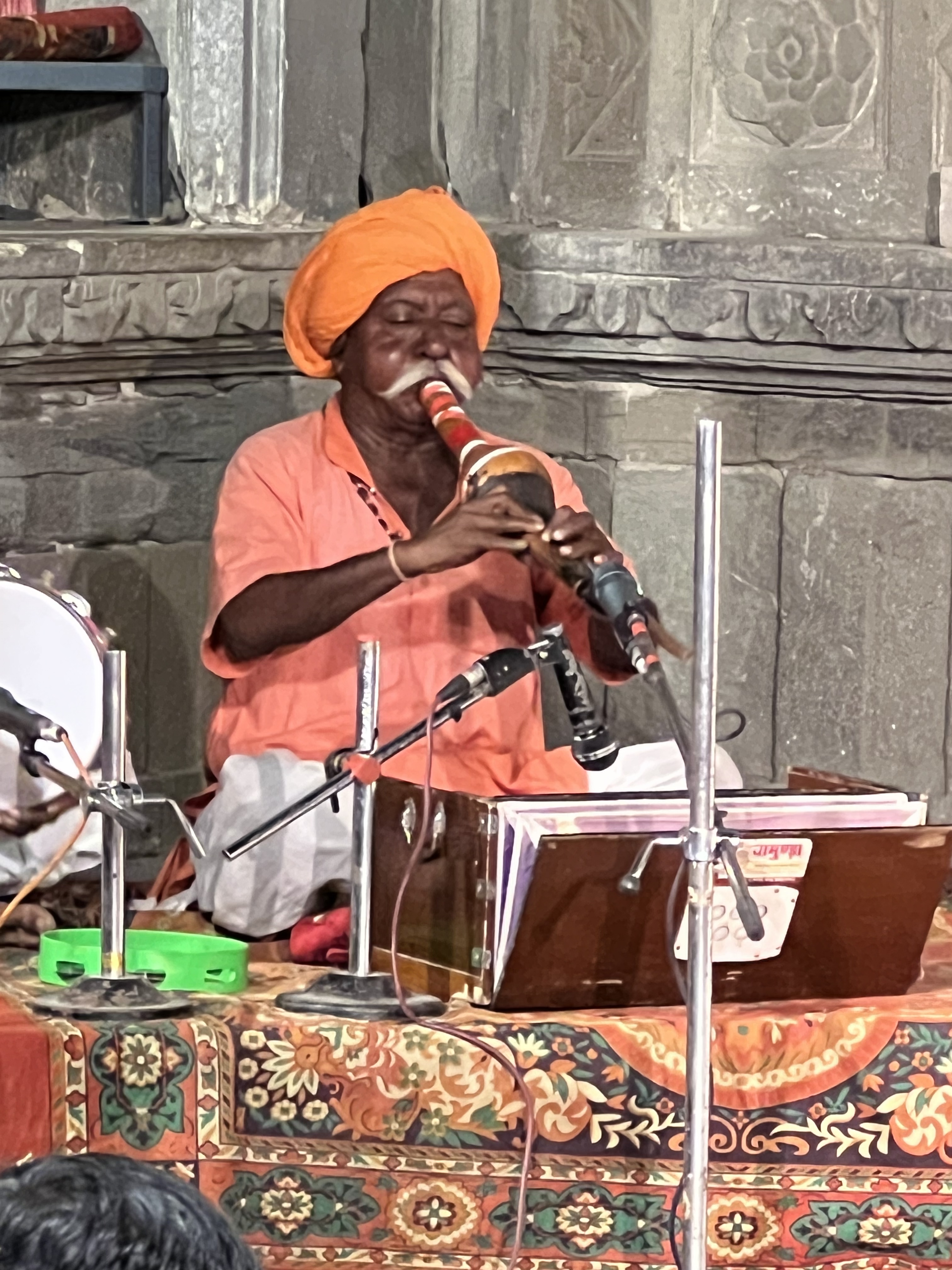
From JP, the owner of our guesthouse near Munnar, who gets up at 4 am each morning for 20 minutes of yoga, to the shopkeeper in Rishikesh who closes his shop at 10 pm, bends down 3 times to kiss the step in front of his shop door, touches the doorframe and then his forehead before getting on his motorcycle to head home, to the clearly well-to-do middle-aged Indian couple who travel to The Ganges to dip themselves in holy water annually, to my lovely harmonium teacher who has a smile for the pesky monkey who pushes open her door when she shakes her head in that ubiquitous, multi-meaning Indian wag and says “He, too, is one of the gods’ creations.”


The human nature of collecting is evident, too.

The same people mentioned above charge money for their goods and services. In general, they unabashedly charge foreigners more – sometimes shocking attempts to charge 10 times more. A Sadu might complain about a donation of 10 rupee (“But a chapati costs 20!”). One South Indian man we befriended had a candid conversation with us about his constant efforts to accumulate more wealth. The yogi with whom I practiced four years ago didn’t charge money (he reluctantly accepted my ‘donation’ of $75 for 10 classes) and this time made his charges clear before we began (less than $6/class).

So where does each of us choose to be on this spirituality-materialism spectrum?

Does being a Sadu, at one side of the spectrum, preclude a bit of materialism? Does being Jeff Bezos preclude a smidgen of spirituality? (btw, did you know that there is not one woman on the list of the top ten richest people in the world?)

Gagan believes that it’s easier for those who have wealth to take on spirituality. Perhaps this originates from his vantage point as a Sikh yogi whose path of relative poverty and practice was inherited, clear from the age of 10. Perhaps he envisions those who have large bank accounts as having the luxury and ease to choose to invest time in introspection and seeking spirituality.

It seems to me, from my vantage point of never having had to concern myself with the possible absence of my next meal or a roof over my head, that it’s easier for those who have not been educated to chase ever-improving material circumstances to take on spirituality.

Clearly Gagan and I bring different life experiences to our sense of things.

Seane Corn is one of the most famous (and wealthiest) yoga teachers in the world. Her net assets are reported to be over 20 million dollars. Not anywhere near Bill Gates’ estimated 100 billion dollars, but still not too shabby. While her exhibition-type, extreme style of yoga is not my cup of tea (maybe I just wish I could have her flexibility), I’ve admired her for years for her tireless work for altruistic causes. Her organization, Off the Mat into the World, offers yoga practitioners the opportunity to volunteer to build community centers in Africa, train young people to teach yoga and meditation in their villages and towns, and offer online courses for leadership initiative. A vegan, Seane teaches 250 days out of the year, and, when not teaching, calls a tiny yurt in Southern California home.

Miriam (not her real name) is a talented artist, living in a rural area of Israel. Her husband of 25 years is most often in the US where he teaches religious studies in a small community where there would be no religious learning if he didn’t offer it. They have little in the way of material wealth, other than the modest, heavily-mortgaged home Miriam lives in, and, sadly, have no children. Their daily lives are committed primarily to the deepening of their spiritual lives and sharing what they believe are their God-given talents – painting and teaching. Miriam offers half-day and full day retreats for women, providing spiritual, artistic and nutritional nourishment, charging on a sliding scale according to means. Her walls are covered with her beautiful original works, into which one can gaze, imbued with Kabbalist and/or personal spirituality.

(not Miriam’s work)

Most of us are neither Seane Corn nor Miriam. We’re neither millionaires nor Sadhus. Some of us may not give a second’s thought to spirituality or ethical behavior or the meaning of life; others may think about it fleetingly or in depth once a week, or at random times.
All that stuff has been in my thoughts for as long as I can remember. Sometimes it led me to political activism, sometimes to volunteer work, sometimes to prayer, sometimes to regrets, sometimes to books, sometimes to an open heart.
I’ve been blessed with 3 months of unrestricted time, a partner who’s happy to listen to and share philosophical thoughts, and surroundings that welcome it all.

We live in an age of moral subjectivism, relative realities, political correctness – some may be tempted to call it an age of wishy-washiness. We hear that there’s no objective right or wrong, better or worse, too much or not enough. It’s all what you choose for yourself. The glorification of the individual, regardless of…well, pretty much anything.

But, hand on heart, don’t we all actually know what having enough looks like? I’m guessing it doesn’t resemble Jay Leno’s collection of cars or Imelda Marcos’s shoe closet. It most probably isn’t even reflected in most American’s refrigerators or leisure time.
I’m a member of a FaceBook group of people traveling in India. Recently there was a post about whether or not to tip in India, and how much. Some of the responses were eye-openers. From ‘Indians don’t tip.’ to ‘It’s good enough to round up.’ to ‘They earn so little that 10 rupee significantly increases their income.’ (10 rupee is the equivalent of 15 cents)
Seriously, guys!?
Then there’s the feeling that we’re too busy to walk the breast cancer marathon or visit the aunt who’s broken her hip or volunteer at the literacy group downtown.

We each choose our own path, even though sometimes it doesn’t feel like it. We have internal voices that may sound a lot like one of our parents, our seventh grade teacher, our partner, our eighteen-year-old self, our rabbi, our neighbor, or all of those people and others besides. Voices that narrow our choices to, well, theirs. Or what they wish they’d chosen.

Confusing…and noisy. Hard to hear our own internal voice with all that racket going on.

Gagan shared his own belief about all this choosing, whether it’s about spirituality, materialism, or how much time to look at a screen of some sort. If you never regret your choice, your choice is good. (I wish you could see his expression and hear his voice as he says that.)

When I pushed him…what about an addict who ends up dying from his addiction?

The answer – If the addict dies with no regrets, then the choice is good.

Say whaaaat!?

That’s going too far for me, but I get it when he elaborates and adds that trying to guide someone else’s path is like trying to steer a passing car. Unless the driver pulls over, stops, and asks for directions, your shouts will just make you hoarse.

I’ve spent many hours perfecting work and making deadline only to find that the client didn’t bother to provide necessary material – and didn’t care. I’ve spent money and time fulfilling a promise that the person on the receiving end, it turned out, didn’t value much, or may have even forgotten. I’ve worried about people’s “wrong” decisions that turned out not to be so disastrous in the long run, or even had their positive aspects.

So if I believe people are happier with spirituality in their lives, authenticity, or altruism, or other people, I choose to resign as one of those internal voices that points it out.

I’ve chosen to integrate those attributes into my life and to respect your right to choose to integrate some, all or none of them into yours.

No regrets.


But what about the family?

This trip started out as one of those ‘round the world’ tickets where you have to keep traveling in one direction – east or west – and can’t cross any specific ocean more than once. I must’ve played with that planning tool on the Star Alliance site for twenty hours or more over the course of several months.

Tel Aviv – St. Petersburg – Mumbai – all over India – China – Bora Bora – Alaska – Oregon Coast – California – Salt Lake City – Mount Rushmore – The Badlands – New Mexico – San Antonio – Fort Lauderdale – New York City – Toronto – The Bay of Fundy/Nova Scotia – Iceland – Tel Aviv

Juggling weather, direction, time.

How much is too ambitious? Australia, yes or no?

Should we rent an RV to travel around the US? A car with motel stays? Flights for the long bits?

But then the time came to make real decisions like renting out the house for the year and what to do with my yoga studio and my husband started hemming and hawing. There were hesitant chords of concern about leaving our lives for so long. I tried to ignore them. Gloss over them. Treat them like background noise.

A year. Twelve months.

I had to admit to myself that it was sounding like a really REALLY long time to me, too.

The house wasn’t the problem. Neither was the studio. Though I love both.

It was the kids, the grandkids, and the friends who have become no less our family in the 30+ years that we’ve shared a life.

So twelve months became ten months became six months and here we are with the second month of our six-month trip drawing to a close.

In this technological era, it’s pretty easy to keep in touch with people. We share our amazing surroundings and the interesting people who inhabit them with a WhatsApp group for our English-speaking friends daily. We post on FaceBook for our Hebrew-speaking friends or send separate WhatsApps or emails. We send messages to our family WhatsApp group, too, and keep in touch with them with video WhatsApp weekly when we can find a strong enough WiFi connection, or with audio WhatsApp when we can’t.

We spoke with our youngest son and his wife yesterday from an isolated snack food kiosk in the jungle as they drove home from an office party in Silicon Valley, California.

We remember the days, not too long ago, when we sat in Internet Cafes, paying for the internet per minute and waiting endlessly for the atrociously weak and slow connection. Then there was Ko Mak, an island in Thailand, where we had to hike an hour to the other side of the island daily for the only internet connection because I had left Israel in the middle of interviewing candidates for a position and had to go over resumes.

Earlier there just was no internet – impossible for our grandchildren to envision – so we made the occasional phone call when we could.

It seems that most of the important people in our lives are healthy and major crisis-free so far during this trip.

Before we left we knew that one friend was scheduled to have a small, probably cancerous, tumor removed from her kidney, and after we left we received the good news that all had gone well with her surgery.

One granddaughter had an ugly eye infection that seemed to linger endlessly. Endlessly finally came to an end after way too long a time for my taste. Her swollen-closed eye then returned to normal.

The worst of it so far has been a shocking but benign head tumor with sudden, unexpected, surgery that’s meant weeks of rehab for a neighbor who’s like a younger sister to me. That was a tough one because I knew that my presence could’ve been important for her morale, but, thankfully, her recovery seems to be going well.

Life is full of surprises – big and small; pleasant, unpleasant and neutral – and they don’t cease when we’re far away from our usual haunts.

So here’s the deal.

Relationships with people are one of the most important ingredients in the tasty soup of life. There’s our relationship with ourselves; our inner world. The one we take with us wherever we go, whether it’s to the living room or to India. Then there are all the others.

The ones we choose; the ones we’re born into; the ones we birth; the ones we marry into; the ones we grow into because of circumstances; the ones who are part of the landscape of our lives.

There are even relationships we’re semi-unaware of until they’re brought to our attention.

There are close relationships and casual relationships. There are close relationships that become casual sometimes and casual relationships that become close at others.

There are relationships that take us by surprise and relationships like old slippers – comfy and constant.

But there’s one reality of important relationships that my husband has pointed out to me many times – they have a past, a present and a future. If one of those elements is missing, the relationship is a like the one with that second grade teacher you had in elementary school. She may have been one of the most significant people in your life when your were seven but she’s only a fond memory today.

Anyone who knows me knows that I’m a relentless technological freak. I love the newest, the most creative, the most surprising new concept, gadget or app. I’m that person that buys the out-of-the-box FaceBook solution for neck tension and was one of the first to contract out administrative projects to freelancers online fifteen years ago. I never give up communicating with people in the Mayalayam spoken and written on my translation app in spite of dozens of puzzled expressions. I trust Uber and Waze and UpWork.

I prefer email and WhatsApp to phone calls or personal business meetings. If you WhatsApp me, chances are you’ll get an immediate reply sixteen or seventeen hours out of twenty-four, even from the tropical jungle of Kerala.

And yet.

I’ve learned to embrace another reality about relationships.

The important ones cannot, ultimately, be sustained with technology. They can be maintained temporarily in a loving electronic space when watered sufficiently – pardon the mixed metaphor – but they will eventually rise from the lower berth to the 3rd tier berth of relationships and become your second grade teacher.

It’s true of best friends, of sisters, of kids, and probably most of all of grandkids, who have the disadvantage of being too young to have solidified any relationship enough to withstand the loss of perpetual physical proximity.

I love to travel. Someday I may not be able, physically, to climb into a train berth or even get on a plane to travel to another exotic location, but I’m guessing I’ll become an armchair traveler. Meanwhile, I look forward to the next four months in India, a week in Greece with my daughter and granddaughter in July, and am already planning to rent a little place for three months in Guatemala next winter.

But I won’t be fiddling with that ‘round the world’ Star Alliance again in anticipation of a year of travel. I have a feeling that I won’t even be looking at six months again. I’m so happy that we grabbed the opportunity to take this incredible journey. I’m seriously enjoying every single day.

While I tend to feel ageless, I am aging. But that’s not the thing. It’s not fun to do many things I used to have fun doing but I’ve barely noticed that I’ve stopped doing them. I’ve moved on to things I may have once thought slow or unexciting and get a huge kick out them now.

The thing is that all the people I love are aging. Yep, even Alex, our youngest grandchild. And certainly our family-like-friends who have almost seventy years on her.

I want to be IN those important relationships. I don’t want a single one of them to become my second grade teacher and I don’t want to be theirs.

I’m so grateful that I’ve birthed, married into, grown into, chosen, and been brought by circumstances into relationships with multi-faceted, quirky, wonderful people whom I love and, wonder of wonders, love me back.

One of the best things about my life is that I’m fortunate enough to live in time that I can nourish both my love of travel and my love of relationship, if I can only remember to balance them and adjust to the times. After all, I could’ve been born under a bridge in Mumbai.

Happy Monday to all from 20 kilometers from the middle of nowhere.

Of Beaches, Lakes and Rivers

The word ‘traveling’ has nine letters and just as many aspects to the activity the word describes. There’s the actual mode of transportation involved which can fill hours, days, or even weeks,

seeing the sights, experimenting with new food, learning about new cultures, seeking spirituality, discovering history, embracing nature, deepening your understanding of yourself, your travel partner, and your relationships with both, opening your heart, your mind…YOUR EYES.

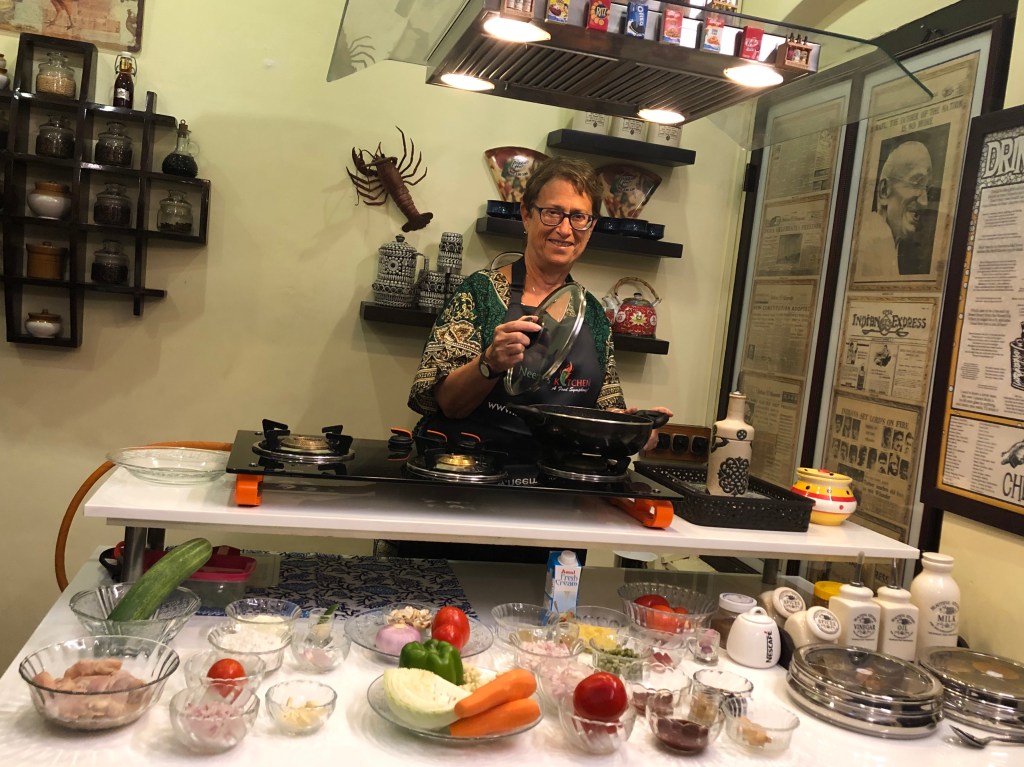
As the husband of my cooking teacher, who spent years on the sea as the captain of a commercial vessel, told me, “Life is like a book. Those who don’t travel are always reading the same page.”

At the risk of offending all too many of you, I have to admit to agreeing with that statement to some extent, but will rein in my judgey side a bit and add that there’s plenty to learn from our everyday lives in our very own homes, too. We just have to do it. Harder than it sounds.

But that’s another story.

I could write an entire blog – or three – on each aspect of traveling, and might do just that, but this one is about an epiphany I’ve had as I’ve moved from my western, Israeli, specifically ideology-driven, life, to crowded Diwali Mumbai, the vast sandy beaches of Goa, the serene backwaters near Alleppey and now to the hill station, tropical green mountain area near Munnar.

I get into the vibrancy of the city-even Diwali Mumbai with all the millions- the constant movement, lights, traffic, endless options and continual visceral stimulation. There seems to be no limit to the number of shops I enjoy entering. I’m happy walking for hours down busy streets, wandering through museums – both conventional and quirky – waiting in winding snake lines of multitudes of people to see the most touristy of sights or hop on the boat, tuk-tuk, or train at the end of the crowd. I have no problem with getting lost for a while or not understanding or being able to make myself understood. It all works out in the end.

I’m attracted to drama, and there’s plenty of that to be observed in the city. Participation voluntary. For the most part.

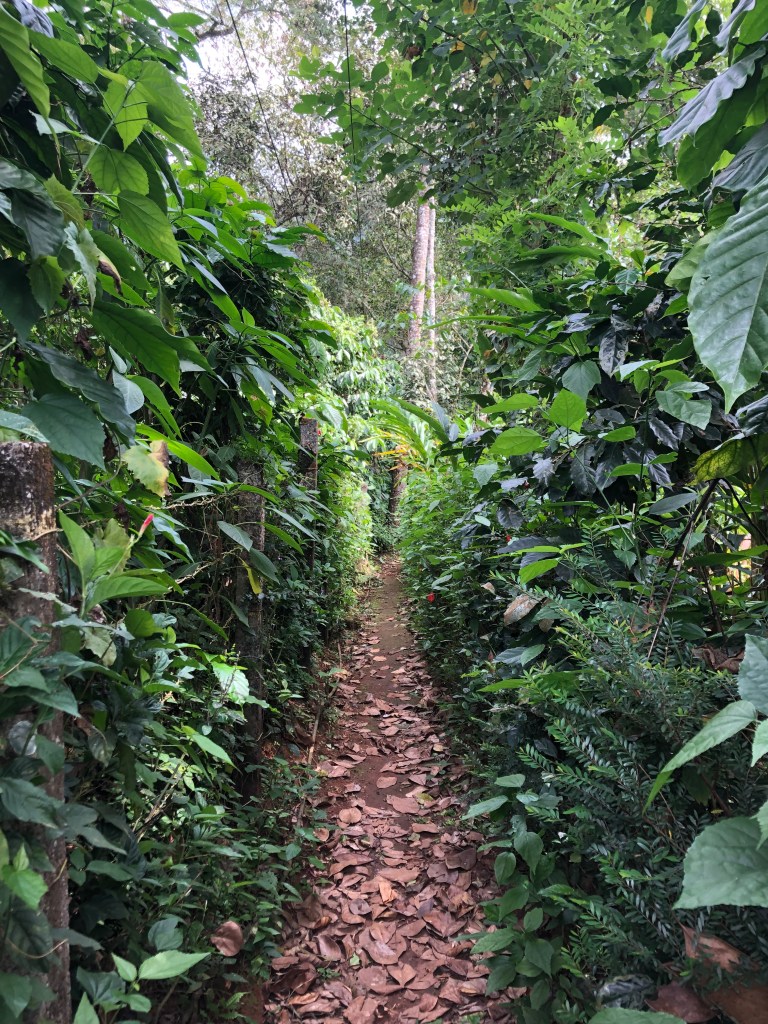
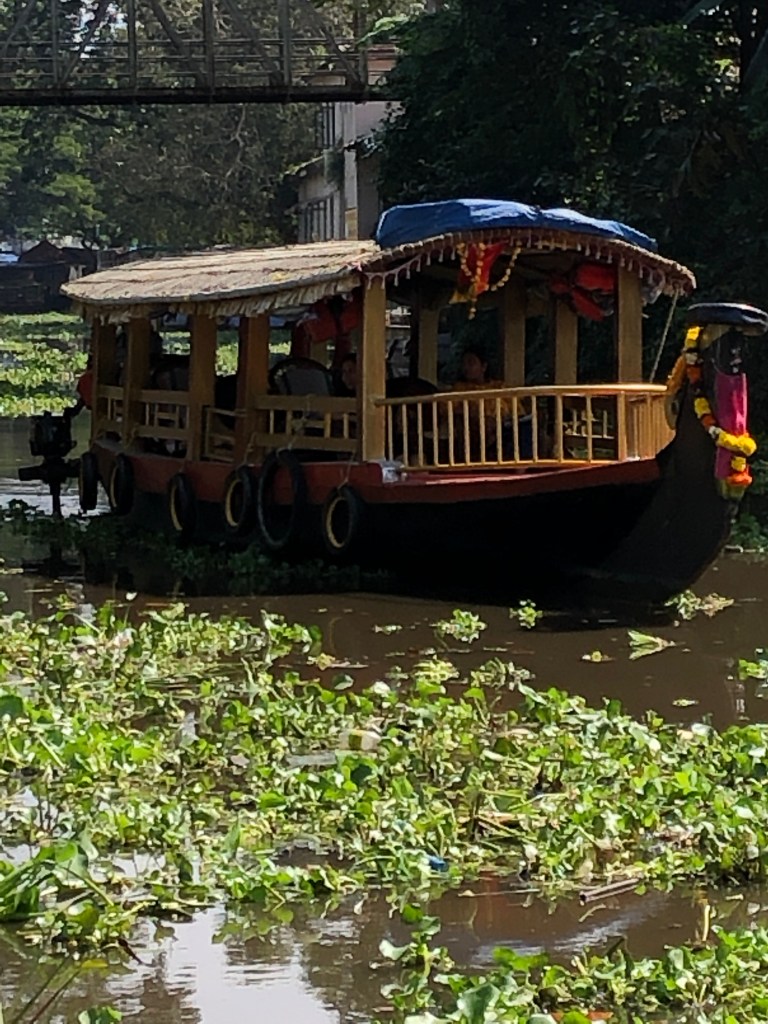
Over the past eight weeks we’ve gradually made the transition inland. From waves crashing onto the rock barrier thirty meters from our balcony and dolphins playing twenty meters beyond that, to the gurgling stream just outside our backyard tropical mountain surroundings. We were somewhat prepared by the serenity of Kerala’s backwaters, running alongside the noisy towns of Alleppey, Ernakulum and Fort Kochi, as well as the steadily deteriorating road between Kochi and Pallivasal near Munnar but nothing can really prepare you for the quiet here.

Being isolated in nature is something that has to be experienced.

We made a conscious decision to settle into our new environment and let it settle into us. No martial arts performance yet. No trip into the town of Munnar. No tea plantation or spice garden tour. Just nature and quiet and us.

It took 24-hours for the monkey chatter to subside.

My yoga practice has been evolving…getting better and better.

I experienced a meditation so deep two days ago that it scared me a bit. The pang of fear brought me to the surface so fast I thought I’d get whiplash. Fear of what? Who knows.

Yesterday’s yoga, just before dusk, was the best yet. Fluid. Soothing and refreshing simultaneously.

At one point I felt I wanted to continue forever.

And then it was just the right moment to finish.

There’s such an awareness of productivity – accomplishing things – in the city.

There’s more an awareness of being out here.

Is there a productiveness in being? Can there be?

Since getting more involved in Eastern Philosophy, yoga and meditation, I find that there’s far less drama in my relationship with the people I love. I’ve integrated the concept of non-grasping without really making an effort to do so. It’s just happened with all the reading, thinking and practice of the past two decades. I worried that it was too much. That I’d become too detached from the lives and challenges of the people I love.

He asked me to close my eyes and try to take myself back to the time when there was more drama and intensity in my relationships. It took a minute of my precious 15 minutes with him but I was able to do it.

Then he asked me to return to a more recent time, with less drama in my relationships and, after a minute or two, asked what I felt in those moments as opposed to the previous ones.

I didn’t have to answer out loud. I opened my eyes to the answering smile on his face.

I love the city. I love the satisfaction of completing many, many tasks during the day. Love noise and crowds and shops and movement.

My body and soul are nourished by nature, by being, by deep silence.

Shabbat Shalom – Peace to us all.

The Quality of Sleep

Some people get into bed at night, fall asleep immediately, and wake up in the morning refreshed.

My husband is one of those lucky people.

We have good friends who go to sleep relatively early and sleep until 10 a.m. if their schedules permit.

I’m not one of those people.

I’ve always been a night person. I’m happy and productive until well after midnight. Two a.m. is the witching hour for me – that hour that marks the border between being able to function well the next day and resigning myself to a zombie day. I’ve trained myself to get into bed by midnight in order to rise at 7 and join my partner for the breakfast he pampers me with, once I smell the wafting scent of coffee.

I no longer fight my inability to fall asleep quickly. Over the years I’ve accepted that resting with my eyes closed during those minutes or hours that I wake up in darkness, dawn far away, can replenish my body, instead of bringing the frustration and monkey mind of trying to bully my way into sleep.

Every now and then – sometimes even once a week – I have nights with virtually no sleep. Those nights are still difficult. I have a bag of tricks that includes breathing techniques and imagery, yoga nidra and other relaxation strategies, but there are nights that nothing brings sleep or rest. I might end up taking half a sleeping pill – that always works – or deciding that the next day will be a lost day. Either is okay; neither is good.

India is a busy, hectic place. Even in villages, the noise level is beyond…well, beyond anything experienced in the western world. There always seems to be something happening: a festival, a rally, a parade, a celebration, a call to worship. In Mumbai, Delhi and other big-beyond-imagination cities, the traffic never ceases. I mean, never.

In the beach towns in which we’ve chosen to begin our six-month adventure, there’s a different rhythm.

For two weeks in Morjim Beach, in Northern Goa, we joined the few people there half an hour before sunset to wait for the big event of the day. Gradually, Russian tourists and Indian residents made their way from their places of refuge from the heat to the kilometers-long, clean, sandy beach for nature’s daily phenomenon. The burst of orange that invariably accompanied the sinking of the sun into The Arabian Sea never failed to mesmerize. The wispy cloud formations lit by the hues of light thrown off with the sun’s seemingly-reluctant relinquishment of energy differed each day, but never failed to enchant.

We could both feel our inner pace slowing daily; our minds becoming less cluttered.

Each beach has its own ambience. Its  own sound. Its own flora and fauna. Each place we stay has its own staff, each with his or her own unique personality, and its own daily sights.

It takes a couple of days, and an open mind and heart, to adapt to new surroundings. To see that the curt, expressionless hotel manager makes it his personal mission to insure your enjoyment and welfare. To realize that anything lacking in your room can easily be obtained by graciously asking for it, and anything that can’t be obtained in this manner isn’t a necessity. To learn the possibilities nearby, how to navigate your way to and from them, and how to balance doing with being.

Thumboly Beach is not Morjim Beach.

Below our second-floor balcony is a sandy yard with a hammock, some tree stump seats, and a raised cement platform where I do my daily yoga and meditation. Beyond the wood-slat fence, with its greenery, is a walkway of sand and spotty grass where solitary villagers or small groups of school children can be observed passing by from time to time.

The apparel is of unending wonder and fascination.

Many men wear baggy shorts made of a large cloth tied in a mysterious way which provides modesty in spite of the tie in front that they open frequently to readjust, and a looseness essential in the humid heat of Kerala by the sea. Others wear a long skirt wrapped around their lower bodies.

Women wear colorful saris or leggings with a tunic on top. They even go into the water dressed this way – but only to their knees. Their modesty is a constant, although their midriff is bare in their saris and partially exposed. Shorts and bathing suits are nowhere to be seen. If on the beach in Tel Aviv women show the maximum amount of skin possible, here women show the least.

Beyond the path is a wall of rocks and boulders set up as a barrier between the village structures and the sea. The waves constantly break onto the rock barrier; sometimes in a gentle lullaby; sometimes with louder music; sometimes crashing with an impressive exhibition of spray. My afternoon yoga is usually accompanied by that drama.

Beyond the waves, the calm, flat Arabian Sea is dotted with fishing boats. Some are barely big enough for one person and his fishing nets; some for three; in darkness, some are big enough for fifteen. Early in the morning we can stand on the beach and watch the fishermen pluck the fish caught in their nets. The catch is never large – 20 kilo on a good day – and the fish are never big. It’s incomprehensible how they make a living from this work. We don’t have a grasp of their reality, though, so it may make perfect sense in their world.

Breakfast arrives on our balcony table at 7-ish every morning and dinner at 8-ish every evening. The creator and carrier of our vegetarian meals is a young man, Veejay, whose wife and five-year-old daughter live a 3-day train ride from here, near the border of Bhutan. The language he shares with the owner of the hotel (for lack of a better word) is Hindi, though his native language is Nepalese and the owner’s is Mayalayam.

Veejay is a vegetarian but accustomed to very simple food. He makes a huge effort to provide a variety of vegetarian meals for us and succeeds admirably. Even when the food is not exactly what we might choose, his intention is so pure that we’re happy to eat with gusto.

His work is endless. He lives onsite and is available 24/7 to provide refreshments, call a tuk-tuk or try to rouse the WiFi. If we were ever lackadaisical about Shabbat, watching people here work every day, all day, has reminded us to be grateful for the wise decision made thousands of year ago in Judaism to set aside 25 hours for rest and spiritual nourishment. The concept, the necessity for such a time and the benefit it brings, was unheard of back then and is still unheard of in India, other than among the Christians.

Our host, Anthony, is a very special person. Born and raised in this small fishing village, his father was a fisherman and, growing up, Anthony loved nothing more than going out on the boat with him. A bright and curious mind has made him an eclectic adult with a well-respected past as a career officer in the anti-terrorist section of the Indian army. He retired as a colonel after 24 years, most of which was spent in Kashmir, the region of continual conflict and terrorism.

Our long conversations include history, not exclusively Indian history, philosophy, science, religion (he’s a Christian with some Hindu undertones), sociology, politics, and ethics. He’s well-versed in current events and spent time in Israel on pilgrimage. He had words of praise for Israeli organization, cleanliness and ingenuity, and said that when he crossed the border into the chaos of Egypt he felt at home.

He has three businesses and has to travel much more than he’d like as a result, but is never happier than when he’s close enough to the sea to hear the waves lapping the shore. He keeps working in spite of yearning for the sea, to maintain employment for his 90 employees. He believes that a person has no self-respect without employment, and finds personal fulfillment providing opportunity for his neighbors. His plan is to work until his 60th birthday – he’s 49 today – and then sell off his businesses to remain within earshot of the waves until the end of his life.

When my husband expressed his fascination with the fishing boats, Anthony called a fisherman friend and hopped – happy as a child – into a small, 3-person fishing boat with his friend and my partner for an hour at sea. I watched as they returned to shore, Anthony paddling, his bare upper body glistening, a big smile on his face. Did I mention that he’s quite beautiful?

But about the sleeping thing.

There’s virtually no internet here. Just enough to entice you into attempts to be online.

I had several logistic necessities to be accomplished online and couldn’t complete any of them, even in the wee hours when the WiFi is at its strongest. I spent one night in a futile attempt, giving up only at 3 a.m. to toss and turn, sleep elusive, my mind dashing from train tickets unreserved and cell phone data packages unrenewed. Breathing didn’t help. Nothing helped. I gave up into the reality of a sleepless night and may (or may not) have dozed off for a short while here and there.

The next day we were able to renew the cell phone data and take care of a few other errands in town. With that off my mind, falling asleep came easily but waking up several times a night came just as easily. Each time, I heard the gentle music of the waves 30 meters from our bed, and drifted back into a peaceful sleep.

Each night since has been the same.

In the morning, I open my eyes only after my ears have opened to the sound of the waves. I feel rocked awake in nature’s arms just as I’m rocked to sleep in the dark of night to the same music.

This morning I awoke to that primordial sound of comfort and a minute later found myself contemplating, with reluctance, our departure from Thumboly Beach four days from now. I gave myself a mental shake to return to the present moment – wherein I’m still in Thumboly Beach and still accompanied by The Arabian Sea.

Our next stop is The Pimenta Cooking School. A cooking course I’ve been looking forward to for months.

My guess is that the sound of The Arabian Sea will be part of me until the end of my conscious life.

In the midst of my cooking course, surrounded by Indian cooking utensils, spices, vegetables and the incredible array of non-wheat flours, I’ll probably have a moment here and there of regret that I’ll be moving on from that kitchen experience at some point down the road.

The bittersweet flavor of traveling. And of life.

Change is a wonderful thing. As I’ve mentioned before, I’m a change junky.

I love my life at home. I love my family, friends and students, my house, studio, and community, and, yet, I get itchy after a while. It might take 6 months or a year, and planning my next trip may keep the itch at bay for months at a time, but the world and its infinite wonders call me louder and louder until I have to go.

Feeling full of gratitude for each moment in this amazing world of ours.


Anyone can Detox on Morjim Beach

I think that after those last few days of stomach butterflies at home leading up to our departure from life as we know it, we chose well with Mumbai as our first stop. The drastic difference of Morjim Beach from those days of checking off the last items on our “to do” list would’ve have been too great a shock to our systems. Mumbai, with its crowds and our 17,000 steps-a-day touring, was a perfect jumping in point.

The five days of incredible Mumbai, with its teeming population of 22 million and the additional Diwali festival crowds, may sound even more hectic than organizing our life to exist without us, but the contrast between colorful India, spicy Indian food, traditionally clothed people passing us on the street and our own reality in Israel made it perfect.

Five days was enough.

We chose Morjim Beach in Northern Goa for two reasons: for the promise of turtles coming ashore to lay their eggs (which hasn’t happened yet) and the claim of serenity and lack of crowds.

Expectations are problematic for travelers. We choose because we can’t stand at the intersection without choosing right, left or straight, but if we expect our lodging to be exactly as pictured/described or expect the town/beach/tourist site to be exactly what we were looking for, without leaving our mind and heart open to accepting a different reality, we’re often setting ourselves up for a bad time.

The relatively few tourists on beautiful, sandy Morjim Beach are Russian (true to what’s reported by google), and Indians. We’ve yet to meet a tourist from an English-speaking country or an Israeli. The beach is almost deserted most of the day. People frolic in The Arabian Sea from early morning until around 10, before the extreme heat arrives, and wander back down to the beach about an hour before sunset to watch the big event.

There are pubs here and there for nightlife but pulsing music is very localized and can’t be heard from our hotel.

Our first week in Morjim Beach was spent at Baywalk Goa where two exceedingly nice, polite, helpful men eased us into beach life. Breakfast was delicious. Service was immediate. Our room was spacious and had a front and back balcony. The older of the two men even showed me his yoga routine, which included an interesting pose that was new to me. The only drawback was that it was not directly on the beach (about 100 meters away) and about a kilometer down the beach from the restaurants.

We spent the weekend in Anjuna, about 30 kilometers away, where the Chabad House correspondence had prepared us for the possibility of it being non-existent that Shabbat. Not that they said that, but they just sounded flakey. As a result, we chose a more luxurious hotel ($40/nite instead of $30) with a quiet Shabbat around the pool as a possibility. In fact, Chabad House was closed and we loved our Shabbat in the pampered surroundings. There was even a surprise bonus of a wonderful Rajasthani Dance and Music performance on Saturday night. The beautiful dancer invited me to dance with her, which I did, and I had a great time.

On Friday we walked to a coffee shop/restaurant that I’d been following online and getting some India travel tips from for several months. The owners are an Israeli man, Moshe, and his German wife, Anastasia. There’s a big lending library with books in a multitude of languages in the restaurant, a wide variety of “Mediterranean” food options – all vegetarian or vegan – a space for yoga, and a bulletin board filled with notices about yoga classes, meditation groups, tai chi classes and upcoming concerts. A very comfortable, safe hang-out for travelers and people like Moshe and Anastasia who have made Anjuna their home.

I IMd Moshe after we left asking if he’d like to be interviewed for the book I’m writing about people who have stood at that proverbial intersection and chosen a path very different from their background and peers. I mentioned that we would be at our hotel all the next day because we keep Shabbat and suggested we get together on Sunday. Then Shabbat started and I wasn’t online to receive his answer.

Saturday in the early afternoon we were sitting around the pool and Moshe appeared. He had come to be interviewed. We sat and talked (mostly I asked a question here and there and he talked) for over two hours. I don’t know if his story will end up in my book – maybe – but it was interesting and I liked him. He’s been in Anjuna for almost 25 years. He’s approaching 50 years old. He sees himself as a citizen of the world and when asked to visualize his two daughters’ future (they’re now 10 and 12), he imagines they will live somewhere out there in the world – not India – and he’ll relish their happiness. Having had three children spend years each in the U.S., I could tell him that it’s much easier to relish one’s children’s happiness from closer up, but why burst his bubble. And, who knows, maybe he won’t feel that way.

Back to Morjim Beach on Sunday but to a place directly on the beach this time and close to restaurants – Ciiroc. Gershon found the manager taciturn and took an instant dislike to him. We’d checked the place out when we were at Baywalk and it seemed very nice. Little cabins surrounding a pristine pool, with comfy beds, a fridge, and pleasant porch.

Expectations.

Reality came in the form of a small(ish) cockroach prancing across the bed as we watched Blue Bloods on my iPad, an internet connection that was so slow that it was truly useless, and no cups to go along with the hot water kettle. As it turns out, though, one has only to ask and everything appears. The “taciturn” manager provides whatever we ask, including better internet by turning off and on the router whenever we ask.

The cockroach had no friends.

We’d eaten at the restaurant the previous week and already knew that they didn’t have about 3/4 of the items listed on the very extensive menu. When we tried (again) to order fish and were told they didn’t have any, the manager came over with an explanation. The fish in the market hadn’t been good that day so they were only serving it to non-guests. He hoped to have better luck the next day at the market and would make fish available to us then. A little scary for those non-guests, eh?

One important thing to note is that every single dish we ordered (that they actually had) was delicious and more than made up for the 3/4 of things on the menu that were unavailable.

We were the only customers most evenings for dinner and could only wonder at the four or five people in the kitchen. I was invited in to take a look at the kitchen and, while primitive, it was clean and a great space to prepare food.

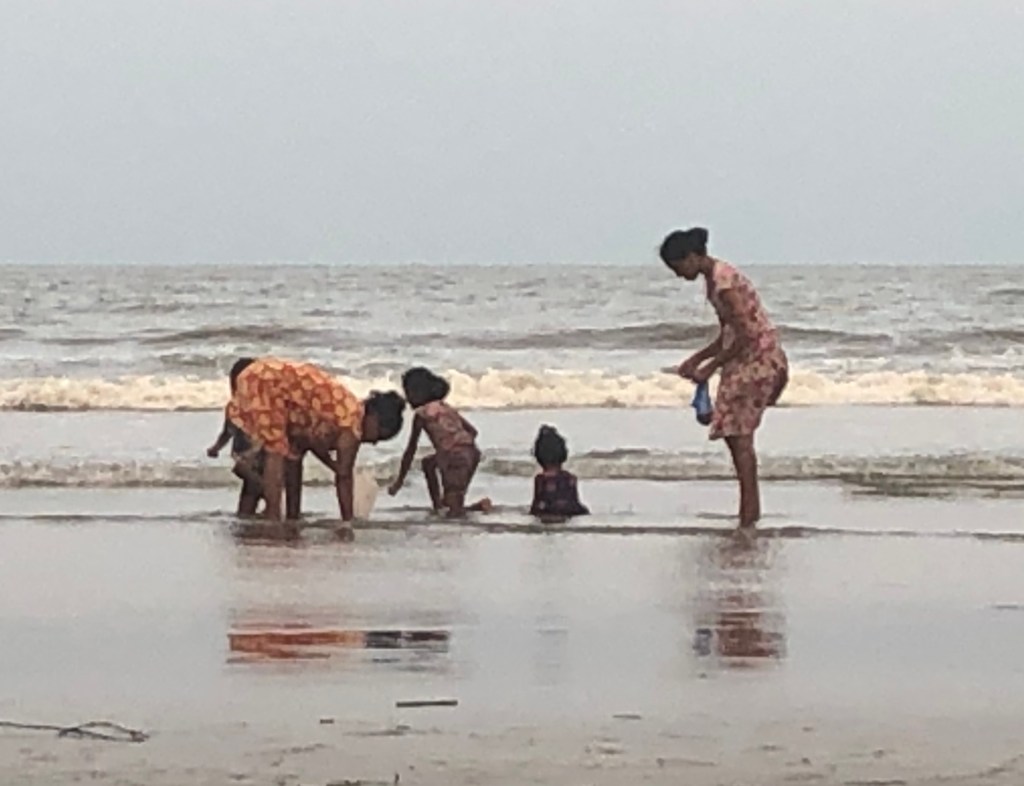
Today we walked the other way on the divine beach and spent an hour or more investigating a rock jetty with tidal pools and many, many living things. There are four kinds of crabs here – bubbler crabs with their amazing artwork, hermit crabs who teach us an important life lesson – to be satisfied with what we have and not chase what looks a bit better – ghost crabs, and a kind of crab we saw on the rocks that Gershon has not as yet identified. The beach and shallows are populated by thousands of tiny clams that women bring their children to gather to add flavor to their soups. There are fish in the tidal pools and the inevitable birds who feast on crabs and fish.

I participated twice in a yoga and meditation class on the beach giving by a 68 year old yogi who seems to be the real deal. I could probably learn  a lot from him but each class is a basic class because he caters to the Russian tourists who come and go. Too much talking and not enough meditating or yoga for my taste. But a very cool experience.

I have to go now. It’s almost time to see the sunset.